Feeds:
Posts
Comments

Posts Tagged ‘joy’

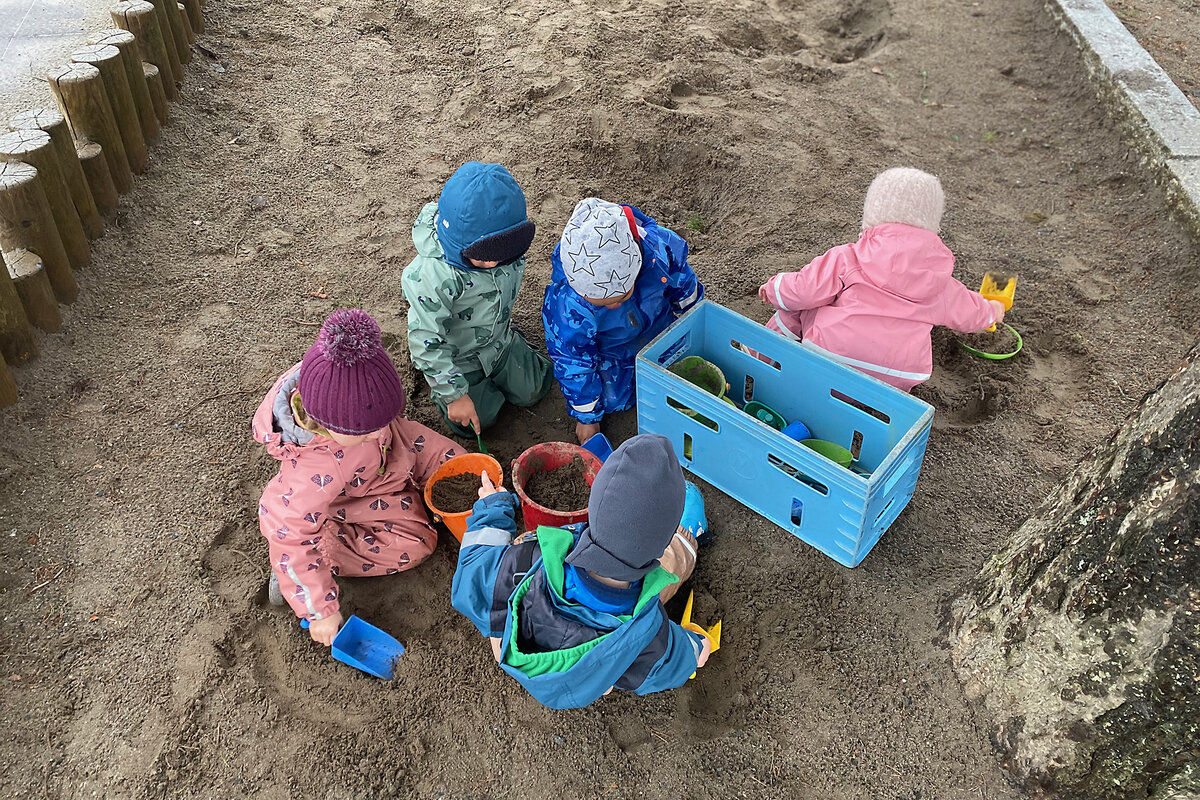
Photo: Jackie Mader/The Hechinger Report.
In Norway, a joyful, secure childhood is a legal right.

I was intrigued by today’s story on Norway’s approach to childhood. One point that made me smile was that the children in early-education programs take naps outdoors, bundled up in sleeping bags. My younger grandson took naps that way. Maybe because he’s half Swedish. Those Northerners don’t believe in bad weather.

Jackie Mader writes at the Hechinger Report via the Christian Science Monitor, “Just north of Oslo, Sylvia Lorentzen’s two child care programs straddle a narrow, winding road that leads up to the lush forests that encircle parts of Norway’s capital.

“In Norway’s system of universal child care, children ages 5 and under immerse themselves in nature. In the winter, those in Ms. Lorentzen’s care learn to ski and sled. In the summer, they swim, canoe, and rock climb – and then rest in hammocks.

“Around age 4, they learn how to safely use a knife. Then they huddle together outside, whittling wooden figures out of sticks to practice. By age 5, they are cutting logs with a saw and building fires. Toddlers nap outside, bundled inside puffy, miniature sleeping bags affixed to their strollers.

“Universal child care is ‘both seen as an investment for the society and an investment for the child,’ says Kristin Aasta Morken, a program leader in the city of Oslo. Public funding covers 85% of operating costs for child care programs in Norway. Parents pay about $182 per month.

“In the United States, it’s parents, mostly, who cover the costs for this care – though some employers and local jurisdictions may offer partial reimbursement.

‘Social differences are something Norway does not accept.’

“ ‘Kindergarten is so important to level out social inequities,’ says Robert Ullmann, head of a consortium of child care centers. ‘In Norway, we think it’s democratic that everyone can have the same opportunities and move out of being poor. Social differences are something Norway does not accept.’ …

“ ‘A really important pillar of Norway’s early ed philosophy is the value of childhood in itself,’ says Henrik D. Zachrisson, director of the Centre for Research on Equality in Education at the University of Oslo. ‘Early ed is supposed to be a place where children can be children and have the best childhood possible.’

“It’s an idea that undergirds Norway’s nationalized approach to its ‘kindergartens,’ which here serve children age 5 and younger, including toddlers and infants. …

“On a drizzly morning earlier this year at Preståsen Kanvas-barnehage, one of Mr. Ullmann’s kindergarten programs in south Oslo, children roam around an expansive play yard, building sandcastles under the canopy of a large pine tree. Others zoom down a hill on bikes.

“In another playground on campus, children shriek as they splash through a large puddle. This draws more children hoping to play. Rather than caution the children about getting wet, a teacher walks over and hands them buckets to have at it.

“Children with disabilities, who are often segregated in American child care programs, are included in activities. Some of them have a city-funded aide who attends to their needs.

“In some rooms, posters on the wall show pictures of common items or common requests, so children still learning Norwegian can point to what they need. In one room, children are learning about the Muslim holiday, Eid al-Fitr. …

“Ironically, Norway’s policies have been inspired in part by American studies that found troubling language skills gaps between higher- and lower-income children. Other influential American scholarship also revealed high educational returns from investing in early childhood programs.

“ ‘The argument I’ve heard is that if you don’t send your children to kindergarten, then you steal some possible experiences from them,’ says Adrian Kristinsønn Jacobsen, a doctoral candidate at the University of Stavanger in Norway who studies early childhood science education rooted in experiencing nature.

“There are important contexts affecting each country’s approach, however. Norway is home to about 5.5 million people, and about 82% are ethnically Norwegian. This population lives in an area roughly the size of Montana. Norway is also a top producer of oil, which helped generate a per capita household income that was over $104,000 in 2022, according to the International Monetary Fund.

“The U.S., on the other hand, has 62 times the number of residents that Norway has and a far more diverse population. In 2022, per capita household income in the U.S. was about $77,000.

“In Norway, nearly 1.4% of the country’s gross domestic product goes toward early childhood programs. The U.S. spends less than 0.4% of its GDP, according to the Organization for Economic Cooperation and Development.

“Public funding covers 85% of operating costs for child care programs in Norway. As of this summer, the tuition parents pay has been capped at about $182 per month. This applies to both public and private programs, and includes in-home kindergartens, which preserve a certain amount of choice for parents. Programs receive funding on a per-child basis. Kindergartens that care for children under 3 years old receive twice the funding of those ages 3 to 5, since toddlers and infants require more individualized care.

“Norwegian children are guaranteed a spot in a kindergarten after they turn 1 year old – about the time many parents’ paid leave ends. If parents decide not to send their children to a kindergarten, they receive financial assistance to stay home.

“Norway’s understanding of kindergarten is deeply ingrained in its culture. But these benefits, signed into law in the Kindergarten Act of 2006 – which repeats the word ‘play’ 56 times – also express some of the country’s deeply held values.

“Child care programs must acknowledge ‘the intrinsic value’ of childhood, according to the 63-page law. ‘The Kindergarten must be based on fundamental values in the Christian and humanist heritage and tradition, such as respect for human dignity and nature, on intellectual freedom, charity, forgiveness, equality and solidarity, values that also appear in different religions and beliefs and are rooted in human rights,’ the law declares. …

“The law proclaims, too, that kindergartens should ‘promote democracy and equality and counteract all forms of discrimination.’ ”

More at the Monitor, here.

Read Full Post »

Photo: Dominique Soguel.
Rua, a Damascus university student, poses for a photo wrapped in the Syrian flag while celebrating the anniversary of the revolution that led to the toppling of Bashar al-Assad, in Damascus, Syria, March 15, 2025.

Although we can’t know where Syria is headed in the long run — or how many powerful countries will interfere with what everyday people want — I think we’re allowed a moment of hope at this this time. Certainly, that is what many astonished Syrians felt when the regime of the tyrant Bashar al-Assad was overthrown in a “sudden” uprising that was many years in the making.

Dominique Sequol of the Christian Science Monitor wrote an article in March about what Syrians were feeling. While it focuses on a new freedom to worship, worship is only one example of the change there.

“Alaa al-Saadi, like many Syrian men of his generation,” she says, “once fought to overthrow longtime dictator Bashar al-Assad. Now Mr. Saadi is savoring his first ‘free’ Ramadan in his hometown of Qaboun, a low-income neighborhood and former rebel stronghold on the outskirts of Damascus.

“At sunset, when Muslims rush home to break the fast with the iftar meal, the business owner stands on a street corner pouring out licorice juice from a giant metal pot. …

“Damascus is observing its first Ramadan since the fall of Mr. Assad, who cast himself as a protector of Syria’s many minorities while ruling them all with an iron fist. The Muslim holy month – one of heightened spirituality, and marked by the pursuit of good deeds to help those in need – is observed in Syria and across the Middle East.

“Mr. Saadi, who spent several years in Libya before returning to Syria in 2019, recalls hiding during previous Ramadans to avoid being conscripted into the Syrian army. Now, he is grateful to be in the position to help his community. …

“Families displaced by the conflict are trickling back to Qaboun, although much of it remains reduced to rubble after years of siege and bombardment.

“ ‘This Ramadan, our loved ones have returned,’ says Mr. Saadi, fielding greetings outside his car-painting workshop. ‘We are reunited. Friends, loved ones, and young men are all back. Things will gradually improve.’

“Indeed, Damascus seems to be inching toward greater functionality, with uniformed traffic police on the streets and a steadier electricity supply. The mood in the capital is one of cautious optimism under President Ahmed al-Sharaa, who broke ties with Al Qaeda and led the military effort that toppled Mr. Assad in December.  

“This has been a month of prayer but also mixed-gender celebrations that continue late into the night under the glitter of Ramadan light installations. Women in all kinds of Islamic dress – from the niqab to the veil – converged on central Ommayad Square for the March 15 marking of the anniversary of the 2011 Arab Spring-inspired revolution. So did women with no veil. …

“There has been no shortage of individual and collective volunteer efforts inspired by the month of fasting.

“In Douma, another war-ravaged suburb of Damascus, Osama Massaya leads the volunteer group Mulham. Boasting 40 participants, age 14 and up, it focuses on cleaning mosques and distributing meals to worshipers. Such ideas are not new – but the possibility of executing them this freely is.

“In 2024, Mr. Massaya, a history student at Damascus University, tried to obtain a license for a volunteer team to clean up mosques. The request never received the green light from the Ministry of the Endowment. ‘At the time, there was no interest in mosques,’ he explains.

“ ‘The mosques were very neglected,’ adds Mr. Massaya, whose team has helped to clean up a handful in Douma already. …

“The Mulham volunteers aim to distribute 4,000 meals throughout Ramadan. Such efforts are financed by individual donations made by local residents, including some who resettled in Europe and the Middle East during the war and remain abroad. Most donations – including a recent batch of 300 kilograms (660 pounds) of dates – are made anonymously. …

“The activities of mosques were closely monitored in the past. In 2011, they were a springboard for post-Friday prayer protests against the Syrian regime, and long were treated as potential hubs of dissent.

“Rua, a university student in Damascus who gave only one name and whose father died in the notorious Sadnaya prison, reports a similar newfound sense of freedom.

“ ‘It’s the difference between day and night,’ she says of this Ramadan, recalling past years when ‘people prayed quietly and left mosques quickly,’ to avoid regime informants.” More at the Monitor, here.

We don’t choose what country we are born into, and perhaps watching the news since 2011, many of us were glad we weren’t born in a country like Syria. But I think that to witness such a moment of hope after despair is something precious.

Read Full Post »

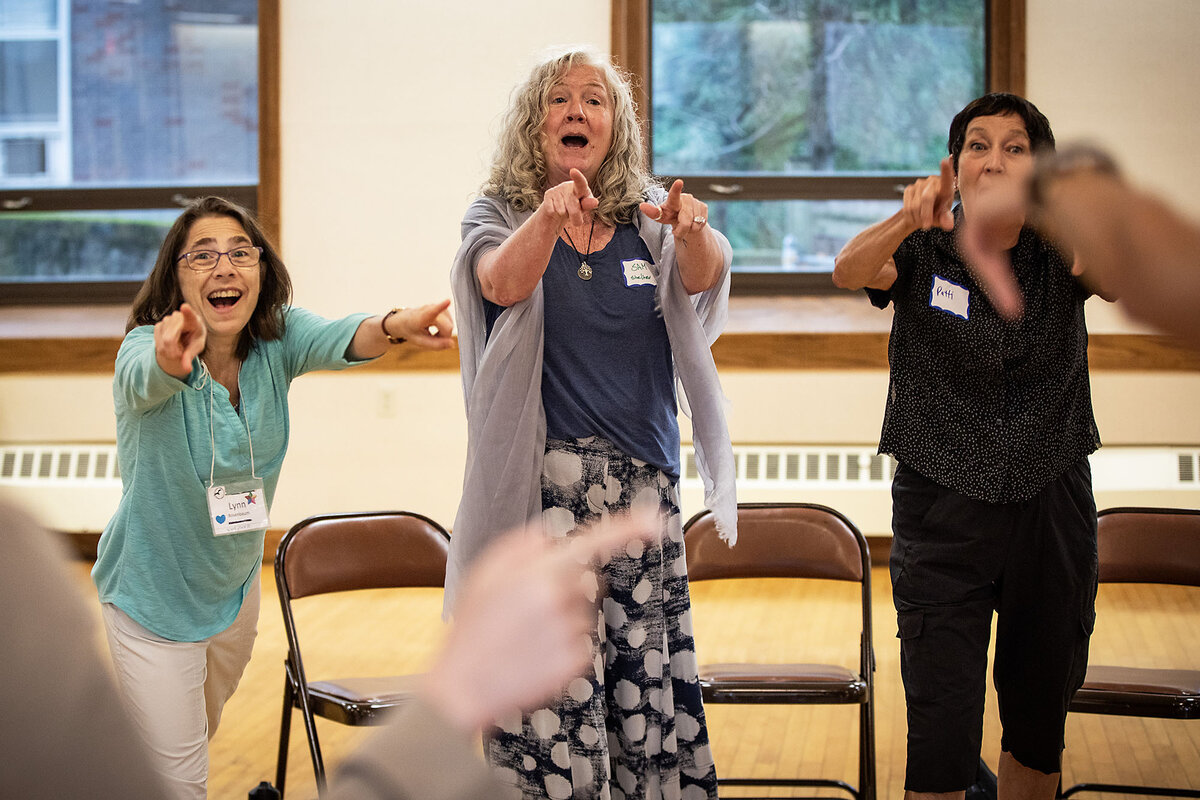
Photo: Melanie Stetson Freeman/CSM.
From left, Lynn Rosenbaum, Sam Whyte, and Patti Gurekian introduce themselves through song at a CircleSinging session at St. Mary Orthodox Church, Aug. 18, 2024, in Cambridge, Massachusetts.

Those of us worry a lot need to make a point of searching out joyful moments. Here’s one way that folks in Massachusetts fill their joy quotient: circle singing.

Oli Turner reports at the Christian Science Monitor, “The song coming from the St. Mary Orthodox Church meeting room in Cambridge, Massachusetts, has never been heard before. And it will never be heard again. 

“Fourteen singers stand in a circle of metal folding chairs, improvising an organic cacophony of harmonious and discordant sounds. Some tap their feet, sway, or bob their heads to the rhythm – but no two people engage with the music in quite the same way. 

“In CircleSinging, there’s no sheet music, no director, no pitch pipe. There’s an art to it, but not a pretentious one.

The singers have coalesced into an intergenerational network of friendship.

” ‘It’s really all about following. Following well,’ organizer Peter McLoughlin explains to the group between exercises. Mr. McLoughlin is not a teacher or a director. He gently sets the group in motion, and then blends into the circle as a participant. 

“ ‘Everybody’s welcome, and we’re not as concerned with whether you’re an excellent singer or you are an excellent harmonizer,’ he says before the rest of the singers arrive. 

“The Boston area’s CircleSinging community – tucked away in church meeting rooms in Cambridge, Arlington, Somerville, and the Jamaica Plain neighborhood – is part of an international network of CircleSingers who delight in the spontaneous art form. 

“The improvisational singing technique was developed by jazz musician Bobby McFerrin, best known for his 1988 hit song ‘Don’t Worry, Be Happy,’ the first a cappella song to go No. 1 on the Billboard Hot 100 chart. Mr. McFerrin’s vocal jam sessions relied on a call-and-response model, in which a leader improvises one vocal part at a time and other singers repeat those ‘loops.’ Any singer can volunteer to lead a composition.

“Cambridge organizer Mr. McLoughlin started the first of the four Boston-area circles in 2015 on Meetup.com, inspired by Mr. McFerrin’s ‘magnificent’ rendition of Psalm 23. The looping choruses and complex harmonies reminded him of the music surrounding his own Catholic upbringing. He was hooked.

“Mr. McLoughlin learned the technique from Mr. McFerrin himself, attending his weeklong workshops once a year for seven years. Then CircleSinging Boston was born in Mr. McLoughlin’s living room.

“Each of the four Boston groups, run by different organizers, holds two-hour meetings that prioritize openness. One Boston CircleSinger, Maureen Root, says her favorite exercise starts by singing a random word – not for its meaning, but for its sounds.

“ ‘So it’s like these different vibrations and things come out,’ Ms. Root says. ‘It’s almost like you’re bypassing the mental circuitry. … It gets me out of my self-conscious mind.’

“Some CircleSingers have no prior musical or singing experience, like Ms. Root, a retired medical technologist and yoga and meditation instructor of more than 30 years. …

“Less-experienced singers like Ms. Root share a circle with vocal professionals like Boston Children’s Chorus conductor Destiny Cooper, who moved to Boston after college, ‘knowing not a soul.’ In experimental CircleSinging, a far cry from her familiar structured choirs, she found belonging.

“ ‘Most of the members are significantly older than me, but nonetheless, I think that community was really important to give me a sense of home,’ Ms. Cooper says. Since joining the group about five years ago, she never missed a circle until the pandemic. …

“Arlington CircleSinging organizer Lynn Rosenbaum leads her meetups with all singers in mind.

“ ‘I tend to think of the arc of where we start and where we end, and bringing people along, building their confidence and their skills,’ says Ms. Rosenbaum, a seasoned improv singer herself. ‘There’s usually a big difference between the beginning and the end, especially for new people – in their level of comfort and how much they’re willing to take risks.’ …

“ ‘Singing together and playing together – I say “playing” as in “playfulness” – it just creates a connection among people,’ Ms. Rosenbaum says. ‘It’s a common denominator that we can all connect to.’ …

“ ‘[CircleSinging is] just this opportunity to express our full range of emotions and letting it out through our voices and our bodies,’ Ms. Rosenbaum explains. ‘There’s not always a lot of opportunities in everyday life to do that, so this creates a safe space for people to be silly and explore and take risks and express joy.’ ”

More at the Monitor, here.

Read Full Post »

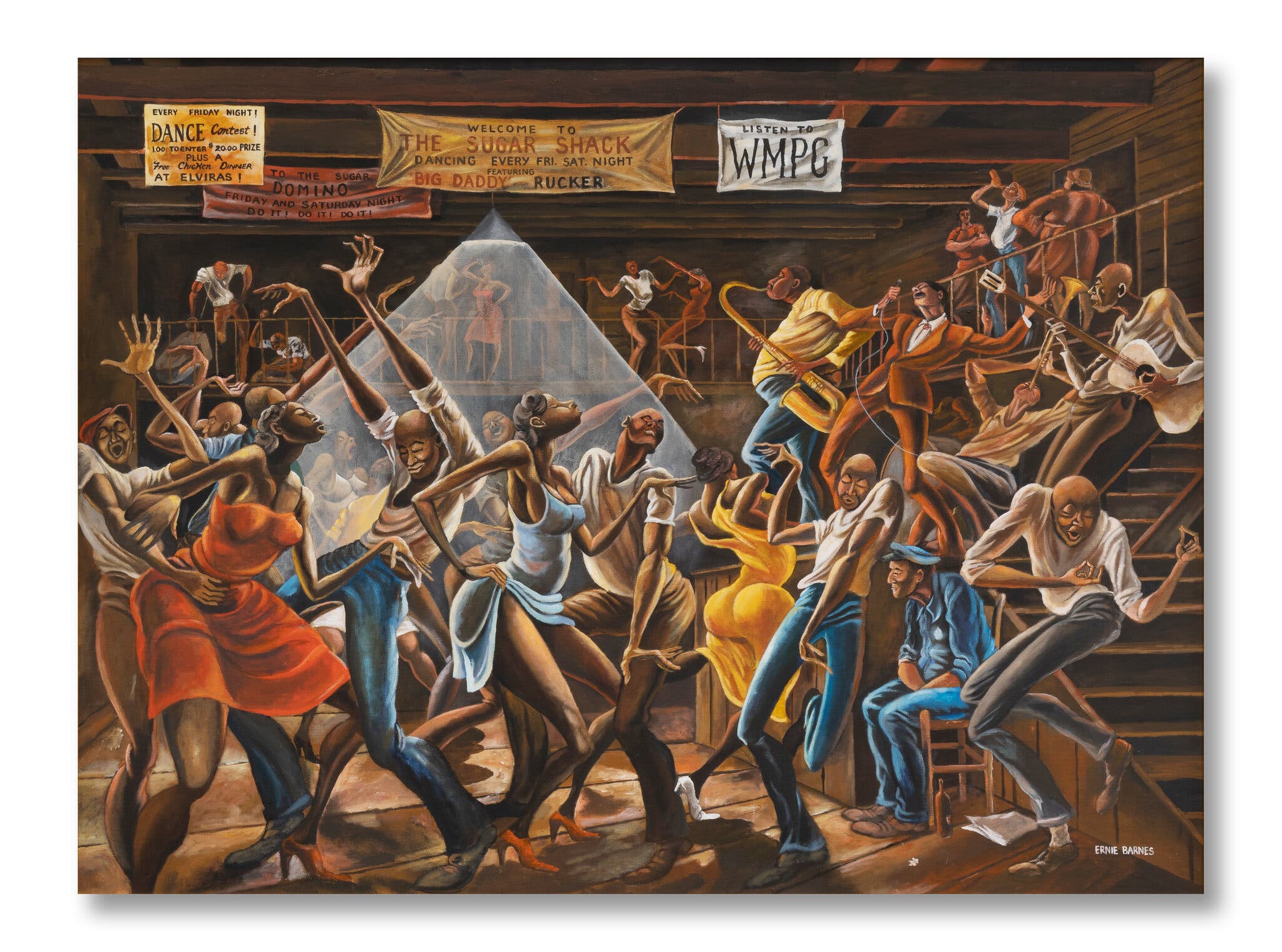
Art: Ernie Barnes.
Photo: Ernie Barnes Estate, Ortuzar Projects and Andrew Kreps Gallery.
Ernie Barnes’s “The Sugar Shack” (1976) sold well above its estimate at a Christie’s auction in 2022.

I’ve been thinking about artists whose popularity often seems to put them beyond recognition by the “academy.” Can they be taken seriously by serious people if they are popular? If their works are deliberately priced to be affordable, does that mean they are not valuable?

Adam Bradley writes at the New York Times about the long underappreciated artist Ernie Barnes, who is having “a moment” now that he has died.

Bradley writes that “in the 1970s, buying a print of Ernie Barnes’s ‘The Sugar Shack,’ the iconic 1976 dance club painting that adorns the cover of Marvin Gaye’s album released that spring, ‘I Want You,’ and appears in the credits for the classic sitcom Good Times (1974-79), required nothing more than mailing a $20 check to the artist’s West Hollywood studio.

“In 2022, the second of two originals — inspired by a childhood adventure of sneaking into a famed dance hall to watch couples drag and sway to the live performances of Clyde McPhatter or Duke Ellington — came up for auction at Christie’s, selling for $15.3 million. The buyer was the Houston-based energy trader and high-stakes gambler Bill Perkins, 54, who won a bidding war against 22 other prospects. This vast divergence of price belies a convergence of spirit: The countless individuals hanging inexpensive prints on the walls of bedrooms and barbershops share with Perkins (and no doubt with the other wealthy collectors who bid the painting up to more than 76 times its high estimate) an ineluctable desire for the nostalgia and affirmation that Barnes’s work conveys.

“Barnes, who died in 2009 at 70, left a paradoxical legacy. He was an artist of the people — most especially of Black people — selling reproductions at prices that enabled everyone to own something beautiful. He was also an artist to the rich and famous; he sold many of his original works to athletes, movie stars and musicians, from Kareem Abdul-Jabbar to Grant Hill, Diana Ross to Bill Withers, Harry Belafonte to Sylvester Stallone. He was among the most visible artists of the ’70s, with millions seeing his paintings on television each week; yet his work was excluded from major museum collections.

“The unprecedented price paid for ‘The Sugar Shack,’ Barnes’s most recognizable work, has changed everything — and nothing at all, inviting a wider (and whiter) audience to revisit an artist whose reputation among Black Americans is unassailable. More than a dozen years after his death, Barnes, long a popular painter, has become an important one, with all that term entails: a hot global market for his work (pricing out many of Barnes’s original collectors); newfound interest from museums; and, most immediately, a major gallery exhibition scheduled for next year at Ortuzar Projects in New York, which will invite a deeper look at Barnes’s varied career.

“Ernest Eugene Barnes, Jr., was born in Durham, N.C., in 1938, and grew up in a segregated neighborhood known as the Bottom. His father was a shipping clerk for Liggett & Myers Tobacco Company and his mother worked as a domestic.

“In his 1995 memoir, From Pads to Palette, Barnes recalls using sticks as a child to sketch undulating lines ‘in the damp earth of North Carolina.’ By the time he was in high school, Barnes had grown close to his full height of 6 feet 3 inches and finally gave in to the football coach’s entreaties for him to play offensive lineman.

“By 1956, he had 26 college scholarship offers; he enrolled at the historically Black North Carolina College (now North Carolina Central University), where he studied art. Though Barnes found support for his artistic endeavors on campus (he sold his first painting, ‘Slow Dance,’ a precursor to ‘Sugar Shack,’ for $90, to the recent alum and Boston Celtics guard Sam Jones), he often faced bigotry beyond it, and this led him away from art. The Baltimore Colts selected Barnes in the 1960 N.F.L. draft, and he played for four other teams in a six-year career before leaving the game because of the physical toll of injury and the psychic toll of delaying his true calling as a painter. …

“Barnes worked for a short period in the off-season as a door-to-door salesman, and as a construction worker building crypts. Then, with the endorsement of the business mogul and San Diego Chargers owner Barron Hilton, Barnes crashed the American Football League owners’ meeting to make a pitch to become the first official painter of a professional sports franchise. Many of the owners ignored him; one heckled him.

“But another, Sonny Werblin of the New York Jets, offered to pay him a player’s salary to become the team’s official painter. After a year, Barnes had built up enough of a portfolio for Werblin to sponsor Barnes’s first solo show, at the famed Grand Central Art Galleries in Midtown Manhattan. Barnes was 28. His work, which rendered football as modern-day gladiatorial spectacle, was stylized and dramatic. One could see within it the stirrings of his mature aesthetic: his loose and gestural handling of human form, his passion for portraying bodies in motion.

“His athleticism was far from incidental to his art. … Barnes understood the human body not from the outside in, in the studied manner of a draftsperson, but from the inside out, through his knowledge of how bone, muscle and ligament move in concert. …

“Barnes’s 1966 New York show might have marked his triumphant emergence into the artistic mainstream. Instead, it was greeted with indifference. ‘It was a shock to me,’ Barnes said decades later. If the art world was going to reject him, then he would reject it. ‘When I found out that I didn’t have to belong, really, to that world, he said, ‘that was much more assuring to me as a human being.’ …

“He expanded his subject matter to suit a broader audience, directing his eye for physicality toward everyday life. What does it look like to walk down the street with swagger, to hoist a heavy bag at day’s end, to jump double Dutch? Inspired in part by the Black Is Beautiful movement of the photographer Kwame Brathwaite and others, Barnes began producing works that would comprise a show titled ‘The Beauty of the Ghetto. It opened in 1972 at what was then known as the California Museum of Science and Industry and traveled the country for seven years. …

“In 1973, he met with the television producer Norman Lear, who was preparing a new program provisionally titled The Black Family. Lear was so taken with Barnes that he proposed not only using Barnes’s paintings on the show but also making the family’s eldest child, J.J. (who’d be portrayed by the actor Jimmie Walker), an artist himself. …

“ ‘His work is really about joy and positivity,’ says Ales Ortuzar, 47, who along with Andrew Kreps co-represents Barnes’s estate. ‘Those are two things that have traditionally been dismissed in the art world.’ Indeed, irony has no place in Barnes’s artistic worldview. His canvases are domains of earnestness and striving, of unalloyed celebration and pride. …

“ ‘There are a number of folks who will say, “Oh, his work has a $15 million price tag on it,” ‘ says [Derrais Carter, 39, a professor of gender and women’s studies at the University of Arizona and the curator of the Barnes exhibition at Ortuzar Projects]. ‘ “Let me pay attention to it.” And I’m like, “Well, Black folks never needed no $15 million to own that work.” It’s been in dens, college dorm rooms, on faded album covers, the whole nine. These [paintings] are like talismans, anchors of home.’ ”

More at the Times, here.

Read Full Post »

I liked today’s story about bringing joy through dance. I especially liked learning about research showing that differences drop away when people move in unison.

Sara Miller Llana writes at the Christian Science Monitor, “He has led firefighters and police officers to the rhythms of bhangra – a centuries-old dance that hails from the farming fields of Punjab. He has danced in front of Canada’s Parliament in Ottawa and amid crashing waves of the country’s Pacific Coast.

“But these days, Gurdeep Pandher has more fans than he ever has – by posting videos of himself dancing in the snow-covered forest behind his cabin near Whitehorse in Yukon, Canada’s northwesternmost territory.

“At this time of year, it’s not until about 11 a.m. that the sun comes out, filtering through the trees and drawing him outdoors. ‘It looks so beautiful, to me it looks just like magic,’ he says. ‘I do feel like I live in a winter wonderland.’

“On the winter solstice last month, in a bright blue sweater, an orange turban, and brown snow boots, Mr. Pandher posted a new video of himself doing what he calls a ‘happy dance’: arms raising to the sky, knees as high as they go, and the broadest of smiles. …

“Bhangra began as a farmer’s dance in Punjab to celebrate a good harvest, but it’s found its way across the globe, from trendy DJ fusions to entertainment on basketball courts of North America. Mr. Pandher has been dancing it since he was a child, and he says there’s no surprise to him that it’s caught on – for its upbeat sounds and its core value of joy.

‘If you’re dancing bhangra, and you are not happy, that is not bhangra, even if you are doing all the moves perfectly,’ he says.

“That’s why he believes his videos, one after the other, keep going viral during the pandemic, when there is so much darkness and heaviness.

“ ‘There’s a Punjabi saying that when there’s a lot of darkness, we value brightness more. And I’ve noticed that, a lot of the sort of people who never cared about watching my videos before, like lawyers, or politicians, or diplomats, are sending me messages,’ he says.

“ ‘Before maybe they didn’t feel like something light was professional, or important, but now in these difficult times they realize the importance of someone dancing to create happiness, someone who’s preaching that kindness is important, what our ancestors from centuries have been preaching.’

“He’s not the only one feeling a new buzz around bhangra. Harshjot Singh, who founded Power Bhangra with his wife in Montreal, is these days offering popular bhangra fitness classes over Zoom. It’s a physical workout, but he says it’s also the culture of bhangra that he believes keeps his students – who span Canada and even North America – signing up. ‘You have to smile, it’s just the rule of the dance. And as students learn about it, slowly and steadily, it just comes naturally.’ …

“Peter Lovatt, the author of new book The Dance Cure, says that dancing, unlike just plain fitness, has four key benefits in the realms of social, thinking, emotions, and the physical – which, fittingly, spell STEP.

“All of those areas are suffering during the pandemic, and everyone benefits from things like physical activity or disconnecting from the Internet. But there is something especially compelling about the synchrony of dance in today’s climate. ‘When people dance in synchrony, it increases how much they like each other,’ Dr. Lovatt says.”

More at the Christian Science Journal, here.

Read Full Post »

Following up on yesterday’s post, which highlighted simple pleasures like spending time in the library, I give you this report by Morgan Ribera at Bustle.

“Apparently, libraries provide patrons with a happiness that money can’t buy. Or at least nothing less than almost two grand in cash. According to a recent study commissioned by the U.K.’s Department for Culture, Media, and Sport, the act of going to the library induces joy equivalent to that brought on by a £1,359 ($1,878) pay raise.

“The study was conducted in an attempt to measure which activities have the most positive impact on an individual’s well-being. Visiting a library scored among the top joy-generating activities, alongside dancing and swimming, giving us yet another reason to hang-out at our local library. …

“And this U.K. study adds even more to the proof already stacking up on the value of libraries, a value that was evidenced extensively in a Pew Research Study released [in March]. The rather pleasing results of this eye-opening Pew study showed that habitual library goers maintain stronger community ties, are more likely to socialize with friends and neighbors, and exhibit higher levels of technological engagement.”

More at Bustle, here.
Photo: Bill Lapp

Read Full Post »