Feeds:
Posts
Comments

Posts Tagged ‘Kazakhstan’

Photo: D Rosengren/Global Rewilding Alliance.
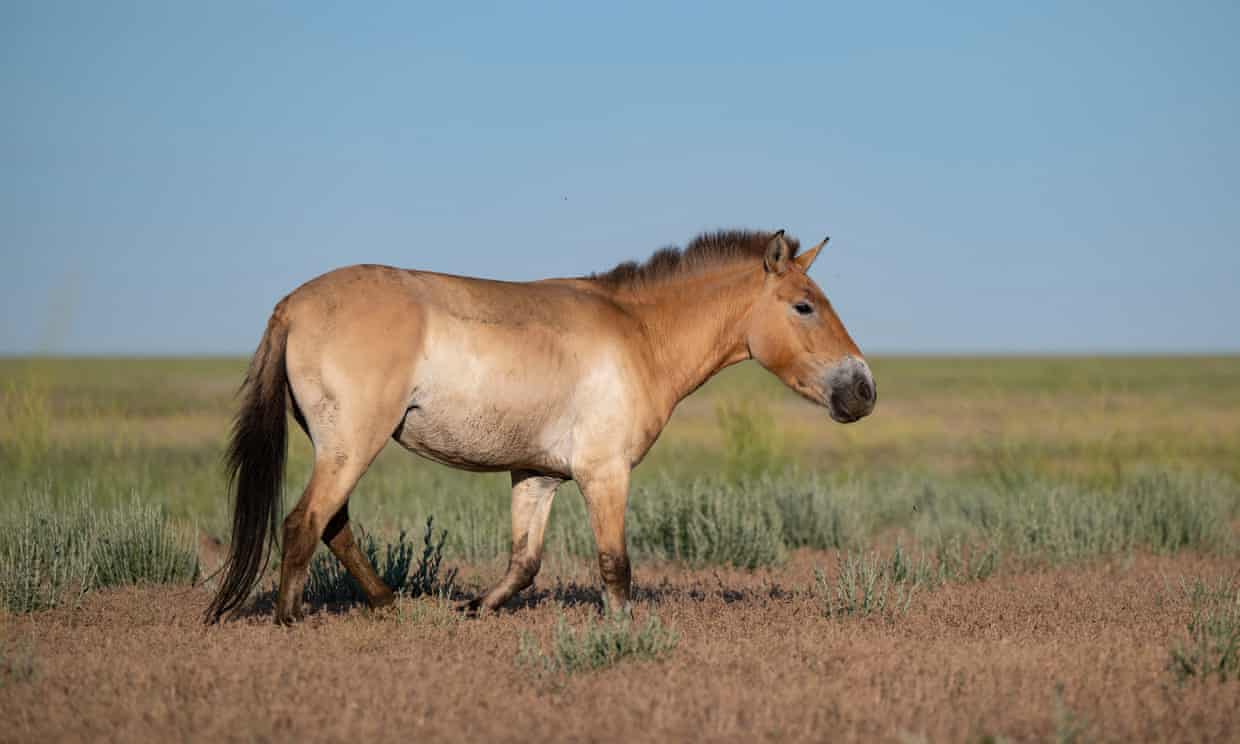
The wild Przewalski’s horses are said to be the only horses in the world that have never been domesticated. They are being reintroduced to the steppes of Kazakhstan.

The woman who cuts my hair has convinced me that, on the whole, zoos are bad for animals — that elephants shifting from one leg to the other for hours at a time are not doing a little happy dance but are bored witless.

Even so, we do hear of zoos doing good work to protect endangered species.

Sophie Kevany reports at the Guardian about some zoos’ recent win for biodiversity.

“A group of the world’s last wild horses have returned to their native Kazakhstan after an absence of about 200 years. The seven horses, four mares from Berlin and a stallion and two other mares from Prague, were flown to the central Asian country on a Czech air force transport plane.

“The wild horses, known as Przewalski’s horses, once roamed the vast steppe grasslands of central Asia, where horses are believed to have been first domesticated about 5,500 years ago.

“People are known to have been riding and milking horses in northern Kazakhstan nearly 2,000 years before the first records of domestication in Europe. Human activity, including hunting the animals for their meat, as well as road building, which fragmented their population, drove the horses close to extinction in the 1960s.

“Filip Mašek, Prague zoo’s spokesperson, said: ‘These are the only remaining wild horses in the world. Mustangs are domesticated horses that went wild.’

“The horses reintroduced into Kazakhstan are descended from two groups that survived in Munich and Prague zoos.

“Originally, eight horses had been scheduled to travel, said Mašek, but one horse sat down before the flight from Prague and had to be unloaded and returned to Prague zoo.

“ ‘He was just a little dizzy returning, but he is fine now. These horses have to stand for the entire journey – they can’t sit down, mainly because their blood needs to circulate properly. It is a 30-hour journey in total, and the horses will only survive if they stand all the way,’ he said.

“Returning the horses from Prague zoo would help increase biodiversity in the region, said Mašek. ‘The horses spread seeds in their dung and when they dig up plants, they help the water get down into the soil. They also fertilize the steppe with their dung.

“ ‘For me,’ he said, ‘the goal of a modern zoo is not just about protecting and breeding endangered species, it is about returning them to the wild where they belong.’ …

“In 2011, Prague zoo was involved in a reintroduction of Przewalski’s horses to Mongolia. The project, which involved nine flights of horses, continued until 2019 when the population stabilized, said Mašek, adding that there were now about 1,500 of the wild horses in Mongolia. Mašek said the plan was to transport a total of 40 horses to central Kazakhstan over the next five years.”

More at the Guardian, here.
Read Full Post »

6000

Photo: Daryl Mersom
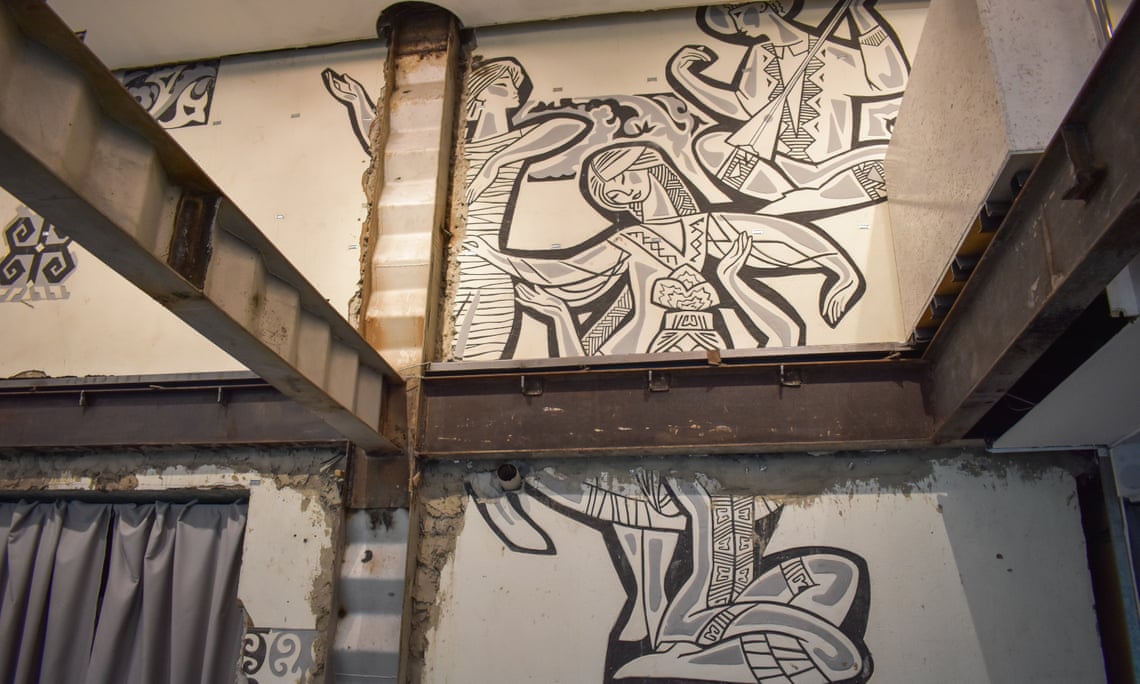
A piece of a sgraffito by the Kazakhstan graphic artist Eugeny Sidorkin (1930-1982) was discovered behind a wall at a cinema in the former Kazakhstan capital. 

Modern art was considered degenerate in the former Soviet Union. It was dangerous to make it, dangerous to own it. Much was destroyed.

But as I wrote in this 2011 post about the wily collector of the “Desert of Forbidden Art” documentary, it could be hidden away in Central Asia without Moscow noticing.

More recently, approved Soviet art, no longer popular, was revealed behind a cinema wall in Almaty, the former capital of Kazakhstan. Nothing is ever completely lost.

Daryl Mersom wrote at the Guardian, “When Jama Nurkalieva and a small group of colleagues conducted a site survey of a disused Soviet-era panoramic cinema in Almaty, the former capital of Kazakhstan, they had no idea what lay behind the internal plasterboard wall that faces out towards the street – until someone spotted a narrow gap.

“As the caretaker shined a light into the darkness behind, the group caught a glimpse of a man’s head. Out came the toolbox and the rest of the artwork was slowly revealed: a Soviet-era sgraffito by the graphic artist Eugeny Sidorkin that had been lost and forgotten for decades.

“From the Italian graffiare, to scratch, sgraffito is a technique that involves placing one layer of plaster or cement over another, and then scratching through the superficial layer to reveal contours or patterns beneath.

“Built to a standardised design in 1964, the cinema was one of the largest in the USSR. It was fronted entirely by large panels of glass that offered an unobstructed view of the sgraffito to passersby. …

“While there is little incentive now to cover or remove Soviet-era artworks depicting folklore and natural landscapes, they were sometimes controversial in their day due to supposed hidden meanings.

“Ekaterina Golovatyuk, curator of an exhibition on Soviet modernist architecture at the Tselinny, recounts an anecdote in which an architect and an artist worked together to create a mosaic for a cafe. It was a straightforward depiction of a lake with a tiger on one side and goats on the other. ‘The [local communist] party was asking them, “What’s the meaning of this?” They were saying, “Nothing, it’s just a natural landscape” – but they couldn’t convince them that there was no hidden political message.’

“Golovatyuk believes Almaty has as many surviving mosaics as it does because Kazakhstan’s president, Nursultan Nazarbayev, changed the country’s capital from Almaty to Astana in 1997.

“With much of the country’s subsequent investment and development directed at this new ‘city of the steppes,’ Almaty escaped relatively unchanged.”

More at the Guardian, here. It’s interesting that although “degenerate” art is now accepted, actual Soviet art is forbidden in former Soviet republics relieved to be free of the yoke of communism. If you want to see the Lenin mosaic in Almaty, hidden behind a curtain, you have to make an appointment.

As the 16th century poet says, “Times Go By Turns.”

Read Full Post »

kazakhstan-treasure

In the remote Tarbagatai mountains, where Kazakhstan meets northern China, archaeologists have found an ancient treasure.

I have heard that the day-to-day life of an archaeologist is all mud and digging and measuring — not glamorous. But imagine having your efforts rewarded by unearthing a pile of gold! You don’t get to keep it, of course, but it must be a thrill to feel a sudden connection with artisans of thousands of years ago.

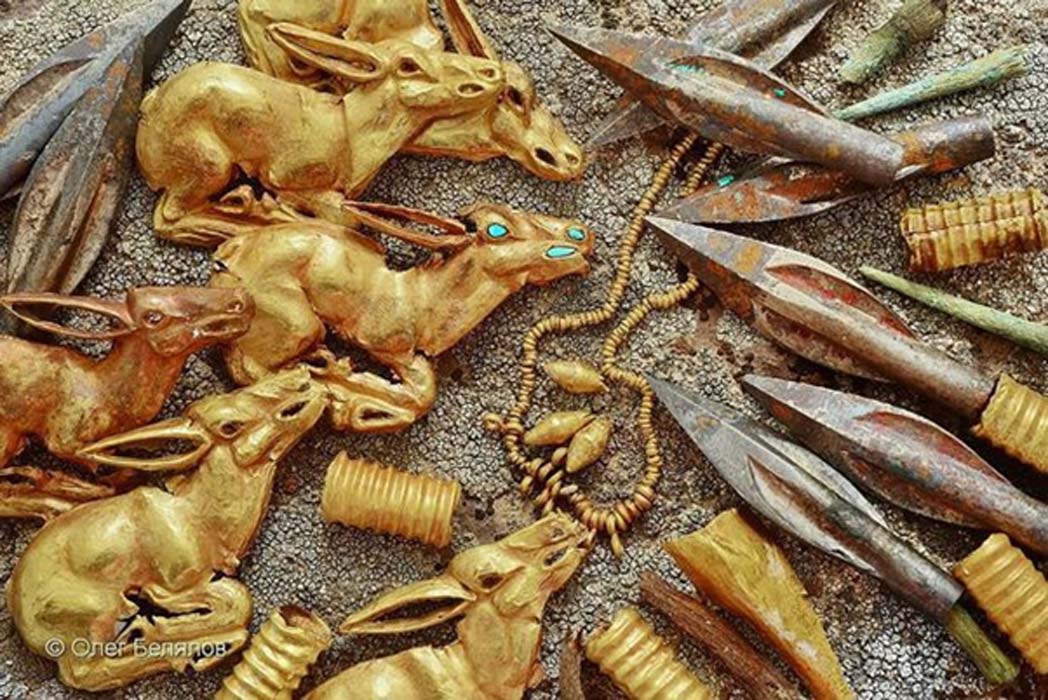
Natasha Frost writes at the History website, “Archaeologists have unearthed a cache of thousands of millennia-old pieces of gold jewelry in an ancient burial mound in Kazakhstan.

“The remote Tarbagatai mountains, where Kazakhstan meets northern China, was once home to the Saka. These expert horsemen were a nomadic people who moved across Eurasia through Iran, India and Central Asia for many hundreds of years—until they were conquered by Turkic invaders in the 4th century A.D. It’s believed these glittering objects may have belonged to members of their elite.

“Though many mysteries remain about the Saka people, their skill with metal is well documented. Among the finds are intricate earrings shaped like little bells, a necklace studded with precious stones, and piles of chains and gold plates. Tiny animals have been expertly wrought out of gold. The items show evidence of micro-soldering, a highly sophisticated technique for artifacts estimated to be as much as 2,800 years old. …

“Some 200 other burial mounds have [been] found on the fertile Kazakh plateau, which was regarded as a paradise by Saka kings. Few have been found with quite so much treasure, however, since widespread looting during the time of Peter the Great depleted many of the burial sites of their riches. Experts say that the area has become a focus for archaeologists, who hope to find other precious objects in other sites. …

“Local politicians are celebrating the discovery, which they say helps to inform them about their ancestors. ‘This find gives us a completely different view of the history of our people,’ former Prime Minister Danial Akhmetov said, in an interview with Kitco News. ‘We are the heirs of great people and great technologies.’ ”

More here.

Read Full Post »