Feeds:
Posts
Comments

Posts Tagged ‘kids’

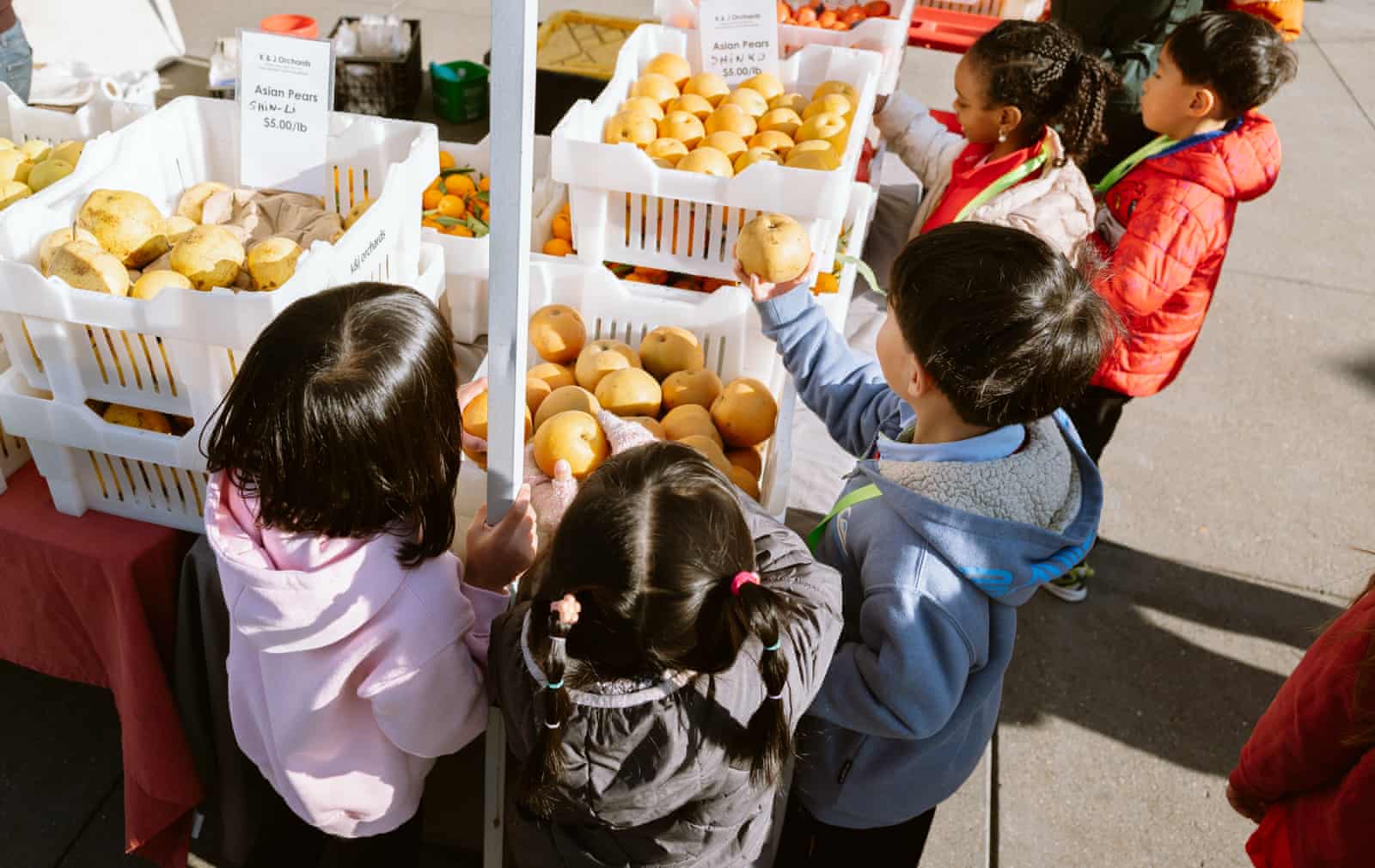
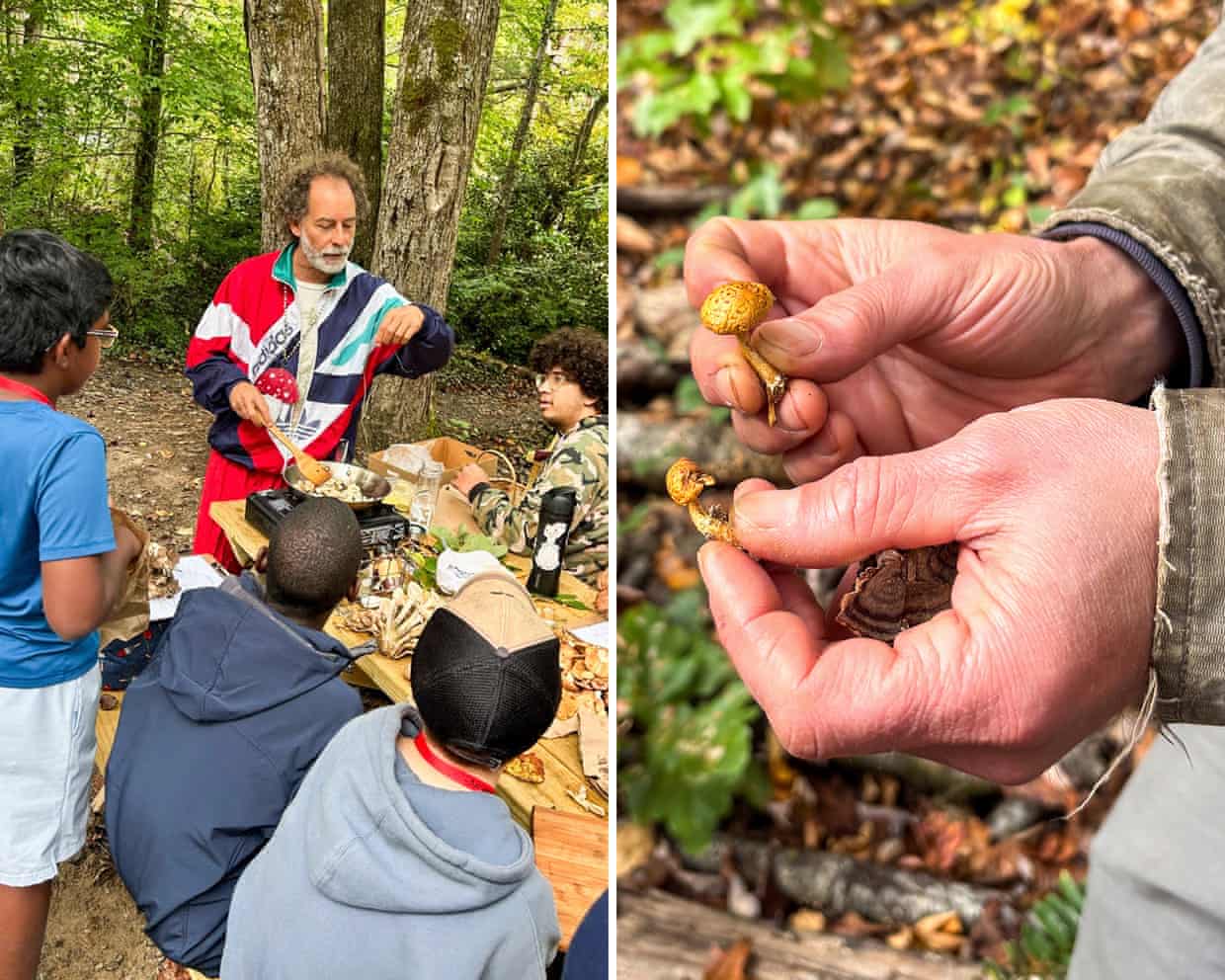
Photo:  Felix Uribe Jr/Guardian.
An organization called Foodwise Kids has brought more than 20,000 students to farmers’ markets to learn about the food system and taste new-to-them produce. Sometimes the teacher will challenge the students to join “the One-Bite Club.” 

When John came back from college the first time, one of the things he said, only half joking, was, “Why didn’t you tell me I liked mushrooms?”

He eats everything now, but as a kid, he had limited tastes, and I was no good at insisting he try something.

Today a special program for young children encourages tasting new things as part of a group.

Cecilia Nowell reports at the Guardian, “On a crisp winter morning in San Francisco, a team of six-year-olds declare that their favorite fruits and vegetables are peaches and broccoli – but then again, they have yet to venture out into the farmers’ market where produce they have never tried before awaits them. With handfuls of tokens, they will purchase persimmons, pomegranates, Asian pears, purple potatoes, kale and more from the farmers who grew them – then embark on a tasting journey, featuring new and familiar spices.

“The first-graders are visiting the Ferry Plaza Farmers Market – a Bay Area institution that draws more than 100 farmers to San Francisco’s waterfront three days a week – with 22 of their classmates from Lincoln elementary. That morning, the children had ridden the subway from their school in Oakland’s Chinatown into the city with parent chaperones and their teacher, Kathy Chen.

“Chen [knows] that at this age, her students are prone to becoming picky eaters – but what is cooked at home and what they try at school can change that. The hope is that after this field trip, when the cafeteria serves up an unfamiliar veggie or they’re offered a new fruit, the students might be a little more willing to take a bite.

“The trip is sponsored by Foodwise Kids, a nutrition and wellness program for elementary school students in the San Francisco Bay Area coordinated by the 30-year-old non-profit Foodwise. Since the program’s launch in 2012, it’s brought more than 20,000 local students out to the farmers’ market to learn about the food system. It’s focused primarily on schools with a high percentage of students of color or kids eligible for free or reduced-price school meals, and education director Tiffany Chung says the aim is to get ‘students excited about eating fruits and vegetables’ in the hopes that ‘they’ll incorporate them into their daily life and eventually lead to longer-term healthy eating options.’ …

“At folding tables, they introduce themselves to Foodwise’s staff and volunteers, and name their favorite fruits and vegetables. Chung jumps in for a moment to speak Mandarin with one student who doesn’t feel comfortable speaking English – she notes that many of the program’s volunteers are bilingual, usually in Spanish, to support the city’s diverse youth.

“While the majority of the classmates in her group prefer peaches, Temnit Desta says her favorite fruit is lemons. ‘She likes sour,’ her mom, Tehesh Hadush, explains. Although Temnit was born in California, her family is from Ethiopia and she has grown up eating lots of spicy foods. …

“Just a few years after the Loma Prieta earthquake devastated the highway running along San Francisco’s coast, community groups began discussing ways to connect downtown with the waterfront – and settled on a farmers’ market. Another aim was to educate urban dwellers about California’s farmland and sustainable agriculture while providing access to healthy, fresh produce. To this day, the market prioritizes urban families – not only by accepting Snap, previously known as food stamps, but by matching every dollar spent so families can double their Snap spending up to $15.

“After they’ve filled a basket with produce – so much that the six-year-olds are carrying the basket in teams of two – the small groups take off for a quick tour of the farmers market. When they return, Chung and other volunteers lead the groups in a game guessing which season different crops grow in. As they play, youth education manager Marcelo Clark starts chopping and roasting different trays of the produce – washing raspberries, flavoring cauliflower with jerk spice and roasting potatoes with cumin. He aims to use a mix of spices the children may have already tried at home – and others that might be new to them.

“ ‘A lot of our students are newer to America, and may not speak English,’ says Chung, but at the market ‘they’re able to see produce that is familiar to them. … They’re able to point out: “I know this. This is cilantro. I have this on tacos.” ‘ …

“When the food has been prepared, Clark carries trays of fruit and both raw and roasted veggies out to the class. The students dive into the purple potatoes, carrots, brussels sprouts, kale and cauliflower – but are more hesitant to try hummus and raw broccoli. Although her classmates and their parents exclaim at the fresh persimmon, Temnit is wary of the unfamiliar fruit.

“ ‘Today is all about trying new things and giving things a chance,’ Chung reminds the class, gently encouraging them to try just the smallest bite of everything.

“ ‘When students are unfamiliar with a fruit and vegetable, there is a lot of hesitation. We try to create this safe space where we’re telling them: “It’s OK if you don’t like it. The whole point is just to try it.” ‘ …

“By the end of the class, Temnit will be asking for more persimmon, and one of her classmates will be racing around trying to finish everyone’s leftover pomegranate seeds.”

More at the Guardian, here.
Read Full Post »

Photo: Malin Fezehai for the Washington Post.
Steve Otieno (described below) rehearsing with the Ghetto Classics orchestra in Kenya.

Charitable work is complicated. It is not always possible to do the good for people that you intend. But if you are making a meaningful difference in some lives, that may be enough.

In Kenya, an orchestra called Ghetto Classics aims to help poor children achieve something fine and eventually move away from the dangers of their extreme poverty.

Katharine Houreld writes at the Washington Post about both the successes and failures of the orchestra.

“The violin’s quaver steadied and swelled through the gloomy concrete staircase, escaped through the wire mesh and soared over the packed-dirt playground before dissipating in the acrid smoke drifting in from the smoldering dump site next door.

“It was the last day of class before Ghetto Classics broke up for Christmas, and 14-year-old Steve Otieno was practicing his Christmas carols for his final performance of 2024. Undeterred by the demolition of his home last month, the floods that devastated his neighborhood in Nairobi this year, or the eye-watering stink of burning plastic all around him, he stroked the strings to coax forth each note of ‘Joy to the World.’

“ ‘Music makes me feel calm when I’m stressed,’ he said shyly. ‘Some people have drugs. For me, it is music.’

“Steve is one of thousands of children from the poorest neighborhoods of the Kenyan capital who have been introduced to classical music by Ghetto Classics. The organization was set up in 2008 by Elizabeth Njoroge, a classically trained singer who studied pharmacology at her parents’ urging but longed to return to music. A chance encounter with a priest trying to fund a basketball court at a Catholic school in the Nairobi slum of Korogocho inspired her to raise money for the first class of musicians there. …

“Now Ghetto Classics provides lessons to about 1,000 students, who feed three orchestras, a choir and a dance group. Njoroge raises funds to support its expanding programs.

“Ghetto Classics works in schools and community centers in Nairobi and Mombasa, but its headquarters is in the St. John compound in Korogocho, where a church, school and community all share space. A tarmacked basketball court and a dirt field for soccer are enclosed by a sagging chain-link fence and scraggly trees; on one side of the compound, the children have planted a garden to try to filter out the choking smoke.

“Ghetto Classics has performed for former president Barack Obama, first lady Jill Biden and Pope Francis. Alumni are studying in the United States, Britain and Poland.

They include one determined pianist who learned to play by watching videos and repeating the motions on a piece of cardboard on which he’d drawn keys.

“The lessons provide a refugee for students suffering from hunger, domestic violence and crime, said violin instructor David Otieno, who is not related to Steve. He joined the program a decade ago as a student; now he’s one of 45 graduates working as paid instructors.

“The tall, dreadlocked 29-year-old credits Ghetto Classics with saving him from the neighborhood gangs. He witnessed his first homicide when he was still in primary school, and as he grew up, the gangs sucked in friend after friend. His teachers became so worried he’d be killed, he said, that they collected money to move his mother and six siblings to a safer neighborhood where he could continue his music.

“Back then, he said, the group shared 10 violins among 30 students. Now he has his own instrument. Once shy and fearful, he has played in Poland, in the United States and at State House, the Kenyan president’s home in Nairobi.

“ ‘The violin gives you a voice,’ he said. ‘It makes you talk to people you’d never otherwise talk to.’ His students filed into the compound bumping fists.

“Thousands of kids enroll in Ghetto Classics, but most fall away. The discipline is demanding. … About a dozen young musicians who spoke to the Washington Post said their parents had never seen them perform. Some were single parents too busy working, some weren’t interested and some were actively opposed. …

“When opera singer David Mwenje started with Ghetto Classics, his father was skeptical, he said, but he came to see him perform and was won over — a bittersweet memory to which Mwenje clings now that his father has died.

“Mwenje sang for six years, including for Pope Francis at the Vatican, before turning professional in 2021. His first audition landed him the role of Okoth — a messenger who must tell a village medicine man that his daughter has taken up with foreign missionaries — in Nyanga: Runaway Grandmother with Baraka Opera Kenya at the Kenya National Theatre. It was the first ray of hope in years darkened by his father’s death and the covid pandemic that shuttered his school, he said.

“ ‘Through this opera, I could control all my pain,’ he said. ‘I also love to sing “Bring Him Home,” from Les Misérables, because the song reminds me of my dad and I feel like I’m pleading with God to bring him home.’ ”

More at the Post, here.

Read Full Post »

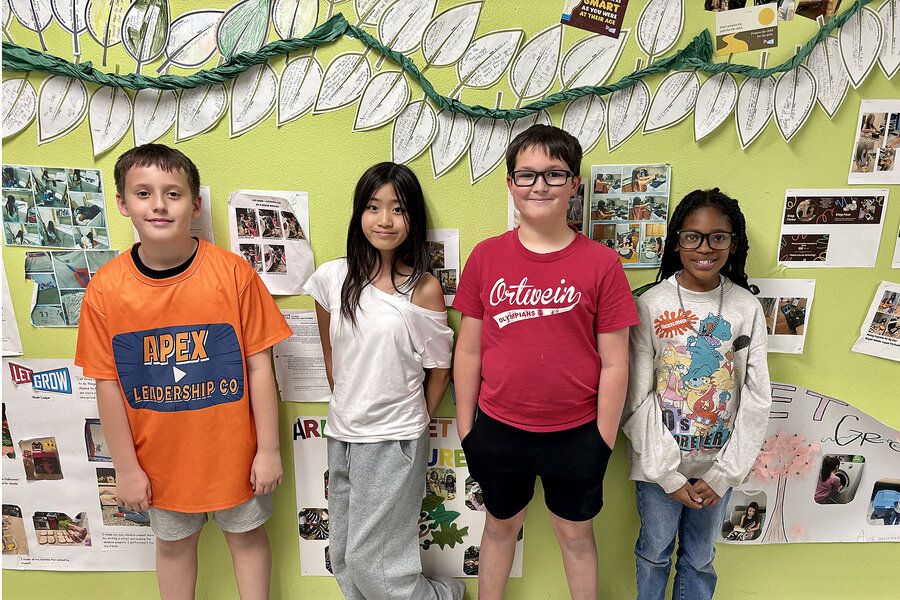
Photo: Jackie Valley/The Christian Science Monitor.
Fifth graders at Dennis Ortwein Elementary School in Las Vegas, Nevada, and their Let Grow posters.

Ultimately, you want your children to grow up able to take care of themselves. Love and convenience give parents plenty of temptation to do things for them beyond the point where the help is beneficial. That’s why a school in Nevada is lending a hand to kids and parents alike to so that fledglings may have a good chance to fledge.

Jackie Valley has the story at the Christian Science Monitor.

“Walking the dog. Wrapping a package. Cooking dinner.

“For adults, these activities often represent mundane to-do list tasks. But for fifth graders in Las Vegas, they offered something different this past school year – a taste of independence. 

“ ‘I can do things by myself more instead of having my dad or my mom do them,’ says Deven Doutis, who learned his dog goes a little nuts when he spots another canine out for a stroll.

The small steps toward greater – and lasting – independence came about in a very intentional way.

“Deven’s teacher, Amy Wolfe, sensed students were entering higher grades with more needs than in past years. Some couldn’t open a water bottle, for instance, or navigate minor conflicts with their peers. So when Ms. Wolfe heard about a program called Let Grow, she decided to pilot it within select classrooms at Dennis Ortwein Elementary School in Las Vegas.

“The program’s premise is simple: When children gain independence, they grow into more confident and capable people. …

“But what, exactly, are kids allowed to do by themselves nowadays? Terms such as ‘helicopter parent’ or ‘overparenting’ have become shorthand to describe adults who are overly involved, sometimes to the detriment of their child’s developmental growth. …

“A poll conducted last year for C.S. Mott Children’s Hospital at the University of Michigan found that three-quarters of parents say they have their children do things for themselves; however, the percentage of parents who report their children do specific activities independently is lower. Only a third of parents, for example, allow their 9-to-11-year-old child to walk or bike to a friend’s house. A similar portion say they encourage their 5-to-8-year-olds to decide how to spend their own gift or allowance money.

“Safety concerns emerged as the top reason those same parents don’t allow their children more free rein. The results did not come as a surprise to Lenore Skenazy, president of Let Grow and author of Free-Range Kids. For years, she has been on a mission to unleash children in a society where they increasingly have little independence in the physical world. …

“She says the backlash stems from a pervasive, heightened sense of danger built by media narratives and litigious tendencies. …

“In a commentary piece published by the Journal of Pediatrics last year, researchers pointed to evidence showing a correlation between children’s dwindling independence and increasing mental health problems over several decades.

” ‘We are not suggesting that a decline in opportunities for independent activity is the sole cause of the decline in young people’s mental well-being over decades, only that it is a cause, possibly a major cause,’ the authors wrote. (The lead author, Peter Gray, is a research professor in psychology at Boston College and a founding member of Let Grow.)

“In Ms. Wolfe’s classroom each month, students chose an independent activity, loosely tied to a theme, and completed it by themselves. Then they reported back to their classmates and teacher about the experience. There were no grades or critiques. If Ms. Wolfe asked any probing questions, it was to suss out how her students felt after, say, baking a cake or pulling weeds. …

“ ‘It’s more about developing the conversations with students to where they see independence … as a value,’ she says. …

“For her first project, Giwan Istefan’s 11-year-old daughter, Aria, decided to make miniature lemon-and-blueberry cheesecakes. Ms. Istefan says it turned into an exercise in parental restraint as well.

“ ‘I was like, “Oh my gosh, I see the disaster happening,” ‘ she says. ‘But I had to step back. It was growth not just for her, but it was growth for also myself.’ “

More at the Monitor, here. What are some of the ways you have encouraged independence in children, not necessarily only as a parent?

Read Full Post »

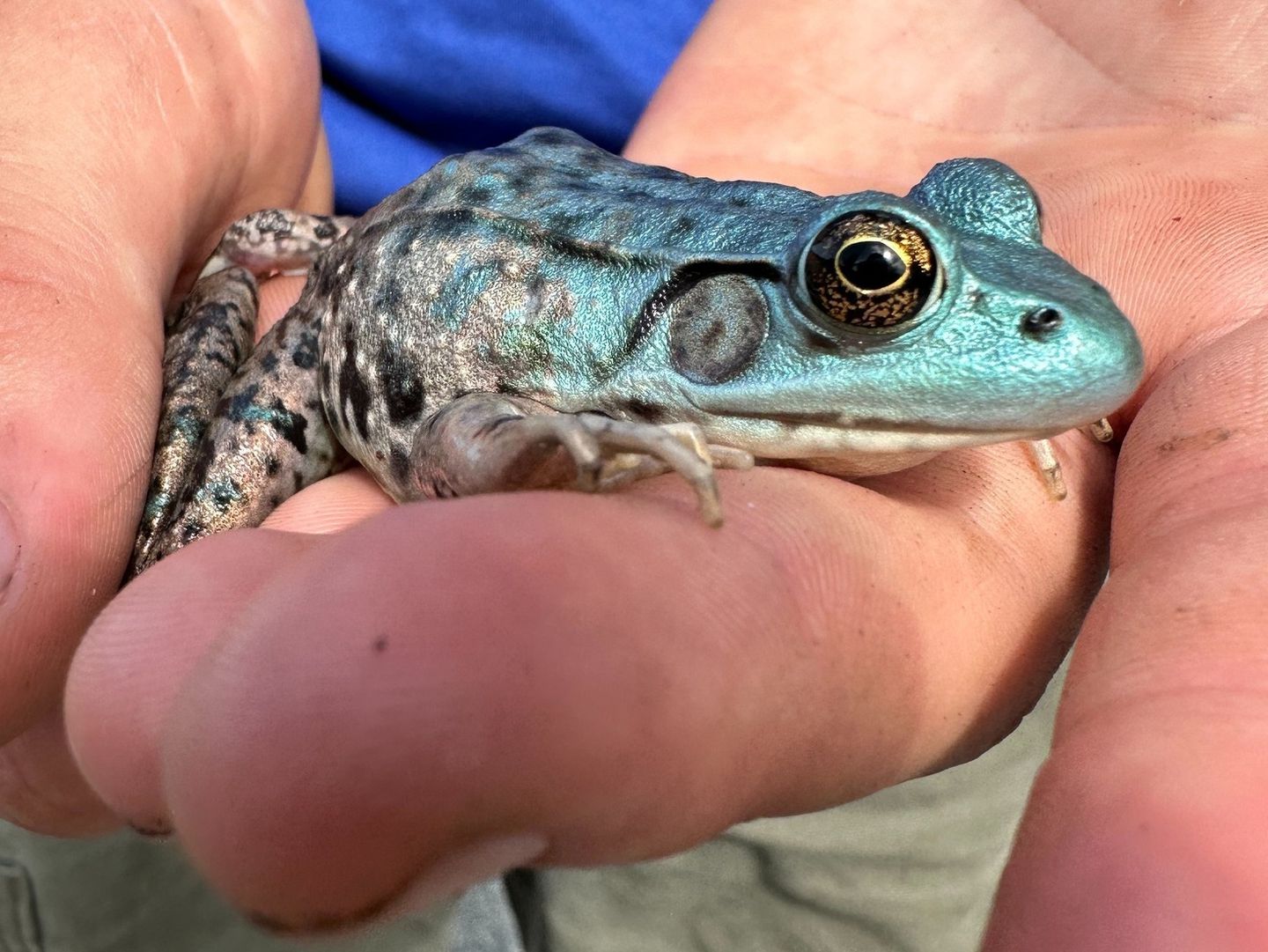
Photo: Ragosta family via RI Department of Environmental Management.
A family in Rhode Island found a rare blue frog and reported it to the DEM.

What turns kids on to Nature? Often it’s a parent’s enthusiasm about fly fishing, say, or their excitement about a rare bird or wildflower. Sometimes it’s just what kids find on explorations of their world. There are natural curiosities everywhere, even in cities, if you walk around with noticing eyes.

Carlos R. Muñoz reports at the Boston Globe about the rare blue frog Rhode Island boys spotted recently.

“A Rhode Island family made the remarkable discovery of a rare blue frog [in July] and reported it to the state Department of Environmental Management. The bullfrog displayed signs of a rare pigmentation known as axanthism, which is a lack of color-bearing cells that turns green frogs blue.

“The department said in a Facebook post on its Division of Fish and Wildlife Outdoor Education page that the condition is most frequently seen in green frogs, leopard frogs, and bullfrogs — species in the Ranidae family of amphibians. …

“A 1966 study by Cornell researchers found that only 69 out of two million frogs (0.003 percent) are blue.

“Michael Berns and Lowell Uhler, authors of the study, said that blue-green frogs are ‘incredibly rare’ but exhibit different regional occurrence rates. In New England, these blue frogs are most common in Massachusetts and Connecticut. …

“ ‘Green frogs are widely distributed throughout Rhode Island, spending most of their lives in freshwater wetlands such as marshes, ponds, streams, and vernal pools,’ according to a DEM brochure authored by wildlife technician Liam Corcoran.

“Kimberly Ragosta, the mother of five whose kids made the once-in-a-million discovery, said her son Jack spotted the glistening blue bullfrog squatting by the road while the kids were running a roadside stand.

“Jack told his mother he was taking a stroll along the road near a swampy woodland area when he noticed the croaking bullfrog’s shimmering skin ‘sticking out like a sore thumb.’ He ushered it into a bucket to show his mother. ‘It didn’t move at all; it was his easiest catch ever,’ Ragosta said.

“Jack went on to research the amphibian and correctly discovered its rarity. They notified the department, but later released the frog into the woods.

“Another blue frog was caught July 2 in northern Rhode Island by 11-year-old Finn Leonard, according to his mother Kate Arsenault Leonard. She saw the department’s Facebook post and commented with a picture of the giant blue frog with a dark leopard print and a broad grin.

“Finn told the Globe that he was trying to catch frogs for a friend when he saw the blue frog and tried to catch it. He said he also saw it last year but could not get it.

“ ‘He hopped out each time,’ Finn Leonard said of his previous attempts to lure the amphibian. He was triumphant this year when he netted the frog, which he said he knew was rare because he saw it on the YouTube Channel ‘Brave Wilderness.’ …

“Kate Arsenault Leonard said one of the reasons her family loves living in rural Rhode Island is the ability to explore nature in their own backyard. They go out looking for salamanders, fishing, watching fireflies, and of course frog hunting. …

“The family is floating ‘Alien’ as a name. Finn set the frog free. …

“DEM said the exact locations of the rare frogs are being kept secret to limit the number of ‘well-intentioned nature observers who inadvertently may cause negative impacts on habitat.’ “

This story reminds me that maple leaves also “turn color” when a certain pigment is missing. And I’m noting the role of the parents here: the kids in both stories knew their adults would be excited. Now they will be doubly inspired to look closely at Nature and try to make more discoveries. Perhaps they’ll be scientists one day. Even if not, they will always be friends of our planet.

More at the Globe, here.

Read Full Post »

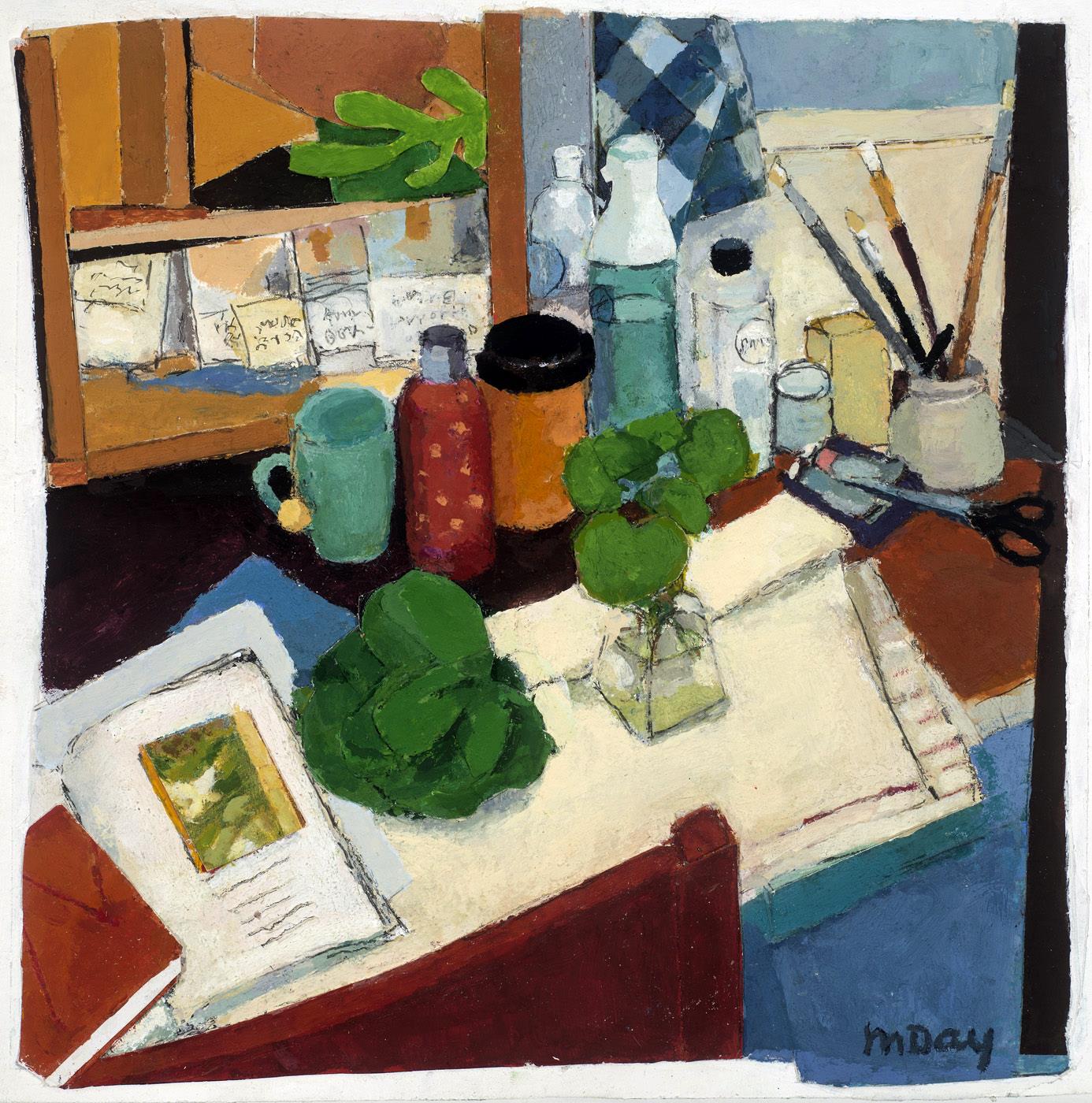
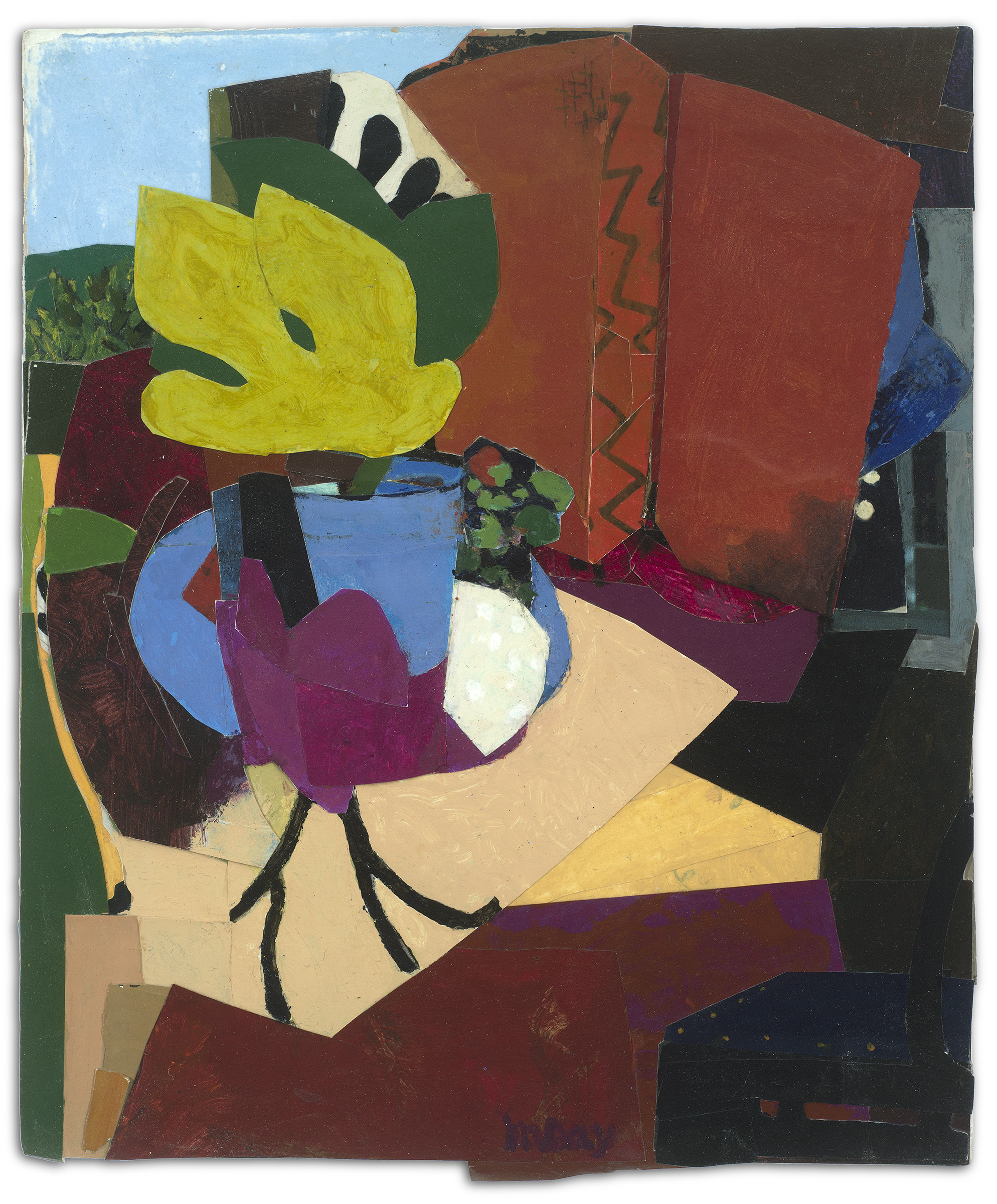
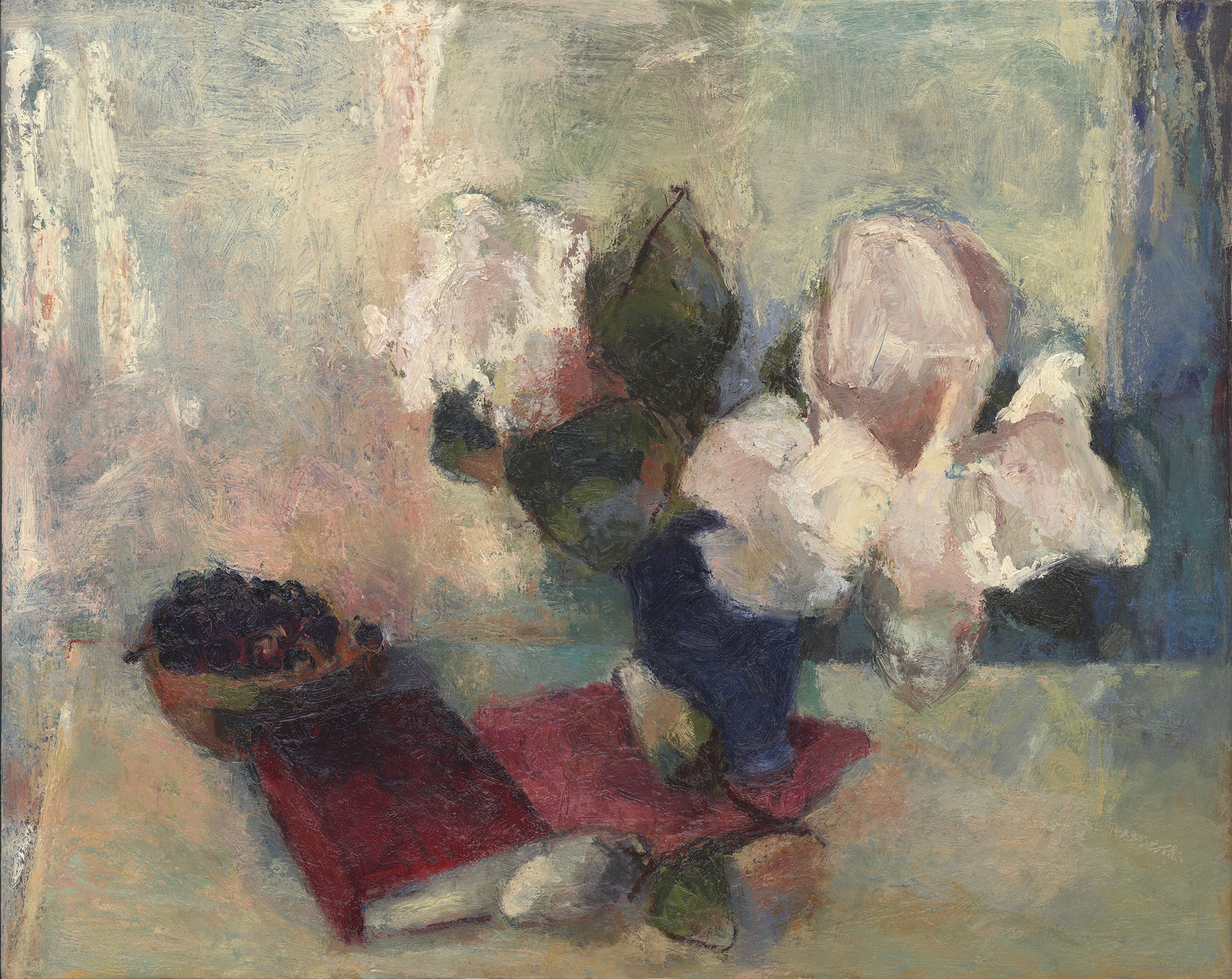
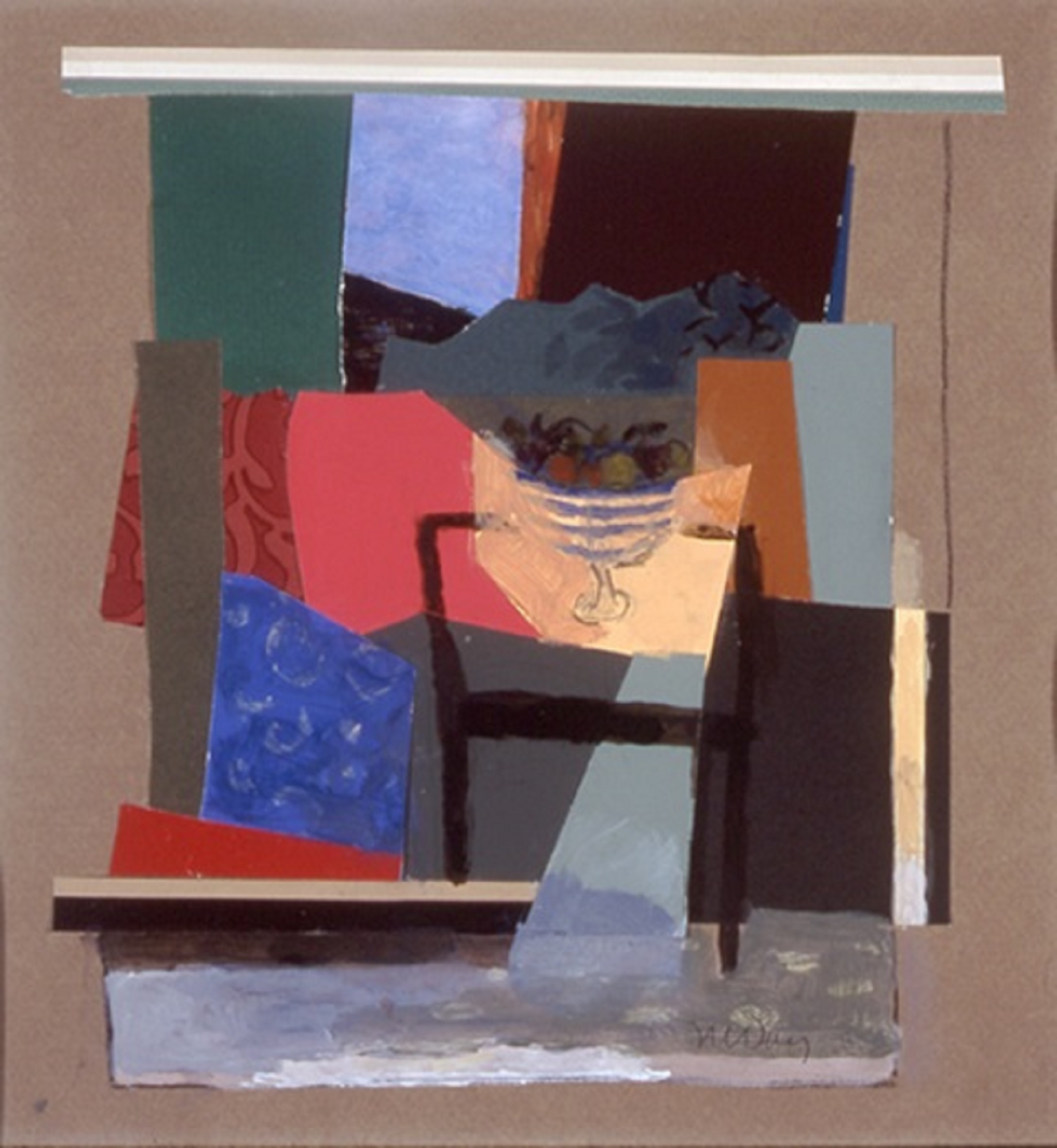
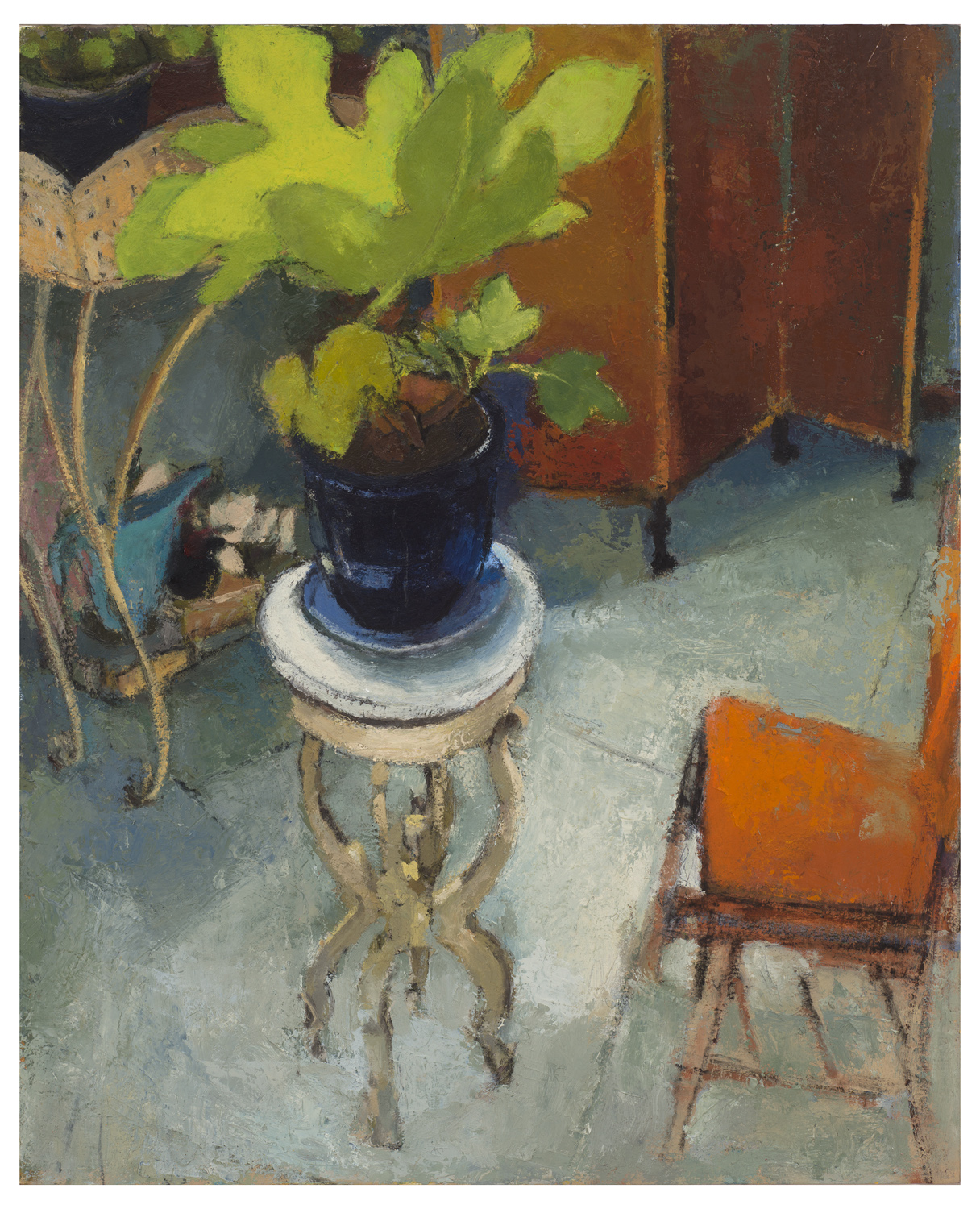
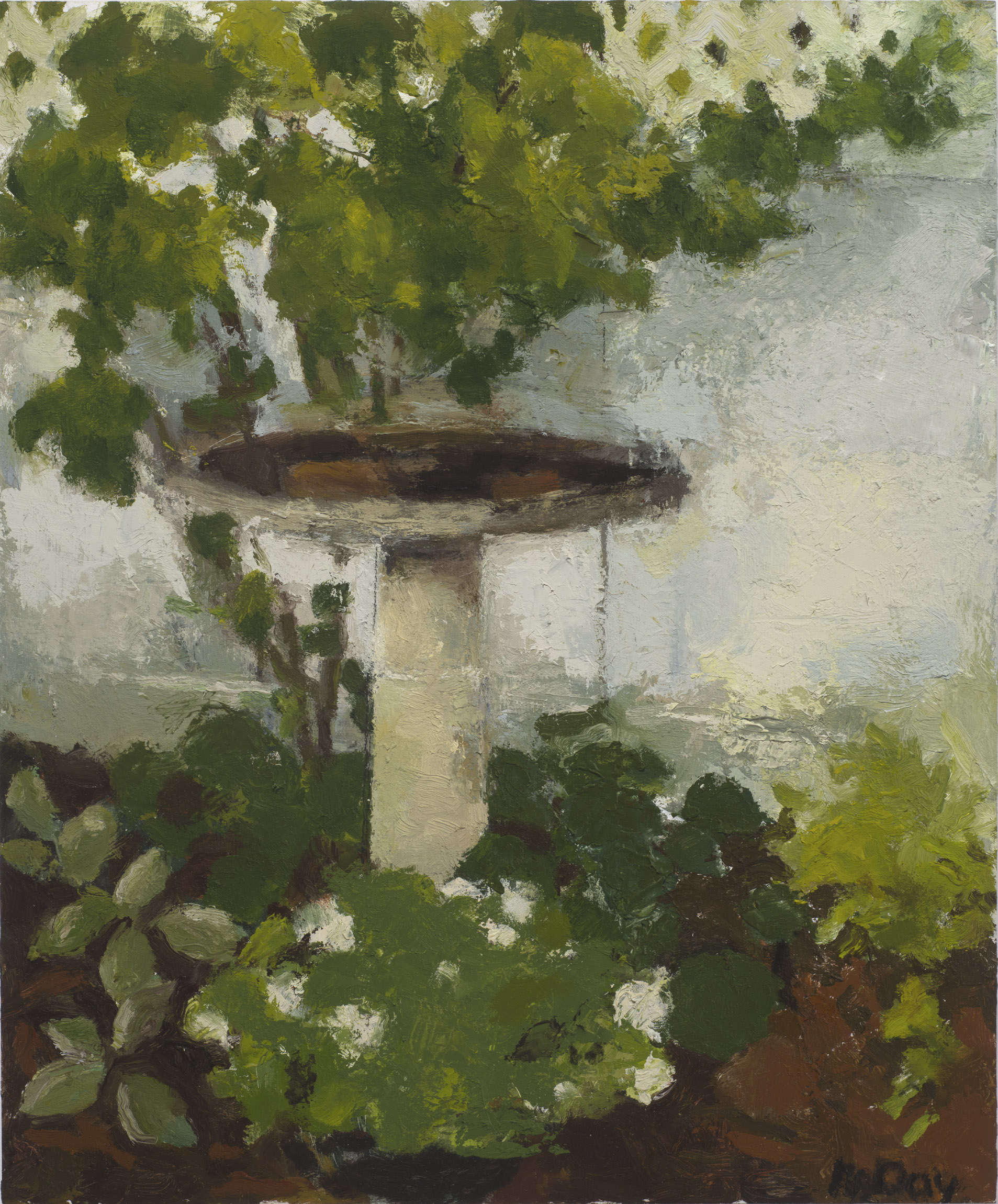
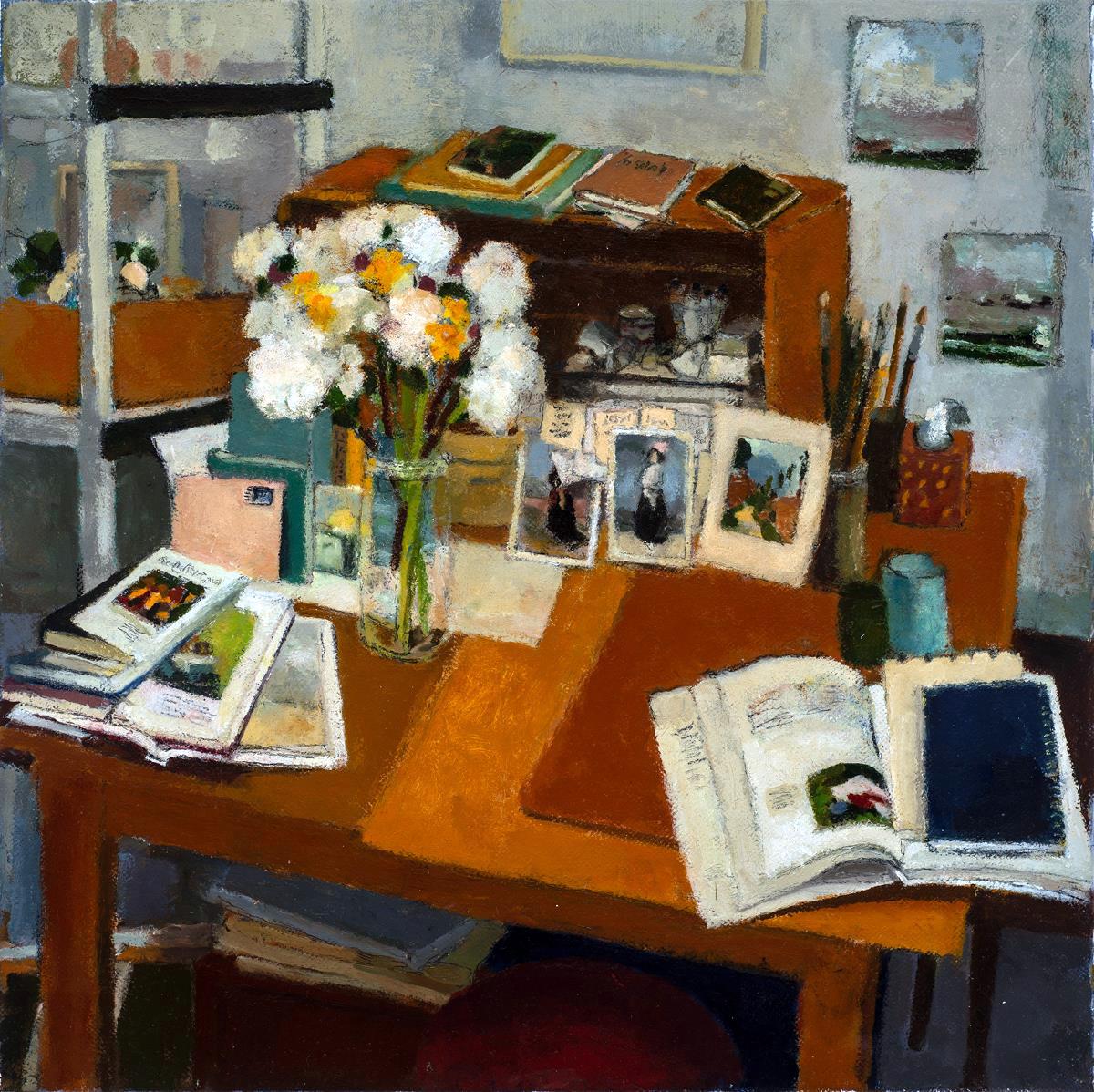
Art: Meredith Fife Day.
Studio Life.

The day job of artist Meredith Fife Day was for many years running a department at a community newspaper chain in Massachusetts. That is where I met her. She was my first boss in publishing. After retiring from the newspaper, Meredith focused on her art while teaching art at a local college during the day and working with the amazing nonprofit she founded, Making Art with Artists (MAwA). MAwA enabled low-income urban kids to practice art under the guidance of working artists. I wrote about the award Meredith received for that work here.

Recently, I asked her if I could do a post on her art, and she sent me these riches.

From her bio: “Her art reviews and essays have appeared in a variety of publications for more than 25 years and she chronicles her days through journaling. She writes poems which, like her paintings, are frequently in homage to observational response, memory and imagination.

“She has exhibited paintings for more than four decades in numerous invitational shows and national competitions. She earned an MFA degree from Boston University after receiving BA and MFA degrees from Louisiana State University in her native Baton Rouge. Meredith has been awarded fellowships at Virginia Center for the Creative Arts in Amherst, Va., and Auvillar, France, and Millay Colony for the Arts in Austerlitz, N.Y.  She has taught at Art New England/Mass Art summer workshops in Vermont and Cullowhee Mountain Arts in North Carolina.” 

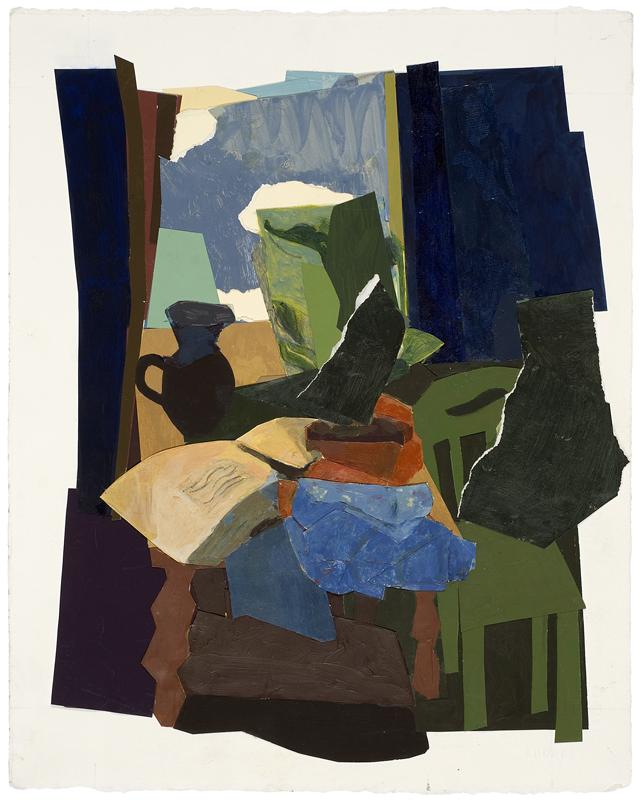
Note how much the ficus plant below returns Meredith’s love by modeling for her on repeated occasions. And do you sense the joy the artist takes in homely things lifted to a spiritual level? I love her work.

Read Full Post »

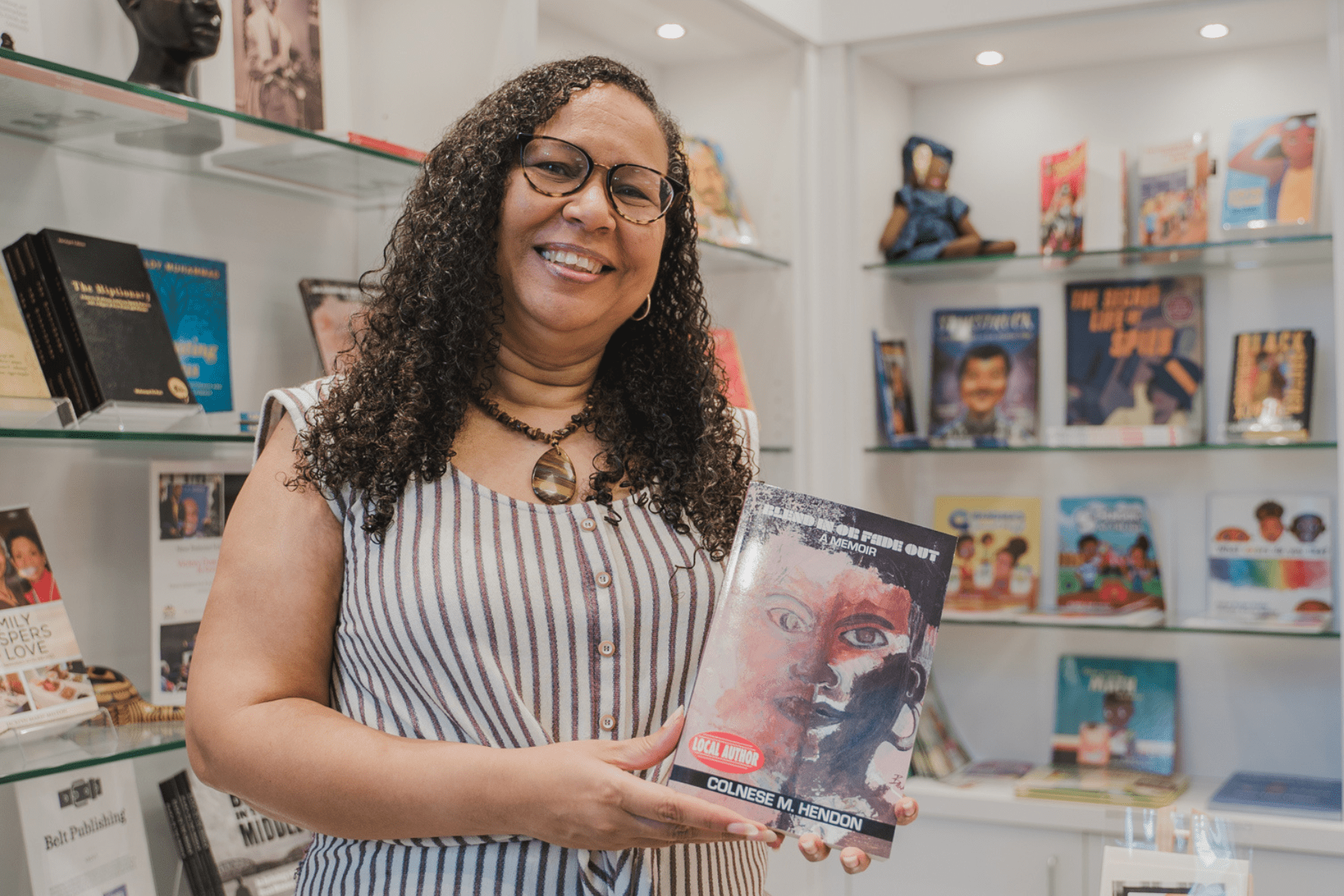
Photo: Drew Arrieta | Sahan Journal.
Mary Taris poses with Blended In Or Faded Out, by Colonese M. Hendon, at Strive Bookstore in Minneapolis on July 15, 2022. 

A Black educator and mother in Minneapolis saw a problem. There were few books with characters her students grandchildren could relate to. So she took action. And in the process, helped her own family and many others.

“When Mary Taris was raising her four children in north Minneapolis,” writes Noor Adwan at Sahan Journal, “she knew she needed to give them books more representative of their identity than the ones she’d had as a child. 

“ ‘I always had to spend extra time and money to find books that our Black children could relate to,’ she said. ‘At a certain point, after years of being frustrated, I just decided I needed to do something about it.’ …

“In 2018, Taris founded Strive Community Publishing to carve out space in the publishing world for Black authors. It has published fiction and nonfiction works for adults and children from 20 authors and five illustrators, and recently opened its first store at the IDS Center in downtown Minneapolis.

“Strive Bookstore’s grand opening [July 20 featured] Anthony Walsh, author of Hockey Is for Everybody. …

“ ‘We’re hoping that at the grand opening we can get to know some of the people who live in the downtown community and find out what they would like to see in a bookstore,’ Taris said.

“Taris’ experiences as a reader, educator, and mother all contributed to her aspiration to provide children with culturally relevant books. When she was a child growing up in north Minneapolis, reading was a reprieve from a chaotic home life.

“ ‘I would just be in my room reading anything I could get my hands on,’ Taris, 58, said recently during an interview at Sistah Co-op, the Black-woman focused business collective in the IDS Center where Strive is also located. ‘It was like reading for escape, and wishing I was somewhere else.’

“But she never felt represented in the books she read as a child. … It wasn’t until Taris was in her 20s that she read something that she could see herself in. One of her coworkers, an older Black woman, had stepped in. 

“ ‘Girl, you need to be reading some books by Black folks,’ Taris recalled her coworker saying. She loaned Taris Disappearing Acts, a novel by Terry McMillan. …

“Taris said the straw that broke the camel’s back came during her final few years of teaching. Her school, located in the Robbinsdale school district, had received an arts grant, and she was encouraged to put together an arts-integrated lesson plan.

“At the time, her class of predominantly Black fifth-graders was busy learning about autobiographies and biographies. But there were only a handful of Black biographies in the school’s library.

“To fill that void, Taris planned to have her students pretend to be adults, and write and illustrate their own autobiographies.

She put in a budget request for blank books and markers for her students. Her request was denied.

“ ‘That was it for me,’ Taris said. ‘It’s like, “I’m just gonna start my own business and I’ll spend my money on what I want for our kids.” ‘ … 

“When Taris founded Strive, she was supported by a circle of writers she calls her founding authors.

“ ‘I give them that distinction because they had to go through the learning process with me,’ Taris said. She said she felt fortunate that they trusted her – and Strive – with their stories.

“ ‘One thing that’s key in publishing is to be able to have the trust of the authors, especially authors who are marginalized like Black authors are, because they have been writing their stories for years,’ Taris said. ‘By the time it gets to me, they’re handing over their baby.’

“Donna Gingery, a 61-year-old Black woman and one of Strive’s founding authors, said one of her favorite parts of working with Strive was the support and encouragement she received throughout the writing process.

“ ‘There’s a lot of things I like about Strive Publishing,’ Gingery said. ‘The encouragement of the writer, the respect that you’re getting from the publisher, and not trying to change the narrative of your book. I think that’s really important.’ 

“Taris said that Strive does its best to hire Black editors to look over their books. …

“Taris’ vision for Strive doesn’t end with the IDS Center location. ‘We do have plans for growth and a possible second location,’ she said.

“In the meantime, she wants to focus on serving the downtown community. ‘We’re really striving to connect across cultures,’ she said.

“Part of that, she said, is portraying the Black community and all of its richness and diversity of talent in a positive light. Readers are already responding.

“ ‘This is a cultural exchange,’ Shimelis Wolde, 70, said recently as he browsed the co-op. ‘It’s important for the new generation.’ “

More at Sahan Journal, here. You can also read summaries of five new books available at the bookstore.

Read Full Post »

Photo: Veronica Blaylock
Lucy Blaylock of Gallatin, Tennessee, makes blankets for kids who need a little extra love.

I’ve shared a lot of articles lately about kids stepping up to help people in distress, but I never get tired of them. Oftentimes, it’s not just the product that matters to recipients, but the sense that someone is thinking of them. Feeling connected to a kind stranger can be as comforting as a favorite blanket.

Andrea Sachs wrote about this at the Washington Post, “Blankets can keep you toasty on cold nights or clean and relatively ant-free on picnics. Lucy Blaylock and Tori Holmes make blankets for a different purpose: to comfort people going through difficult times. … We spoke to the girls, who each won a Prudential Spirit of Community Award, about their inspiration, who has received blankets and how kids can get involved in helping others.

“Lucy learned to sew three years ago, when she was 8. After she made a flannel blanket for a friend’s birthday, she started to think about other kids who might need a little extra love. She asked her parents if she could organize a giveaway and shared her idea on her mom’s Instagram account (lucysloveblankets). She received 16 responses from children facing issues such as cancer, autism, bullying, divorce and the death of a grandmother.

“ ‘It makes me excited when I think of the kids getting the package in the mail and opening it,’ said the 11-year-old, who just completed fifth grade in Gallatin, Tennessee.

‘I always hope they know someone cares about them.’

“Since 2017, Lucy has donated about 500 Lucy’s Love Blankets to kids living in 14 countries and nearly three dozen states. She spends about two hours sewing the fabric by machine and hand-stitching her name inside a heart — her logo, of sorts. During the coronavirus pandemic, she turned her attention to making masks for health-care workers, but she jumps back into blanket action when she receives a request from a child suffering from a terminal illness. ‘Even though it gets a little hard sometimes,’ she said, ‘it is always the right thing to do.’

“For kids interested in volunteering, she recommends they forge ahead without overthinking it. ‘Don’t wait until you have everything figured out. Just do it, and keep going,’ she said. ‘Even when you feel like it might not be making that big of a difference, serving other people always matters.’

“Tori knows firsthand the challenges of being separated from a parent. When she was 6 years old, her mother was hospitalized for six months with leukemia. Tori moved into her aunt’s house, leaving her Corning, New York, home so quickly that she had only enough time to pack an overnight bag.

” ‘I missed my blanket and, of course, I missed my mom,’ the 13-year-old said. … Last July, inspired by her own experience, Tori started to make pairs of blankets for family members kept apart by unfortunate circumstances, such as illness. The parents receive one blanket; the kid gets the other one.

“ ‘I wanted to make a magic blanket that connects people,’ she said. ‘This way they have hope that they will be together again.’ …

“She donates the blankets to a children’s hospital, the medical-care facility that took care of her mother and the school where her mother teaches. Families can also request the twin blankets at operationstarways@gmail.com. …

“Tori, who will enter high school in the fall, said … ‘I want to give people who are going through what I went through hope.’ ”

Read Full Post »

69e5c57b-13a8-4f7b-90ca-5ec55c34bad9-768x675-1

Photo: Parklands Primary School
Children from Parklands Primary School in the UK enjoyed a Christmas extravaganza at the ice rink of Leeds East Academy. And Parklands staff volunteered their time to serve a hot Christmas meal.

Here’s a Christmas dinner story from the UK, one that would be perfect if it weren’t so necessary.

Alex Evans writes at the Yorkshire Evening Post, “Staff at Parklands Primary School volunteered their time to serve up a hot meal for the school’s 328 pupils and their families [Monday] at its ‘Christmas Eve Eve’ party.

“Youngsters were able to meet Santa Claus at the party which was set up by headteacher Chris Dyson. He says he was left ‘heartbroken’ when he discovered some of his pupils had never met Father Christmas and many wouldn’t receive gifts. …

“Each child received a Christmas present to unwrap — likely to be the only one they will receive this year, Mr Dyson said.

“The school, in Leeds, West Yorkshire, serves one of the largest council estates in Europe and an area in the top 1 percent in England for deprivation.

“Only a third of working-age adults have jobs and three-quarters of pupils qualify for the pupil premium, extra money given to schools from the Government to support the poorest children.

“Headteacher Chris Dyson, hailed ‘an inspirational leader’ by Ofsted inspectors said: ‘It broke my heart when I started at the school five years ago and found out that some families don’t even go to visit Santa, which is something we all just take for granted. …

” ‘So I said I would bring Santa to Parklands and get every child at least one present to open.’ …

“Mr Dyson’s initiative saw 150 people attend the school’s first party six years ago. The number doubled the following year and continued to grow. [Today] 800 people benefited from the headteacher’s generosity, which has been helped by donations from local business who have given cash and gifts, as well as Leeds City Council who have provided food.

“Mr Dyson added: ‘We are in the middle of one of the biggest council estates in Europe, a lot of our families don’t even go off the estate. …

” ‘Christmas is a vulnerable time for families, its cold and for some people it is the only hot meal they will get this week. I’m blessed that I have had so many presents donated that those with a birthday coming up will get a birthday present as well.’

“Mr Dyson took over at the school in 2014, after it went through five headteachers in just one year and was rated inadequate by Ofsted, the government’s education watchdog. It had the country’s highest number of annual exclusions and a padded cell was used as a form of punishment. Mr Dyson said he wanted to bring ‘love and smiles’ back to the school and has extended that to the wider community. …

” ‘It’s for the entire community, anyone can come and they all do. Our first year we had a lot of kids who didn’t come to our school come round, and I said Santa doesn’t turn people away. So we just welcomed everyone. … It’s a vulnerable time, food isn’t as plentiful here as where I live. It’s important they get a hot meal.

‘These kids will ask why doesn’t Santa answer my letters like he does to people in those middle class areas. I want to make sure they feel Santa hasn’t forgotten about them.’

More.

Just a reminder about the miracle of great teachers.

Hat tip: @HertsLearning on twitter.


Read Full Post »

Photo: Parish of East Baton Rouge Recreation and Park Commission
Kids in Baton Rouge, Louisiana, compete in a sack race using equipment provided by the local parks and recreation commission. Mobile playgrounds designed to fight childhood obesity are catching on nationwide.

Did you always have some kind of gym class in elementary school? Something that kept kids running around and exercising even if it was only Dodge Ball? I did.

In recent decades, many schools have seen cutbacks in classes that are important for both intellectual growth and overall health — arts, music, gym, and more. Concerned communities are doing whatever they can to make up the difference.

Christine Vestal writes at the Washington Post, “In a state with the fourth-highest rate of youth obesity in the nation, the Baton Rouge parks and recreation agency wanted to lure Louisiana kids away from their screens and into the parks to get moving.

“But the low-income youths who needed exercise the most weren’t showing up at the parks. Officials learned that they didn’t have transportation, and their parents were too busy working to take them. So they decided to take the parks to the kids.

“With money donated in 2012 by corporate sponsors and a portion of their parish budget, the local parks and recreation agency, known as the Baton Rouge Recreation, or BREC, bought a box delivery truck, painted it with bright colors, and filled it with scooters, hula-hoops, balls, slack lines, trampolines, sidewalk chalk, and jump ropes.

” ‘The idea came to us one day while we were watching a bunch of kids turn flips on an old mattress someone had discarded near the office,’ said Diane Drake, who directs BREC’s playground on wheels. ‘We realized it wouldn’t take much to get kids moving if we put it right in front of them.’

“Naming the mobile playground BREC on the Geaux (a Cajun play on words for the word ‘go’), the agency in 2013 started what would become a daily program by holding community events at housing complexes, churches, parks, and schools in low-income neighborhoods.

“If peals of laughter and swarms of activity are any indicator, BREC on the Geaux was an immediate success, Drake said.

‘‘ ‘Once word spread, children would come running out of their apartments as soon as we pulled into the parking lot,’ Drake said. ‘It was all we could do to unload the equipment before they grabbed it and ran off.’

“A year after it began, BREC officials drove the mobile playground to a meeting of the National Recreation and Park Association in Charlotte.

“Since then, BREC has received dozens of e-mails and phone calls from other cities seeking advice on how to start a similar program, Drake said. …

“Transporting the joy and the health benefits of play to kids in underserved neighborhoods isn’t a new idea. A concept called ‘Play Streets,’ in which local volunteers work with police and health officials in urban neighborhoods to temporarily block traffic so kids can play, has been thriving for decades in places like London, Chicago, New York, and San Francisco.

“But the idea is now starting to take root in small- and medium-size cities — and in a handful of rural towns — where low-income children and adults are even more susceptible to obesity than in the nation’s urban centers, according to a June report from the Centers for Disease Control and Prevention. …

‘‘BREC started its mobile playground project with $110,000, half from the Blue Cross Blue Shield of Louisiana Foundation and half from the parish budget. A Play Streets project funded by the Robert Wood Johnson Foundation supported play events in four diverse low-income rural communities last summer — Warrenton, N.C.; Talihina, Okla.; Oakland, Md.; and Cameron, Texas — on a much smaller budget: $6,000 for a handful of community events. …

“In Baton Rouge, Louisiana State University’s Pennington Biomedical Research Center found that similar events sponsored by BREC resulted in children getting about 50 percent more physical activity, as measured in Fitbit steps, compared with weekdays and weekends without Play Street events.”

More here.

Photo: Our Home Louisiana
Baton Rouge Recreation celebrates a new mobile-playground truck with Pennington Biomedical Research Center’s Elizabeth Gollub, an evaluator of the anti-obesity initiative.

Read Full Post »

Photo: WideOpenPets.com
The University of Maine used baby goats to calm student stress during finals. Valley Edge Farm, which specializes in Nigerian Dairy Goats, provided the rambunctious kids.

This is exactly the sort of offbeat story I love. (Feel free to send me other kooky stories.)

Emily Burnham writes at Bangor Daily News, “For the past few years, the University of Maine has brought in therapy dogs — mostly cuddly golden retrievers and adorable Pomeranians — to soothe the frazzled nerves of students during finals week.

“This spring, however, it decided to try something a little different: baby goats.

“Brittany Smith, a staffer with UMaine’s campus activities board, got the idea when a co-worker mentioned that her sister, Abby Skolfield, owned and operated a goat farm, Valley’s Edge Farm, in the western Maine town of Strong. …

“A few quick phone calls later, a truckload of baby goats was on its way to UMaine, bound for an afternoon visit with students — most of whom had no idea they were going to hang out with month-old Nigerian Dwarf goats. Once word got out, a line stretched all across the mall, full of students waiting for their chance to pet a goat.

“ ‘I thought maybe 30, 40 people would show up, but this is ridiculous,’ said Smith. …

“Skolfield’s goats are old hands at dealing with crowds. Her goats are mostly for show, and they visit daycares and walk in parades regularly.

“ ‘I get hit up for goat yoga more times than I can count,’ said Skolfield. ‘I don’t see how that’s relaxing, but hey, whatever works.’ …

” ‘They come when called. Their little tails wag,’ she said. ‘They are the most dog-like of all livestock.’ ” More here.

I had actually heard of goat yoga! The goats stand on yoga students’ backs.

Video: CBS News

Read Full Post »

Shows how far we have come from ancestors who let nothing go to waste that making clothes out of leftover fabric is a novelty. But it’s a good idea nevertheless.

Katherine Martinko at TreeHugger writes that Beru Kids is a children’s clothing company in downtown Los Angeles that makes use of textiles that would otherwise be landfilled.

“The garment workers are mostly female,” she says, “and are paid higher than minimum wage (not per-garment, as is usual in the fashion industry).

“What’s really interesting about Beru is that it repurposes deadstock fabrics to make its clothes. ‘Deadstock’ refers to surplus fabric that has not been used by other factories. In LA, it is sent to a warehouse, where Beru’s founder Sofia Melograno goes on a regular basis to purchase whatever textiles catch her eye. Beru has also begun recently incorporating organic, traceable cotton into its garments.”

Traceability means the cotton can be traced back to its original source so it’s possible to assess whether all steps in the supply chain are environmentally and ethically sound.

Martinko adds that because the fashion industry is a huge polluter, finding a use for fabric that would otherwise get thrown away is good for the planet.

More here.

Photo: Beru Kids (via Facebook)
Beru-Kids-Molly-Bee-dress

Read Full Post »

I was first drawn to Joseph P. Kahn’s story about clowns in children’s hospitals by the cute pictures — and the fact  that my brother sometimes performs with a clown troupe at his church.

But what I especially appreciated learning from the article is that hospital clowning today is not just about getting a laugh out of a sick kid, important as that is. It’s also about giving children a little bit of control — to point out that the clown is doing something wrong, for example, or even to say the clown is not welcome and should go.

Kahn writes, “For hospital clowns Joyce Friedman and David Levitin, no two tours of duty are quite the same. Which is just how they like it.

“During rounds at Boston Medical Center, Friedman (a.k.a. Frizzle) and Levitin (Toodles) showed off their improv skills room by room, careful to assign an active role to each young patient they visited.

“At the bedside of 10-year old Cheyanne, the pair held a mock marriage ceremony, prompting Cheyanne to exclaim, through her oxygen mask, ‘You forgot to exchange vows!’ …

“Handed a joystick, a child might be encouraged to ‘control’ the clown as he or she chooses. Another patient, nervous or scared, might not want a visit at all. Either way, something positive comes from the encounter.

“ ‘Being empowered is really a key component of the healing process,’ says [Children’s Hospital endocrinologist Dr. Michael] Agus. ‘The more passive you are with an illness, the more challenging it is to heal.’ …

“Whatever a patient’s age or condition, said [clown Cheryl] Lekousi, she and her colleagues focus on the positive, even in the bleakest situations.

“ ‘Our message to the kids is, we’re a witness of you, of your childhood,’ said Lekousi.”

More here.

Photo: Dina Rudick/Globe Staff
Christopher reacts to the entrance of Cheryl Lekousi (a.k.a. Tic Toc).

Read Full Post »

Kids ages 3 to 5 seem to have a strong compulsion to check out trucks up close. So when organizations like Concord Recreation decide to do a little fundraising by providing the opportunity, parents of preschoolers know they just have to go.

I was walking back from the store when John’s wife and son pulled up and said they were on their way to Touch a Truck. I couldn’t resist. I said we’d meet them there.

I don’t know the names of all the trucks, but I can tell you the array included an ice cream truck, a fire engine, a police van, a front loader, and a truck for drilling telephone pole holes. There was one with a bucket for raising a person up high. My husband pointed out the rubber gloves you have to wear if you’re working around high-voltage lines. He explained how many times the gloves get dipped in rubber and carefully checked during the manufacturing process.

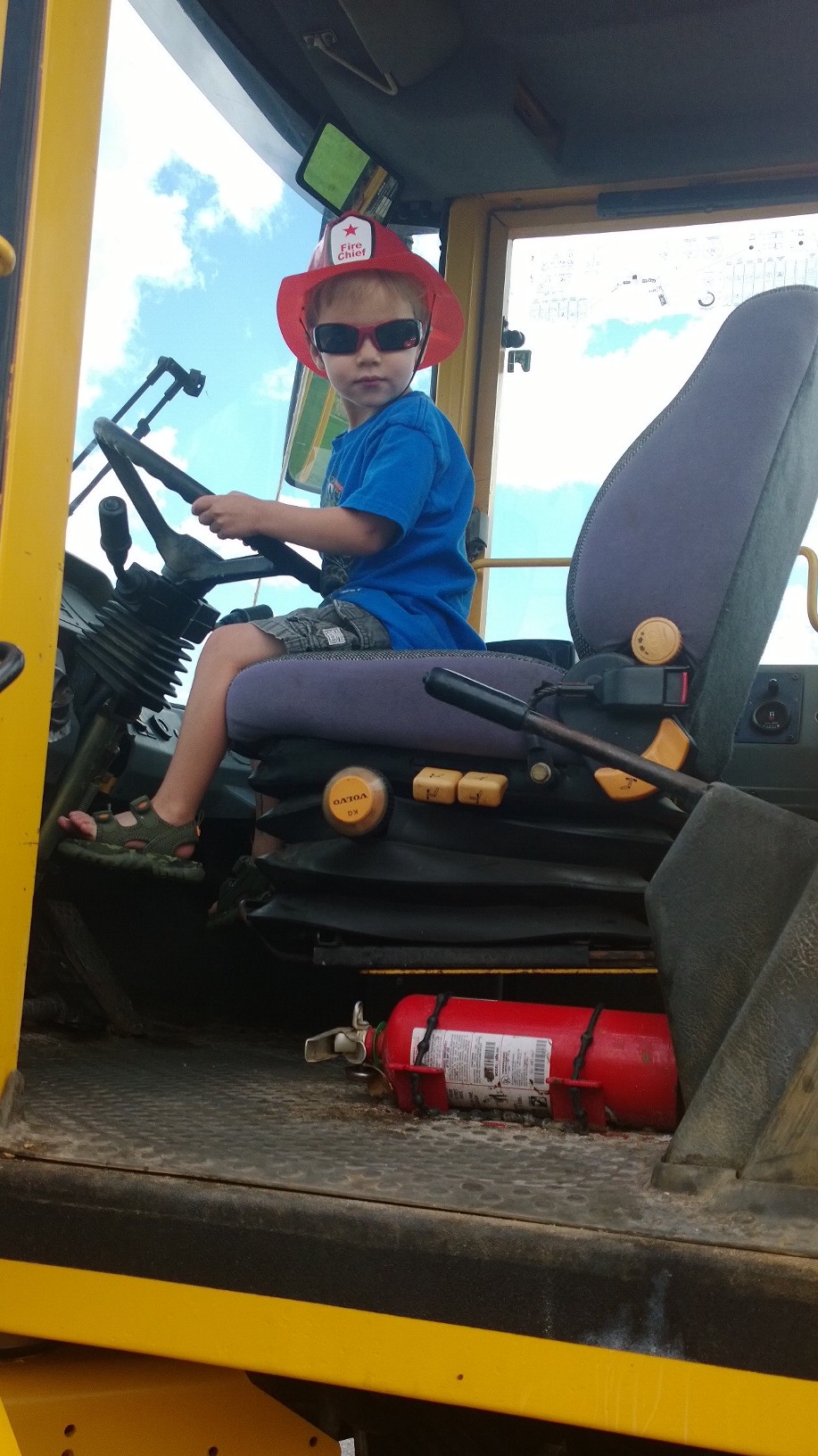
My grandson tried all the trucks. You can see that it’s fairly serious business.

051814-touch-a-truck

serious-truck-driver


checking-out-the-truck

Read Full Post »

A woman in my tai chi chuan class yesterday mentioned that she was taking her son to an “Instrument PettingZoo” this weekend to see if he could find an instrument he’d like to study.

What a great name for the event! With a title like that, no one needs to explain that the idea is to help children learn about different instruments — and have fun at the same time.

This weekend’s Instrument PettingZoo is at Powers Music School.

The school’s website provides some history:

“Powers Music School is a regional, not-for-profit institution established in 1964 to provide superior music instruction and performance opportunities to all interested students. Each year the School also provides musical outreach opportunities in the community through programs such as Belmont Open Sings, the Stein Chamber Music Festival, the Peter Elvins Vocal Competition, and the Mildred P. Freiberg Piano Festival.

“The founding principles, that all students are entitled to high quality musical instruction and that music is an essential part of our lives and belongs in the community, continue to guide the School today. During 2010-2011, the School worked with over 1,000 students who traveled from 50 surrounding communities. In addition, Powers gave over 70 student recitals/community performances.”

I love the school’s dual-meaning slogan, “A great place to play.”

Makes me realize my off-and-on-music education may have left out the playful side of “play.”

Photograph: PowersMusic.org

Read Full Post »

Older Posts »