Feeds:
Posts
Comments

Posts Tagged ‘koala’

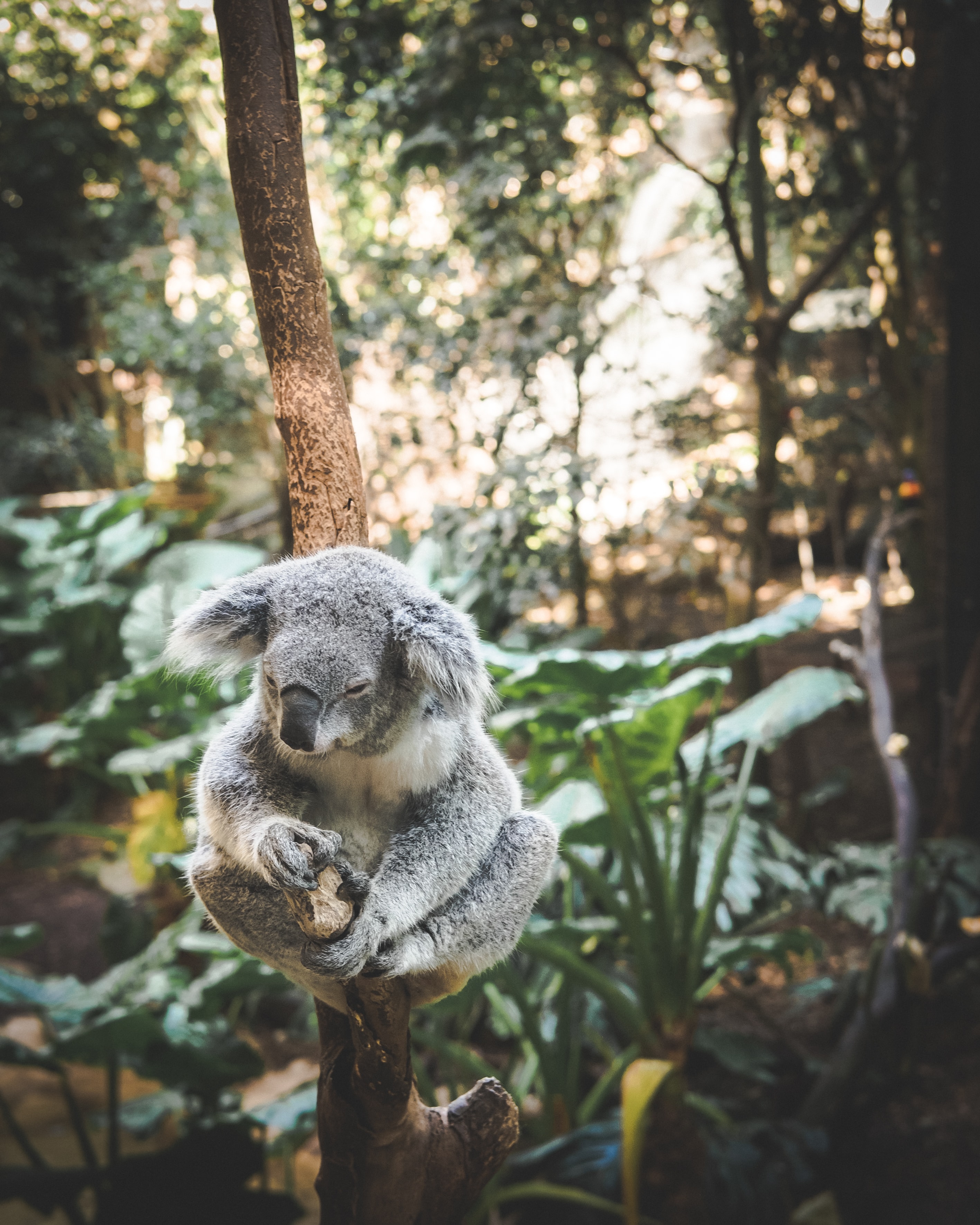
Photo: Daniel Norris via Unsplash.
Koalas, decimated by Australian bush fires in recent years, may be surviving at higher elevations than previously expected.

Researchers in Australia are trying to unravel a mystery about koalas in order to protect them. But some koalas may be doing OK on their own.

Michael E. Miller reports at the Washington Post that the scientists “had been stalking the remote, fire-scorched stretch of forest for an hour in the sizzling midday sun when Karen Marsh spotted something on the trunk of a tall mountain gum.

“ ‘Do you see all the claw marks?’ the ecologist asked a student research assistant, pointing to scratches in the wood above a blackened base. ‘Something definitely likes going up this tree.’

“Marsh peered up at the canopy of eucalyptus leaves, hoping to catch a glimpse of the animal she and a small team had spent weeks searching for — a koala. But one of Australia’s most iconic animals is getting harder to find.

“Two years ago, when bush fires supercharged by climate change killed or displaced an estimated 3 billion animals, thousands of koalas were among the dead. Between the blazes, drought, disease and deforestation, almost a third of the country’s koalas have disappeared since 2018, according to one conservation group. The federal government is weighing whether to label half the country’s koalas as endangered.

“The collapse is especially severe in New South Wales, where the bush fires destroyed 70 percent of some koala populations and a state inquiry warned that the species will probably go extinct before 2050 without urgent government intervention.

“Marsh and her colleagues had come to Kosciuszko National Park on a mission. For decades there had been speculation that koalas roamed its 1.7 million mountainous acres.

Now, with the 2019-2020 bush fires boosting funding and urgency, the scientists aimed to determine whether koalas were hiding in one of the country’s best-known wilderness areas.

“The discovery would do more than just increase the known number of koalas. It would also add to growing evidence that koalas can live at higher elevations, raising hopes that the marsupials might survive global warming better than feared.”

According to the Post, koalas were hunted nearly to extinction from the late 18th century to the early 20th. Even after hunting was outlawed, they “continued to suffer from a chlamydia epidemic and a habitat shortage as eucalyptus forests were paved for subdivisions. Although adapted to Australia’s frequent dry spells, the animals couldn’t cope with a climate-change-fueled drought in 2018 and 2019 that saw dehydrated koalas literally dropping from trees.

“Then came the Black Summer bush fires, which burned more than 20 percent of Australia’s forests. Marsh, a research fellow at Australian National University in Canberra, watched as the blaze roared to within a few hundred yards of her house. She and her colleagues began receiving calls from people who had rescued koalas, some badly singed but others simply emaciated.

“ ‘They were in awful condition,’ Marsh said of the roughly 30 koalas that ended up at the lab. As nocturnal animals, even a small rise in temperature can make koalas less hungry. But heat can also play havoc with a koala’s ability to break down the toxins in eucalyptus.

“While Marsh and her colleagues nursed the koalas back to health, they were pleased to see the notoriously picky eaters were able to consume some types of epicormic growth, the green shoots that sprout from burned eucalyptus trees and can be especially toxic. That enabled the researchers to release the animals into the scorched landscape a few months later. When they did, they were surprised to find that koalas that had survived in the bush were doing just as well.

“ ‘Essentially, they recovered by themselves in the wild,’ Marsh said, adding that the findings, though still provisional, suggest koalas that survive bush fires are less susceptible to starvation than feared. …

“Scientists have long speculated that the stunning wilderness surrounding Australia’s highest peak could harbor koalas, but a 1940 sighting was followed by decades of silence. Then, in 2016, a motorist spotted a male koala crossing a highway running through the park and snapped a picture. The incident sparked renewed interest, and in the past three years, National Parks cameras set up to detect invasive species such as foxes and deer in Kosciuszko have captured images of koalas on four occasions. …

“With the koala mating season ending this month, the researchers have only a few more weeks to search for the animals in Kosciuszko. But they are only now recording some of the most promising sites, and the first batch of audio files have already come back with lots of potential hits.” More at the Post, here.

Should we be worried that human activity, often the cause of devastation to the koala world, should be pushing into a sanctuary? Those humans better not be carrying anything flammable!
Read Full Post »

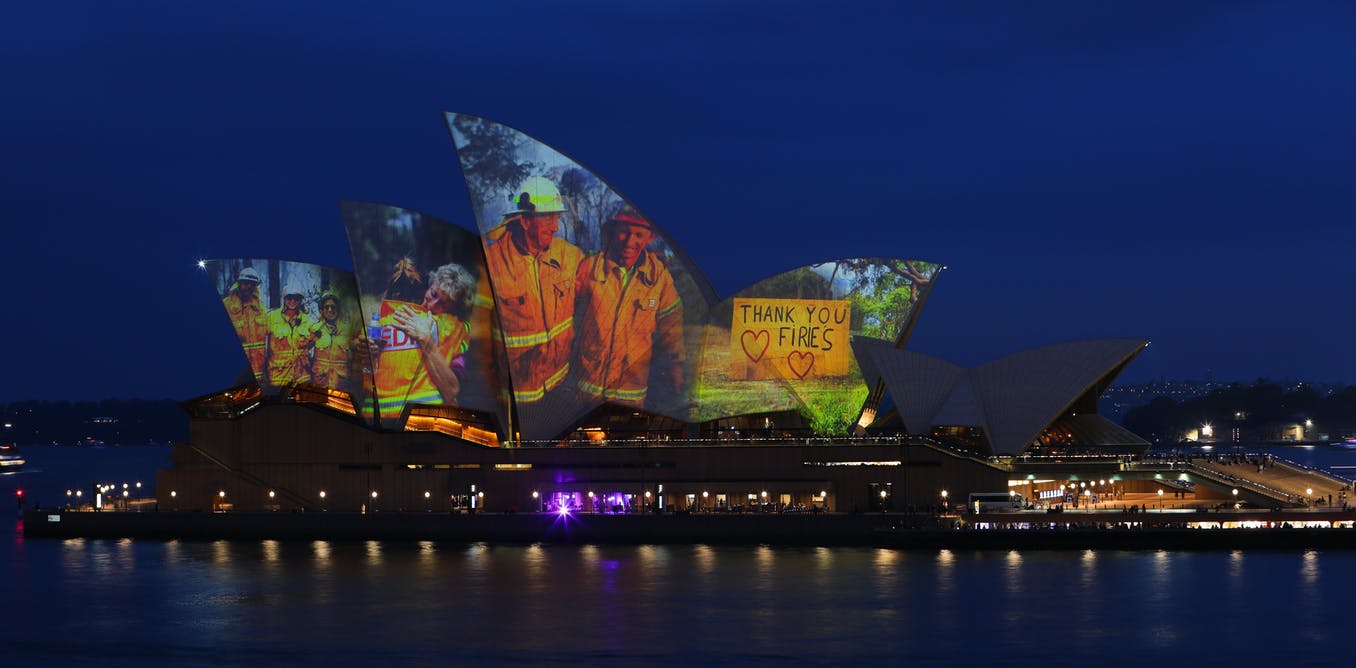
Photo: Paul Braven/ AAP.
Images in support of the men and women fighting devastating bushfires were projected onto the Sydney Opera House January 2020

Remember the massive fires in the Australian bush and all the terrified koalas? It wasn’t that long ago. Artists were among those who used their talents to raise funds in the aftermath. I think the opinion piece written for the Conversation in January 2020 about Australia foreshadows the many ways artists were destined to help during the international disaster we now refer to as Covid.

Jo Caust, associate professor at the University of Melbourne, wrote the op-ed because at the time, a government was treating the arts as a nice-to-have but unnecessary frill.

Caust wrote, “Artists are again finding themselves at the receiving end of criticism over funding.

“A mural on the wall of a fire station funded through the Western Australia Percent for Art scheme has met with a hostile reaction in the light of the bushfire crisis.

“In WA [Western Australia] all new public buildings costing $2 million or more must spend 1% of the building costs on public art projects – a bipartisan initiative since 1989.

“Public art plays an important role in connecting communities, humanizing the environment and giving a community a unique identity, but WA Shadow Minister for Emergency Services Steve Thomas told the ABC ‘I think it is time for this policy to end. [It] is more important to put that money into the equipment [emergency services] require rather than art work to decorate the building,’ he said.

“Artists are a critical community resource, but this criticism is a familiar refrain in Australia, where arts practice is seen as non-essential.

“The federal government determined in December 2019 the arts no longer matter to the nation by disappearing the arts from mention as a governmental responsibility and continuing to cut arts funding.

Across the country, the average income of artists from their artwork is A$18,800, yet artists have raised millions of dollars in support of the 2020 bushfire crisis.

“Comedian Celeste Barber has raised over $50 million from more than 1.2 million people to help those who need it. Pink, Elton John, Metallica, Nicole Kidman and Keith Urban, Chris Hemsworth, Kylie and Danni Minogue – to name only a handful – have personally donated large amounts of their own money to help fighters and victims.

“Visual artist Scott Marsh raised more than $60,000 by painting a mural in Chippendale. … The Stardust Circus prevented a blackout at the Ulladulla Evacuation Centre by lending their generator. Theatre companies are organizing collections at their performances for bushfire relief.

More than 32 concerts are taking place across the country with musicians giving their time for free to fundraise. Visual artists are auctioning their work. Writers, illustrators and editors are donating books, mentoring, and naming rights to characters in forthcoming books to support firefighters. …

“Art and artists can have a transformational role in rural communities by building resilience. Rural communities value their local history and artists can play an essential role in recording and validating a community’s culture.

“Arts institutions, such as regional galleries, can also have a dramatic impact on a community. In 2012, the Bendigo Art Gallery generated $16.3 million for the local economy. The Book Town festival in Clunes, the Writers Festival in Byron Bay and the Folk Festival in Port Fairy are all crucial to the sense of community in those towns.

“Artists can be critical in restoring hope and providing healing to a community after it has experienced trauma. The Creative Recovery Network works together with emergency management agencies across Australia to help communities affected by trauma and natural disasters to recover from their experiences. …

“While the arts can create provocation, they can also be a means of honoring feelings and processing grief. There are times when communities need more than financial relief to recover from loss. They need a way to make sense of it so they can move forward.

“Artists have stepped up in a huge way at this dark time in Australian history by volunteering their talents and resources to support communities and firefighters.

“They have demonstrated artists and arts practice can contribute to our society with passion, ingenuity, and imagination. It is time the arts and artists received the respect they deserve by our governments and the broader community.”

More at the Conversation, here.

Read Full Post »

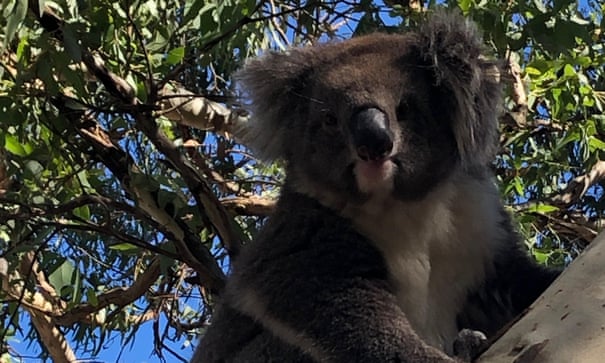
Photo: Nadia Tugwell.
After the koala caused a multi-vehicle crash by ‘stomping’ on an Australian freeway, Nadia Tugwell put it in her car and called for help. The koala played around with the car’s steering wheel while waiting for Adelaide Koala Rescue and was ultimately released at a safe distance.

It was only last summer, when bushfires raged through koala habitat in Australia, that the adorable marsupials were threatened with extinction (story). Here’s a recent article about one that got itself into a different kind of danger but stayed calm and carried on.

Josh Taylor reported at the Guardian, “A koala crossing one of South Australia’s busiest freeways has led to a six-car pile-up as drivers abandoned their vehicles to mount a rescue of the ‘calm’ marsupial.

“[South Australia] police confirmed the multi-car crash occurred on Adelaide’s South Eastern Freeway. … A male driver reportedly was the first person to stop his car to try to rescue the koala before 7am. His car was then hit from behind, causing a chain reaction.

“An Adelaide woman, Nadia Tugwell, was behind the pile-up and said at first she couldn’t tell what was causing the delay in traffic. … Then Tugwell saw the koala moving between the cars and a concrete barrier in the middle of the freeway.

“ ‘The koala was just cute … sort of stomping between the cars and the barrier. Then I saw a lady running behind it, trying to catch it with a blanket or something.’

“Tugwell grabbed a jacket from her car and also raced towards the koala.

‘When it saw me it instantly turned around to run backwards but the other lady was there and so we jumped it, bundled it up, and it ended up in my car because she had children,’ she said.

“Tugwell had previously rescued animals from other roads so she had the number for the Adelaide Koala Rescue centre saved in her phone. She arranged to meet them at a nearby service station.

“While she waited an hour for the rescuer to arrive, Tugwell said the koala made itself at home in her car, including on the steering wheel.

“ ‘I was sitting there entertaining myself but I had to jump out of the car at that stage when he decided to take over,’ she said. …

“ ‘He was actually quite a calm koala, he didn’t even fight about being in the bag, he was just calm and went into the basket,’ Tugwell said.

“The volunteer released the uninjured koala back into the wild a kilometre from the freeway.

“An Adelaide Koala Rescuer volunteer, Ann Bigham, told the ABC, … ”The koala was in really good condition, it was lucky it hadn’t been hit at all and thanks to the rescuers it was kept safe.’ “

Wouldn’t it be something to have that experience? I’d love to be a koala hero like Tugwell. Can’t see it happening in New England, though.

More at the Guardian, here.

Read Full Post »