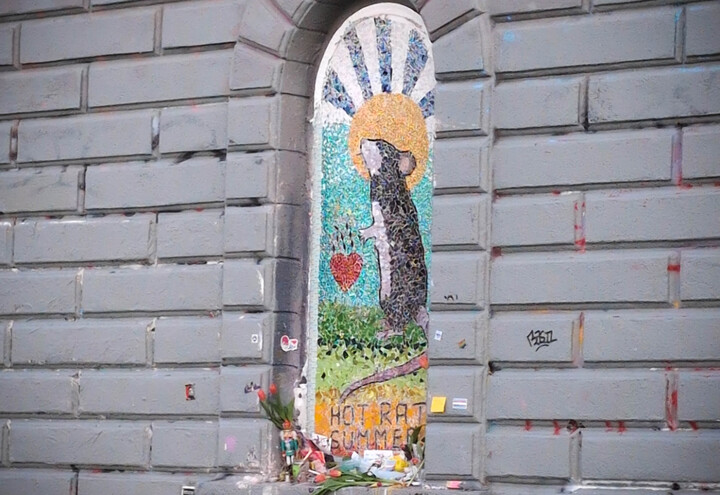
Photo: FoxyDonuts.
Seattle is making a game of loving rats.
Gotta love the kooky things people come up with. Today’s story is about people in the state of Washington who’ve decided there is a patron saint of rats. They call him St. Rat.
Nathalie Graham writes at the Stranger, “Heat waves shimmer along Pine Street. A rancid, somehow warm fishy smell wafts from Momiji’s dumpster, which is baking in the hot sun on 12th Avenue. The crumb rubber in Bobby Morris Playfield’s astroturf emits its own corona of heat, absorbing the sun’s rays. …
“Nearby, genderqueer youths balance on the concrete lip of the Cal Anderson Gatehouse scrubbing Hot Rat Summer, a pseudo-famous, pseudo-religious guerrilla mosaic of a rat with a halo. …
“Hot Rat Summer features St. Rat, a kind of patron saint for those at the bottom of the societal heap. … They leave offerings of doodles, flowers, and snacks at St. Rat’s feet. They protect the art and the saint within it.
“Last month, City Hall decided to protect Hot Rat Summer from bureaucracy, but that has not kept it safe from taggers, who’ve consistently spraypainted it. Ten days ago, it was a wash of black. …
“The taggers may not see the value of St. Rat, but the art and theology professors at Seattle University who spoke to the Stranger certainly did. They gave a few hot takes on this venerable rat.
“Ken Allen, an associate professor of Art History at Seattle University, strolled over to Hot Rat Summer to analyze it in person. For the scholar of West Coast art in the mid-20th century, the rat’s saintly halo evoked the Beatnik era and artist Joan Brown, part of a loose, bohemian artist collective in the mid-50s called the Rat Bastard Protective Association.
“These bastards ‘often used urban detritus in their assemblage and collage work,’ Allan wrote in an email. Brown, herself, often featured animals, including rats, ‘in a similarly dignified if not quite saintly way as in the Rat Summer piece.’ Take her various portraits of weird cats or The Bride, a painting of a beautiful cat in a wedding dress with a leashed pet rat (the groom?). Or the less sanctified Fur Rat, a rat sculpture made with chicken-wire and a raccoon fur coat.
“ ‘They would have admired the underground spirit of the anonymous artist of Rat Summer, no doubt,’ he continued.
“As would Beatnik writers like Jack Kerouac, who ‘idealized the poor and oppressed.’ …
“Dr. Kristin Doll, adjunct professor in Seattle University’s Department of Theology and Religious Studies, meditated quite a bit on the ‘Saint Rat’ figure central to Hot Rat Summer.
“Doll wrote in an email that she couldn’t attribute any intentional religious metaphors to the artist(s) because she did not know them, but says the work is full of symbols with a clear religious history that make for a ‘clever twist on tradition.’ She loved it.
“ ‘The creators of Hot Rat Summer are certainly creative, humorous, and they have injected a serious topic (protection of trans people and their rights) with tongue-in-cheek versions of traditional religious themes,’ she wrote. …
“Mosaics are common in religious art, Doll wrote, especially in the Eastern Orthodox tradition and in the Byzantine empire, which popularized the style. …
“St. Rat is not a saint. Cannonization is a lengthy, posthumous process analyzing a saint’s life for piety and holiness, plus a series of documented miracles. We don’t know if St. Rat is based on a real rat, if that real rat is dead or living. … This makes analyzing holiness hard.
“And, Doll points out, the Vatican formalized the process in the 12th century to prevent situations exactly like Saint Rat, or, as she explained, ‘the rise of a popular cult based on a figure that may not meet the Church’s standards of holiness.’ Worshippers of Saint Guinefort, a greyhound who became a folk saint in 13th century France, know what she’s talking about.
“Anyone who has been to Cal Anderson has seen the dog worshippers. Rats are not so well loved. We’re quicker to associate rats with garbage, plague, and excellent French cooking than we are to associate them with holiness. ‘A rat is a subversive image that challenges traditional notions of sanctity,’ Doll wrote.”
More at the Stranger, here, and on Instagram. Fun pictures at both sites.


 Suzanne's Mom's Blog