Feeds:
Posts
Comments

Posts Tagged ‘labor day’

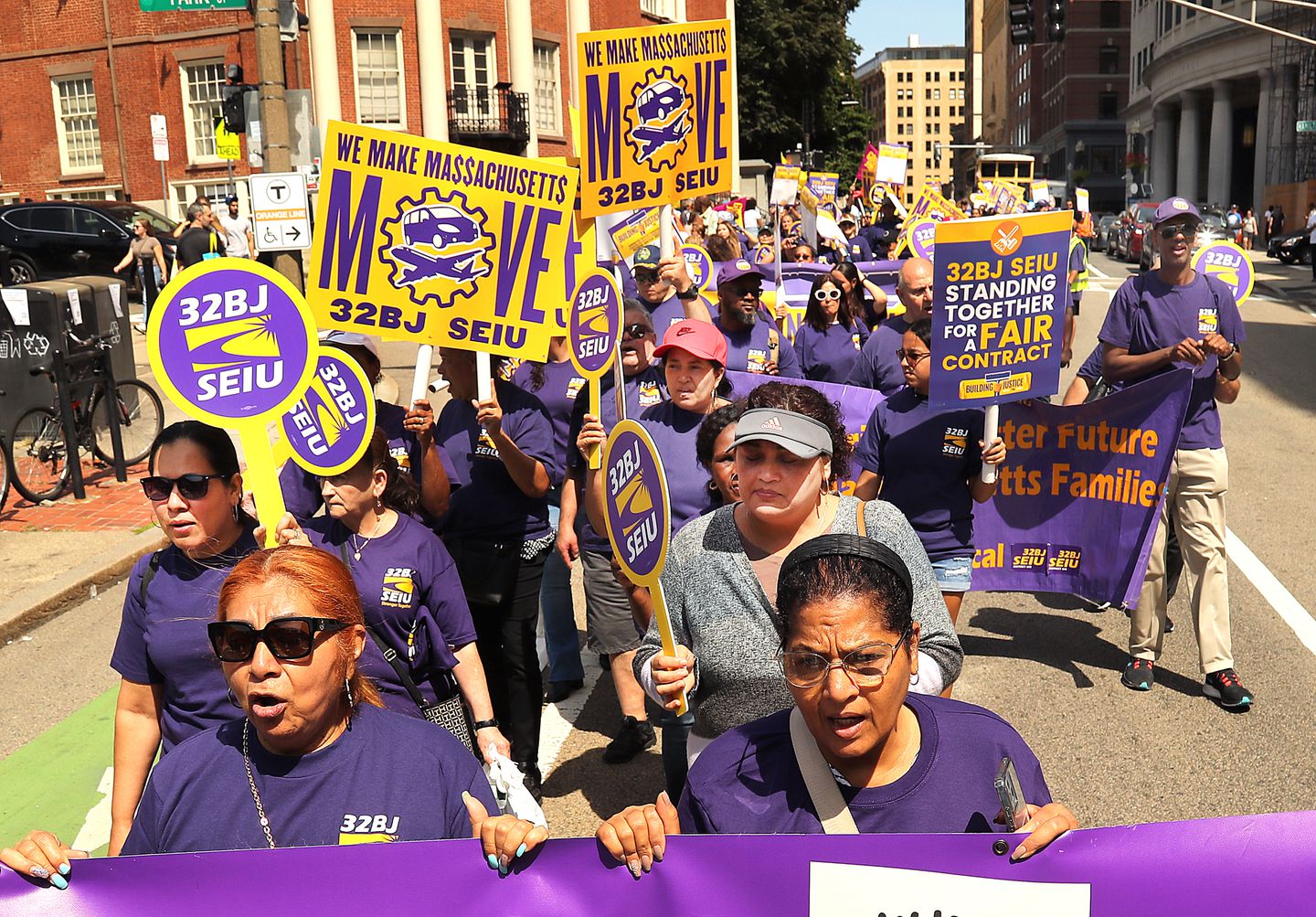
Photo: John Tlumacki/Globe Staff.
The Boston Globe reported recently on service workers marching “down Tremont Street to Boston Common, where they held a labor rally for new contracts and freedom to unionize.

As a member of the general public, I don’t like being inconvenienced by a labor strike any more than the next person. But I know my history. I know what life was like when workers couldn’t strike and how some gave their lives to change the status quo. So I think of that on Labor Day.

At the Boston Globe, John Hilliard wrote recently about service workers, who are among the last to band together for better working conditions. We need to stay as grateful to them as we were during the pandemic.

“Hundreds of essential workers — including janitors, airport staff, and ride-hailing drivers — marched through Boston’s streets Saturday demanding better post-pandemic workplace conditions after laboring to keep the economy afloat during the health crisis.

“The Labor Day weekend demonstration, organized by Local 32BJ of the Service Employees International Union, drew together service workers from across Greater Boston who are members, as well as some who are organizing to join the union, according to Roxana Rivera, a labor organizer and assistant to 32BJ president Manny Pastreich.

“ ‘This is a moment for workers, because they put so much of themselves out there during the pandemic. They didn’t have a choice to work remotely. Service workers risked their own personal health, and those of their families,’ Rivera said. ‘The fact that they still struggle to make ends meet is unacceptable.’ …

“Luis Medina, of Malden, who works full time as a janitor, said he joined the demonstration because he is fighting to secure full-time hours for colleagues struggling to make ends meet with part-time employment. …

“Saturday’s demonstration came amid a dramatic resurgence in labor organizing and activity across the country — from Starbucks workers seeking to unionize to Hollywood writers and actors now on strike — demanding better pay, benefits, and working conditions from employers.

“Among the successes are Teamsters and UPS workers who have secured new contracts through union efforts.

Support for labor unions in the US has soared, with roughly two-thirds of Americans now saying they approve of them, according to a Gallup poll released Wednesday.

“And demonstrators in Boston Saturday, like Marty, a 43-year-old from Plymouth who works as an Uber driver and gave only his first name, drew a direct line between union successes nationwide and efforts to support workers locally.

“ ‘We are really important, because we are the people who move the economy,’ said Marty, who wore a Screen Actors Guild shirt to support striking actors. ‘If no one is making any money, no one’s spending anything, [and] that’s when the economy starts to suffer.’

“Rivera said that even though many people now can work from home, commercial buildings must still be cleaned and maintained, while airport employees and ride-hailing drivers remain vital to keeping the economy going. ‘We need to make sure that we are not leaving these workers behind,’ Rivera said. …

“Waitstaff and food service workers at restaurants along the route gathered at doors to watch the protesters. One worker left her restaurant, asked a union representative for a flyer being handed out and took it back inside.

“The city was packed with people enjoying a beautiful end-of-summer Saturday, and throngs watched from sidewalks, many taking photos with their phones. Several raised their arms in support, and one man on a scooter beeped his horn as he rode along Tremont Street.

“Elizabeth Hill-Karbowski, who was visiting Boston with family from Wisconsin, watched as demonstrators marched along Tremont Street and read from a flyer.

“ ‘It’s a timely type of demonstration for the Labor Day weekend, very peaceful, well organized and [it is] people just wanting to have their voices heard,’ Hill-Karbowski said. …

“State Senator Lydia Edwards, whose district includes East Boston, Revere, and Winthrop, spoke to workers in Spanish then English. …

“ ‘We celebrate all the victories that we have had, but also we need to remember the lives that we’ve lost in the fight for justice, and the lives that you have saved as workers’ during the pandemic, Edwards said.

“Ed Flynn, Boston City Council president, told the crowd: ‘When workers aren’t receiving a decent wage here in the most liberal, progressive city in the country, there’s something wrong with that.’ ”

More at the Globe, here.

Read Full Post »

Image: York Notes.
York Notes, a literature guide, says, “Bob Crachit is Scrooge’s clerk and represents the lower classes. He has to accept poor wages and working conditions because he has a family to support.”

I was thinking about Labor Day and remembering that in many of my favorite novels Dickens wrote with passion about the working conditions of the poor. He had himself worked in a blacking factory as a child when his father was in debt, and few topics were more likely to spark his outrage.

John Broich, an associate professor at Case Western Reserve University, wrote at Time that Dickens decided Scrooge, his hard-working clerk Bob Crachit, and the half-starved Tiny Tim would have more impact on the big issue of the day than the political pamphlet he’d been planning.

“Published 173 years ago this month,” Broich writes, “Charles Dickens’ A Christmas Carol was an instant bestseller, followed by countless print, stage and screen productions. … But A Christmas Carol’s seemingly timeless transcendence hides the fact that it was very much the product of a particular moment in history, its author meaning to weigh in on specific issues of the day.

Dickens first conceived of his project as a pamphlet, which he planned on calling, ‘An Appeal to the People of England on behalf of the Poor Man’s Child.’

“But in less than a week of thinking about it, he decided instead to embody his arguments in a story. … So what might have been a polemic to harangue, instead became a story for which audiences hungered.

“Dickens set out to write his pamphlet-turned-book in spring 1843, having just read a government report on child labor in the United Kingdom. The report took the form of a compilation of interviews with children — compiled by a journalist friend of Dickens — that detailed their crushing labors.

“Dickens read the testimony of girls who sewed dresses for the expanding market of middle class consumers; they regularly worked 16 hours a day, six days a week, rooming — like Martha Cratchit — above the factory floor. He read of 8-year-old children who dragged coal carts through tiny subterranean passages over a standard 11-hour workday. These were not exceptional stories, but ordinary. Dickens wrote to one of the government investigators that the descriptions left him ‘stricken.’

“This new, brutal reality of child labor was the result of revolutionary changes in British society. The population of England had grown 64% between Dickens’ birth in 1812 and the year of the child labor report. Workers were leaving the countryside to crowd into new manufacturing centers and cities. Meanwhile, there was a revolution in the way goods were manufactured: cottage industry was upended by a trend towards workers serving as unskilled cogs laboring in the pre-cursor of the assembly line, hammering the same nail or gluing the same piece — as an 11-year-old Dickens had to do — hour after hour, day after day.

“More and more, employers thought of their workers as tools as interchangeable as any nail or gluepot. Workers were becoming like commodities: not individual humans, but mere resources, their value measured to the ha-penny by how many nails they could hammer in an hour. But in a time of dearth — the 1840s earned the nickname ‘The Hungry ‘40s’ — the poor took what work they could arrange. And who worked for the lowest wages? Children.

“Popular theories about how — or whether — to help the poor often made things worse. The first was the widespread sense that poor people tended to be so because they were lazy and immoral, and that helping them would only encourage their malingering. If they were to be helped, it should be under conditions so awful as to discouraged people from seeking that help. The new workhouses were seen as the perfect solution — where families were split up, food was minimal and work painful. ‘Those who are badly off,’ says the unreformed Scrooge, ‘must go there.’

“Associated with this concept were the ideas of Rev. Thomas Malthus, who cautioned against intervening when people were hungry because it would only lead to an untenable population size. Better that the poor should starve and thus ‘decrease the surplus population.’ …

“Friedrich Engels read the same report on child labor that Dickens did and, with his collaborator Karl Marx, envisioned an eventual revolution. Dickens was very much an anti-revolutionary. In fact, he implied that [revolution] was the fearsome consequence of not solving the problem some other way.

“ ‘This boy is Ignorance. This girl is Want. Beware them both, and all of their degree, but most of all beware this boy, for on his brow I see that written which is Doom, unless the writing be erased.’ …

“Dickens wasn’t a ‘systems’ thinker, nor was he proto-socialist. Yet what Dickens did propose in A Christmas Carol … was that employers are responsible for the well-being of their employees. Their workers are not of value only to the extent to which they contribute to a product for the cheapest possible labor cost. They are of value as ‘fellow-passengers to the grave,’ in the words of Scrooge’s nephew, ‘and not another race of creatures bound on other journeys.’ Employers owe their employees as human beings — no better, but no worse, than themselves.

“And, yes, that might mean ‘a prize Turkey’ at Christmas … but the real salvation that Scrooge gives to the Cratchit family is a raise.

“As Scrooge and the Ghost of Christmas Past watch Tim, his father holding his [hand], the miser pleads, ‘say he will be spared.’ The ghost reminds readers of Scrooge’s Malthusian quote. ‘If he be like to die, he had better do it, and decrease the surplus population.’ ” More at Time.

Today we know that most of the labor benefits we have today, including the Monday holiday in America, were not handed down by benevolent company owners but were wrested from them by workers and unions.

You can read that history at Wikipedia, here. Even so, I do think stories help prepare a population to accept change — to recognize that the way things are is not always the best way.

Read Full Post »

df59b7bbd4c1a071922f705dbbf5f485

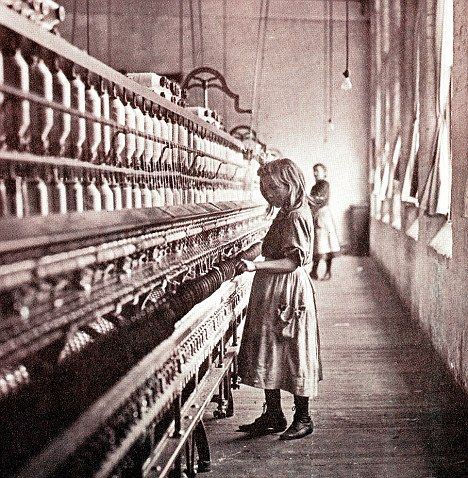
Before the rise of unions and child labor laws, it was common to see scenes like the one above showing a young girl working with dangerous textile machines in Lowell, Massachusetts.

The pendulum has swung too far away from workers. Just my view. There was a time that unions had built up power to the point of abuse. That’s not where we are now. We have all benefited from people banding together to fight deadly working conditions, end child labor, and negotiate a living wage.

Ideally, it would be corporate leaders themselves who recognized that everyone is better off when employees have a decent life. How likely are we to see such leaders today? Too many parents work two or three jobs while their children still don’t eat well without the free lunch at school. CEOs’ attitude: Not my problem.

But wait! There’s news.

Ben & Jerry’s leaders may be outliers. Of course, it took worker activism, but a good-faith effort led to positive results for all.

As John Dillon reports at Vermont Public Radio, “Some Vermont dairy workers say their wages and living conditions have improved, thanks to an agreement reached last year between the workers and Ben & Jerry’s, a division of global consumer products company Unilever.

“Times are tough on dairy farms around the country, with milk prices declining for the fourth year in a row. But 72 farms that supply Ben & Jerry’s earn a little more by agreeing to follow labor and housing standards.

“Enrique Balcazar is a former dairy farm worker and an activist with the group Migrant Justice who helped negotiate an agreement last year called Milk with Dignity. …

” ‘There are farmworkers in the state who, in collaboration with their farmers and with support from the Milk With Dignity Standards Council, are now receiving a day off every week when they previously didn’t have one, who are receiving wages to bring their wages up to the Vermont minimum wage,’ he says. …

“Farms enrolled in the Milk with Dignity program also commit to providing five annual paid sick days, five paid vacation days and to meet housing health and safety standards.

“Farmers get a premium for following these standards, but it’s not clear how much. …

” ‘Ben & Jerry’s is paying the premium because we recognize a lot of farmers will need some of the financial support to improve housing conditions or to make up for the vacation days that they’re going to provide workers,’ [Cheryl Pinto, manager of values-led sourcing at Ben & Jerry’s,] says. …

“The Milk with Dignity program covers all farmworkers whose farms are enrolled — and not just undocumented workers who work on many of Vermont’s dairy farms. … Migrant Justice says the program is a model for other dairy processors.”

How about you consider Ben & Jerry’s if you are buying ice cream or frozen yogurt for your Labor Day party? Cherries Garcia, Moo-phoria, anyone?

More at Vermont Public Radio, here.

Read Full Post »

I Hear America Singing

By Walt Whitman

I hear America singing, the varied carols I hear,
Those of mechanics, each one singing his as it should be blithe and strong,
The carpenter singing his as he measures his plank or beam,
The mason singing his as he makes ready for work, or leaves off work,
The boatman singing what belongs to him in his boat, the deckhand singing on the steamboat deck,
The shoemaker singing as he sits on his bench, the hatter singing as he stands,
The wood-cutter’s song, the ploughboy’s on his way in the morning, or at noon intermission or at sundown,
The delicious singing of the mother, or of the young wife at work, or of the girl sewing or washing,
Each singing what belongs to him or her and to none else,
The day what belongs to the day—at night the party of young fellows, robust, friendly,
Singing with open mouths their strong melodious songs.

090116-working-on-the-railroad

Read Full Post »

Do you remember seeing a René Magritte painting called “Ceci n’est pas une pipe”? It took me a while to get what he meant. It was a picture of a pipe, after all. Why would he call it “This is not a pipe.”

(Oh, right. It’s not a real pipe. You can’t fill it with tobacco. You can’t smoke it.)

In the same spirit, I am posting pictures of not-summer.

On a warm July day, I took my photos of blue skies, beach paths, and small boats, and the next thing I knew we were having a Labor Day clambake. Within two days, summer was over, and a curtain of cold, windy rain descended. Along with the September mindset, my husband says.

Ceci ne’est pas l’été. Au revoir.

Read Full Post »

Back before “labor” became a dirty word in the minds of some politicians, “workingmen” were more appreciated.

A corporation might even honor workers in the architecture of a headquarters. (Note the photo taken in Boston’s financial district.)

These days, looking around the subway at the tired bodies heading home at night, I’ve begun to think of almost everyone as the workingman. All but a few folks who are very well off. There is hardly anyone in the middle anymore.

The people slogging back and forth, doing whatever they have to do, are unconscious of a kind of heroic aura that envelops them collectively. You can see it if you look.

Read Full Post »