Feeds:
Posts
Comments

Posts Tagged ‘late in life’

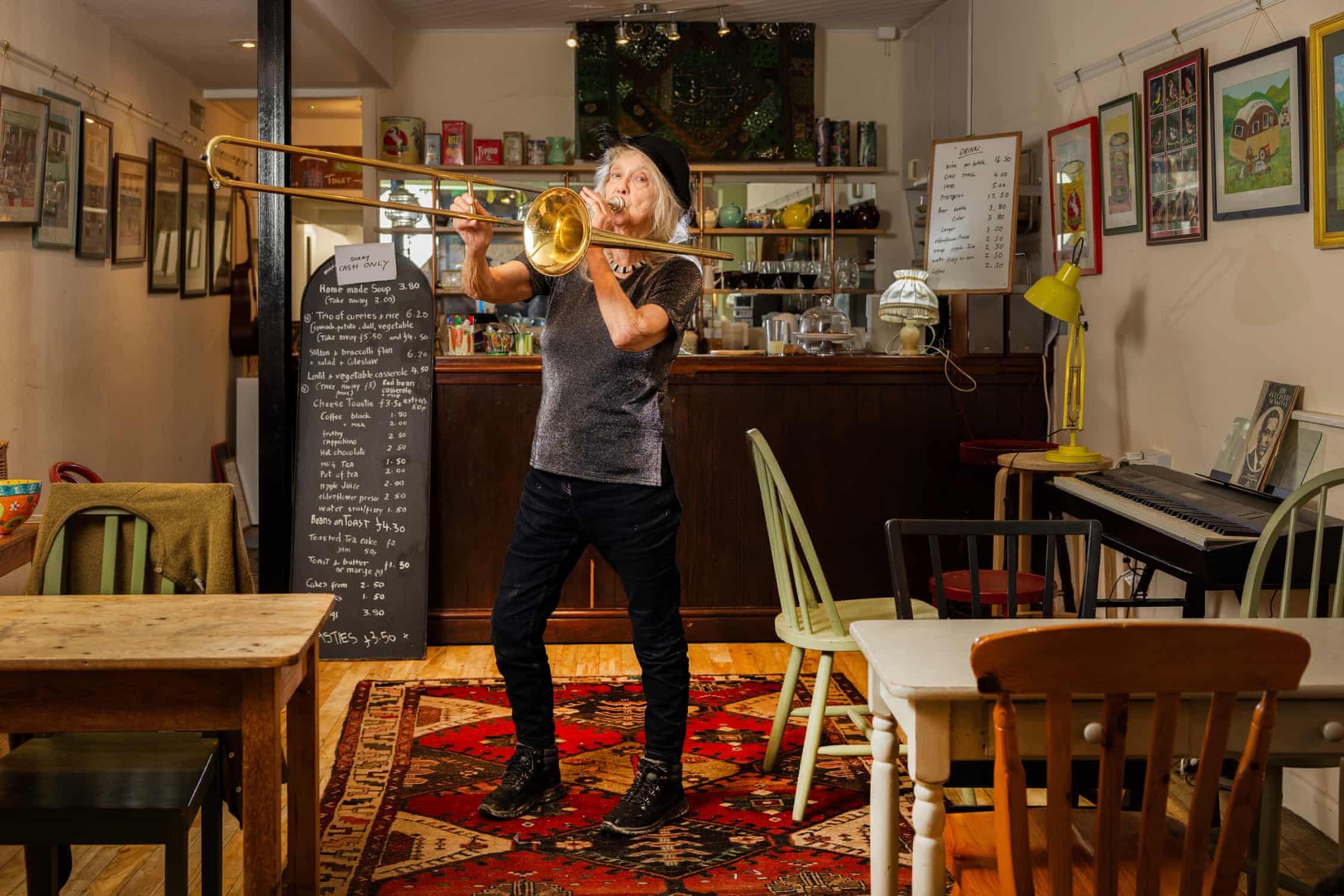
Photo: Fabio De Paola/The Guardian.
Eighty-four-year-old Noreen Davis took up trombone at 72 and never looked back.

Where I live now, it’s nice to see people taking up some pursuit that always interested them but seemed out of reach. For example, there’s a retired radiologist across the hall whose wife is an artist whose work he has always admired. Nowadays, he’s throwing himself heart and soul into some high-level art classes here and is doing an impressive job.

Today’s story is similar. It starts with a woman in the UK Midlands paying attention to a dream she had when she was sound asleep.

Ammar Kalia writes at the Guardian, “Twelve years ago, Noreen Davies had a dream. In it, the artist and cafe owner, then 72, saw herself wielding an unusual instrument. ‘There was a jazzy tune on in the background and I was playing along on a trombone, bending the notes and having a great time,’ she says. ‘When I woke up, I knew I had to learn it.’

“She headed to her cafe in Leominster, Herefordshire, and had a [routine] meeting with her accountant. ‘At the end, I asked him if he knew anyone with a trombone I could try out and he said he had five! Turns out he played in a local brass band with his wife, so he ended up bringing one round to me, along with an old music book on the instrument, and that’s how it all started.’

“Now 84, Davies has gigged throughout the West Midlands with groups exploring everything from the blues to vintage jazz and big band funk. No matter the tune, she has stayed true to her vision of bending the notes on the giant horn, twisting and wailing like a held string on an electric guitar. ‘I’ve only had two lessons and in the first one the teacher told me to just play what was written, but I do whatever I want to,’ she says. ‘I use it more like a percussion instrument, improvising over the tunes.’

“The trombone is notoriously difficult to learn, since players have to judge the distance between notes by pulling and pushing its tubing, rather than pressing fixed keys. Davies, though, found the instrument easy, thanks to her musical history. At 14, she took up the guitar and taught herself to play chords with her younger brother. ‘I forced him to play along with me. I taught myself the piano, too, by working out songs I liked listening to,’ she says. …

“Davies’ confidence to play live grew through hosting monthly music nights at the cafe, including a jam session with Ric Sanders of Fairport Convention, although she faced a setback when a series of operations on her lungs meant she was unable to play for several months.

“One evening in 2018, when she had regained her strength, she went along to a jam session in nearby Bromyard and met two young musicians who were looking for a trombone to round out their trio. Luckily, she had hers in the boot of her car in case such an opportunity arose. ‘We did a few numbers together and they ended up adopting me,’ she says. ‘We played for a couple of years, until Covid. It was great fun.’

“The open world of jam sessions and gigs has since led Davies to more instruments. She is back on the piano and has added the accordion, the washboard and the baritone ukulele. ‘I ended up in a vintage jazz band because they needed a washboard player and I was the only one who took it up in the local area. I also play Bob Dylan tunes on the ukulele and I’m trying to learn some Cole Porter on the accordion,’ she says. … ‘Everyone should try it out – just get yourself to a jam session somewhere and see what happens.’ “

More at the Guardian, here.
Read Full Post »

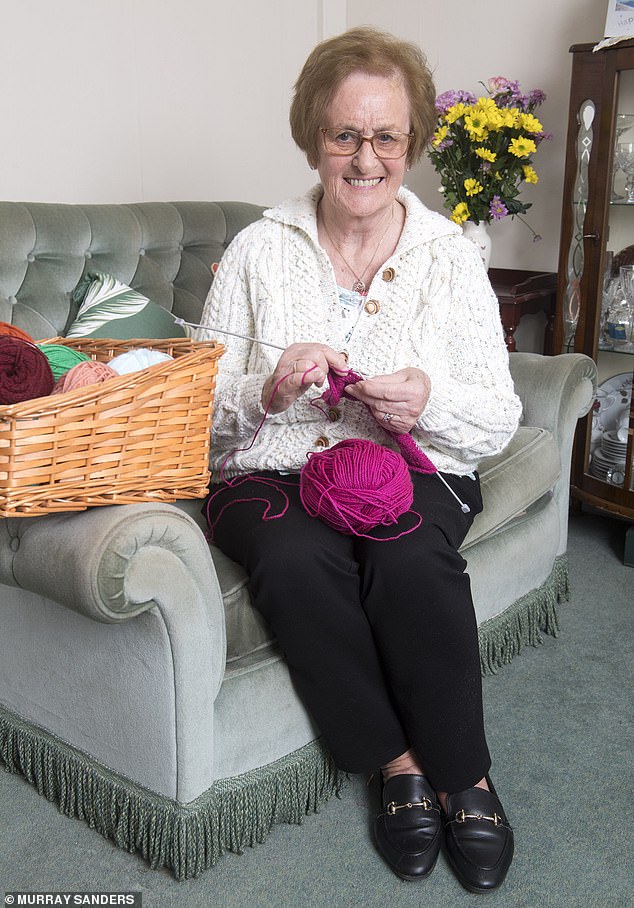
Photo: Murray Sanders via the Daily Mail.
Delia Barry, an 83-year-old widow from Greystones, County Wicklow, started knitting classes to improve her skills for a cancer charity after her husband of 48 years died suddenly in 2010. Now she’s a knitter to the stars.

How many ways are there to love this story? An Irish woman gets serious about knitting late in life and becomes so highly skilled that she’s in demand. An acclaimed movie director’s team seeks her out to make sweaters (“jumpers”) for actors in a film that turns out to get an Oscar nomination. She has to watch the movie twice because the first time, she is only looking at the sweaters. And when the New York Times calls, she says to call back because she’s playing bingo!

Lou Stoppard reports at the Times, “When I first contacted Delia Barry, she asked to be called back later. It was a Wednesday afternoon in Greystones, Ireland, where she lives, and she was playing bingo. ‘It’s just more of a social gathering for local senior citizens, which I am one of,’ Ms. Barry, 83, said by telephone.

“When not at bingo, Ms. Barry is usually knitting. Four of her sweaters appear in the Oscar-nominated film The Banshees of Inisherin, which is set on a fictional island in 1923, toward the end of the Irish civil war. These include a navy roll-neck and a red pullover with a distinctive long collar, both worn by Colin Farrell; a thick blue knit worn by Brendan Gleeson; and a purplish ribbed fisherman’s sweater worn by Barry Keoghan. Esquire U.K. called Banshees the “Next Great Knitwear Film.”

“ ‘It’s pure madness,’ she said of the attention. ‘I’ve knitted so many jumpers, they are just another jumper to me.’ She hopes to see the film a second time soon, she said, to better appreciate the acting and Martin McDonagh’s direction. ‘When I went the first time, I was just looking for the knitwear,’ she said.

“Ms. Barry learned to knit at school in Cahir, County Tipperary, at age 7. As a teenager, she made her own clothes, trying out new patterns, perfecting shapes. At 20, she moved to London with her future husband and worked in a telephone factory. More than a decade later, they returned to Tipperary, where Ms. Barry worked in a bar before moving to her husband’s birthplace of County Wicklow, where the town of Greystones is. …

“Ms. Barry knitted throughout her marriage, she said, but her commitment grew when her husband died in 2010, and she began knitting to raise funds for Greystones Cancer Support. ‘They were very good when he was diagnosed,’ she said. She donated a portion of her film earnings to the organization. …

“On an average week, Ms. Barry rises at 6 a.m. and knits until 8:30 a.m. She always knits in the same spot — on her sofa, with the light from the window behind her. At 9:30, she goes for a walk to the beach with a friend, about two miles away. She has never owned a car, she said, and has walked everywhere her whole life. …

“Back home, she’ll knit for another three to four hours. She’ll take a short break for dinner, then knit throughout the evening. ‘I get up and walk around every so often,’ she said. … ‘When you’re living on your own, it’s nice to have something to do.’ she said. …

“Eimer Ni Mhaoldomhnaigh, the film’s costume designer, commissioned Ms. Barry to create the sweaters. After the release of the movie, Ms. Ni Mhaoldomhnaigh recalled, ‘My daughter, who is 20, came and said Delia is a TikTok sensation.’

“Ms. Ni Mhaoldomhnaigh came across Ms. Barry’s work when she was sourcing knitwear for a 2017 television adaptation of Little Women. A woman working on the production knew that Ms. Barry had helped on other films, including Dancing at Lughnasa, for which she created knitwear for Meryl Streep’s character.

“ ‘Ireland is very small,’ Ms. Ni Mhaoldomhnaigh said, laughing. ‘It’s all word of mouth.’

“Ms. Barry credits her success to being willing to take on a job without a pattern, something many knitters would be wary of. For The Banshees of Inisherin, Ms. Ni Mhaoldomhnaigh provided photographs of Irish fishermen from the 1920s, which Ms. Barry studied with a magnifying glass. One showed a sweater with a distinctive long collar, the inspiration for the red piece that would become Mr. Farrell’s. …

“Once each item was complete, it went to the aging department, where pieces are dyed and distressed. ‘People think they just take a cheese grater to it, but it’s not as simple as that,’ Ms. Ni Mhaoldomhnaigh said. She sees the process as a means of communicating subtleties about a character — somebody who walks purposefully with their hands wedged in their pockets, somebody who gets nervous and wipes their hands on the front of their clothing.”

More at the Times, here. For the story at the Daily Mail, here, there is no firewall.

Read Full Post »

Photo: AP via News10.
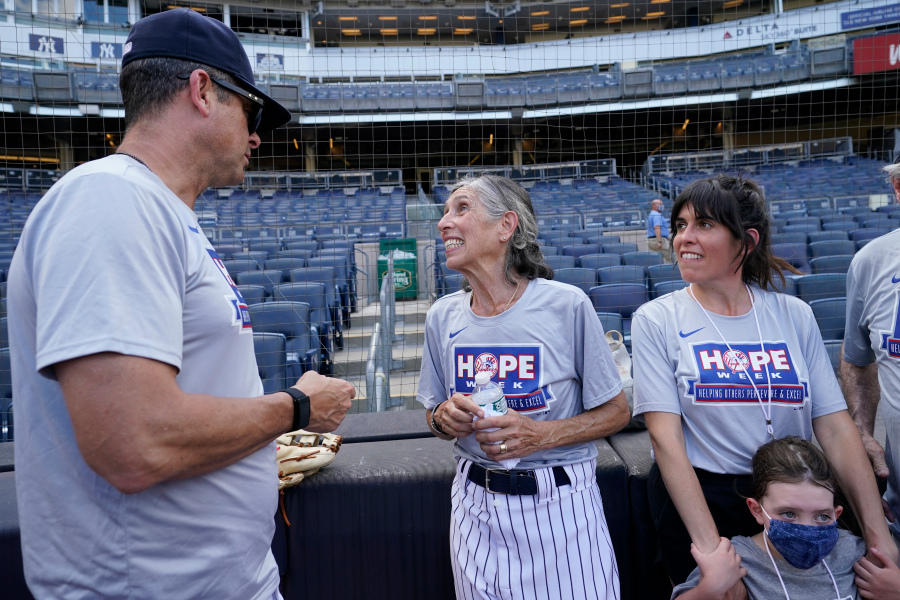
It only took 60 years to fulfill a dream of being a Yankees bat girl! Fortunately, the young lady still has the same dream.

John knew I’d like this story about a grandmother achieving a late-in-life dream. ESPN was among many outlets that carried it.

“Gwen Goldman exchanged fist bumps with the New York Yankees, whom she had been admiring for decades from afar, walked onto the field and waved to the crowd.

“She got to be a Yankees’ bat girl on Monday night at age 70 — a full 60 years after she was turned down because of her gender.

“Shaking with excitement, she beamed while recounting how it felt to be at Yankee Stadium on this day for the game against the Los Angeles Angels. …

” ‘From walking in the front door of the stadium at Gate 2, to coming up to a locker with my name on it that said “Gwen Goldman” and suiting up, then walking out onto the field,’ she said. ‘It took my breath away. … It was a thrill of a lifetime — times a million. And I actually got to be out in the dugout too. I threw out a ball. I met the players. Yeah, it goes on and on. They had set up a day for me; that is something that I never would have expected.’

“Goldman retired in 2017 as a social worker at Stepping Stones Preschool, a public school in Westport, Connecticut.

“She used the Hebrew word ‘dayenu’ — which translates to ‘it would have been enough’ — to describe the different parts of her experience.

” ‘It just kept coming and coming,’ she said.

“Goldman had been rejected by then-Yankees general manager Roy Hamey, who wrote her in a letter on June 23, 1961: ‘While we agree with you that girls are certainly as capable as boys, and no doubt would be an attractive addition on the playing field, I am sure you can understand that it is a game dominated by men. [A] young lady such as yourself would feel out of place in a dugout.’

“Current Yankees general manager Brian Cashman said he had been forwarded an email written by Goldman’s daughter, Abby. In a letter dated June 23, 2021, Cashman wrote, ‘… it is not too late to reward and recognize the ambition you showed in writing that letter to us as a 10-year-old girl.’

” ‘Some dreams take longer than they should to be realized, but a goal attained should not dim with the passage of time,’ Cashman added. ‘I have a daughter myself, and it is my sincere hope that every little girl will be given the opportunity to follow her aspirations into the future.’

“Wearing a full Yankees uniform, Goldman threw out a ceremonial first pitch to New York player Tyler Wade, then stood alongside manager Aaron Boone for the national anthem.

” ‘I think it’s really cool,’ Boone said. … ‘Hopefully, it’s an experience of a lifetime.’ …

“New York extended the invitation as part of the Yankees’ annual HOPE week, which stands for Helping Others Persevere & Excel.

“Goldman posed with the umpires when the lineup cards were brought out. After the third inning, the Yankees played a video that included the letters. … She then was introduced to the crowd, walked up the Yankees dugout steps and onto the field, and waved her cap as fans applauded.”

More at ESPN. Also at the Washington Post.

Read Full Post »

Back in January, I read Michelle Herman’s Slate column about taking up ballet late in life, and I’ve been wondering if she’s kept it up during the pandemic. Even professional ballet dancers have found it challenging to practice.

Here is how Herman got into ballet at age 62.

“The dance studio had just opened on my corner — I didn’t even have to cross a street to get there. So what I asked myself was just how lazy I would have to be not to try a class. I had fond, if vague, childhood memories of the weekly modern dance classes I took for five or six years at the famous Marjorie Mazia School in Brooklyn. …

“It had left its mark: The thought of a dance class did not fill me with despair or fury the way a Pilates class or the contemplation of a gym membership would have. Plus, I enjoyed dancing at parties. So maybe this would be fun, I told myself. Maybe I wouldn’t hate it.

“I didn’t hate it. I didn’t hate it so much that almost right from the beginning I was in tears. … There is no reason it should have felt so right to have one hand on the barre as I extended a foot that I was concentrating very hard on simultaneously turning out and pointing — concentrating not only on that pointed foot, but also on muscles throughout both that leg and the other leg, the one that was supposedly just standing still. And on my right arm in second position.

“I believe what happened that day was that I fell in love.

“There were only four of us in the room that first day. Three students (two old, as in over 50, and one young, as in under 20) and Filippo Pelacchi, the teacher (who was very young himself, although not in dancer years—he had just turned 28).

“If I cannot recreate every one of the 75 minutes of that first adult beginner class I took in the summer of 2017, it’s because by now I’ve spent approximately 84,000 more minutes in that studio—that is, 1,400 hours, something like 950 dance classes plus rehearsals for performances, and those minutes run together in my mind. But I do know this—that in that very first class, …  I had a moment of what seemed like perfect clarity: My body and my mind were working as one. …

“I’m a writer and a teacher, so all my work is mental work. But in ballet there was what seemed to me a remarkable twist: I was living that mental work in my body. In my body — with which, even more remarkably (even more improbably), I was making art. …

“In ballet, there is no separating the body and the mind. I have to think hard to create the shapes, to make the movements, of ballet. Even standing still in first position — which to the observer doesn’t look like anything — requires the engagement of muscles that will not turn on without my express command, muscles that do not engage reflexively the way my muscles do when going about ordinary tasks. There is nothing ordinary, nothing of the daily life, about ballet. …

“And there is this: Almost from the start I saw that ballet would fulfill a longing I’d had as far back as I could remember, a longing that accounts for the pleasure I take in hosting and leading a Passover Seder although I am a firmly nonbelieving Jew. …

“Sometimes the ballet advice sounds a lot like life advice.

  • Build a solid structure, Filippo tells us, and then find the open spaces where you can experiment, be yourself, and make it your own.
  • With stability comes freedom. If you are strong in your center, the rest can move freely around it.
  • Everything is connected. Everything you do is informed by what you have done before.
  • Commit to the transitions, he urges us. Even though they are not the highlights, they are the platform for the highlights.
  • And: No matter what happens, stay in it. Even if you forget or make a mistake, keep moving. “Here I am!” Own it. And then find your way back in.
  • Search every moment for what is there. Especially in the pauses, you have time to find something new, the next thing.”

More at Slate, here.

Art: Natalie Matthews-Ramo

Read Full Post »