Feeds:
Posts
Comments

Posts Tagged ‘latino’

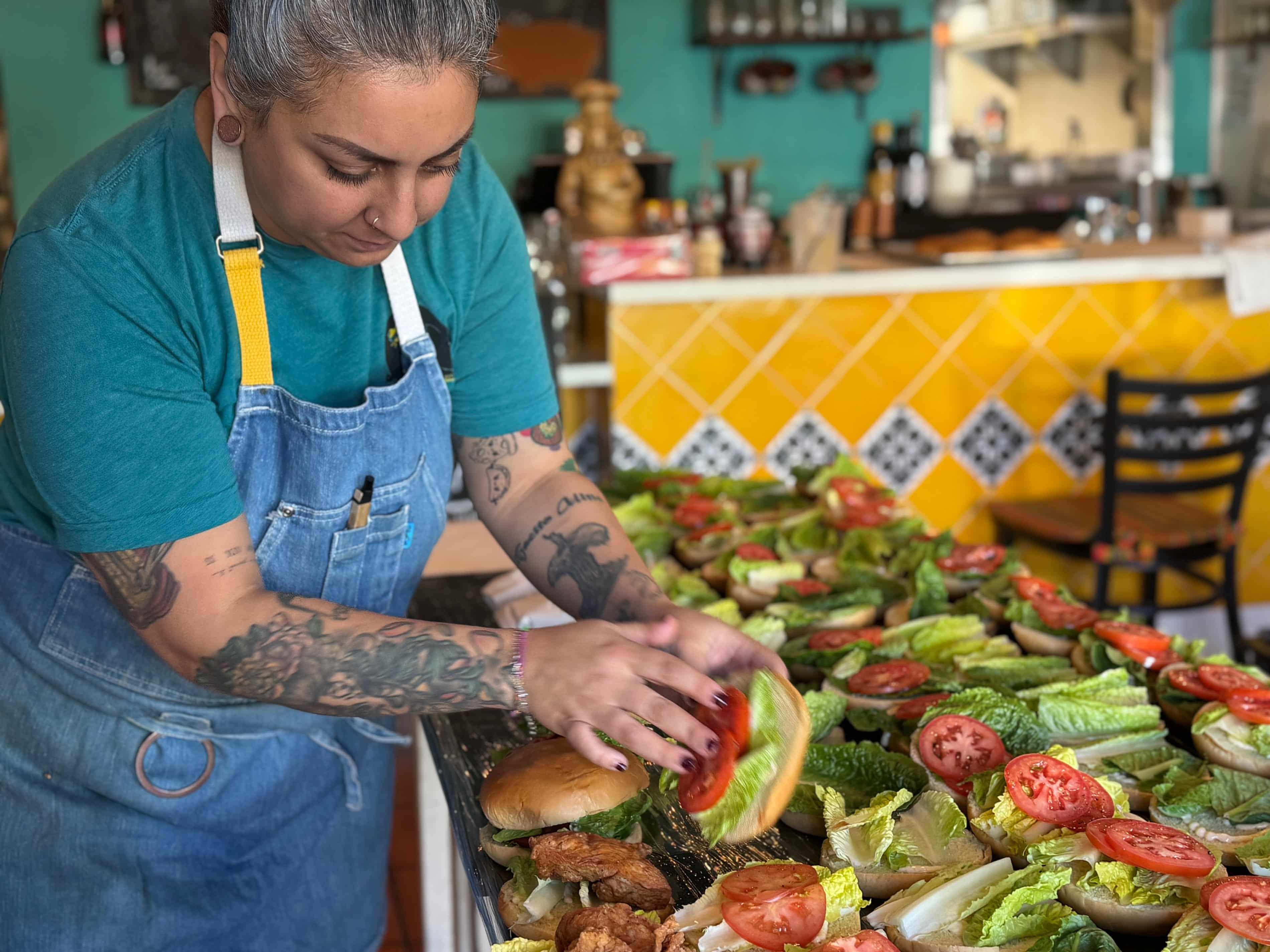
Photo: Danielle Duran Zecca/Amiga Amore.
Danielle Duran Zecca, co-owner of Amiga Amore in Highland Park, Los Angeles. 

Well, in one way, this is a time of great opportunity. There are endless opportunities in the US to meet the growing needs. Endless opportunities to practice charity in daily life.

A chef in Los Angeles knew opportunity as soon as she saw it. The revealing moment took the form of government officers in masks snatching people off the streets.

Victoria Namkung reports the story at the Guardian.

“When Danielle Duran Zecca saw military-style immigration raids and people being snatched off the streets and put into unmarked vehicles in her native Los Angeles earlier this summer, she was in disbelief. …

“Duran Zecca, a James Beard Award nominated chef and co-owner of Amiga Amore in Highland Park, a historically Latino neighborhood in north-east LA [said] ‘I didn’t know what to do, but I knew how to feed people and love on people because that is exactly how I was brought up in my family.’

“When several of Duran Zecca’s workers expressed fear about coming into the restaurant, the chef had a realization.

“ ‘If they didn’t want to leave their homes, how many others were like this and how many weren’t eating,’ she said. Earlier in the year, Amiga Amore received donations that allowed the Mexican-Italian restaurant to give meals away to those affected by the LA wildfires, but this time she would need a different approach, one that made people feel safe.

“Duran Zecca began personally delivering free meals to 25 to 30 people every other Sunday in nearby Boyle Heights. …

“Since ICE began to infiltrate LA in June, once-bustling neighborhoods have become quiet. Vendors locked up stalls in the flower district. Popular taco stands and fruit carts are closed and some restaurants sit empty. Although it is unknown exactly how many people are staying home due to Ice’s aggressive arrests, immigration sweeps at restaurants, farms, Home Depots and even car washes have created a chilling effect on businesses that rely on immigrant labor.

Restaurants such as Amiga Amore and other groups from the food and hospitality industry are stepping in to help people in their community who have nowhere to turn – even while their own businesses are suffering economically. …

” ‘Latinos are not only the backbone to our industry, they are the industry,’ said Duran Zecca. ‘Behind every chef are Latino line cooks ready to make magic happen. All they want to do is work, make a living and feed their families.’

“To make her deliveries twice every month, Duran Zecca receives logistical support from her good friend Damián Diaz, the co-founder of No Us Without You, an LA-based non-profit that provides food security for undocumented people, including back of the house staff from bars and restaurants.

“ ‘The administration has been doubling down on making it much more difficult for the families in the community and also small grassroots organizations like us to really be impactful,’ said Diaz. In the past, No Us Without You had drive-through lines for food distribution, but stepped-up enforcement made that impossible, so they pivoted to working with a coalition of restaurants to serve up to 40 families every fortnight so they can shelter at home.

“ ‘This environment of fear in light of increased enforcement, and really excessive enforcement, is causing folks to miss out on some very key necessities such as doctor’s appointments and going to the grocery store,’ said Rita Fernández director of immigration policy project at UnidosUS, a Latino non-profit advocacy organization. …

“This summer, Congress allocated $170.7bn in additional funding for immigration and border enforcement … creating what some critics call a ‘deportation-industrial complex.’ …

“That’s why many others in the restaurant and non-profit industry have also been mobilizing to bring groceries to immigrants who are in hiding. The Oaxacan-Mediterranean restaurant X’tiosu in Boyle Heights, one of the US’s most heavily Latino-populated neighborhoods, packed 150 bags of fresh produce, dried pasta and other goods that were delivered to people in need by local Oaxacan youth in June and they have continued to support undocumented families. The student-led group, Raíces Con Voz, coordinated food and care package deliveries to more than 200 families, and Aquí Para La Comunidad, which operates throughout southern California, has a growing waitlist.

“Vanny Arias decided to host an impromptu food drive in front of the Offbeat Bar in Highland Park, where she’s a bartender, after realizing people staying home were likely in need of groceries. … Arias organized with other community activists and volunteers to start dispensing basics.

“Once she launched an Instagram account, she started hearing directly from desperate families. ‘People said: “My husband got arrested” or “We’re afraid to leave the house and my kids haven’t eaten in days,” ‘ said Arias. ‘When you’re on the ground you see the hurt and pain in their eyes and hear it in their voices.’

“Since July, Arias’s Nela Food Distribution has grown to deliver free groceries to 150 people in and around Highland Park with the help of community donations, two local food warehouses, a bakery and a team of volunteers. ‘We’re a bunch of people who love their community,’ said Arias. ‘I don’t care what color you are, we’re freaking humans and I’m here for you. You’re not alone.’ ”

More at the Guardian, here. The Guardian is free, but please consider donating to them.

Read Full Post »

hazleton_1280

Photo: Erin Clark/Boston Globe
Hazletonians reacted to a hula hoop competition during Fun Fest in downtown Hazleton, Pa., a city that has benefited from the influx of immigrants.

In 2019, the Boston Globe did an interesting series on battleground states, going into communities to listen to a range of voices in hopes of understanding what people are really thinking. Laura Krantz covered Hazleton, Pennsylvania, where residents have mostly embraced a change of industry — and of population.

She reports, “Bob Curry is a man in constant motion, not unlike this fast-changing community he’s always championing. Passing a colorful mural in the community center he runs, its rainbow letters spelling out a Maya Angelou quote about the strength and beauty of diversity, he paused for effect.

“ ‘You see our mural, if you don’t like it, get back on the elevator, you’re free to leave,’ Curry proclaimed.

“He’s kidding — sort of. The Hazleton One Community Center is in a small city all too familiar [with] incendiary anti-immigrant proposals and political dog whistles. … Back in 2006, the City Council voted to make English the official language and proposed fines for landlords and employers who rented to or hired undocumented immigrants, all in an attempt to preserve, as one official said back then, ‘Small Town USA.’ …

“Curry and most others don’t feel a need to talk about that anymore. Time has marched on, and Hazleton has changed with it. …

“Like the rest of this swath of northeast Pennsylvania, Hazleton flourished more than three-quarters of a century ago during the mining of the anthracite coal buried deep below the region’s green hills. But that industry, and that generation, began to fade in the 1950s.

For a while Hazleton was practically a ghost town. Then starting in the early 2000s, something strange happened. A new industry took root, and with it, a new population of mostly Latino families arrived from New York, New Jersey, and Philadelphia.

“Hazleton is located near a confluence of major highways that connect it to much of the Eastern Seaboard. The proliferation of online shopping gave birth to a booming sector of distribution warehouses, long low-slung buildings tucked into the rolling hills that surround the city. And with those warehouses came salaries that would cover the cost of a perfectly nice home. Families arrived in pursuit of a middle-class life. …

” ‘Everything has changed here,’ Curry said. …

“Amilcar Arroyo is in many ways the personification of this change, as well as the chronicler of it. He is the publisher of El Mensajero, and from his first-floor office, he has seen the sleepy downtown street revived by Latino families who have flowed into town over the past two decades. There were few children when Arroyo arrived some 30 years ago from Peru; now they are everywhere.

“Amid the surge in Latino residents, Arroyo has taken it upon himself to show the town the many contributions of the Latino community. There always seems to be a need for more justification.

“So he keeps a tall whiteboard in his office where he has scribbled a long list: barbers, beauty shops, car garages, grocery stores, restaurants, bars, discotheques, furniture stores, pawn shops, transportation companies, media companies, cleaning businesses, photographers, DJs, nail artists. One afternoon, he remembered he needed to add something else — food trucks.

“ ‘I want to present how many businesses we have in Hazleton,’ he said. …

“Up the hill from Broad Street, the gridded neighborhoods are filling up again with young families. Flowers sprout through cracks in the sidewalks. Sloping awnings cool front porches. Tucked between the modest homes is the community center that Curry runs with his wife, Elaine. …

“Curry left a corporate job to run the center full time when it opened six years ago. He and Elaine don’t take salaries so this is not a luxurious retirement, but their house is paid for and their daughters graduated from college. …

” ‘We always talk about how one candle lights another. This ain’t one candle lighting another, this is lots of candles and really helping to try to illuminate the city.’

“When they opened the center, the Currys hoped they might see 300 children in the first month of their after-school program. Instead, families flooded through their doors, and they’ve never served fewer than 1,000 people — children and adults — each week. …

“After the center opened, the Currys quickly added English language courses for adults, citizenship classes, bilingual pre-kindergarten, and summer camps that cost $25 per week.

“This summer, the project was murals. The basement walls are now splashed with color. The hallway smells of paint. The children started the summer painting a daytime mural, but soon added a nighttime scene because someone drew fireflies and they needed the dark. …

“Earlier in the summer, [after news] that there would be massive immigration raids across the country, … someone drew an alien spacecraft that captured the fireflies, and many of the children painted rocket ships hurtling away through the darkness.

“ ‘There is an undercurrent of nervousness and trepidation that flows through the city,’ Curry said. …

“Mariluz Rodriguez represents the new Hazleton. Her family moved here from Queens, N.Y., when she was 8. Now she is a mentor at the center and preparing to leave for college on a full scholarship.

“ ‘It was just weird being different at first, but after a while it didn’t matter, you’re just part of the community,’ she said as she paused to have a snack. …

“This year, Elaine Curry gave her a wall to paint her own mural. She designed a glowing bouquet of flowers that surrounds the doors to the elevator.

“These are the things Rodriguez thinks about, not demographic shifts, presidential politics, or a sense of belonging. She’s gotten a few looks over the years, but she said she has never felt like a target of racism.

“Here, even though there are always the little things that you get from people, we still have it off really well, and we make it work.’ …

“Penelope Rodriguez [her mother] said she has never felt the kind of racism you hear about on television in Hazleton. Her co-workers and parents in the PTA have been kind and welcoming. The neighbors on their street know each other. …

“ ‘The unknown, which is the great fear, becomes the familiar. And when it’s the familiar, your biases start to dissipate,’ Curry said.”

More here.

Read Full Post »


Photo: Brian van der Brug / Los Angeles Times
Lining up for tacos outside the Islamic Center of Santa Ana.  The ‘Taco Truck at Every Mosque’ event for iftar (evening meal that breaks the fast during Ramadan) promotes solidarity and understanding.

Community organizers are getting creative with ways to pull different groups together. Consider this California example.

Anh Do writes at the Los Angeles Times: “Activists Rida Hamida and Ben Vazquez wanted to find a way to promote unity among the region’s Muslim and Latino communities, so they came up with a novel idea.

“After daily fasting as part of the holy month of Ramadan, dozens of local Muslims joined their Latino neighbors Saturday night in the parking lot of the new Islamic Center of Santa Ana, taking part in the inaugural event of the campaign dubbed Taco Trucks at Every Mosque.

“Organizers said the idea is to demystify Islam through the sharing of food and to unite two groups, Muslims and Latinos, facing increasing discrimination. …

” ‘This is perfect timing. The purpose of this month is to give charity, to grow our character and our inner lives and to nourish our soul through service. What better way to do that than by learning from one another?’ asked coordinator Hamida, whose goal is to host food trucks that will serve halal tacos at every mosque in Orange County. …

“Even young participants such as Idrees Alomari, 13, were encouraged by Saturday’s event, which he said was a good way to show how people can appreciate their differences and similarities. …

” ‘All the way from the parking entrance to inside, everyone’s been like, “Welcome, welcome, we’re so glad to have you here,” ‘ said Dulce Saavedra, 24, [a] youth organizer for Resilience OC, a nonprofit created from the merging of Santa Ana Boys and Men of Color and Raiz, a group pushing for partnerships between law enforcement and immigrants.” More at the Los Angeles Times, here.

This initiative reminds me of an annual event that took place in Lowell, Mass. It was a gigantic soccer tournament with teams from the scores of immigrant groups in the city. I always admired the ONELowell initiative because it can be hard to get minorities to band together and realize they can collaborate to promote common needs. Sharing a sport loved by many nationalities seemed like a good place to start.

Read Full Post »

I usually try to get to an event or two at the annual Concord Festival of Authors, and one year I ended up attending readings by new novelists held at Kerem Shalom temple.

Iris Gomez, an immigration lawyer, was one of them, and I bought her novel Try to Remember. The protagonist’s Puerto Rican/Columbian childhood in Miami was fascinating, but hard for me to relate to. Why, for example, would the family not seek help for a clearly deranged parent? Painful to observe.

I passed the book along to a colleague from the Dominican Republic, who immediately got what Gomez was trying to convey. She said, “Omigosh! This is the story of my life.” When the Latino employee group was looking for speakers, Gomez was chosen to join WBUR radio’s “Con Salsa” host José Massó for a lunchtime presentation.

It was interesting to learn about Gomez’s other life, as an immigration lawyer, and to hear her describe the duality of the immigrant experience. She grew up trying to bridge her family’s world and that of the new country. Today she bridges the worlds of  novelist and a lawyer, in both cases trying to build understanding.

From the website at her day job: “Iris Gomez joined [Massachusetts Law Reform Institute] as an immigration attorney in March 1992, is a nationally-recognized expert on asylum and immigration law, and directs MLRI’s Immigrants Protection Project. Prior to joining MLRI, she was a Senior Attorney at Greater Boston Legal Services. She also worked as a law school lecturer, a public defender, a farm worker lawyer, and has been the Chair of the Board of Directors of the National Immigration Law Center. She graduated from Boston University School of Law.”

José Massó was a dynamic and entertaining speaker. With both humor and seriousness, he told us about his culture shock coming from Puerto Rico to a supposedly liberal college on the mainland and about how he developed his concept of a third way for immigrants, one that takes from the two cultures but makes something new.

Photograph of José Massó: WBUR

Read Full Post »

There’s a theory that if you want information to stick, it helps to tie it to emotions. The Center for Community Capital at the University of North Carolina tested the idea with The Bold and the Bankable: How the Nuestro Barrio Soap Opera Effectively Delivers Financial Education to Latino Immigrants.

It’s all true: If a character you like goes bankrupt because of reckless behavior with money, you are likely to remember and apply the learning to your own situation.

Last week I had the pleasure of attending a theatrical production by teenagers from the Underground Railway Youth Theater who had written a script from interviews they conducted with 80 people of all ages. The teens asked interviewees about their experiences with money and how they felt about it. Some of the stories were quite moving, and the high school audience’s emotions were likely engaged as they were quiet as mice.

There was a talkback afterward. A few students wanted to know how to join Youth Underground.

From the group’s website: “Youth Underground serves youth ages 13-18 with stipend eligible opportunities to create theater together and in tandem with community-based organizations; and to showcase their work throughout the city, Greater Boston, and at Central Square Theater. Youth Underground holds both an academic year program and intensive summer residency with an annual Ensemble of 30 members. Youth Underground showcases work through performances, a youth driven Community Dialogue Series, and peer exchanges with local and global organizations.”

The Boston Globe has a good article on it.

Read Full Post »