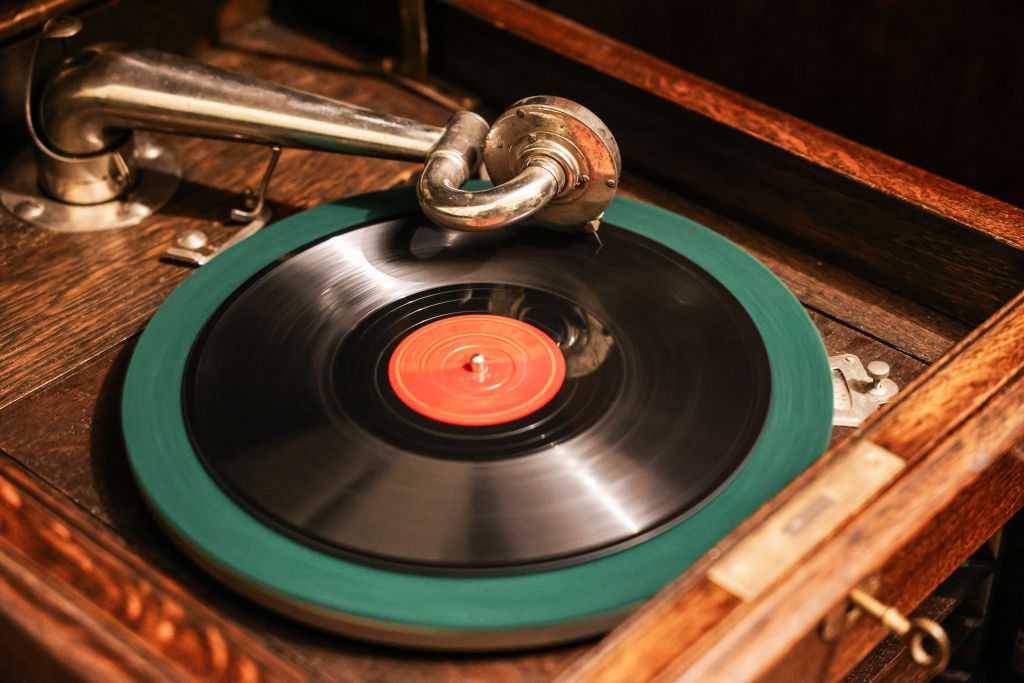
Photo: picture alliance.
An old-time record player playing a 78 rpm record. This is shellac — ie, before vinyl.
Maybe it’s because I still feel guilty about how my brother and I made a game of smashing our grandfather’s shellac records when we were children, but I can’t help taking sides in the court battle described below. Now that I’m a grownup, I believe that we should protect these oldies, and let the public get at them.
Ashley Belanger reports at Ars Technica that the Internet Archive’s battle with music publishers has ended in a settlement that will, in my view, be to the public’s benefit.
“A settlement has been reached in a lawsuit where music publishers sued the Internet Archive over the Great 78 Project, an effort to preserve early music recordings that only exist on brittle shellac records.
“No details of the settlement have so far been released, but a court filing on Monday confirmed that the Internet Archive and UMG Recordings, Capitol Records, Sony Music Entertainment, and other record labels ‘have settled this matter.’ …
“Days before the settlement was announced, record labels had indicated that everyone but the Internet Archive and its founder, Brewster Kahle, had agreed to sign a joint settlement, seemingly including the Great 78 Project’s recording engineer George Blood, who was also a target of the litigation. But in the days since, IA has gotten on board, posting a blog confirming that ‘the parties have reached a confidential resolution of all claims.’ …
“For IA — which strove to digitize 3 million recordings to help historians document recording history — the lawsuit from music publishers could have meant financial ruin. Initially, record labels alleged that damages amounted to $400 million, claiming they lost streams when IA visitors played Great 78 recordings.
“But despite IA arguing that there were comparably low downloads and streams on the Great 78 recordings — as well as a music publishing industry vet suggesting that damages were likely no more than $41,000 — the labels intensified their attacks in March. In a court filing, the labels added so many more infringing works that the estimated damages increased to $700 million. It seemed like labels were intent on doubling down on a fight that, at least one sound historian suggested, the labels might one day regret.
“Notably, the settlement comes after IA previously lost a court fight with book publishers last year, where IA could have faced substantial damages. In that fight, IA accused book publishers of being unable to prove that IA’s emergency library had hurt their sales. But book publishers, represented by the same legal team as music labels, ultimately won that fight and negotiated a judgment that similarly included an undisclosed payment.
“With both legal battles likely ending in undisclosed payments, it seems likely we’ll never know the true cost to the digital library of defending its digitization projects.
“In a court filing ahead of the settlement in the music label fight, IA had argued that labels had added an avalanche of infringing works so late into the lawsuit to create leverage to force a settlement.
“David Seubert, who relied on the Great 78 Project and manages sound collections at the University of California, Santa Barbara library, previously told Ars that he suspected that the labels’ lawsuit was ‘somehow vindictive,’ because the labels’ revenue didn’t seem to be impacted by the Great 78 Project. He suggested that perhaps labels just ‘don’t like the Internet Archive’s way of pushing the envelope on copyright and fair use.
” ‘There are people who, like the founder of the Internet Archive, want to push that envelope, and the media conglomerates want to push back in the other direction.’ “
More at ArsTechnica, here. Of related interest, at My Dad’s Records, here, my nephew once preserved the old R&B vinyl 78s of the same naughty brother who was guilty with me, but my nephew let the tumblr site go years ago. Check it out anyway.


 Suzanne's Mom's Blog