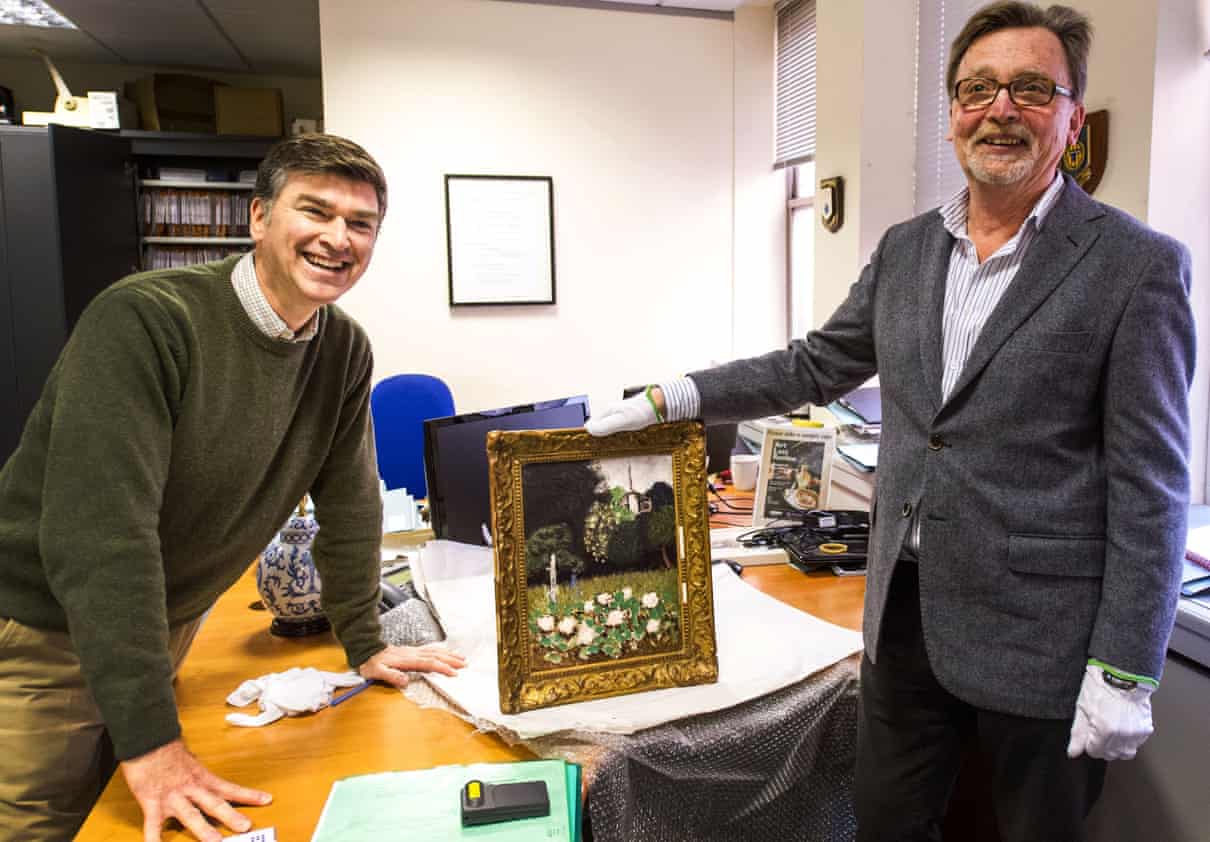
Art detective Christopher Marinello, left, returning the long-lost Le Jardin by Matisse to Lars Bystrom of the Modern Museum in Stockholm in 2013.
Now for something completely different, how about we delve into the life of a lawyer who walks some dangerous paths to recover stolen art?
Alex Daniel writes at the Guardian, “One summer morning in 2008, Christopher Marinello was waiting on 72nd Street in Manhattan, New York. The traffic was busy, but after a few minutes he saw what he was waiting for: a gold Mercedes with blacked-out windows drew near. As it pulled up to the kerb, a man in the passenger seat held a large bin-liner out of the window. ‘Here you go,’ he said. Marinello took the bag and the car sped off. Inside was a rolled-up painting by the Belgian artist Paul Delvaux, Le Rendez-vous d’Ephèse. Its estimated worth was $6m, and at that point it had been missing for 40 years.
“Marinello is one of a handful of people who track down stolen masterpieces for a living. Operating in the grey area between wealthy collectors, private investigators, and high-value thieves, he has spent three decades going after lost works by the likes of Warhol, Picasso and Van Gogh. In that time, he says he has recovered art worth more than half a billion dollars. …
“Cases tend to go the following way. A stolen artwork – in this instance, a bird by the Martin Brothers pottery makers, which was swiped from a London library in 2005 – will often turn up at auction or on social media. It then falls to Marinello to establish whether it is actually the missing work and, sometimes, to get it back. This, he says, is usually relatively simple.
“Stolen works often change hands several times before resurfacing, leaving subsequent possessors in the dark about their provenance. This is most likely what happened with the Delvaux. The painting, completed in 1967, depicts several nude women in a dreamlike landscape that’s part classical architecture, part mid-century tram station. Delvaux himself sold it a year later, but it was stolen before it reached the buyer. In 2008, Marinello got a call from somebody who wanted to return it. What happened to it in the intervening 40 years is unclear, although its final location is known. It was rolled up, says Marinello, in the wardrobe of ‘a very well-heeled celebrity. And their very expensive lawyer made it clear they would never be named.’ …
“A slight, 58-year-old Italian American with a soft Brooklyn accent, Marinello … trained as a lawyer, cutting his teeth as a litigator in New York representing galleries, collectors and dealers in cases involving disputed works. ‘Eventually, it developed into a full-time art recovery practice,’ he says. In 2013, he formed his own company, Art Recovery International, which is based in Venice but has offices in London. …
He says. ‘[I’m] a pretty good negotiator. I can convince people to do the right thing. … The bottom line [is] that if you are trying to sell something that is stolen, you’re the one with a problem, not me.’ …
“He adds: ‘With a lot of art crime, there is nobody to arrest and people rarely go to prison. It’s just a matter of recovering the work.’
“However, sometimes a suspect will refuse to cooperate. Then, things are different. ‘We go after them like pitbulls and never let go,’ he says. ‘And that is when they start getting nasty, when they are concerned they’re going to go to prison.’ “
More at the Guardian, here. If you don’t follow the Guardian online, do check it out. I really love it. It’s free, but grateful readers volunteer to pay what they can.

 Suzanne's Mom's Blog