Feeds:
Posts
Comments

Posts Tagged ‘librarian’

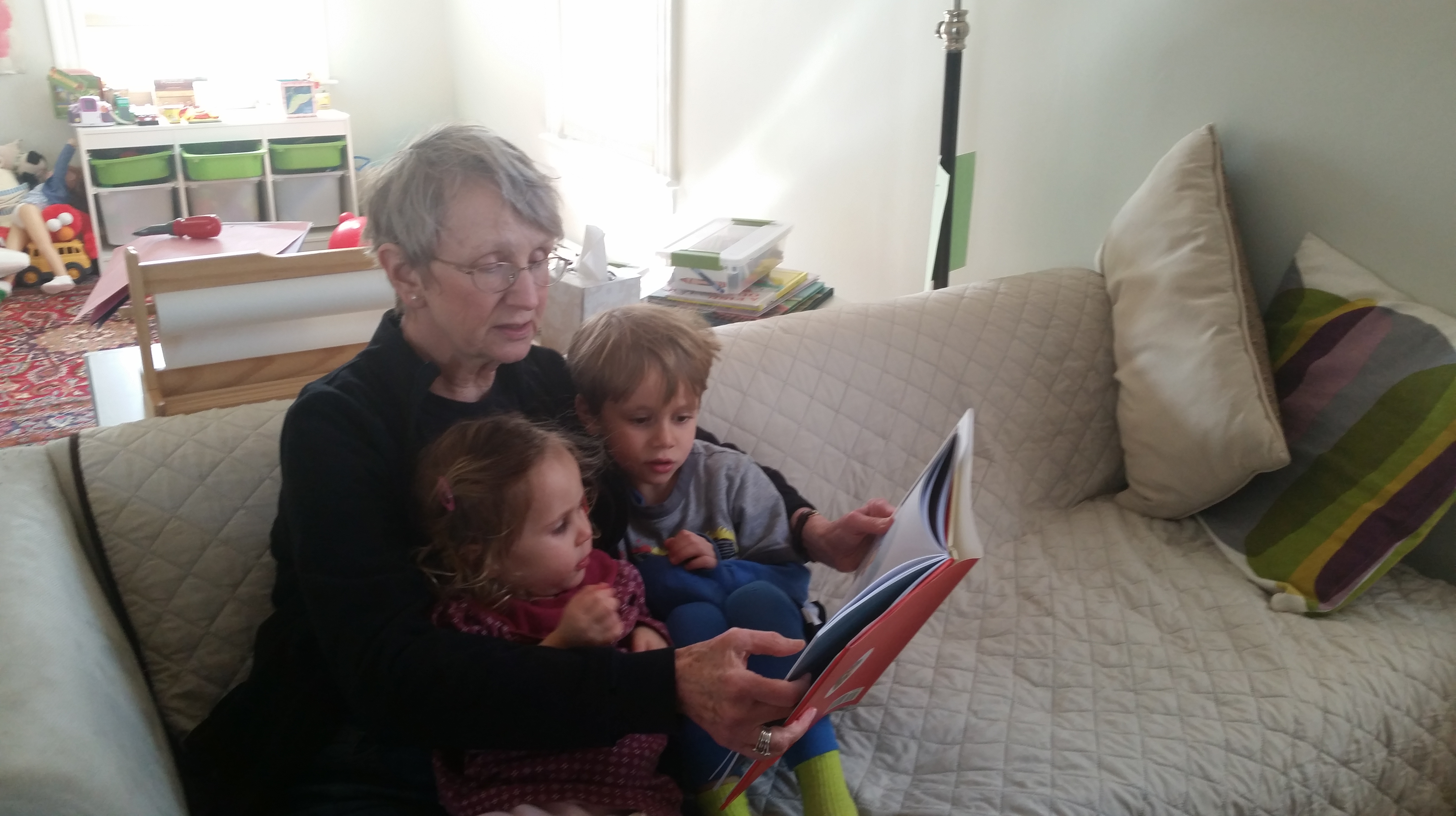
Photo: JRE.
Now almost 12 and 15, these two are good readers.

I recently learned about a group called Grandparents for Truth, organized in reaction to other groups pushing book bans in schools and threatening librarians.

I am not a member, but I think reading is important and I understand enough history to know what happens to countries that start with book bans, so I thought I would share the information.

Huda Hassan wrote at MSN.com in late 2024, “Last August, a retired special-education teacher named Holly Hall joined a rally of grandparents warring against book censorship in Temecula, a small Southern California town. Locals had gathered to oppose a school-board decision to ban a social-studies reader, Social Studies Alive!, for citing Harvey Milk — the first openly gay politician elected in the state. ‘The Harvey Milk reference was in the supplemental materials,’ 72-year-old Hall says, ‘which meant that it wouldn’t have even been mentioned in some classes.’

“The world of literature is currently ablaze with rapidly escalating book bans targeting narratives and histories about gender and sexual identity, race, class, and just about anyone deemed ‘other.’

“[In 2024] alone, 1,128 books have been challenged, according to the American Library Association, which documents ongoing censorship attempts across the nation. Florida is the state with the most banned books (3,135 bans, according to PEN America), and in the 2022–23 school year, there were book bans in 153 districts across 33 states, including Texas, Missouri, Utah, and Pennsylvania.

“Earlier this year, schools in Escambia County, Florida, removed 1,600 books on gender and race from school libraries and, through this process, even banned multiple dictionaries. In August, New College of Florida, a public liberal-arts college, disposed of hundreds of library books, emptying the school’s Gender and Diversity Center. Then, this fall, major publishers — including Simon & Schuster, Penguin Random House, and HarperCollins Publishers — filed a lawsuit against book-removal provisions in Florida (through HB 1069, a law introduced in 2023).

“When Hall, who taught in California for 40 years, spoke out at that rally in Temecula, she gave an impassioned speech about censorship in her state. ‘I addressed the dangers of banning books,’ she says. ‘It’s not 1933 Germany.’ Opponents attended the Temecula rally too, such as Moms for Liberty, a Florida-based parenting group formed in 2021 that’s pushing for banning books on race and what it calls ‘gender ideology.’ A few months prior, the same three school-board trustees Hall spoke against had voted to ban the school’s study of critical race theory the day they were sworn into office. This preemptive act confused many, as no courses on critical race theory had been offered at the school. …

“As parents across the country and groups like Moms for Liberty have joined the attacks on literature, grandparents like Hall are mobilizing in response, and they are afraid. ‘I am so concerned about my country, our freedom, and the world,’ Hall says.

“But she felt encouraged to speak in front of her peers and opponents last year because she knew she was not alone. She was invited to the rally by Grandparents for Truth, a national organization formed in the summer of 2023 to fight for the right to read. ‘A neighbor walked by and told me about the group. He had a sign in his yard,’ says Hall. …

“In Philadelphia, Ruth Littner, one of the earliest members to join Grandparents for Truth last summer, discovered the collective through her daughter, Alana Byrd, the national field director of People for the American Way. Like Hall, the pair are committed to countering book banning despite heckling or pushback from the police. ‘I am the daughter of two Holocaust survivors,’ Littner says on the phone from her home. ‘When Alana told me she had an initiative to fight this kind of authoritarianism, I jumped right on that. I was the first one to get the Grandparents for Truth T-shirt.’

More at MSN, here. No paywall.
Read Full Post »

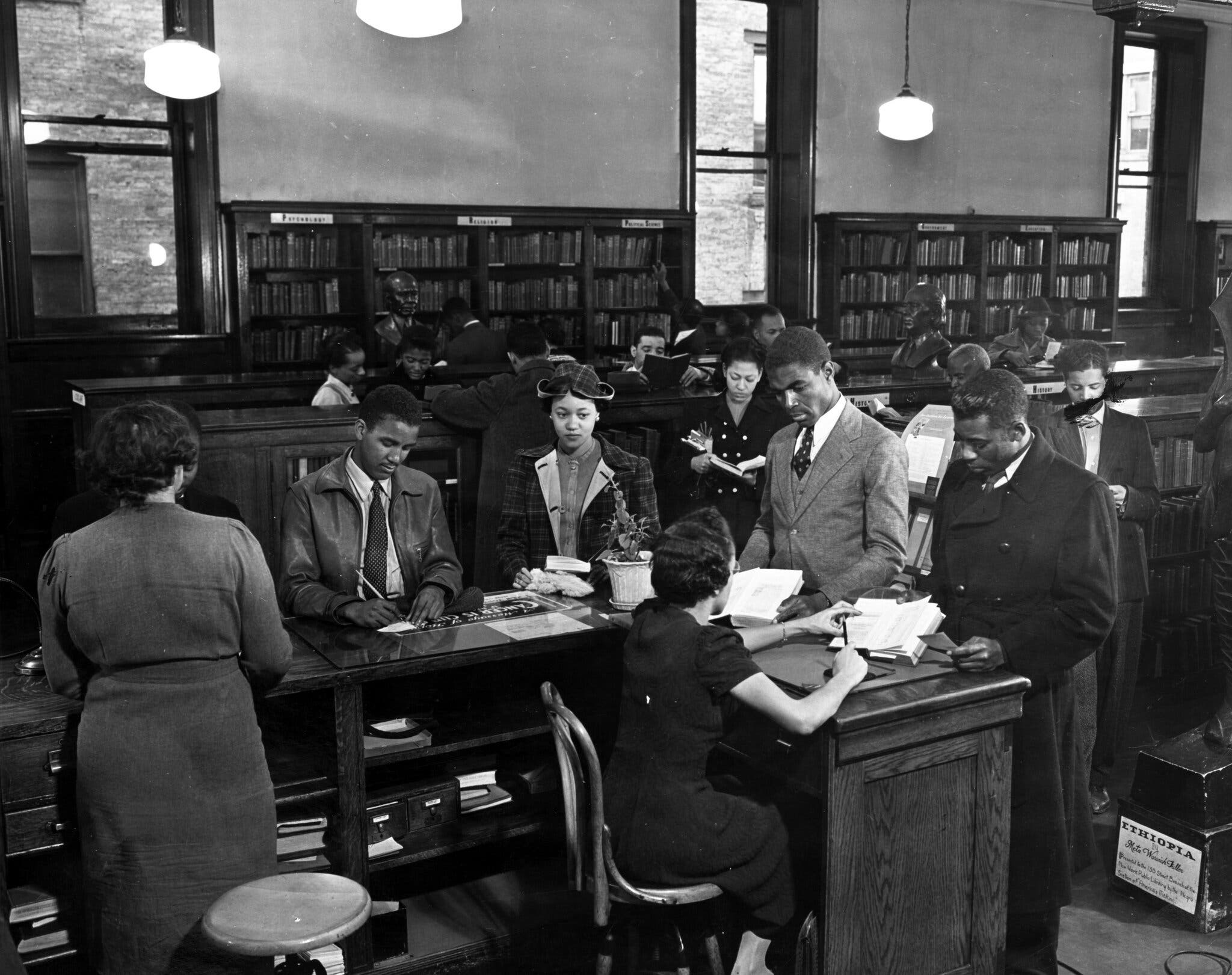
Photo: New York Public Library.
In 1925, the New York Public Library system established the first public collection dedicated to Black materials at its 135th Street branch in Harlem, now known as the Schomburg Center for Research in Black Culture.

I have read numerous accounts of what a public library has meant to poor children with insatiable curiosity. The most recent was the autobiography Up Home by future intellectual and university president Ruth J. Simmons. She grew up in a desperately poor Black sharecropper’s family in Texas. Books and encouragement from Black teachers meant everything.

Meanwhile in Harlem, Black librarians meant everything to generations of Northern children.

Jennifer Schuessler reports at the New York Times, “It was a banner day in the history of American libraries — and in Black history. On May 25, 1926, the New York Public Library announced that it had acquired the celebrated Afro-Latino bibliophile Arturo Schomburg’s collection of more than 4,000 books, manuscripts and other artifacts.

“A year earlier, the library had established the first public collection dedicated to Black materials, at its 135th Street branch in Harlem. Now, the branch would be home to a trove of rare items, from some of the earliest books by and about Black people to then-new works of the brewing Harlem Renaissance.

“Schomburg was the most famous of the Black bibliophiles who, starting in the late 19th century, had amassed impressive ‘parlor libraries’ in their homes. Such libraries became important gathering places for Black writers and thinkers at a time when newly created public libraries — which exploded in number in the decades after 1870 — were uninterested in Black materials, and often unwelcoming to Black patrons.

“Schomburg summed up his credo in a famous 1925 essay, writing, ‘The American Negro must remake his past in order to make his future.’ In a 1913 letter, he had put it less decorously: The items in his library were ‘powder with which to fight our enemies. …

“Today, figures like Schomburg and the historian and activist W.E.B. Du Bois (another collector and compiler of Black books) are hailed as the founders of the 20th-century Black intellectual tradition. But increasingly, scholars are also uncovering the important role of the women who often ran the libraries, where they built collections and — just as important — communities of readers.

“ ‘Mr. Schomburg’s collection is really the seed,’ said Joy Bivins, the current director of the Schomburg Center for Research in Black Culture, as the 135th Street library, currently home to more than 11 million items, is now known. ‘But in many ways, it is these women who were the institution builders.’

“Many were among the first Black women to attend library school, where they learned the tools and the systems of the rapidly professionalizing field.

On the job, they learned these tools weren’t always suited to Black books and ideas, so they invented their own.

“At times, they battled overt and covert censorship. … But whether they worked in world-famous research collections or modest public branch libraries, these pioneers saw their role as not just about tending old books but also about making room for new people and new ideas.

“ ‘These librarians were very tuned in and understood that a cultural movement also needs a space,’ said Laura E. Helton, a historian at the University of Delaware and author of the recent book Scattered and Fugitive Things: How Black Collectors Created Archives and Remade History. …

“In the 1920 census, only 69 of the 15,297 Americans who listed their profession as librarian were Black. Many cities in the segregated South had no library services at all for Black citizens. And even in the North, those branches that did serve them often had few books geared to their interests, and sometimes no card catalogs or reference collections at all.

“That started to change, if slowly. In 1924, in Chicago, Vivian Harsh became the first Black librarian to lead a public library branch there. [But] no place captures the transformations of the era more than Harlem, where, starting in 1920, a white librarian named Ernestine Rose hired four young Black librarians at the 135th Street library. …

“The poet Arna Bontemps (who himself later became a librarian) recalled visiting the 135th Street library after his arrival in Harlem in 1924. ‘There were a couple of very nice-looking girls sitting at the desk, colored girls,’ he said. ‘I had never seen that before.’ …

“Other ‘girls’ at the branch fostered the neighborhood’s artistic ferment in different ways. Among them was Regina Andrews, a young librarian from Chicago (where she was mentored by Harsh) who came to New York City on vacation in 1922 and decided to stay. She … soon settled into an apartment at 580 St. Nicholas Avenue with two friends who worked at Opportunity, a new magazine that aimed to capture the creative ferment bubbling up in Harlem. Nicknamed Dream Haven, the apartment quickly became a salon and crash pad for some of the most celebrated figures of the period.

“It was there that Alain Locke held some planning meetings for the special issue of the Survey Graphic magazine that later grew into his landmark 1925 anthology The New Negro. And it was there that many Black artists and writers who attended the 1924 Civic Club dinner now recognized as an opening bell of the Harlem Renaissance gathered.”

Read more at the Times, here.

Read Full Post »

Do we praise the work of librarians enough? I started following the Ferguson Library on twitter and Facebook after reading how it was the calm eye of the storm in Ferguson, Missouri, amid the 2014 riots. As a result, I now get good leads about other libraries. Here is a report on Ohio librarians who go the distance — and beyond.

Katie Johnson at School Library Journal describes her experience with “Play, Learn and Grow, a pop-up storytime and early learning program created through a collaboration between Twinsburg (OH) Public Library and Akron Metropolitan Housing Authority (AMHA). …

“I noticed that none of the children living in the housing development were coming to storytime at our library. I reached out to AMHA representatives, hoping they would be open to the idea of the library hosting a weekly program at the development. They were, partnering me with one of their employees, Kellie Morehouse, who was already working with families within the complex.

“We set up Play, Grow, and Learn in an unused room behind the apartment leasing office. Our initial goal was to get to know children age five and younger and their families through storytime, crafts, and free play. As the weeks went on, we saw everything that these families lacked: employment, education, transportation, healthy food, proper healthcare, access to preschool, even reliable phone service.”

They got involved in all those areas — helping children get vaccinations and nutritious food, for example, and arranging for isolated young mothers to address depression.

“Early experiences with storytime revealed a desire of the young mothers to interact with one another.  This led the AMHA representative to suggest teaming storytime with one of the organization’s programs for moms.  AMHA and a local behavioral health agency had been working together to provide maternal depression support groups to low-income women in other parts of the county. …

“Twice a month, the moms in our storytime are able to meet in a group setting with a professional to discuss their frustrations and worries. Mom-ME Time has become key, as so many of our moms are dealing with heavy pressures every day, and most do not have a strong support network. Being able to vent and get helpful parenting advice can be crucial to the choices they are making for their young children.”

It is worthy of applause when a librarian sees the whole child, not just a child in storytime, and tries to tackle the barriers to a better life. More here.

Photo: Katie Johnson/School Library Journal
Moms are included in programming for children.

Read Full Post »