Photo: Grounds Krewe. In the interest of environmental protection, barriers were set up to block discarded Mardi Gras parade throws and party trash from going down storm drains.
New Orleans likes to have fun, and whether it’s a funeral with a brass band playing “When the Saints Go Marchin’ In,” men high-stepping in feathers to welcome the New Year (Mummers), or the abandon of Mardi Gras before the solemnity of Lent, parades produce litter. A lot of litter.
That’s why environmentally oriented New Orleanians have decided to do something about cleaning up.
As Jackie Delamatre writes at the New York Times, “In recent years, the city’s huge, weekslong party has been producing more waste than ever: an average of 1,123 tons per year for the last decade, according to the city’s Sanitation Department.
“ ‘It’s an environmental catastrophe,’ said Brett Davis, who runs a nonprofit group, Grounds Krewe, that’s trying to make Carnival greener.
“The New Orleans area is especially vulnerable to climate change because of hurricanes and coastal erosion. Yet, for weeks of ebullient parading, which culminate on Tuesday, those problems are forgotten as float riders fling plastic beads, cups, doubloons and foam footballs at teeming crowds. In the moment, these baubles can seem like treasures. Within days, though, what was caught, as well as the excess left on the streets or dangling from oak trees like Spanish moss, ends up in the trash.
“Now, a coalition of nonprofit organizations, city officials and scientists is trying to clean up the party. … It’s not just that all this party detritus is swelling landfills. A 2013 study found that more than 60 percent of Mardi Gras beads contained unsafe levels of lead. And in 2018, the city discovered 46 tons of beads clogging catch basins that are essential for clearing floodwaters. …
” ‘When I was a kid, we caught everything that came off the floats,’ Mr. Davis said. ‘There was a big hoopla about who was going to get it. Now it’s a carpet, a river of waste.’ …
“Mr. Davis came to believe that, by reusing beads, he was just ‘recirculating toxic, plastic junk no one wants,’ he said. Now, he has pivoted to waste prevention, building a catalog of sustainable throws.
“To date, he has sold more than $1 million of these festive but practical items, including jambalaya mix, native flower starter kits and plant-based glitter. He has also recruited a cadre of volunteers, from fifth graders to retirees, to help package the goods.”
Read at the Times, here, about scientists inventing sustainable Mardi Gras beads containing okra seeds. Imagine yourself cooking the okra you grow in your gumbo and reliving happy New Orleans memories.
Photo: Maggie Penman/The Washington Post. Marci Johnson shows off a tiny watering can from deep in a pond. Johnson is a member of Susan Baur’s group Old Ladies Against Underwater Garbage, OLAUG.
A question from today’s article is a perfect example of the real meaning of “begging the question.” Although nowadays the phrase seems to mean “leads to a new question,” good old Fowler’s says it really means something more like “making an unproved assumption.”
Thus “why does diving for trash in a pond make people so happy?” makes the assumption that diving for trash does make people happy.
Let’s read more about the person who begged the question: Susan Baur, founder of the group Old Ladies Against Underwater Garbage.
‘It’s a reminder when things feel too overwhelming — it’s not overwhelming if you do it together.’
Maggie Penman writes at the Washington Post, “On an overcast chilly morning in late August, a group of women gather in a sandy parking lot, nearly all of them sporting a bright orange hat with the letters OLAUG — Old Ladies Against Underwater Garbage.
“Founder Susan Baur gets the group’s attention to go over the plan: Two groups of swimmers with masks and snorkels will be dropped off by a pontoon boat in different sections of Johns Pond in Mashpee, Massachusetts.
“Each group, accompanied by a kayaker, will swim in zigzags toward each other, diving as deep as 12 feet to pull trash from the pond’s muddy depths.
“All of the divers — women between 65 and 85 years old — have an enthusiasm for litter. …
“ ‘You literally never know whether you’re going to be excited, humbled, saddened. It’s all there, the whole emotional range you go through on a dive,’ Baur said.
“This area has been cleaned up before, but they know there’s more trash, in particular from a nearby construction site, that is getting dumped in the pond, Baur said. …
“Baur is a retired psychologist. At 85 years old, she is tiny but strong, moving quickly and fluidly as she checks equipment and greets swimmers. She says this project started on a whim in 2018, inspired by her daily swims in freshwater ponds and lakes near her home on Cape Cod.
“ ‘It was three or four or five friends that would get together and clean up a pond and laugh,’ she said.
“They were astounded at how much trash was in local waterways and ponds, and thought they could use more hands. In 2023, OLAUG held tryouts for the first time, making sure volunteers could swim half a mile in under 30 minutes and finish the mile comfortably. They also had to be able to dive repeatedly down 8-10 feet. Overnight, the group expanded to 21 women. The youngest was 64. …
“The dives are organized with walkie-talkies and safety protocols, and coordinated with local homeowners, who often express appreciation with baked goods. Each dive is run by an assigned ‘beach boss’ who handles logistics and checks swimmers in and out of the water. Each diver has an area of expertise. If it’s deep, call Marci. If it’s disgusting, call Susan. …
“Many of the women involved in OLAUG are motivated by environmentalism: wanting to clean up ponds and lakes for the fish and turtles that populate them.
“Some are motivated by the camaraderie or the exercise. For others, it’s the joy of imagining the provenance of the objects pulled out of the mud.
“ ‘Where did this garbage come from?’ asked kayaker Diane Hammer, 70. ‘And how did it get in the pond in the first place?’
“She got involved with OLAUG after moving from Boston to Falmouth in 2020. She looked out her window and saw people in wet suits digging in her pond. Hammer had been watching a lot of true crime during the pandemic, and her first thought was that the divers were FBI agents looking for dead bodies. She soon learned it was Baur and a friend looking for trash.
“ ‘There’s nothing better than doing something good with good people,’ Hammer said. ‘It’s a reminder when things feel too overwhelming — it’s not overwhelming if you do it together.’ …
“This particular Monday morning, divers find a makeshift anchor and a rusted rudder, as well as two shoes — one a woman’s strappy sandal. On another day they found a blue toilet. On another, the back end of a Corvette. They’ve found old beer bottles that seem to have been dumped after an ice fishing expedition a century ago, lots of golf balls and so many baby doll heads. …
“The main reason Baur thinks the women keep coming back to OLAUG is because in the water, they reach a state of flow — the concept in psychology that some researchers believe holds a critical key to happiness.
“ ‘The cool thing about flow is there’s no one thing you have to do to achieve it,’ said Richard Huskey, an associate professor in the communication department at the University of California at Davis who has written about flow. He says the easiest way to understand it is as ‘being in the zone’: being so fully engaged in a task that you are entirely present, totally unselfconscious, not thinking about anything else.
“ ‘There’s nothing like cold water, icky garbage and a little bit of danger to get you out of your head,’ Baur said.
“Marci Johnson agrees. She’s one of the swimmers who joined the group in 2023. Johnson grew up on Cape Cod and moved back with her husband when she retired, but then he died. She was diagnosed with breast cancer. She was feeling isolated and struggling — and then she saw OLAUG was having tryouts.
“ ‘I never was good in gym, I wasn’t on a sports team in school, but I do love swimming,’ she said. ‘You get into a rhythm when you’re swimming long distances, and your mind just goes somewhere else. You work through those problems you’ve been trying to figure out, sitting there thinking about it. But when you’re swimming the answer comes to you. It’s a happy place.’ ”
Photo: The Smart Local. Members of the Gomi Hiroi Samurai, or the trash-collecting samurai, wear full-length samurai outfits and wield waste tongs that look like swords.
Proving that any kind of work can be turned into a game, Rebecca Rosman and Julia Kim report at Public Radio International’s the World, about some waste pickers in Japan.
“Passersby do a double take when they see Kaz Kobayashi and Ikki Goto. The two men glide through Tokyo’s bustling Ikebukuro district in full-length samurai outfits, while wielding objects that look like swords. They are members of the Gomi Hiroi Samurai or the trash-collecting samurai. …
“On closer inspection, their samurai swords — or katanas — are actually just very long tongs, used to pick up litter. Kobayashi said the tongs are important for novelty value.
“ ‘We’re doing this as entertainment … but it can be tiring sometimes. It’s tough, Man.’
“The Gomi Hiroi Samurai do this three times a week. There’s four of them, and they’re professional actors. In their spare time, they volunteer to keep the streets of Tokyo clean. Goto formed the group in 2009. Since then, they have become a viral sensation on TikTok, with over 700,000 followers and counting.
“Here in Ikebukuro, they target back alleys and parking lots, which are rife with litter. Kobayashi and Goto, working in sync, slice and spin their tongs through the air, meticulously seizing cigarette butts one by one before tossing them into the wastebaskets strapped to their backs. …
“An hour later, Kobayashi and Goto took their wastebaskets to a recycling base. There, they separated out every piece of rubbish they’ve collected. They said that they hope to recruit more Gomi Hiroi samurai in Japan — and around the world — to spread their message: ‘We punish immoral hearts.’
“It means that trash in and of itself isn’t bad. Instead, it’s people and the actions that stem from their negative mindsets. And a growing sense of negativity is something that Kobayashi said worries him.
“ ‘This is a problem in Japan,’ he said. ‘People don’t go outside.’
“Last month, a government survey showed that 1.5 million people are living as social recluses in Japan. With loneliness and depression on the rise, Kobayashi said he hopes that their fun, zany take on something as mundane as trash-collecting helps people reengage with the outside world.
“ ‘Samurai is a warrior,’ he said. ‘Our philosophy is to help people.’
“For these eco-warriors, ‘clean space, clear mind’ is more than just a saying — it’s the way of the Gomi Hiroi samurai.”
More at the World, here. I was amazed that the “samurai” are doing this hard work as volunteers. PRI also has stories on trash pickers in countries like India, Ghana, and Colombia, where they earn a meager amount of pay and live very difficult lives.
I have to say, I think that public litter is best addressed by everybody pitching in. Clean communities are often the result of peer pressure against creating litter in the first place and individuals who are proud enough of their community to pick up litter where they see it.
PS. In case you don’t always read the Comments, do look at Hannah’s, which included a tip about Ya Fave Trashman. Like the trash samurai, he adds entertainment to an undervalued job. His online talks gained him fame during the pandemic, when trash was piling up in Philadelphia. Read about him here.
Photo: South West News Service
Pat Smith, married mother of two, grandmother, and owner of a B&B in Cornwall, cleaned plastic from 52 English beaches in 2018 and is still going strong.
Doesn’t 2019 feel like the year that environmentalism will pick up more proponents than ever? Thanks to activists and journalists, people are really up in arms about the plastic that’s defacing our beautiful beaches and about what fossil fuels and giant agribusinesses are doing to the climate. Humanity seems to take steps forward and then take steps back, but I feel like this is a forward year.
Consider these three anti-plastic, anti-litter stories.
Maddy Foley writes at Inverse about the origins of plogging, which is a “mash-up of ‘jogging’ and plocka uppa, the Swedish word for ‘picking up.’ …
“Plogging first emerged in 2016,” she says, “started — or at least branded — by Erik Ahlström, following his move from a resort town to Stockholm. Ahlström was reportedly struck by the amount of trash he passed by during regular runs — so he began picking it up along the way, often sporting medical gloves. Soon Ahlström was organizing community runs throughout the city, marrying environmental advocacy with sensible amounts of exercise.
“The practice supposedly grew from the long-standing Swedish philosophy of lagom, the Goldielocks of lifestyle tenets. Meaning ‘not too much, not too little.’ Lagom values moderation; it heralds the pleasure of existence, without being seduced by the lure of consumption.
“In plogging, those tenets translate to picking up some trash (not every single piece), while jogging (not sprinting). It’s about being out in the world, while accepting that it’s become a world beset by trash.” More at Inverse.
There’s also a nice story at Public Radio International’s The World about Ripu Dama, a long-distance runner in India who caught the plogging bug and who recently spread the word on a run through Europe.
Marco Werman reports on Dama’s efforts in India, “Dama, who is being called ‘India’s first plogger,’ is spreading a message of physical activity and environmental protection in Mumbai while participating and organizing clean ups — documenting everything on social media @ploggersofindia.
“ ‘I’m a runner. I run marathons and ultras. When you’re a runner and you run in the mornings, the thing that you observe most is trash and plastic. So [members of my running group and I] were already cleaning up individually. In 2017, we came across the term “plogging” and we thought “this is exactly what we do.” It was kind of becoming a global trend.’ …
“Dama hopes to make an impact on the younger generations. … ‘Schoolchildren take it up like fish to water. And that’s been the biggest high out of all of this. When we are doing this activity in our local parks or somewhere and kids see us doing it … they just come and join us and the habits that get inculcated at this young age will last a lifetime.’ ” Listen to the PRI interview here.
But wait! You don’t need to be a runner or a kid.
As Ed Riley writes at the Daily Mail, an English grandmother walked 52 beaches in 2018 cleaning up plastic, and she has no intention of slowing down.
Pat Smith, “founder of the environmental campaign group Final Straw Cornwall, said: ‘Doing 52 beach cleans in 2018 was my New Year’s Resolution and it’s finally done. I won’t stop as our beaches need me.
” ‘A lot of the rubbish I have picked up consists of everyday items. These things are used by all of us and it is shocking to find them polluting our beautiful beaches. …
” ‘I’m driven to try and protect our living planet for my children and grandchildren, and I will continue to do everything in my power to achieve that. …
” ‘I grew up in the generation where plastic use was at its worse. … [But] even though it was everywhere, we had no plastic at home — we would walk to the shops or get the bus to get groceries.’
“Mrs Smith said that she was often joined by other volunteers who were determined to keep our beaches clean. But she said not everyone understood, and on some occasions, she would be mistaken for doing community service.
“She said: ‘People don’t understand I’ve been doing this voluntarily. We should all take responsibility for picking up the litter, as well as ensuring we don’t drop litter in the first place.’ ” More at the Daily Mail, here.
If you are ever in Cornwall, you might consider staying at Mrs. Smith’s B&B. She sounds like a good person to know.
Photo: Chhavi Sachdevx/PRI On weekdays, Afroz Shah (center, in black hat) is a constitutional lawyer. On the weekends, he tries to spend at least four hours picking up trash at the beach in Mumbai.
Here is proof that “one and one and 50” really do make a million. Read about the personal mission of one man in India who put his love for the ocean into action and inspired countless others.
Chhavi Sachdev reports at Public Radio International (PRI), “Mumbai has 72 miles of coastline, some of it covered in mangroves and some of it sandy or rocky — but none of it is clean.
“There isn’t a beach culture here. It’s not a place for gathering and tanning — more often it’s a public toilet, garbage dump and, sometimes, a free place to hang out. Exercising and running are next to impossible. The litter makes it an obstacle course. There are cows, crows and stray dogs — but there are also a gazillion candy wrappers, chips packages, cookie packages, shoes, bottles, detergent sachets, disposable cups, and thousands and thousands of blue and white plastic bags.
“But when the tide is out, hundreds of volunteers can be seen on their hands and knees — thankfully wearing gloves — and pulling all these things out of sand into a plastic tub. They’re here because of one man who’s basically tackling the trash problem head on.
“Afroz Shah is a constitutional lawyer and a full time ‘ocean lover and a beach cleaner.’ Two years ago, he moved to a beautiful apartment with a view of the ocean near Mumbai’s Versova Jetty. From his windows, he could see the sea, but, also, a disturbing amount of trash.
” ‘There was 5.5 feet of plastic at the northern end of the beach. It had piled up, piled up, piled up. So then I said I must do something,’ he explains. …
“Since Oct. 2015, he’s been clearing trash for four hours every weekend in what the United Nations has called the world’s biggest beach clean up ever. His efforts have inspired others.
“On this weekend, Shah is on the beach with 300 people. He’s in a blue T-shirt and trackpants, muddy sneakers and thick rubber gloves — which were a gift from a Norwegian volunteer. …
“When a TV reporter asks him to stand and answer some questions, he politely asks them to come crouch near him so he can keep working while they film.”
Read more about Shah and the volunteers’ wide variety of motivations, here.
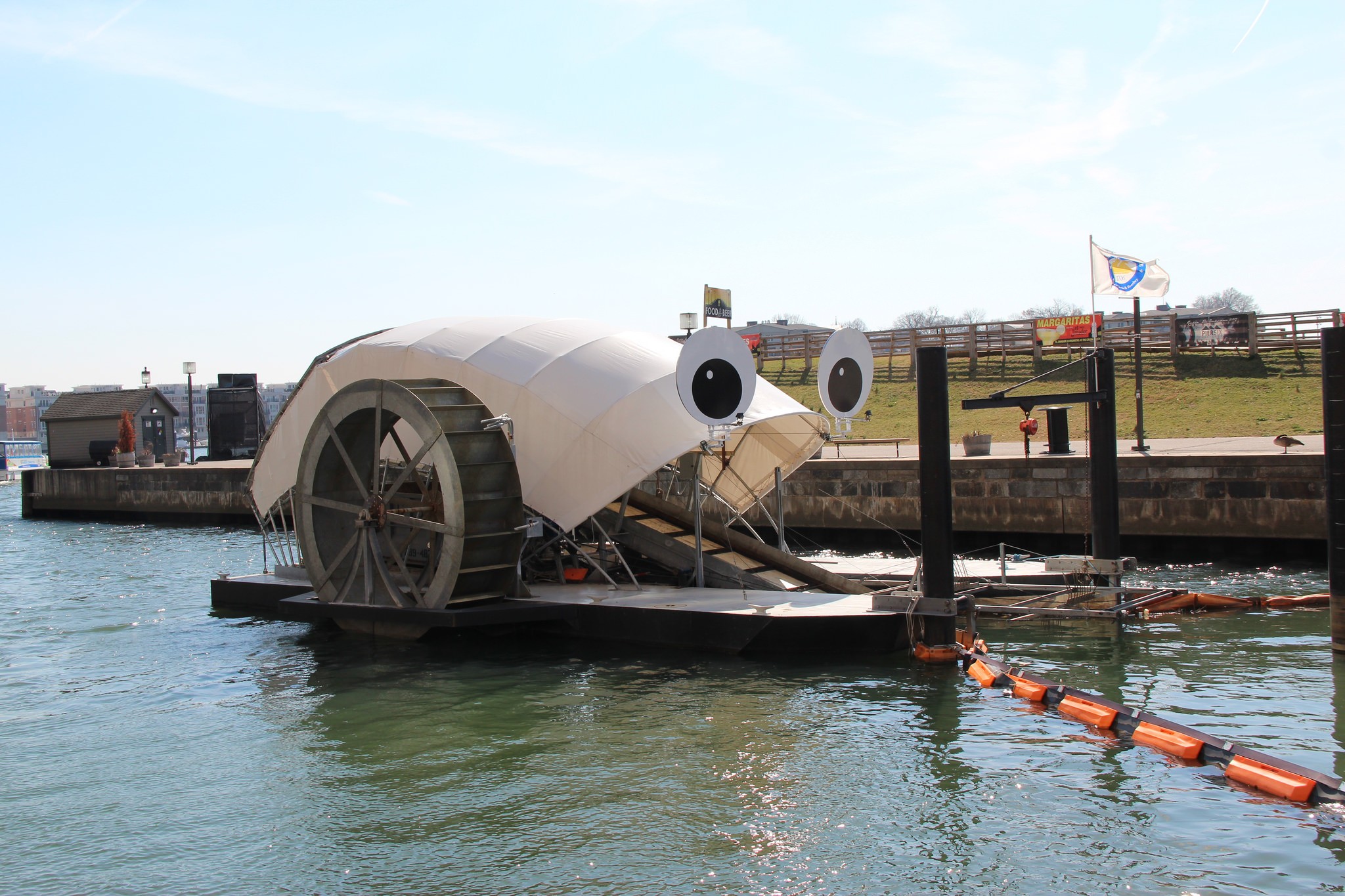
Photo: The Waterfront Partnership Known as “Mr. Trash Wheel,” this floating device sucks up plastic from polluted harbors.
There’s an ongoing controversy about whether the energy spent on cleaning up trash in the ocean and other waterways should be devoted to eliminating trash at its source. I’m inclined to think we need to try everything.
Baltimore’s Mr. Trash Wheel is an example of dealing with the litter that got away.
Jackie Snow wrote about it at National Geographic. “Mr. Trash Wheel and Professor Trash Wheel, the latter of which was installed in December, are solar- and hydro-powered trash interceptors based in Baltimore’s Inner Harbor, clearing debris before it enters the Chesapeake Bay. Over a million pounds of trash has been pulled out of the water by Mr. Trash Wheel since it was installed in May 2014.
“The trash wheel’s creator, John Kellett, worked on the harbor for years and saw garbage floating on the water every day. A sailor and engineer, he approached the city and offered to take a stab at cleaning up the harbor. He built a pilot trash wheel and installed it in 2008. …
“The Waterfront Partnership of Baltimore, a local nonprofit organization that works on the harbor, noticed a significant reduction of the amount of trash during the pilot program. The organization approached Kellett and offered to get the funds for a bigger trash wheel. The result was installed at the end of the Jones Falls River, which empties into Baltimore’s Inner Harbor. Besides the pilot, no other like it had existed.
“ ‘No one knew what they were getting themselves into,” said Adam Lindquist, the director of Healthy Harbor Initiative at the Waterfront Partnership.
“The contraption works by drawing power from solar panels and the current of Jones Falls River to turn a waterwheel, which in turn powers a conveyer belt. Containment booms direct the trash towards the conveyer belt, which then drops the debris into a waiting Dumpster. That bin sits on its own platform and can be floated out when it’s time to change it.
“Kellett keeps track of the garbage pulled out of the water. The haul includes almost nine million cigarette butts and over 300,000 plastic bags. The data is used to support environmental legislation. For example, the Waterfront Partnership recently supported a bill that would ban Styrofoam containers. Mr. Trash Wheel picks up an average of 14,000 Styrofoam containers a month, second only to cigarettes. …
“The waste is most often common consumer products, but some unusual things turn up occasionally, like a live ball python—which the National Aquarium in Baltimore helped rescue — and a keg, which was returned for a deposit. Once, an acoustic guitar in pretty good shape turned up. Lindquist asked to keep that one.”
More here and here, where you can see a diagram explaining how it works.
I think this children’s book, reviewed at Brain Pickings, is one I need to buy.
Maria Popova writes, “This Moose Belongs to Me (public library) — a disarming story about a boy who believes he owns his pet moose Marcel, only to discover that so do other people, who call him by different names, while the moose himself doesn’t quite get the concept of being owned and is thus oblivious to the boy’s list of rules for being a good pet. …
“For the backgrounds of his illustrated vignettes, Jeffers reapporpriates classical landscape paintings by a mid-century Slovakian painter named Alexander Dzigurski, rendering the project a sort of posthumous collaboration and a creative mashup.”
Read the intriguingly philosophical Brain Pickings review here.
And here is a children’s book reviewed by Asakiyume that embraces insights about both the environment and other cultures.
She writes, “Discarded plastic bags are more than just an ugly nuisance in the West African nation of the Gambia. There, plastic shopping bags kill livestock that eat them and provide a breeding ground for malaria-carrying mosquitoes.
“A woman named Isatou Ceesay found an ingenious solution. She learned how to make plarn [yarn made from plastic bags], and, with her friends, started crocheting small change purses from the discarded plastic bags, which she and her friends sold. The trash problem — and attendant health risks — disappeared, and Isatou and her friends had a new source of income. The project was so successful that Isatou started teaching women in other villages, and in 2012 she won the International Alliance for Women’s World of Difference award.






 Suzanne's Mom's Blog