
Photo: Associated Press.
This image from the National Oceanic and Atmospheric Administration [NOAA], shows a North Atlantic right whale in the waters off New England, May 25, 2024.
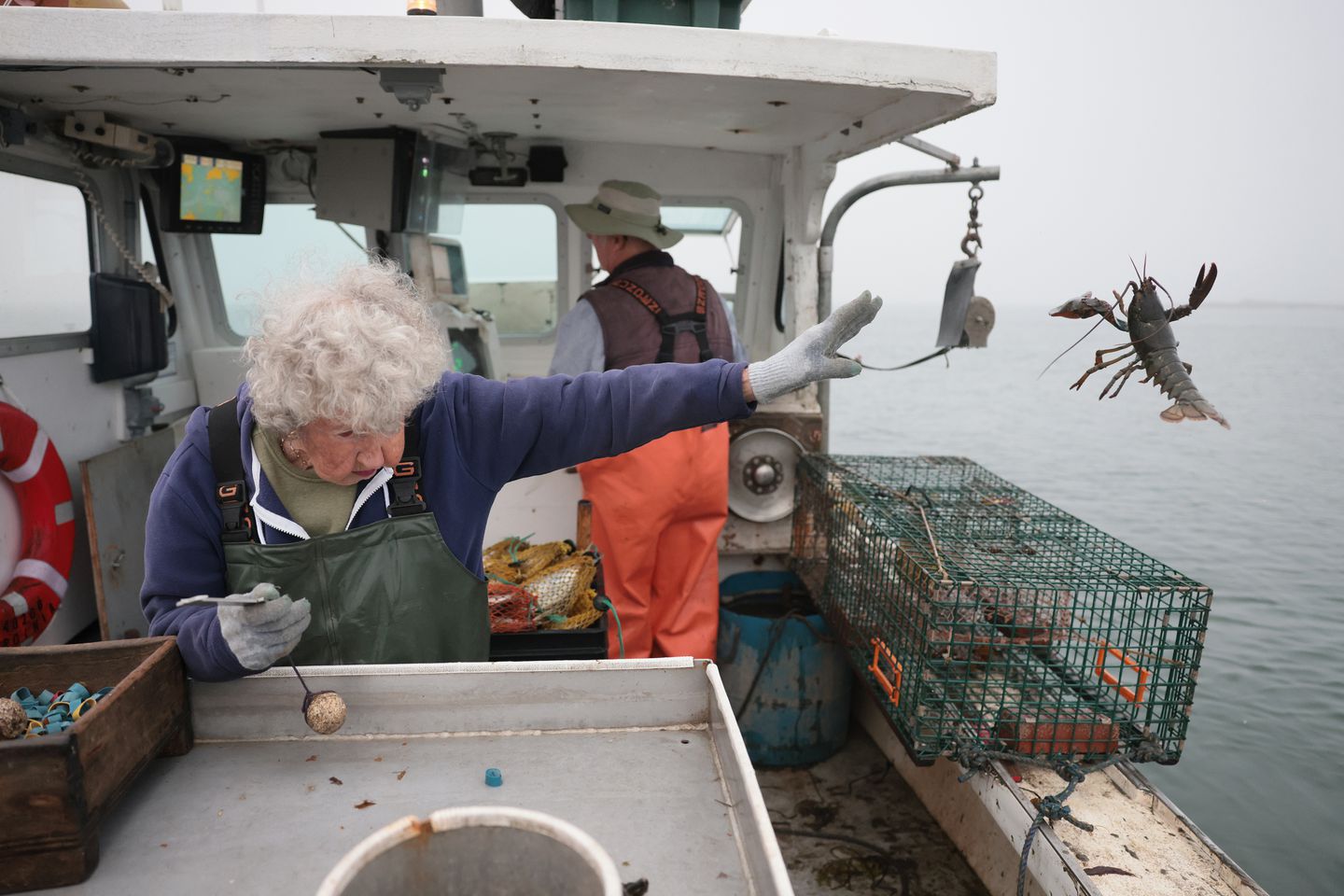
Recently a long Inside Climate News essay about NOAA’s efforts to get lobster fishermen to switch to ropeless gear — and save a few whales — appeared in the Boston Globe. The approach is sound but costly for lobster fishermen struggling to make a living.
Kiley Price wrote, “It was a blessedly calm day as Scott Landry’s team set out in their inflatable boat to scan the glistening waters of Great South Channel between Rhode Island and Massachusetts for an endangered whale affectionately known as Wart. They were on a mission to save her life.
“The group, from the nonprofit Center for Coastal Studies located in nearby Provincetown, had spent the better part of three years monitoring Wart after an aerial team spotted the North Atlantic right whale with a large piece of rope lodged in her mouth.
“Instead of coming loose on its own, the fishing rope slowly tangled itself deeper into Wart’s baleens, hindering her ability to eat and reproduce. Finally, Landry’s team decided to take a more hands-on approach — a dangerous but necessary last resort. …
“His team had to rig up a tool that could slice the rope at a distance — essentially a crossbow with an arrow like a throwing star. Eventually, Wart came up for air close enough to Landry’s dinghy for him to get a single clean shot. He took a breath and fired. The whale immediately dove underwater again, leaving the team in suspense. A few minutes later, she popped back up, revealing the knife had cut right through the chunky rope. …
“Wart’s case is a rare bright spot in the pervasive problem of rope entanglements, one of the leading causes of death for whales. …
“The situation is particularly dire for North Atlantic right whales like Wart, with only around 350 left in the wild. Found along the East Coast of North America, the whales’ migratory paths overlap with highly productive lobster fishing areas in Maine and Massachusetts, where scientists say the whales struggle to dodge copious amounts of gear and traps. …
“Scientists and conservationists are scrambling to find a strategy to reduce entanglement risk without threatening the lobster industry, which is facing its own struggles with climate change. In recent years, a seemingly simple approach has taken center stage: getting rid of the rope.
“The traditional lobster traps that sit on the seafloor are connected to the surface by a line of rope attached to a floating buoy. But the National Oceanic and Atmospheric Administration (NOAA) is working with manufacturers and partners to help develop different high-tech traps that they can sink to the seafloor without the rope tethered to the surface — in hopes of giving whales an unobstructed path through fishery waters. Then lobstermen can use a device to call these wireless traps back up to the surface with their catch.
“Officials say this ‘ropeless’ on-demand gear could help people continue to work during seasonal fishing closures. Enacted by the federal government in New England over the past decade, these restrictions limit lobster harvesting at different times of the year during the whales’ migration season. As whale populations struggle to bounce back, more potential closures loom. …
“The problem? Many lobstermen don’t want it.
“Rob Martin’s lobster boat carved through the gray waters off Cape Cod’s Sandwich Marina this May, temporarily transformed into a gear testing laboratory. NOAA scientists and tech experts had squeezed in alongside Martin, a Massachusetts lobsterman, and his crewmate, former lobsterman Marc Palombo.
“Martin brought the boat to a halt once they were far enough out in the bay, and the team dropped on-demand traps into the water, which quickly sank to the seafloor. Several minutes later, Martin activated the gear using a device onboard. … A few yards away, a bright yellow buoy that had been underwater a moment before now bobbed in the water. Martin and Palombo fished the float out of the water, revealing a cage with a string of lobster traps attached to it. …
“This year, fishers from 19 vessels participated in restricted area trials using on-demand equipment borrowed from a NOAA-run ‘gear library’ located in Woods Hole, Massachusetts. Under a special permit, the participants are allowed to keep and sell their catches throughout the winter and spring months. …
“The end goal for these ropeless gear efforts is to give lobstermen an option to get back out on the water during seasonal fishing closures or restrictions. That includes one in place since 2015 across a stretch of Cape Cod Bay every February to April. The federal government is likely to establish new large closures in just a few years to prevent right whales from going extinct. …
“In 2022, the Massachusetts Division of Marine Fisheries published a report to assess the feasibility of ropeless gear throughout the state, produced by the ocean policy consulting company Homarus Strategies. To assess potential economic impacts, Homarus combined the estimated costs of switching to ropeless gear with the potential loss of revenue from the additional time it takes to operate the gear compared to traditional traps — and the findings were stark. If the government mandates a fisheries-wide shift to ropeless gear, the state could lose around $24 million in revenue per year, according to the report.
“There’s a big caveat to that conclusion: The government has no plans to require this type of shift, said Colleen Coogan, branch chief for the Marine Mammal and Sea Turtle Team at NOAA Fisheries Greater Atlantic Region’s Protected Resources Division.
“ ‘We’ll never require fishermen to use ropeless gear, but that means that if they don’t use it, there will be areas that will be closed for fishing,’ she told Inside Climate News. ‘It’s more that the closure is what helps the whales; the ropeless [gear] is what helps the fishermen.’ …
“ ‘Personally, I don’t think there’s anything that they’re going to be able to do to make it viable … to deal with the financial burden,’ said Cape Cod lobsterman Jeff Souza, whose house is the collateral for a loan he took out a few years ago to build a new boat. … ‘I just want to keep being able to fish and not go broke.’ …
“In the fight to pull right whales back from the brink of extinction, there is a bright spot. Last year, NOAA released the annual population estimate for the species using the most up-to-date data, and found that the rate of their decline is slowing down, likely due to the regulations protecting them. Research suggests that ropeless gear could further help. …
“Landry thinks whales can deal with ‘some level of challenge that we throw at them, but, you know, it’s pile upon pile. There’s the changing of the prey, there’s the rope, there’s the boats. You’re asking a lot of a population of 350 animals.’ ”
More at Inside Climate News via the Globe, here.







 Suzanne's Mom's Blog