Feeds:
Posts
Comments

Posts Tagged ‘loneliness’

Photo: Jamie Fullerton/The World.
A snowman figurine made by the woodworkers at the Witney Shed, part of the UK Men’s Sheds Association.

In my retirement community, there are two or three times more women than men — and more activities geared to women. It’s not surprising that some male residents become a prey to loneliness. Loneliness can plague older men anywhere, not just men in retirement communities.

That’s why some countries have taken the concept of the backyard work shed where men hang out alone and put it in more of a group setting.

Jamie Fullerton writes at the radio show The World, “In the United Kingdom, there is a gently mocking stereotype about older men and sheds — the wooden outhouses usually found at the end of a garden.  The cliche image is of an elderly man tinkering with tools for hours, alone and avoiding the outside world.

“Things are more social in The Witney Shed, in the town of Witney in Oxfordshire, southern England. 

“ ‘I just like coming here; it’s the camaraderie with everybody,’ said Tony Halcrow, a regular visitor to the Witney Shed, as he worked on a lathe, making wooden Christmas decorations. ‘And it gets me out of the house.’

“In the large shed, situated behind a church-run community center, there’s space for about 10 shedders, as they are known, plus a few more working in the garden outside. They’re making bird boxes and other wooden objects, occasionally pausing for coffee and light banter.

“The Witney Shed is one of around 1,100 community sheds in the UK, affiliated with the UK Men’s Sheds Association. The charity originated in Australia, and was set up in the UK around a decade ago, primarily to help older men tackle loneliness.

“Some British community sheds charge small fees, but people can turn up to the Witney Shed for free, then join in with woodwork or just have a coffee. Most people who visit are seniors, but people of all ages are welcome. ‘Anybody can come, even ladies,’ said Phil Tarry, co-founder of the Witney Shed. …

“The shedders make wooden items like bird boxes, bat boxes and Christmas decorations, and sell them locally at cheap prices, to help fund the shed. They also help out local residents, schools and the church where the shed is based. ‘On a Monday morning, the first thing is a toddler group in here, and they’re our best customers, for repairing toys’ [says Tarry].

“Over a third of shed leaders said they believed that their community shed may have helped prevent a suicide. Tarry said he certainly thinks so.

“ ‘Loneliness is a very big part of it,’ he said, ‘because there are a lot of lonely people out here. I live in sheltered housing, and I know what it’s like. Some people don’t see anybody from one week to another, and it is important to get those people to come out.’ …

“Local doctors have told some of their mental health patients about the shed. A couple of men with dementia also visit.

“ ‘You’ve got to be very patient because, with people with dementia, they’ll come and say, “What can we do today?” and you say, “Oh, can you sand this?” They’ll go off, then come back and say, “What are you doing today?” You’ve got to be patient and say, “Yeah, it’s OK. Sand this,” ‘ Tarry said.

“Rachel Meadows, who works as the volunteer and community development manager for the UK Men’s Sheds Association, said … ‘We hear a lot that people find it easier to talk to each other when they’re engaged in an activity. … It’s easier to talk shoulder-to-shoulder, rather than face-to-face,’ she said. ‘Somebody’s not looking you in the eye and asking you to talk about your feelings, but there’s usually somebody at the shed who’s maybe been through something similar, or can relate to how you’re feeling.’ …

“Nearby, an older man sat alone on a bench. Tarry asked him if he was OK. The man said he was fine, but a bit confused. But later, he suddenly stood up and started helping another man, glueing together a bird box. …

“Tarry said that his main problem is that the Witney Shed is so popular, they’ve decided their next woodwork project needs to be a shed extension.”

More at The World, here. No firewall. Charming photos.

Read Full Post »

Photo: Oscar Espinosa.
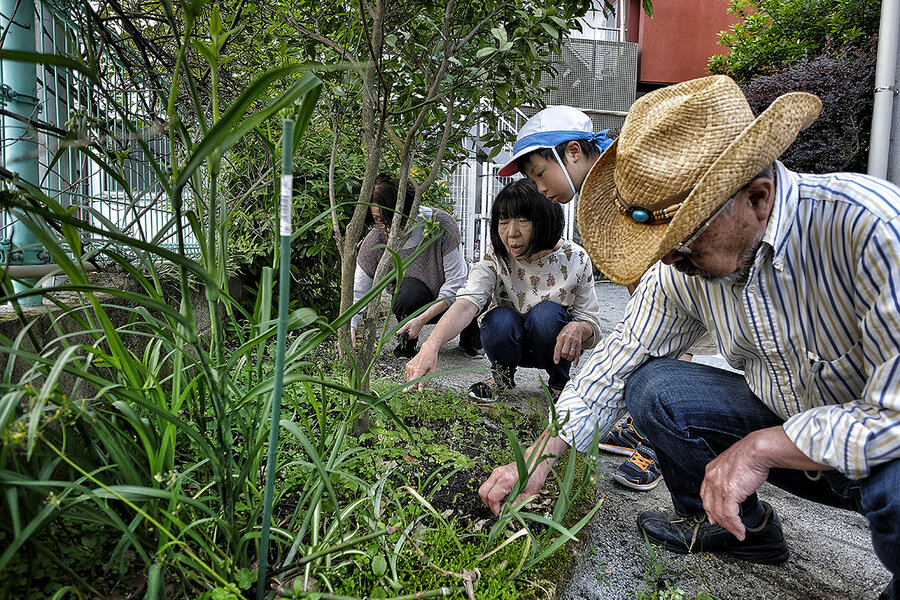
Residents of a Japanese apartment building designed to combat loneliness in seniors are seen weeding with a boy from the child development center on the first floor.

Social media, working at home, and lack of face-to-face interaction are among the reasons for the increased isolation of all ages in our world. Isolation is not good for individuals or for society.

At the Christian Science Monitor, Oscar Espinosa describes an apartment building in Japan specially designed to bring people together more.

“A message on a small whiteboard near the elevator,” he writes, “is a reminder that dinner in this apartment building is tonight at 7 p.m., as it is once every month. Many of the residents are likely to attend, since being together is the point.

“Nagaya Tower, in the peaceful city of Kagoshima on the Japanese island of Kyushu, houses 43 people, ages 8 to 92, including a family with five children. With shared community spaces, the tower was built so that different generations could meet and interact. The staff is dedicated to supporting residents and connecting them with each other to generate that community life so important to combating the loneliness of older people, which has become a significant problem in Japan’s increasingly aging society.

“ ‘This community is inspired by the ancient nagayas of the Japanese Edo period,’ says Nomura Yasunori, who moved here five years ago with his wife. ‘From children to the elderly, families, singles, from different occupations, all lived together in the same long compartmentalized house.’

The building was designed in a V shape so that everyone could see each other when they enter or leave their homes.

“[In 2021], the Japanese Cabinet Office appointed a minister for loneliness and social isolation. … According to a survey conducted in 2017 by Japan’s National Institute of Population and Social Security Research, 15% of older men who live alone talk with one person or no one every two weeks, while 30% feel they have no reliable people they can turn to for help in their day-to-day lives.

“Dozono Haruhiko, founder of one of Japan’s first palliative care clinics, saw how his patients could suffer from social isolation. He believed that what these patients needed was human interaction, and so, in 2011, he applied for a government grant with his idea for Nagaya Tower, which was completed in 2013.

“By 6 p.m. on this evening, residents are starting to arrive with food for the communal dinner. Some of them rearrange tables to form a single one that takes up almost the entire room; others go to the kitchen to lend a hand.

“ ‘After coming to Nagaya Tower I feel rejuvenated,’ smiles Kukita, who arrived three years ago with his wife. … ‘Here you stay young because you are surrounded by children and young people.’ Kukita says he walks every day in the park, swims in the pool, participates in the art workshop once a month, and, above all, takes every opportunity to talk and spend time with the children.

“ ‘I can learn a lot from the elderly people through the exchange,’ says Takai, who is in his 30s and is one of the younger residents. ‘We help each other from time to time if we have a problem.’

“The building was designed in a V shape so that everyone could see each other when they enter or leave their homes, allowing them to greet each other, which is not common practice in other places, according to Moemu Nagano, age 27, who has lived here for two years. …

“After dinner, Kawasaki Masatoshi sings Bob Dylan’s ‘Blowin’ in the Wind’ to a standing ovation, making it clear that Nagaya Tower’s motto, ‘Life is happy when you have someone to smile with,’ is more than just a phrase on a piece of paper. He loves community life and boasts of being resident zero, when he moved in 10 years ago.

“ ‘I signed up before the construction of the building was finished, and I will stay here for the rest of my life,’ Mr. Kawasaki says.

More at the Monitor, here. No firewall. Charming photos. And for more insights on communal or supported living, read the blog Making Home Home, here.

Read Full Post »

Photo: Suzanne and John’s Mom.
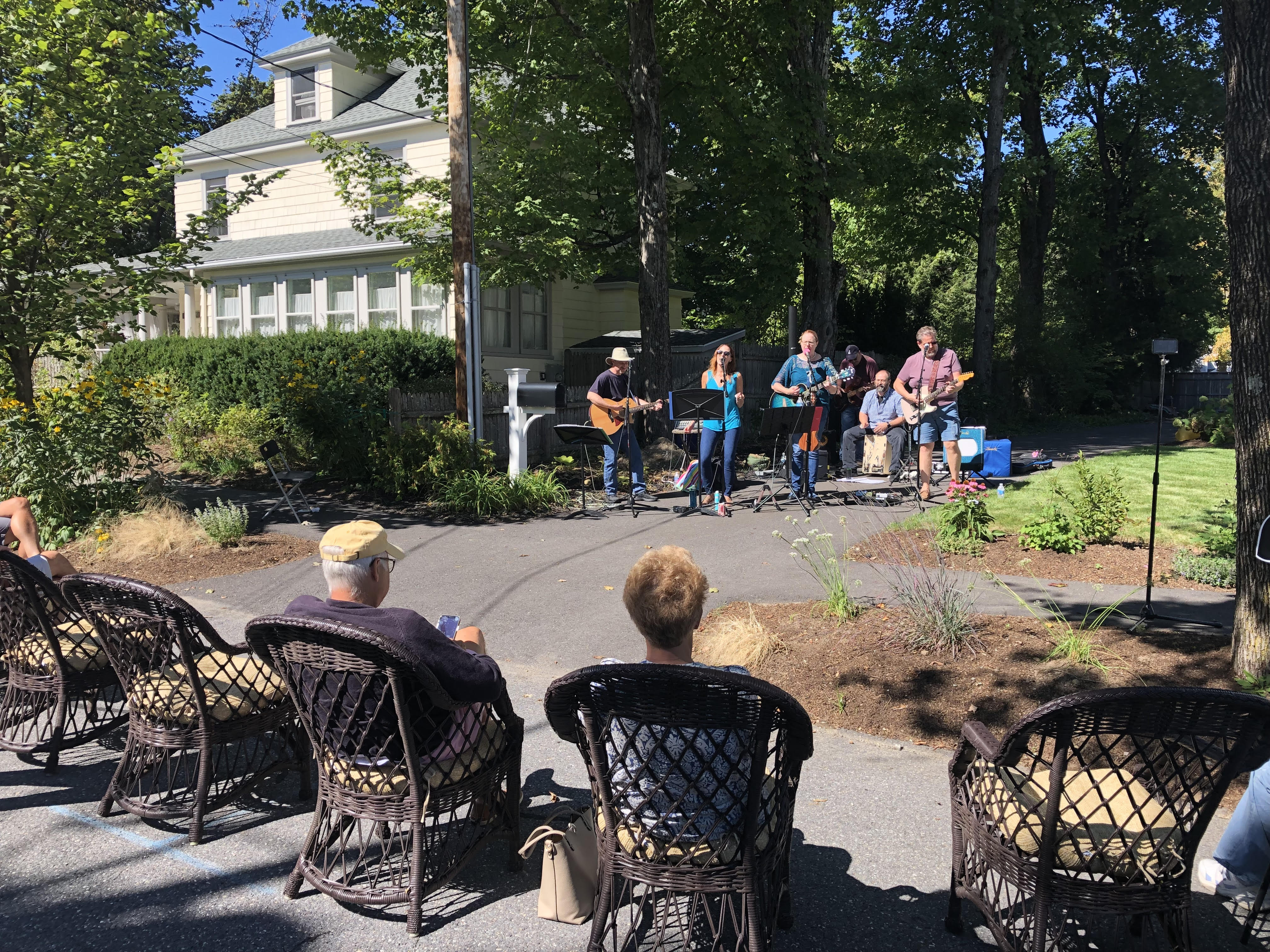
Porchfest events in Massachusetts towns promote neighborliness.

When Sara and I traveled together at age 16, one of the many things I learned from her was that it was perfectly fine to be friendly to strangers under some circumstances. You know, for example, how women who don’t know each other may strike up a conversation in a restaurant ladies room? That’s the kind of thing that was a revelation to me.

Nowadays, some folks have gotten more wary. Too wary. It is one factor in an epidemic of loneliness.

Sophie Hills  writes at the Christian Science Monitor, “Lida and Mark Simpson sit on the steps of their porch with friends while the blues rock band Red Medicine plays in a yard across the street. People crowd all four corners of the intersection, dancing and chatting. It’s PorchFest in Petworth, a neighborhood of Washington, D.C. Some 100 performers will play on porches and yards throughout the day. A new group of people walks up, searching for space with a view of the band. ‘Sit, sit,’ says Ms. Simpson with a big smile, gesturing toward the wall at the edge of the yard.

“The Simpsons, who have a 4-year-old and a 6-year-old, chose Petworth because it’s walkable, close to restaurants and playgrounds and public transit, and still has a neighborhood feeling. When they first moved in eight years ago, Ms. Simpson says she hoped for an active front porch culture. But it didn’t quite coalesce until people began socializing from their yards in 2020. Happily, says Ms. Simpson, ‘porch and stoop culture restarted during the pandemic, and it’s stayed around.’

“[This spring], the U.S. surgeon general declared an epidemic of loneliness and isolation, saying that 1 in 2 adults reported experiencing loneliness even before the pandemic. At a time when neighborliness is decreasing and Americans are growing further apart, some, like the Simpsons, are intentionally building relationships within their communities. And events like porch fests are growing in popularity. Central to a culture of neighborliness, many say, are front porches. …

“ ‘As it has built for decades, the epidemic of loneliness and isolation has fueled other problems that are killing us and threaten to rip our country apart,’ wrote Surgeon General Vivek Murthy in the New York Times on April 30, announcing a framework to rebuild community. …

“A front porch is a liminal space, says Michael Dolan, a writer and editor in Washington. ‘It’s the outside of the inside and the inside of the outside. … When people who have [porches and stoops] don’t use them, they’re missing out on the opportunity to interact with the environment. [And] the environment includes humans and includes passersby, includes somebody coming up to ask directions, includes somebody coming by to say hello.’

“The type of neighborliness embodied by Mister Rogers is no longer the norm. Over half of Americans say they only know some of their neighbors. … Over half of Americans who say they know some of their neighbors say they never get together socially, according to a Pew study from 2019.

“It takes curious and open people to build the kind of community that has block parties, borrows ingredients, and watches each other’s kids, but social spaces like front yards and porches are important too, says [Campbell McCool, founder of a Mississippi development that centers community life]. ‘A front porch is central to the whole personality of a neighborhood,’ he says. …

“Historically, Mr. McCool says, three things sped the decline of the front porch in suburbia in the 1950s: air conditioning, television, and the car. Air conditioning and TV coaxed people indoors. Cars meant more people lived further apart from each other.

“When sociologists began studying differences between residents in neighborhoods with and without porches, they found that in the latter there was little to no interaction. People drove straight into their garages, and private backyard decks grew in popularity. …

“Today, polls show that older Americans are more likely to have neighborly connections. Just 4% of Americans over 65 say they don’t know any of their neighbors, compared with 23% of adults under 30. …

“Karen Goddard, who prefers porches to private decks, calls herself a ‘professional porch sitter’ in her attempt to make neighborliness popular again. …

“The point, Ms. Goddard says, is to meet on front porches without agendas, minutes, or formality – ‘just meeting and conversation.’

“It resonated with Ms. Goddard as something she was already doing. ‘My friends in my neighborhood in New Hampshire knew that they could come to my house any Friday night and hang out on the porch,’ she says. …

“ ‘I like to smile and make eye contact and say “hello” if possible, because I just think that’s important for human connection and for neighbors.’

“The porch has always been a place of social interaction, says Mr. Dolan. That’s been his experience for the four decades he’s lived in the Palisades neighborhood of Washington, where he says neighborliness shines. …

” ‘I like to answer my door and say hello to the people who come to my house,’ he says. ‘[One gains] the feeling of trust in the neighborly compact, the ability to rely on one’s neighbors and call one’s neighbors. … Or even if your neighbors bother you, … you tolerate them because they’re neighbors. So it’s a sense of place that reinforces your feeling of being part of something.’ ”

More at the Monitor, here. No firewall. Subscriptions welcome.

Read Full Post »