Feeds:
Posts
Comments

Posts Tagged ‘los angeles’

Photo: Jordan Freeman/Sam Shoemaker.
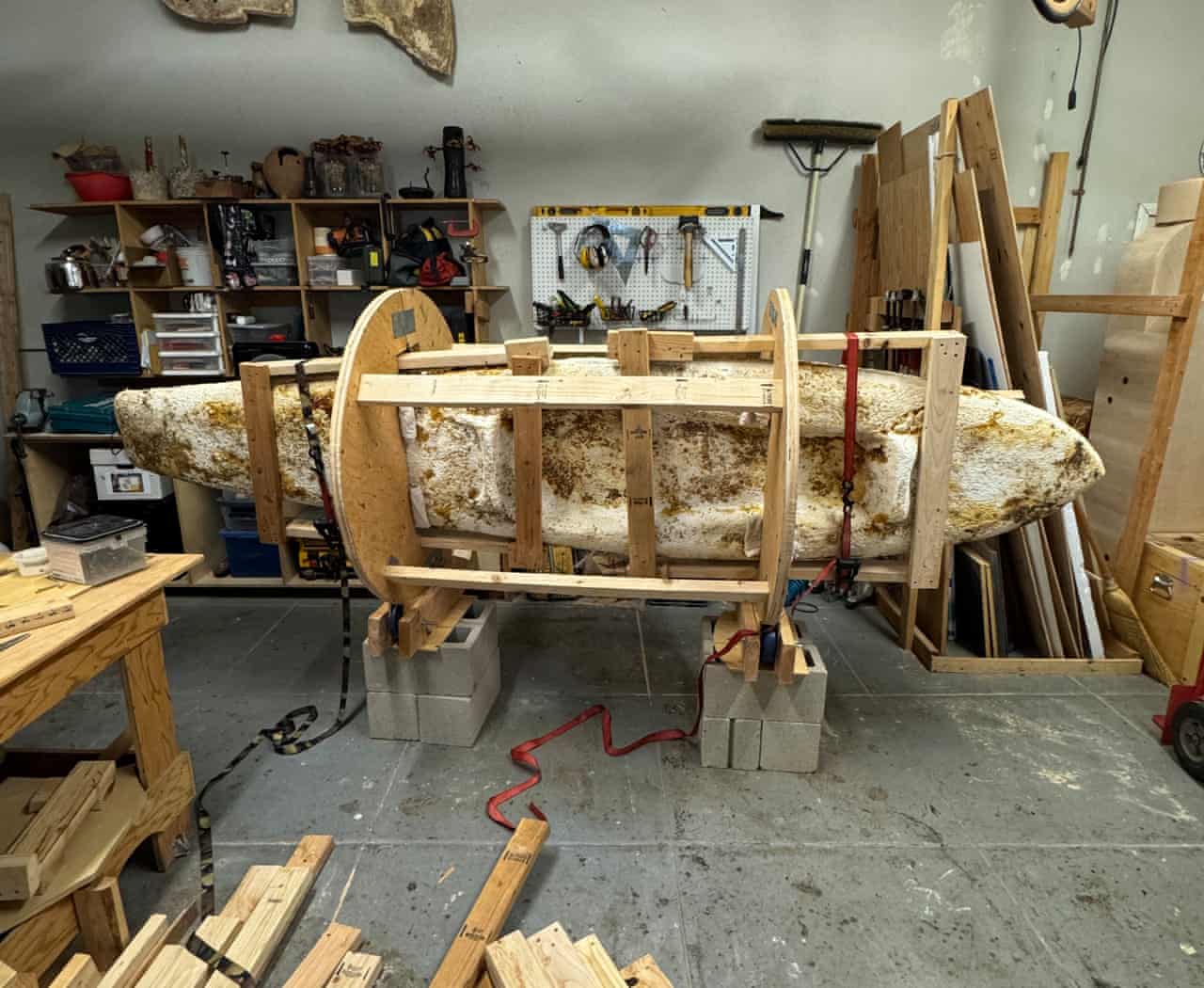
Sam Shoemaker made a kayak entirely from mushrooms.

Mushrooms! What next?

This week I chatted with Ann about a class where she learned to use mushrooms for natural dyes. And you may remember a post, here, about human caskets made from mushrooms.

But, wait! There’s more, says Open Fung, a nonprofit advancing the future of fungi-based technologies, materials, and the arts. Their latest endeavor: making a kayak from mushrooms.

Lisa Kwon reports at the Guardian, “On a clear, still morning in early August, Sam Shoemaker launched his kayak into the waters off Catalina Island and began paddling. His goal: to traverse the open ocean to San Pedro, just south of Los Angeles, some 26.4 miles away.

“But upon a closer look, Shoemaker’s kayak was no ordinary kayak. Brown-ish yellow and bumpy in texture, it had been made – or rather, grown – entirely from mushrooms. His journey, if successful, would mark the world’s longest open-water journey in a kayak built from this unique material.

“With his phone, GoPro camera, walkie talkie, and a compass affixed to his life vest, Shoemaker left shortly before 6am in order to avoid the worst of the swells in the forecast. But three hours in and powering through his ninth mile, the coastline still out of sight, Shoemaker began feeling seasick.

“Suddenly, he heard the sound of a large animal breaching the waters. To his left, a fin whale flashed its glistening tail, then trailed slowly behind him. As the 50-ft creature followed him for three more miles, Shoemaker found the strength to finish out the maiden voyage … which took him 12 hours.

“As he stumbled onto shore with his mushroom kayak still intact, the artist and mycologist embraced his friends and family. …

“Shoemaker began his career as an artist creating sculptures with propagated mushrooms. Upon returning to Los Angeles after graduating from Yale with an MFA in 2020, he began exhibiting artwork that captured the unique behavior of mushrooms as they grew out of hand-built ceramic vessels and blown glass. … Shoemaker now belongs to a small community of scientists and artists exploring the potentiality of fungal innovation as an alternative material that could be used in everything from kayaks and buoys to surfboards.

“Their focus is on mycelium … a pivotal connective tissue in the animal kingdom. Mycelium-based materials in an aquatic context are known as AquaFung, a term coined by Shoemaker’s mentor Phil Ross, an artist and the co-founder of a biotechnology company called MycoWorks that engineers mycelium-based materials including a mushroom ‘leather‘ that can be used in furniture, handbags and biomedical equipment. After cofounding MycoWorks, Ross cofounded Open Fung. …

“Ross argues that AquaFung has many of the appealing properties as plastic – such as being lightweight and buoyant – but without the harmful footprint. …

“Shoemaker began working on his first mycelium boat in 2024. …

He modified a used fishing kayak to serve as his fiberglass mold, then grew the mycelium network inside the mold …

“Shoemaker meticulously dried the resulting kayak composite structure using fans over the course of several months. …

“Confident in his prototype, Shoemaker began searching for appropriate support. Shoemaker met Patrick Reed, the lead curator of the Pasadena-based arts organization Fulcrum Arts, in December 2023 through mutual friends. After a studio visit, Reed was blown away by everything that the artist had to show him. … Shoemaker completed his second mushroom boat in June; grown from the same wild Ganoderma polychromum mycelium. …

“The completion of Shoemaker’s boat marks the second ever water-tested mushroom boat to be made after Katy Ayers, who holds the Guinness World Record for growing, then testing, what was then the world’s longest fungal mycelium boat on a Nebraska lake in 2019.

“ ‘A lot of people really didn’t think it was possible,’ says Ayers, who grew her boat after being inspired by a documentary called Super Fungi. …

“Ayers and Shoemaker credits mycology pioneers like Ross for making the technology more accessible. And mushroom-based materials are slowly beginning to pop up in the mainstream: In 2021, Stella McCartney made headlines with its launch of the world’s first-ever garments made from lab-grown mushroom leather, in consultation with Ross.”

More on the future of fungal materials at the Guardian, here. No paywall: Please consider offering some financial support to the Guardian.

Read Full Post »

Photo: Danielle Duran Zecca/Amiga Amore.
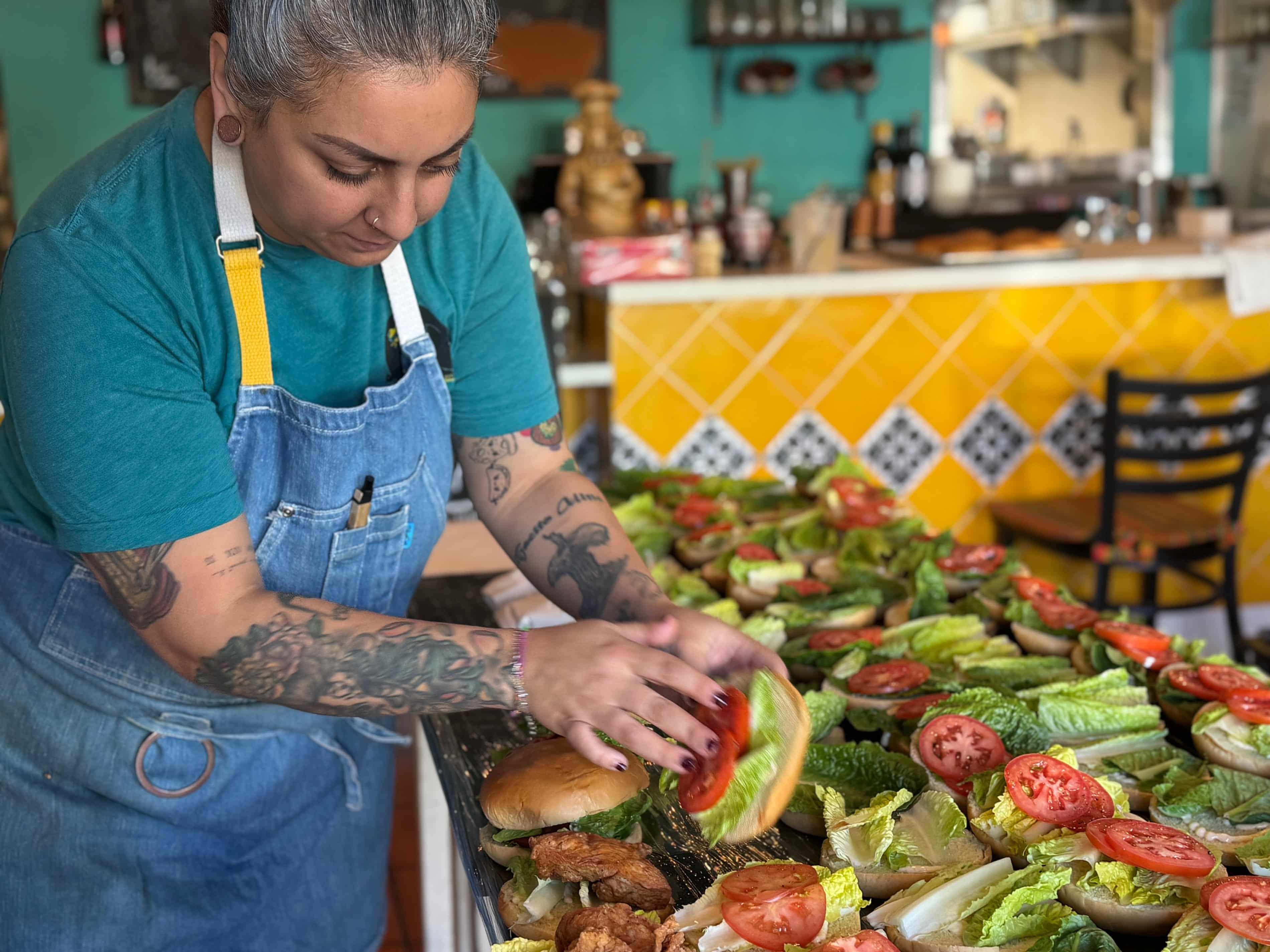
Danielle Duran Zecca, co-owner of Amiga Amore in Highland Park, Los Angeles. 

Well, in one way, this is a time of great opportunity. There are endless opportunities in the US to meet the growing needs. Endless opportunities to practice charity in daily life.

A chef in Los Angeles knew opportunity as soon as she saw it. The revealing moment took the form of government officers in masks snatching people off the streets.

Victoria Namkung reports the story at the Guardian.

“When Danielle Duran Zecca saw military-style immigration raids and people being snatched off the streets and put into unmarked vehicles in her native Los Angeles earlier this summer, she was in disbelief. …

“Duran Zecca, a James Beard Award nominated chef and co-owner of Amiga Amore in Highland Park, a historically Latino neighborhood in north-east LA [said] ‘I didn’t know what to do, but I knew how to feed people and love on people because that is exactly how I was brought up in my family.’

“When several of Duran Zecca’s workers expressed fear about coming into the restaurant, the chef had a realization.

“ ‘If they didn’t want to leave their homes, how many others were like this and how many weren’t eating,’ she said. Earlier in the year, Amiga Amore received donations that allowed the Mexican-Italian restaurant to give meals away to those affected by the LA wildfires, but this time she would need a different approach, one that made people feel safe.

“Duran Zecca began personally delivering free meals to 25 to 30 people every other Sunday in nearby Boyle Heights. …

“Since ICE began to infiltrate LA in June, once-bustling neighborhoods have become quiet. Vendors locked up stalls in the flower district. Popular taco stands and fruit carts are closed and some restaurants sit empty. Although it is unknown exactly how many people are staying home due to Ice’s aggressive arrests, immigration sweeps at restaurants, farms, Home Depots and even car washes have created a chilling effect on businesses that rely on immigrant labor.

Restaurants such as Amiga Amore and other groups from the food and hospitality industry are stepping in to help people in their community who have nowhere to turn – even while their own businesses are suffering economically. …

” ‘Latinos are not only the backbone to our industry, they are the industry,’ said Duran Zecca. ‘Behind every chef are Latino line cooks ready to make magic happen. All they want to do is work, make a living and feed their families.’

“To make her deliveries twice every month, Duran Zecca receives logistical support from her good friend Damián Diaz, the co-founder of No Us Without You, an LA-based non-profit that provides food security for undocumented people, including back of the house staff from bars and restaurants.

“ ‘The administration has been doubling down on making it much more difficult for the families in the community and also small grassroots organizations like us to really be impactful,’ said Diaz. In the past, No Us Without You had drive-through lines for food distribution, but stepped-up enforcement made that impossible, so they pivoted to working with a coalition of restaurants to serve up to 40 families every fortnight so they can shelter at home.

“ ‘This environment of fear in light of increased enforcement, and really excessive enforcement, is causing folks to miss out on some very key necessities such as doctor’s appointments and going to the grocery store,’ said Rita Fernández director of immigration policy project at UnidosUS, a Latino non-profit advocacy organization. …

“This summer, Congress allocated $170.7bn in additional funding for immigration and border enforcement … creating what some critics call a ‘deportation-industrial complex.’ …

“That’s why many others in the restaurant and non-profit industry have also been mobilizing to bring groceries to immigrants who are in hiding. The Oaxacan-Mediterranean restaurant X’tiosu in Boyle Heights, one of the US’s most heavily Latino-populated neighborhoods, packed 150 bags of fresh produce, dried pasta and other goods that were delivered to people in need by local Oaxacan youth in June and they have continued to support undocumented families. The student-led group, Raíces Con Voz, coordinated food and care package deliveries to more than 200 families, and Aquí Para La Comunidad, which operates throughout southern California, has a growing waitlist.

“Vanny Arias decided to host an impromptu food drive in front of the Offbeat Bar in Highland Park, where she’s a bartender, after realizing people staying home were likely in need of groceries. … Arias organized with other community activists and volunteers to start dispensing basics.

“Once she launched an Instagram account, she started hearing directly from desperate families. ‘People said: “My husband got arrested” or “We’re afraid to leave the house and my kids haven’t eaten in days,” ‘ said Arias. ‘When you’re on the ground you see the hurt and pain in their eyes and hear it in their voices.’

“Since July, Arias’s Nela Food Distribution has grown to deliver free groceries to 150 people in and around Highland Park with the help of community donations, two local food warehouses, a bakery and a team of volunteers. ‘We’re a bunch of people who love their community,’ said Arias. ‘I don’t care what color you are, we’re freaking humans and I’m here for you. You’re not alone.’ ”

More at the Guardian, here. The Guardian is free, but please consider donating to them.

Read Full Post »

Photo: Kevin Winter/Getty Images
After a bad year for wildfire, the Oscars gave the Los Angeles firefighters some well-deserved recognition.

After wildfires devastated the Los Angeles area last winter, Hollywood decided to give the firefighters some love. For men and women who are professionally calm in the face of extreme danger, being around celebrities felt a bit scary.

Jada Yuan reported the story for the Washington Post. “When 12 of greater Los Angeles’s firefighters took the stage at the Oscars … they got a standing ovation so big you could hear it the lobby bar. Screams filled the Dolby Theatre, which had been evacuated in early January when one wildfire ripped through the Hollywood Hills.

“Onstage, Los Angeles Fire Department Capt. Erik Scott earned his laughs, joking, ‘Our hearts go out to all of those who have lost their homes … and I’m talking about the producers of “Joker 2.” ‘ He and his fellow firefighters would take Monday off, but after that, it would be back to work — back to 5 a.m. wake-up calls, back to heartbreaking days, back to being on constant alert in a city that has barely recovered from the destruction wrought by the fires this winter. …

“Was Scott tearing up as the crowd cheered? ‘Maybe!’ he told the Washington Post … laughing sheepishly in the Dolby lobby after the bit. ‘I was not expecting for them to have that standing ovation for that long. I put my head down, and they got louder.’ … He kept emphasizing that they’re mere representatives of thousands of firefighters in the L.A. area. …

“This Hollywood awards season has been as Tinseltown-focused as ever, but for good reason. The devastating wildfires that swept through Pacific Palisades and Altadena, destroying tens of thousands of homes and businesses and killing 29, broke out two days after the Golden Globes. At first, it seemed like awards season might have to be put on hold. Every subsequent event was paused, rescheduled or reassessed as organizers tried to figure out how to honor the artistic achievements of an industry that is the lifeblood of this city without seeming indifferent to the struggles of so many.

“Inviting first responders to the awards shows and honoring their hard work and sacrifices — beginning with the Grammys and continuing through the Critics Choice and Screen Actors Guild awards, all the way through to the Oscars — has allowed the Los Angeles music and film communities to give thanks. …

“Many of the firefighters on the Oscars stage had been deployed for 28 days straight after the fires began, either actively fighting fires in the hardest-hit areas or getting information to the public. A month later, they were back out there, responding to life-threatening mudslides from heavy rains that even swept one firefighter’s car into the ocean.

“They’ve got a story to tell while the stage is theirs. Since the fires, Scott says he’s been dealing with a lingering cough and wheezing, as are others, because even a mask can’t protect you from breathing in toxic smoke for 28 days straight. … He has been put on breathing treatments, and researchers from the University of Arizona have given him and many others a full blood panel to test for heavy metals as part of a multiyear cancer study because of all the particles from vehicles with lithium batteries that were floating in the air.

“The immediate dangers are over, but the long-term ones will persist, and they are similar to those faced by first responders on and after 9/11 — something Scott is eager to explain to anyone who will listen, from the Hollywood A-list on down. … Scott said, ‘It’s part of the inherent dangers of our chosen profession.’ …

“ ‘Firefighters in general, we want to come to work, do our job, put the fire out, and we’re there to help people,’ Capt. Adam VanGerpen said. ‘We’re not looking for recognition. We don’t need praise. So we’re not used to that. It’s overwhelming for the amount of recognition that we’re getting, not just by these awards, but by just the general public coming by the fire station.’ They had so many supplies dropped off at various fire stations that they had to get flatbed trucks to spread the love around. …

“In the field, the LAFD had plenty of celebrity encounters, often with no fanfare and no cameras present. Jay Leno brought barbecue on his vintage fire truck to the Palisades base camp multiple times and would spend all night serving food. Gary Sinise did the same. Singer Steven Tyler invited the LAFD members to his Grammys after-party and then showed up at Station 69 in the Palisades and just hung out. VanGerpen’s favorite, though, was ‘J.T.’ — Justin Turner — the former Dodger who came out with his wife to serve firefighters food till 8 p.m. and then just chilled in the kitchen at the station, FaceTiming everyone’s kids. ‘He’s like a hero to these guys. That’s probably the No. 1 guy these guys want to see.’ “

More at the Washington Post via MSN, here.

Read Full Post »

Photo: SÜPRMARKT.
SÜPRMARKT is the reason a district in Los Angeles went from a food desert to a vegan oasis.

What a difference healthful eating can make! We all know someone who became healthier after changing diet. Unfortunately, communities that grocery chains have abandoned have almost no access to fresh fruits and vegetables or other healthful, nourishing food. In a “food desert,” people may live off fast food or whatever the local gas station or convenience store has on offer.

Nabou Ramu recently wrote at the Guardian about the difference that a vegan market made in what had been a Los Angeles food desert.

“The plate is her canvas,” writes Namu about a Los Angeles resident. “Imani Cohen never wants her dish to look too brown nor too starchy. She gravitates toward foods bright with luminous colors such as greens, purples and orange, during her weekly Saturday visits to the farmer’s market – a ritual she’s kept for herself and family as a way to be intentional [about food]. …

“Growing up in south central Los Angeles a lot of exotic vegetable ingredients Cohen’s mother loved to cook with were not always readily available in the neighborhood. …

“It’s why in 2020 her longtime homegirl, Olympia Auset, started a pop-up, SÜPRMARKT, in front of artist and educator Ben Caldwell’s storefront, KAOS in Los Angeles’ Leimert Park neighborhood to combat the existing food desert that dehydrates south central Angelenos. In July 2024, SÜPRMARKT upgraded into a brick and mortar oasis and became the first vegan grocery store in south central Los Angeles.

“Auset was disappointed that there were only three grocery stores within Crenshaw’s six-mile radius. She started SÜPRMARKT because she hated that residents had to travel miles into Manhattan beach, Marina Del Rey or Westchester to hunt for high value produce.

“ ‘It’s out of our way,’ said Auset, 33, who studied public relations and sociology at Howard University.

“Places such as Simply Wholesome, a Black-owned whole food store, has been a staple on Slauson Avenue and Overhill Drive but are more of an earth pharmacy and health restaurant. …

“SÜPRMARKT is accessibly located … inside a 1,908 sq ft free-standing home. Upon arrival, patrons are greeted by a patio with ample seating. Inside resembles ‘a cozy residential house.’ …

“The market offers a well-stocked selection of fresh, organic fruits and vegetables, including perfectly ripe mangoes, onions, yams, chard and dairy. Their open kitchen allows one to eat clean foods from their menu such as the signature ‘Everyday People’ salad, cornbread, cabbage and vegan gumbo. Customers are also able to purchase items using funds through government- and community-assistance programs.

“Gaining access to vegan processed foods for SÜPRMARKT was difficult for Auset, who said she faced racism and discrimination. One distributor laughed in Auset’s face questioning, ‘vegan ice cream on Slauson?’ Then denying her service citing the neighborhood ‘unsafe.’

“ ‘I have had people do a lot of really weird things when we were going through our permit process,’ Auset said.

“She wants to raise awareness of these problems to make access smoother for people who are attempting to make a healthier oasis in the communities needed most.

“Nearly one in five Angelenos – or roughly 2 million people – are food insecure … defined by the US Department of Agriculture (USDA) as a lack of access to enough food for an active, healthy life. …

“Residents in the four neighborhoods along the Crenshaw district – West Adams, Windsor Hills-View Park and Baldwin Hills – are more than likely to eat fast food and get food from liquor stores or [convenience stores] due to the lack of access to fresh ingredients in the area, according to a study done by students at the University of Southern California.

“ ‘I focus on food injustice and food access because I feel like it’s one thing that we have the ability to solve,’ said Auset.

“However, Cohen suggests that the locals’ inner priorities define what food they have to eat in their hood. As the ‘Hood Healer’ she pushes people in the neighborhood she grew up in to eat with the same self-love she does, and put their health first.

“Diets are ‘impacting our productivity,’ she said. ‘We are functioning under high stress. Let’s start working on changing our diets.’

“She points to the Crenshaw Farmers Market, operated by Food Access LA, that serves a large swath of south central Los Angeles. The market features regional farmers, food and artisan vendors who bring a diverse selection of local produce as well as sprouts, breads, nuts, baked goods and delicious prepared food. …

“The Baldwin Hills Crenshaw farmers market exists at the Crenshaw Mall bringing sustainable food systems that benefit low-to-moderate income residents of Los Angeles and supporting California’s small- and mid-sized farms and local small businesses, their website says.

“ ‘These markets are not well supported,’ said Cohen, who began a social media movement on Instagram ‘Farmers Market Saturday’ where she promotes and connects people to the farm-to-table experience and connect locals with Black farmers. …

“For Auset, quality food is about one thing – keeping people alive.

“ ‘Statistics are not just numbers, they’re actual people. I don’t want to go to my friend’s funeral when we’re 40,’ she said.”

More at the Guardian, here.

Read Full Post »

Photo: Rasmus Hjortshoj.
Dortheavej residence in Copenhagen. Social housing accounts for about 20% of all housing stock in Denmark and is available to anyone, regardless of income.

I’m always interested in housing stories, partly because among the issues that the department I worked in at the Fed addressed was housing. After the mortgage meltdown in 2008, I remember, we had a gigantic event at the Patriots’ football stadium to gather borrowers in danger of foreclosure under one roof with organizations that could help them.

Today’s story looks at new ideas in public housing from around the world. Maddie Thomas reports at the Guardan, “The social housing of last century often calls to mind towering blocks of flats, poorly maintained with dark, pokey and cold units. But alongside a rise in community living, the 21st century has brought quality construction, sustainability, and quality of life to the forefront of social housing design.

“Australia’s commitment to and funding for social housing stock is limited. But by 2037, Australia is estimated to have 1.1 million people seeking social housing. Professor of architecture and head of the University of NSW’s school of the built environment, Philip Oldfield, says that for an investment in social housing to match cosmopolitan cities like Paris or Barcelona, more housing of quality needs to be built.

“ ‘Architects are trained in this … so when they’re given the opportunity to do it well, Australian architects will create as good a housing as anywhere else in the world,’ he says. ‘At the moment, the system, with few exceptions, doesn’t give them that creative opportunity to deliver … the kind of world class social housing we would love to see.’

“While Australian not-for-profits are building design-led affordable housing for low to middle income earners, government-funded social housing for those on waitlists is lacking. Oldfield says organizations like Nightingale Housing are pioneers in built-to-rent housing, with 20% of apartments assigned to community housing providers for those most in need. But examples like Sydney’s Sirius building, previously owned by the state government, show that Australia needs more purpose-built social housing to cater to demand and match international standards.

“ ‘In conventional market-led housing, you build for the people who purchase the house … so you don’t consider as much the energy bills that are going to accumulate over time,’ he says. ‘With social housing, you’re not trying to create a profit so you can consider things like the life cycle costs for housing in a much more significant way.’ …

“Social housing in Denmark is available to anyone, regardless of income. Highly regulated to ensure quality construction, social housing accounts for about 20% of all housing stock in Denmark. In 2013, global architecture firm Bjarke Ingels Group was commissioned by Lejerbo, a Danish organization building housing for those in need, to design ‘Dortheavej’ – a social housing block in Copenhagen.

“Bjarke Ingels’ ‘winding wall’ of social housing has 66 units for low-income citizens, with a small balcony and floor-to-ceiling windows in each.

“ ‘The stacking of prefabricated elements consisting of two kinds of stacked modules, which are repeated to create the characteristic checkered pattern,’ says Kai-Uwe Bergmann, partner at Bjarke Ingels. ‘By gently adjusting the modules, the living areas open more towards the courtyard while curving the linear block away from the street to expand the sidewalk into a public square.’

“The stairwells allow for the units to be filled with daylight, and views of the neighboring green space. Pathways through the site give access to the street. The apartments themselves range from 60 to 115 sq m [~646 to ~1200 square feet], but with open plan designs, space within the units themselves is flexible.”

Read housing stories from Mexico City, Paris, Barcelona, Los Angeles, and Vienna at the Guardian, here; no paywall. You’ll appreciate the variety of approaches around the world and enjoy some great photos.

Making Home Home blog, looking at you!

Read Full Post »

Photo: Melanie Stetson Freeman/CSM Staff.
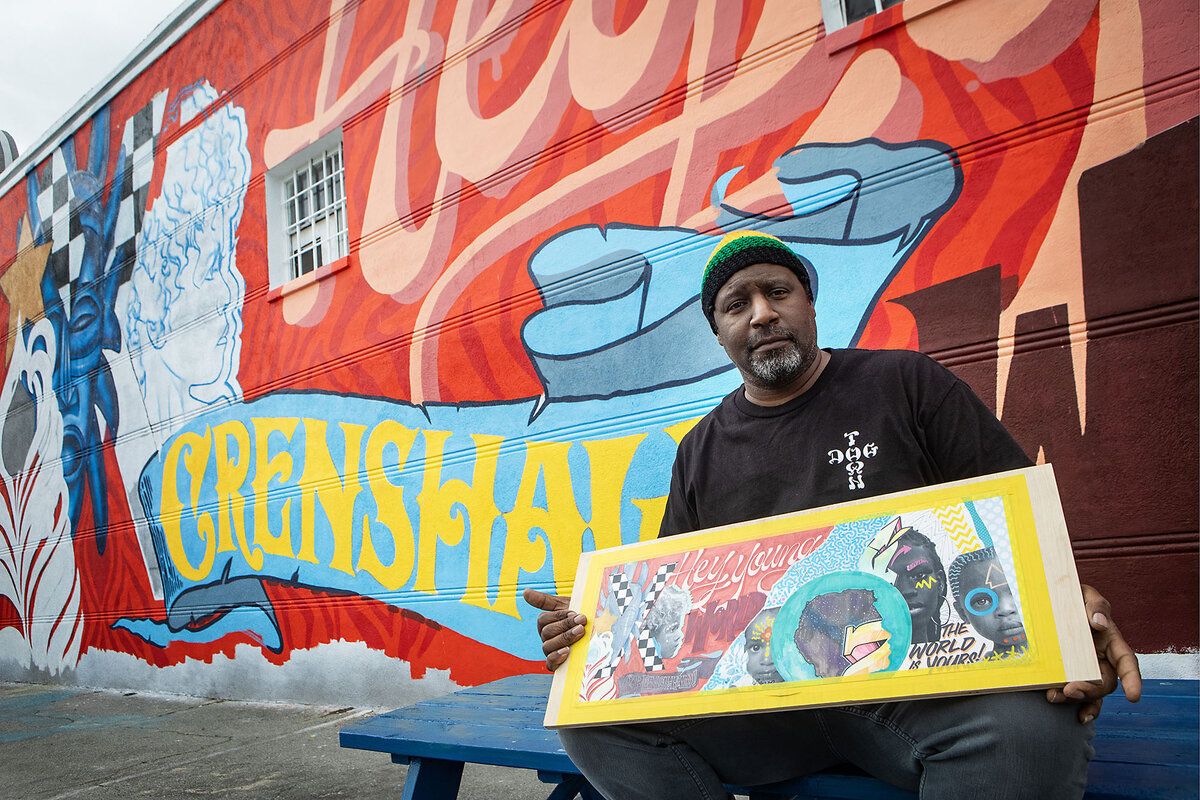
Anthony “Toons One” Martin created this mural as part of a $100 million art-focused initiative in South Los Angeles called Destination Crenshaw.

To bring out the beauty inherent in a marginalized community, you need to get everyone on board. Because the beauty is there.

Ali Martin writes at the Christian Science Monitor about Destination Crenshaw, a part of Los Angeles that used to be known as South Central.

“Growing up in South Los Angeles, Anthony Fagan was ‘very much part of all of the problems that take place in this community,’ he says. Today, he’s overseeing construction on a park that is at the heart of efforts to make the Crenshaw District a must-visit stretch of LA.   

“ ‘We’re going to change lives with this park on so many different levels,’ says Mr. Fagan, an assistant superintendent with PCL Construction. 

“The $100 million initiative has drawn public and private funding to transform a 1.3-mile stretch of Crenshaw Boulevard into the largest Black-centered public art display in the United States. Destination Crenshaw is a holistic plan that weaves economic and community development together with cultural celebration to recast this neighborhood as a tourism center and create economic stability for those who live here – and for generations to come. …

“Destination Crenshaw runs north-south through the Hyde Park neighborhood – part of South LA, known as South-Central Los Angeles until 2003, when the LA City Council changed the name, hoping to dissociate the 16-square-mile area from a reputation for gang violence and race riots. 

“Destination Crenshaw touches three census tracts that fall in California’s highest quartile for poverty and unemployment. On average, about three-fourths of the residents who live in these neighborhoods are Black.

“In the 1950s, South LA had the highest concentration of Japanese Americans in the country. … African American families soon followed, and by the late 1960s, Crenshaw Boulevard was a corridor of flourishing Black-owned businesses. Leimert Park, capping the northern end of the district, was a center of artistic expression.

“Rosemary Williams moved here from Chicago in 1968. She opened Dog Lovers Pet Grooming on Crenshaw Boulevard in 1980. … Ms. Williams’ daughter convinced her to participate in Destination Crenshaw’s mural program, which pairs artists with storefronts. Her reluctance gave way, she said, because of the organizers’ efforts to support small businesses and to clean up the area. …

“Anthony ‘Toons One‘ Martin answered the call. He grew up in South LA in the ’70s, and remembers it as vibrant. He turned a talent for graffiti art into a career and worked around the world as a muralist. … His design is titled ‘Hey Young World,’ inspired by the hip-hop song with the same name. He hopes, in turn, to inspire the youth who live here to take pride in their neighborhood and themselves – and dream big about their futures. … He says, ‘If we want to see [solutions], we have to be a part of that process.’  

“Nobody knows that better than Marqueece Harris-Dawson, City Council member representing the 8th District and a driving force behind Destination Crenshaw. The South LA native came into office as plans were underway to build a light rail station at Leimert Park.

“Residents were upset that the line would be built at street level, instead of below or above ground, bisecting their main throughway and disrupting foot traffic. But Mr. Harris-Dawson took a cue from Beverly Hills, which lobbied to have its light rail at grade to showcase the world-famous shopping district around Rodeo Drive, where palm trees punctuate power lunches and luxury stores.

“He enlisted the Crenshaw community for ideas about building on the city’s investment. … What emerged was a plan to capitalize on the art and culture that radiate from this district, stimulate economic development, and strengthen community ties. …

“People associate Black culture with Harlem, Chicago, or Atlanta, ‘but they don’t think of LA. And it’s because we just don’t put it forward,’ says Mr. Harris-Dawson. … Organizers describe Destination Crenshaw as ‘unapologetically Black.’ Sankofa Park showcases that spirit. The triangle-shaped plot sits across from Leimert Park Station, one of a half dozen pocket parks. …

“Every detail is intentional: The park name – Sankofa – is for the African bird that represents moving forward while learning from the past.”

More at the Monitor, here. No firewall. Subscriptions are reasonable.

Read Full Post »

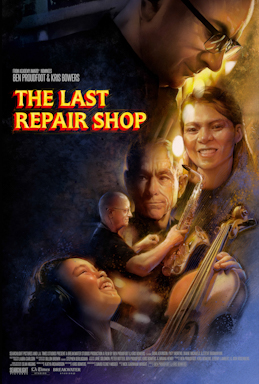
The Last Repair Shop, above, is a 2023 American short documentary film directed by Ben Proudfoot and Kris Bowers

I listen every day to WICN, a jazz station in Worcester, Massachusetts. Besides providing wonderful music, the station does good works that I appreciate. For example, they collect unused school instruments to donate to local public school students. Both Suzanne (oboe) and John (sax) let me take the instruments they hadn’t touched for years to WICN and donate them.

Other school districts also offer free instruments, but few have a reliable way to repair any that need work. Now, publicity for an Oscar-winning film about a repair initiative in one district is spreading inspiration.

Sheena Goodyear reports at CBC Radio, “Steve Bagmanyan is putting retirement on hold — and he couldn’t be more thrilled about it. Bagmanyan is the supervisor at a warehouse in Los Angeles, where a small, but mighty, team of music lovers repair musical instruments for thousands of public school students. 

“One of the last programs of its kind in the U.S., it has struggled to stay afloat over the years. But now, thanks to the Oscar-winning documentary short The Last Repair Shop, donations are pouring in. …

The Last Repair Shop tells the story of the L.A. Unified School District (LAUSD) Musical Instrument Repair Shop, where 11 technicians service about 6,000 instruments each year for more than 1,300 schools across the city.

“It spotlights the shop’s staff, including Bagmanyan, as well as the students who benefit from their work, showing how music has changed each of their lives in momentous ways. 

In an interview with As It Happens earlier this year, co-director Ben Proudfoot, a Halifax native, called the film ‘a vehicle to get people to stand up and cheer for music and arts education around the world.’

“Now, that’s exactly what people are doing. Proudfoot and co-director Kris Bowers have teamed up with the Los Angeles Unified School District to create ‘The Last Repair Shop Fund,’ hosted online by Paypal. …

” ‘Ben and I can’t think of a better impact for our film to make,’ Bowers said in a press release. … As the money comes in, Bagmanyan says he and the school district have big plans — new equipment, upgraded tools, more technicians and, if possible, an apprenticeship program.

” ‘Maybe some high school kids would be interested in learning the trade since there’s not many repair people left really,’ Bagmanyan said.

“Ever since The Last Repair Shop was nominated for best documentary short at the Academy Awards, Bagmanyan says life has been a whirlwind. After years of toiling in relative obscurity, he and his colleagues are now attending screenings, doing media interviews and going to red carpet events. 

At one of the first screenings, they met some of the students who rely on the public school instruments they repair — many of whom could never afford an instrument out of pocket.

” ‘It was very rewarding,’ Bagmanyan said. ‘I felt very proud. I always did, but when I met students and actually went to all the screenings, it’s a different way of feeling proud. It’s like you actually see who you’re doing it for.’

“One of those students, violinist Porché Brinker, was featured in the doc and shared the stage with Proudfoot and Bowers when they won the Oscar.  Bagmanyan and the other technicians were watching proudly from the balcony.

” ‘To see the way that everyday people have shown up to make sure that kids like Porché have a working violin in their hand is truly moving, and goes to show that good old fashioned generosity and goodness is still very much alive,’ Proudfoot told CBC in an emailed statement. …

“But the most amazing thing to come out of the film, Bagmanyan says, are the boxes of hand-written, thank you letters that keep arriving at the shop from L.A. public school teachers and students, he says. …

” ‘Every note is our Oscar. Every thank you email from a teacher, that’s our Oscar,’ he said. …

“Funding cuts and furloughs over the years meant that by the time he took over as supervisor in 2013, [the repair team was down to six from 30].

“With new funding and attention from the Oscars win, he’s aiming to ‘bring it — at least partially — back to its capacity.’ “

More at CBC, here.

Read Full Post »

Photo: Dezeen.
Abandoned Los Angeles skyscrapers covered in graffiti.

Is graffiti a scourge or an art? I guess that depends on the graffiti and your point of view. In Los Angeles, graffiti on a monumental scale is the subject of debate.

Corina Knoll reports at the New York Times that, first, there were fancy buildings.

“It was a billion-dollar aspiration meant to transform a neighborhood. A trio of shimmering skyscrapers would feature luxury condos, a five-star hotel and an open-air galleria with retailers and restaurants. …

The vision was called Oceanwide Plaza, and the chief executive said it would ‘redefine the Los Angeles skyline.’ An executive for the design firm said it would create ‘a vibrant streetscape.’ The website said it would be a place of ‘rare and unexpected moments.’

“All these statements, some would say, proved to be true. Just not in the way originally imagined.

“Funding for the venture quickly evaporated. The towers went up but were unfinished and empty. Plagued by financial and legal issues, the plaza was in a quiet limbo for five years. …

“Now those skyscrapers have become a symbol of street swagger, ‘bombed’ with the work of dozens of graffiti writers and artists. Their aliases cover windows that rise more than 40 stories, visible from the nearby highways.

“ ‘Everybody’s talking about it, of course,’ said Ceet Fouad, a French graffiti artist based in Hong Kong, known for his commissioned murals featuring cartoon chickens. … ‘It’s the best promotion you can have.’

“The sentiment is obviously not universal. Many Angelenos see the graffiti as unconscionable vandalism, encouraging waves of crime. Those who live near it say it has jarred their sense of safety. Civic leaders see it as an immediate hazard to the neighborhood as well as to trespassers, not to mention a worldwide embarrassment.

“Others have admired the work, some traveling to see the embellished towers for themselves and ruminate on what they represent. …

“A subculture took note that no one was bothering to clean off the fresh paint. Crews were trudging up together, their backpacks rattling with spray paint. Some lugged up gallons of paint and roller brushes. Security guards on patrol were easy to evade. Inside, they saw loose wires dangling from ceilings and rebar left exposed. Ladders and buckets littered the concrete floors. Bathtubs were full of water from the rain.

“ ‘We got a little lost at first; it’s kind of like entering a little city,’ said a graffiti artist who goes by Aker and managed to paint his alias twice. Although advice was passed around (bring water, the flight up is killer), he said there was no coordination among artists, just individual ambition. …

” ‘This is the problem of the city, people do whatever they want,’ said Rodel Corletto, who built Aladdin Coffee Shop on a nearby corner four decades ago.

“Mr. Corletto, 76, said that over the last 15 years, his windows have been broken, his chairs thrown into the street. He often feels like there is no recourse. The plaza, he said, was a larger example of downtown’s lawlessness. …

“In mid-February, city leaders were scrambling to figure out their role in a private property gone wrong. They had a responsibility, they said, to keep people safe and set an ultimatum: The plaza owner, Oceanwide Holdings, a conglomerate headquartered in Beijing, was ordered to secure the property within a matter of days. …

” ‘For them to have just completely abandoned these properties speaks more volumes about their irresponsibleness as opposed to the graffiti artists,’ said Kevin de León, the councilman who represents the area.

“The city earmarked $1.1 million to start to secure the property, including fencing. Mr. de León also said city leaders were looking into estimates for graffiti removal and putting a lien on the property. ‘The taxpayers will be repaid,’ Mr. de León insisted. …

“Some residents have openly wondered whether the funds might be better used to house the homeless. Or whether the trespassing will be curbed completely. …

“Whatever happens, graffiti artists like Aker say the takeover magnified and transformed a company’s folly hiding in plain sight.

“ ‘They failed not just themselves but the city,’ he said. ‘And this is what happens when things just get left — graffiti artists are like spiders, we’ll go out and put webs up there.’ “

Many outlets have covered this. More at the Times, here, at Dezeen, here, and at the Guardian, here.

Read Full Post »

Photo: Melanie Stetson Freeman/CSM Staff.
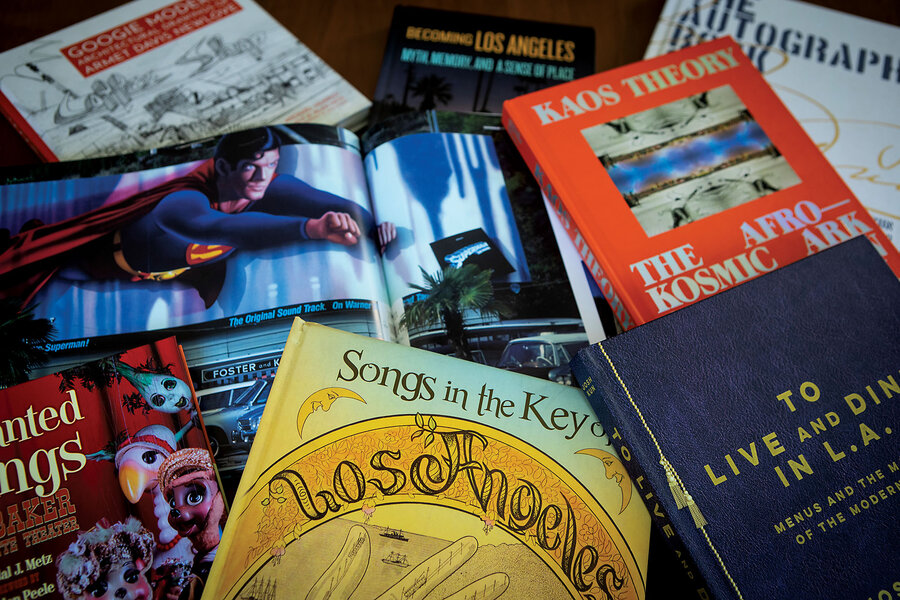
An assortment of books published by Angel City Press. The press’s owners donated the indie publishing operation to the Los Angeles Public Library in December 2023.

Libraries are under pressure because, you know, they offer people books. One library is taking the general outrageousness of book culture a step further by getting into publishing.

Ali Martin writes at the Christian Science Monitor, “The City of Angels is known for glitz … but Angelenos recognize a deeper creative spirit, found in its eclectic and diverse neighborhoods, where stories of resilience are illuminated with quirky, indelible characters. 

“ ‘There’s something really valuable in trying to reflect a true portrait of the city, not just to the people who live here, but [to people] everywhere,’ says Terri Accomazzo, editorial director for Angel City Press. …

“For more than 30 years, the small independent Angel City Press has published nonfiction by local authors. Now, the company’s founders are handing it all over to the Los Angeles Public Library (LAPL) in an arrangement unprecedented in scope — forging what the city’s top librarian describes as a natural alliance. ‘The library is about collecting stories, we’re about preserving stories, and we’re certainly about telling stories,’ says City Librarian John Szabo. …

“With e-books and self-publishing, getting a book to market has never been easier, says Andrea Fleck-Nisbet, CEO of the Independent Book Publishers Association. The hard part is connecting with an audience. 

“ ‘By taking a small indie publisher and then being able to continue its life through a nonprofit like a library that’s already serving that market, you have that built-in community,’ she says. …

“Angel City’s donation includes its catalog of published books — titles that might be retired if acquired by a company focused solely on profits, says Ms. Accomazzo, who will keep her position after the transition. It also ensures that the press ‘continues to operate with an eye toward storytelling and a focus on telling things that matter.’ …

“One of those stories is A Handful of Earth, A Handful of Sky: The World of Octavia E. Butler, by Lynell George, about the life of the celebrated science fiction writer. Ms. Butler, a Black woman, grew up poor in Pasadena during the 1950s and ’60s, finding refuge in her journals and sanctuary in the area’s libraries. 

“Ms. George, a well-published author, says Angel City’s local focus allows for a ‘much more rich conversation about shaping and sharing stories.’ Publishers from outside California often want LA stories to fit a preconceived narrative, she says. But in working with local publishers, ‘you’re just writing about what you see, what you love, what you have complicated feelings about. You’re not writing in response or retort to … a cliché.’

“In KAOS Theory: The Afrokosmic Ark of Ben Caldwell, author Robeson Taj Frazier brings to life the far-reaching cultural impact of a multimedia arts pioneer. By tracing Mr. Caldwell’s journey from his childhood in the American Southwest to filmmaking at UCLA and the establishment of his media arts center in LA’s Leimert Park neighborhood, Dr. Frazier shines light on civil rights and the Black experience in America. 

“The self-described ‘latchkey kid’ who spent much of his childhood in public libraries now runs the University of Southern California’s Institute for Diversity and Empowerment at Annenberg. …

“The LAPL is the nation’s second-largest public library by population served, with the largest digital circulation — more than 10 million e-books, audio books, podcasts, and other electronic media. That kind of reach combined with publishing can have a profound impact, says Sonia Alcántara-Antoine, president of the Public Library Association. …

“The Angel City collaboration builds on an evolution of libraries as maker spaces, where anyone can access resources to build, fix, or create things. ‘This is very much part of where we are in libraries,’ says Ms. Alcántara-Antoine, who heads Baltimore County Public Library, ‘which is not only providing access to content, but facilitating the creation of it.’ …

“Angel City’s 135-plus titles are eclectic, diverse, weird, fun, and beautiful, says Mr. Szabo. As the library picks up that mantle, ‘it’s about telling stories that might not otherwise be told.’ ”

More at the Monitor, here. No paywall.

Read Full Post »

Photo: Shervin Lainez.
Molly Lewis, a professional whistler.

So many kinds of jobs in the world! And anyone who doesn’t see the ideal job out there can always invent one. In the case of Molly Lewis, she joined a very small elite of professional whistlers.

Shane O’Neill writes at the Washington Post, “If you’re a comedian, at some point you’ve gotten the dreaded ‘Tell me a joke!’ from a stranger. If you think that’s bad, try being a professional whistler. ‘It happens all the damn time,’ said Molly Lewis with a smile. ‘Sometimes I’ll oblige.’

“Lewis’s first album, ‘On the Lips,’ was released [in February]. She’s hoping that it can raise the profile of whistling. ‘People often don’t have a reference for whistle music apart from a jingle or a riff in a bad pop song,’ Lewis said. ‘I think it’s a beautiful instrument.’ …

“People are beginning to take notice. Her whistled cover of Billie Eilish’s ‘What Was I Made For?’ appeared in the Barbie movie, once in a scene and again during the credits. …

“Believe it or not, Lewis brings depth and nuance to a form that is usually cheerful or absent-minded. Still, she’s aware that there’s something novel and kitschy about what she does. … One of her chief inspirations was Marty & Elayne, the husband-and-wife lounge duo with a cult following in Los Angeles. ‘They played for 37 years, five nights a week, and it was this very special, beautiful thing,’ Lewis said. ‘They had great outfits.’ She bristled when this reporter implied that some people didn’t care for Marty & Elayne’s brand of camp. …

“Lewis learned to whistle when she was 4 years old. She occasionally fielded compliments from strangers, but hadn’t taken her talent seriously until she saw Pucker Up, a 2005 documentary about competitive whistling. She attended the International Whistlers Convention in Louisburg, N.C., in 2012 and has been plying her trade in music clubs ever since.

“Lewis’s whistling has brought her to a residency in Mexico and a show in Shanghai, but Los Angeles remains home.

‘To me, L.A. is a magical place where you can make a living doing wonderful, strange, creative things.’

“There, she has found a community of show people on the creative fringes, including puppeteers and theremin players.

“Starting in 2017, Lewis curated a series of shows called Café Molly at the Los Angeles music club Zebulon that drew the likes of actor John C. Reilly, Karen O of Yeah Yeah Yeahs and singer-songwriter Mac DeMarco. She also appeared at an open mic held at Canter’s, a beloved time capsule of a Jewish deli near West Hollywood. …

“On tour, she would strive to create an atmosphere of louche elegance. ‘I wanted to make a show that felt like the kind of show I would want to go to,’ she said. ‘Beautiful, lounge-y, something where you want to get dressed up to go.’ …

“Now, with ‘On the Lips,’ she wants to bring that experience home. The album comes with instructions on how to enjoy it: ‘Mood lighting is a must — the record will not play if you have bad lighting. Splayed on a chaise lounge with eyes closed works too.’ “

More at the Post, here. And speaking of whistling, check out my 2015 post on a Turkish whistling language, here.

Read Full Post »

Photo: S.C. Mero.
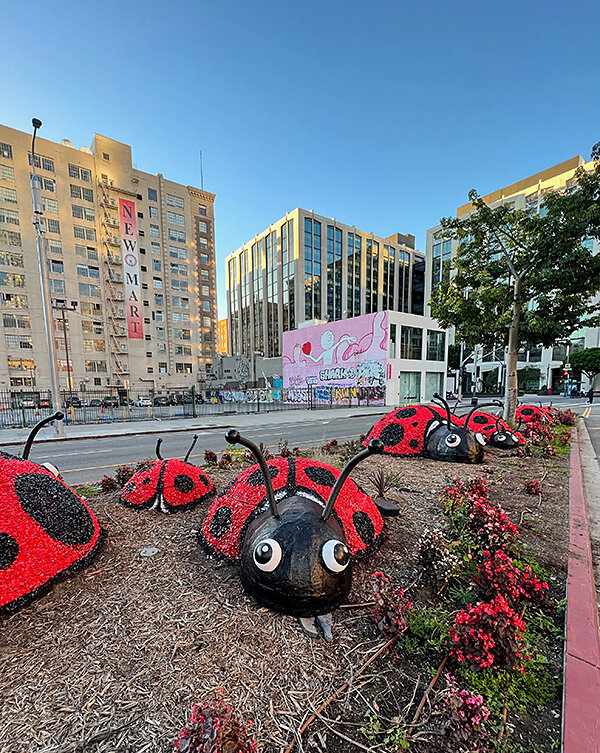
Ladybugs nestle into the intersection of 9th, Main, and Spring Streets in Los Angeles, spring 2023. LA’s Fashion District commissioned S.C. Mero to create a series of installations to decorate the median, which had fallen into disrepair.

Art can lift up a community. It can be an outlet for feelings of all kinds. Whether it’s the art of graffiti (see Manny’s documentary Stations of the Elevated), the art of whimsy, or any other kind.

In today’s post, Ali Martin interviews a whimsical street artist, S.C. Mero, for the MonitorDaily.

“In downtown Los Angeles, absurdity interrupts urban blight: A fire hydrant sprouts stockinged legs; a winged telephone leaps from a phone booth; a mailbox towers, inaccessible, over passersby. 

“The city’s historic business district and surrounding neighborhoods are the backdrop for contemporary street artist S.C. Mero, who sees opportunity in a landscape dogged by disappointment and deferred dreams.

“The Minnesota native embraced the area, known as DTLA, after graduating from the University of Southern California (USC) a decade ago. Today, her rogue installations are part of downtown’s creative fabric – and local authorities are in on it. She’s been honored by the city for her contributions to the Skid Row neighborhood and commissioned by the nearby Fashion District to decorate a median at an intersection.

“Transformation governs her art. Ms. Mero’s first pieces were mosaics made of pennies which she altered with heat, dye, and tools. Other projects reshape abandoned spaces into commentaries on politics and humanity. 

“Her work insists on hope, which she describes as rebellious. ‘To put something like cute little turtles on a median with downtown the way it is, it’s resisting something, right? It’s resisting the default, which is to be negative,’ says Ms. Mero.

“The Monitor spoke with Ms. Mero at Something Poetic, her venue for performance art. The space, offered to her during the pandemic by the Historic Core Business Improvement District, has become a hub for local artists. The conversation has been edited for clarity and length. 

Monitor: Why downtown? You joined an artist collective on Skid Row after graduating from USC. I’m guessing there were other options. 
“S.C. Mero: I think my mom asked me the same question all the time. I just feel like it’s a good fit for what I’m doing. It’s really a creative vortex. … You have the Arts District, the Flower District, the Fashion District, Little Tokyo, you have the Industrial District, the Financial District. And maybe that’s typical of most cities, but I feel like there’s a lot happening here and it’s good for cultivating ideas.  I’ve just felt like I want to see it through, too. Look at these [historic, vacant] buildings. I think this could come back to life and they’re not there yet. So I want to be part of that transition. …

You look at a pothole, you look at something breaking down around you, and you see whimsy and light. How does that happen? 
“Because nobody cares about it anymore. It’s free game, right? Nobody’s going to stop you from really, truly doing anything on a pay phone right now, or a newspaper stand, or – in certain areas – a pothole. … To do anything to it, people are like, ‘Oh, you know, it’s better than what was there.’ 

What do you want people to take away from your art? 
“I feel like wanting people to take away something is in a way thinking that I want something from them. … I’m thankful that they are even allowing me to do it. So the fact that their reaction is positive, I’m just even more grateful for that – it makes it a little easier to be able to keep doing it. So I don’t know if I want a certain reaction from people. I just hope that they can find something that they do that they love as much as what I’m doing. 

Is there a theme or an idea that pulses through your work?
“Yes. At first I didn’t really see it. … The age-old idea of spiritual growth and transformation. And I think that that’s evident in a lot of my work – the whole idea that something can lose its identity or lose its value, but then come back even stronger. 

“A lot of my work is critical of our government, but I still maintain hope that there is a better way. It speaks to the truth because it’s not really about a payphone or a penny. We’re no different than that, right? Something is that way, but it can be better. What does it take for that to happen? It takes a belief, for one. It’s not going to get better by not thinking or imagining or seeing it that way. 

What is the relationship between your work and the downtown community?
“They’re as much of a part of [the art] as I am. It’s that we’re-in-this-together kind of vibe. Whether they like the piece or not, they get it because they’ve seen that pothole. They’ve seen a payphone like that. … It has that sense of camaraderie, I think.”

More at the Monitor, here. Note the funny mailbox, among other things.

Read Full Post »

Photo: Dua Anjum.
“Poet Hiram Sims,” the Christian Science Monitor reports,” has given poetry a permanent home in his South Los Angeles neighborhood.

This is another story about how the Covid pandemic gave some people a moment of “not much going on” to pursue a dream.

Dua Anjum writes at the Christian Science Monitor, “From Hiram Sims’ earliest memory, poetry defined his inner world – songs of praise at his church choir; the rap lyrics of The Notorious B.I.G., Puff Daddy, and Mase’s ‘Mo Money Mo Problems’; Edgar Allan Poe’s ‘The Raven’ in seventh grade.

“ ‘Poetry’s like a frequency that I can hear above all other frequencies,’ he says. … ‘When I hear that sound, I pay attention.’

“That sound became his favorite form of expression. As a kid, he wrote about candy, his thoughts about God, and a lot of verses for girls at school. In college, while he progressed to mature writing around the Black experience in America and the struggles of being young and broke, witty comic poems remained key to his repertoire. He chuckles recalling a poem comparing Ugg boots to rhinoceros feet. Now, he has published three collections of poetry and frequently writes love poems for his wife.

“While it was clear early that his calling was poetry, Mr. Sims remembers having an anchorless feeling: Poetry sections of libraries were rare, and the poetry scene was a series of countless borrowed spaces in restaurants, cafes, and bars. It felt like ‘poetry is homeless because it’s constantly couch surfing,’ says Mr. Sims, who became a creative writing and composition professor at colleges in the area, including his alma mater, the University of Southern California.

“In 2020, he gave poetry a permanent home in his South Los Angeles neighborhood, founding the Sims Library of Poetry, for reading, writing, studying, and performing poetry. 

“The space has evolved into an indispensable gathering place for anyone looking for inspiration, say poets who live nearby. It whimsically invites the public in: ‘Poetry Lives Here’ is painted on a low concrete boundary. A mural pays homage to the dragon fire that poets spit in words. A ‘Poet Parking Only’ sign peeks from a patch of grass. 

“The spiritual foundation for this landmark came from what Mr. Sims considers a personal triumph: the Community Literature Initiative (CLI), through which he helps poets produce manuscripts ready for publication and connect to presses.  

“ ‘I was at an open mic and I heard all of these amazing poets. After the show, I said, “I’d like to buy a copy of your book,” and none of them had books,’ says Mr. Sims, who has coached poets in publishing now for 10 years in space provided by USC. … Sims Library origin story goes back to a $29.99 suitcase.

After assigning his CLI students to read one book of poetry a week, he realized: They couldn’t afford them, and libraries had slim poetry offerings. 

“So, he fit 80 books from his collection into the purple-brown suitcase, carted it around in his car, unzipped it, and let students borrow poetry collections by living authors, especially local LA poets.

“ ‘One of my students said, “This is the little Sims library of poetry right here.” And I was like, “Wow.” … After that, I put all my energy into building that microcosm of the library that I had in my head.’

“The idea came to life in his garage at a birthday party-turned-library-launch. … Several poets read their own verse. And people brought boxes full of books: The party started with 300 and ended with 2,000. 

“Mr. Sims’ mother, Gwendolyn, who remembers her young son loved to read greeting card stanzas at the Rite Aid, was one of the first to donate money. The library continued to thrive with family, community, and foundation contributions of books, cash, and grants. And CLI class tuition also helped. 

“It was peak pandemic, and the preschool run by his wife, Charisse, closed. The family decided to take over the building as the next iteration of the library. Mr. Sims’ father, Edward, who is a contractor, and his brother Job helped with shelves. Word of another donation drive reached further and book donations came from across the country. …

“The nonprofit offers more than 9,000 volumes of poetry, says Mr. Sims. ‘So many of these books are people that live in LA, you know, people in this community.’ 

“Open until 8 on Saturday nights, the thrum of activity – from book launches, workshops, and open mics – spills into the neighborhood with singing voices, fingers snapping, and the rhythm of rhyme. …

“Mr. Sims says, ‘I think the library represents value for a part of people they don’t often share. So people often bring poems from their shoeboxes and folders. It’s so personal with people.’ …

“ ‘When the first volunteers came in, they expected to come to a library, but then realized, we have to build one,’ says Karo Ska, library manager and a CLI writer. For them, the best part is that the library has books that can’t be found elsewhere – pre-1950s special collections, self-published collections, periodicals, local literary journals, and handmade chapbooks.

“ ‘The idea of giving back to the community is a phrase that a lot of people use but isn’t always manifested,’  says Lynne Thompson, 2021 Los Angeles poet laureate. ‘[Hiram] is as interested in the work of others and facilitating not only the writing of it but the publishing of it as he is in his own work.’ …

“Poet bridgette bianca, who grew up in the neighborhood without a public library nearby, says: ‘We are in an area that’s very much Black, very much brown, very much working class. And that somebody built a library here is just fantastic.’ 

“Now, as a community college professor, she uses the library as a resource, encouraging students to explore the poetry collection and attend events for extra credit.”

More at the Monitor, here. No firewall, but subscriptions are encouraged.

Read Full Post »

Photo: Everybody Dance.
Summer dance participant in Los Angeles.

There are certain kinds of opportunities that are taken for granted in higher-income families. Being able to participate in sports that require equipment, tutors, summer camp, music and dance and art classes, college. Mary McNamara writes at the Los Angeles Times about a dance class that gets lower-income children and families thinking that opportunity might be possible for them, too.

“We could all use some good news these days, and that’s what Natasha Kaneda offered when she said [‘You can’t be scared when you’re dancing’] to her Jazz I class of 8- and 9-year-olds. …

“She was reminding them to stay focused even if something went wrong during a routine — to resume their dance without fear. She said it quickly, almost as an afterthought, but it should be on a T-shirt, like the Everybody Dance LA! T-shirts these kids were wearing.

“Practicing for their upcoming spring recital, these boys and girls could be part of any dance program. Well, maybe not any — their execution of steps exhibit grace, precision and energy, and their teachers, though unfailingly patient, are not about to let an imperfectly pointed toe or lethargic arm movement pass uncorrected.

“Whatever the skill level, the courses at Burlington studios, part of the building that also holds Camino Nuevo Charter Academy, are so instantly familiar they could be anywhere.

“Except that … for kids living below a certain income bracket, dance class is too often an impossibility. Clothing and lessons cost money; access to those mirrored rooms, even the ones at the local Y, is often out of reach.

“The dancers and the parents at the Burlington studios … wouldn’t ordinarily be taking pride in last summer’s performance with the Youth Orchestra of Los Angeles and the Los Angeles Dance Project, or preparing to send all of their graduating seniors off to college.

“Yet here they all are, part of the Everybody Dance LA!, an almost-too-good-to-be-true program founded more than 20 years ago by a grieving mother who believed that things should not remain unequal — and that you can’t be scared when you’re dancing.

“In 1999, 13-year old Gabriella Axelrad was hit by a car while biking in the Grand Tetons National Park. After Gabriella died, her mother, Liza Bercovici, found herself unable to simply return to her life as a family law specialist. Instead, she decided to commemorate her daughter, who loved to dance, by creating a program for low-income children. She would employ top dance teachers at professional wages and emphasize excellence and life skills along with creativity and collaboration.

“Bercovici’s biggest fear when she opened the doors to those first classes a year later, in the ballroom of the renovated Sheraton Town House hotel near Lafayette Park, was that no one would come.

“ ‘I looked out the window and saw this huge crowd,’ she says now. ‘I thought it was people wanting to rent apartments in the [low-cost] building. But it was people who had come for the dance classes.’

“What started as 35 children in 12 extra-curricular classes grew to more than 5,000 served by in-school, after-school and summer camp classes; in 2014, Everybody Dance won a 2014 National Arts and Humanities Youth Program Award.

“Many students enter the program when they are 4 or 5 and stay until they graduate high school; a few, like Zuleny Ordonez and Kimberly Gomez, returned to work for EDLA!

“ ‘When you’re a low-income family, there’s a stigma about asking for help,’ says Gomez, now a teaching artist with the program, who joined the staff as a dance site coordinator after graduating from UC Irvine. ‘The teachers here gave us someone to talk to, someone to listen to us. I would be here from right after school until 9. Change in the car, do homework here, it was my second home.’

“Ordonez works here as teacher’s assistant while taking classes at Santa Monica College. ‘I was very hyper as a child and my mom found this,’ she says. ‘I grew up with the other students here.’ …

“Bercovici realized she could do even more good if she ‘had the kids for eight hours instead of two.’ So she founded the Gabriella Charter Schools; in 2015, she stepped down as Everybody Dance’s director, turning it over to Tina Banchero, a former dancer and artistic director of Dance Mission Theater’s Youth Program in San Francisco. Banchero has run it ever since. …

“EDLA! lost about 1,100 students during the peak of the pandemic. For those who stayed, dance class, like everything else, went virtual. ‘We pivoted to online in less than two weeks,’ Banchero says. ‘I was so proud of everyone.’

“Children across the country were trapped at home for more than a year, struggling with online learning and isolation. But Banchero’s students, Banchero’s families, have had a harder time than most. For low-income, urban families, COVID-19 has been particularly devastating. Many parents lost their jobs and many of those who didn’t continued to work in person. Cramped housing, which often included multiple generations, left little space for kids to study, much less dance.

“ ‘We had kids dancing between two bunk beds,’ Banchero said. ‘But it was so important for them to turn their cameras on, see our teachers and other students, and dance. We had a number of kids who were struggling with depression. So many of our families lost a loved one. …

“ ‘I realized how much l love my job during that time,’ Kaneda says. ‘Because when I ended my Zoom class, I would feel happy for the first time that day.’ “

More at the LA Times, here.

Read Full Post »

Photo: American Alliance of Museums.
A young visitor is captivated by Dakota, Natural History Museum of Los Angeles County’s full-suit Triceratops puppet.

When Suzanne was a few months old, John was learning about dinosaurs, and we got into a kind of chanting routine reeling off all the fancy names we knew. Baby Suzanne seemed to think they were hilarious. If she was fussy, dinosaur names would distract her and make her laugh.

Dinosaurs and their names have always enchanted small children. To up the enchantment, a museum in Los Angeles has begun experimenting with bringing dinosaurs to life. Sort of.

Ilana Gustafson writes at the American Alliance of Museums blog, “The anticipation of an imminent transformative journey is palpable in the diorama hall at the Natural History Museum of Los Angeles County (NHMLAC), where a Dinosaur Encounter is about to begin.

“During the show, the audience cheers as a young guest, decked out in a bedazzled dinosaur shirt, is called onstage to feed the juvenile Triceratops known as Dakota. … The audience falls into a quiet anticipation as Dakota’s feet shuffle impatiently, her beak opening and closing, indicating that she’s hungry. The child onstage gets closer to the dinosaur, leaf in hand, and reaches their arm out nervously toward her beak. Slowly Dakota approaches. …

“Dakota opens her mouth and suddenly clamps it closed with the leaf in its clutches and excitedly wiggles her tail. The audience cheers as the child onstage, grinning from ear to ear, watches a dinosaur playfully eat a leaf right at their feet. The host of the show thanks the young visitor. …

“The full-suit Triceratops puppet, created by the fabulous puppeteers at Erth, is made of aluminum and plastic boning, foam, and lycra painted with acrylic, and contains an internal speaker and other mechanisms. Inside is a puppeteer … holding the sixty-five pounds of the weight of the puppet on their back, using largely their shoulders and core strength to maneuver it. Many technical elements need to come together to bring the dinosaur to life, but when they all unify in a performance, the audience forgets to focus on the mechanisms at work. …

“This act of relating to the characters on stage is another thing that make theater so powerful. In a study published in the Journal of Experimental Social Psychology, researchers discovered that watching theater can lead to increased empathy, the ability to understand the feelings of others. … I would make the argument that this empathy toward the dinosaur increases intellectual curiosity about these creatures, paleontology, and other related studies. …

“The father of a dedicated fan shared with us in an email the love his son had developed for our puppet, and in turn for the Natural History Museum.

‘Lev didn’t just watch T-Rex and Triceratops. Lev became T-Rex and Triceratops. After each show, Lev would show us his improvisational reproduction of the show we had just watched. He insisted upon silence while he delivered his performance, mirroring and perfectly mimicking the T-Rex right down to lifting his legs, bending over with retracted arms, and delivering his ferocious ‘roar’ while bobbing his head back and forth seeking his prey.’ …

“The designs of the full-suit Triceratops and T. rex puppets were informed by the museum’s paleontologists, including Dr. Luis Chiappe, Senior VP of Research and Collections, who advised the fabricators on how best to merge entertainment with science. The physical characteristics of our juvenile Triceratops and T. rex puppets were based on our paleontological collections and research. The museum’s scientists were keen to have some of the current research on dinosaurs reflected in these creatures. After a performance with our T. rex puppet, known as Hunter, we often get the question from a visitor (young and adult alike), ‘What’s that fluffy stuff all over his body?’ This opens up a conversation about proto-feathers, and how scientists have been able to make the connection between theropod dinosaurs and modern-day birds. …

“The experts at NHMLAC see the value these puppets have in garnering interest and support for their research. Dr. Nathan Smith, Curator at NHMLAC’s Dinosaur Institute, says … ‘The puppets are a truly unique way where we can envision these species as living animals, but also allow visitors to interact with them.’ “

More at the American Alliance of Museums blog, here. If you missed the giant puppet at the San Diego Zoo, you can read about it here. And here‘s a post from last fall on the one that strode across Europe.

Read Full Post »

Photo: Mile Marker One.
Igloos at Mile Marker One restaurant in Ipswich, Mass.

Plenty of people I know are eating indoors at restaurants again, but I’m still too Covid-phobic. I want to support restaurants by doing takeout, but I am not going to take off a mask indoors unless I know that everyone in the building is triple vaccinated.

One innovation during the pandemic has been the tent for outdoor dining. Although some of those tents look too enclosed for your faithful hypochondriac, I thought it was interesting to read what Carolina A. Miranda had to say at the Los Angeles Times about their evolution.

She wrote, “Over the course of the last year, I’ve eaten enchiladas in a party tent. I’ve gotten COVID-tested in a party tent. I spent a night dancing to house music in a party tent. I’ve seen party tents double as retail shops, church naves, gymnasiums and outdoor living rooms. …

“Last year, as the pandemic isolated us into our respective domestic cocoons, designers took to their AutoCAD to imagine a brave new world of design ‘solutions’ for the pandemic. These included wearable head-to-thigh social distancing shields and space-age cones [But] we’ve learned infinitely more about how to rethink the design of our buildings from the pandemic’s most prominent workhorse: the party tent. …

“It can be staked into soil or anchored on pavement. The simplest models, a standard canopy, can shield you from the sun; more protective ones come with collapsible walls that can be adapted to the weather as needed. …

“The party tent is symbolic of all the other improvised architectures that have arisen during the pandemic: the parking lots turned into eating spaces with twinkle lights and umbrellas; the wooden dining platforms crafted out of plywood and two-by-fours; the izakaya on La Brea whose collapsible walls are actually transparent shower curtains. In Echo Park, Misty Mansouri, the owner of the Lady Byrd Café, has turned an impractical triangle of concrete on her property into an al fresco dining room courtesy of an ebullient agglomeration of Christmas trees and portable greenhouses employed as individual dining pods.

“Temporary structures can even be found in hyper-glam iterations — like the space-age, vented dining pod at Wolfgang Puck’s Spago in Beverly Hills. A 6,500-square-foot modular dining room constructed in the middle of Canon Drive, it was created by VX Design Solutions, a custom fabrication studio, and Choura, an event production company, and was assembled in less than a week. That structure opened in March 2021 and is still going strong. ‘We fill it up every single day,’ says Steve Scott Springer, the restaurant’s general manager.

“Party tents may not be around for the long haul, but they have qualities that are worth integrating into the hardscape of our cities. They offer flexibility and permeability and serve as a reminder that in the mild Southern California climate we don’t always need to encase ourselves in hermetically sealed cells of HVAC. If well-building design issues such as fresh air and sunlight had been gaining currency before the pandemic, COVID-19 and its many variants have made it a matter of urgency.

“ ‘Being able to kick open the doors makes people who are inside those doors feel so much better,’ says architect Oonagh Ryan, founding principal of ORA, an L.A.-based studio that has worked extensively in the commercial and hospitality sectors. ‘And operable windows, those are key.’

“One of ORA’s most recent projects is the design of Agnes, a popular Pasadena comfort food outpost that also contains a cheese shop. Housed in a 1920s stable once employed by the Pasadena fire department, the bulk of the restaurant’s design was conceived before COVID, but a number of programmatic choices made since the pandemic began have helped make the space more resilient.

“The key is flexibility. The street-facing side has operable windows and the rear of the dining room has sliding doors that can be propped open to connect with a patio out back, drawing fresh air through the building. A private dining room likewise opens to the elements. The patio, which harbors additional seating, is protected by a weatherproof canopy that can be pulled back when the weather is mild. It’s an outdoor space that can be used come rain or come shine. And the furniture isn’t fixed, so it can be reconfigured into different densities. …

“When the restaurant opened in June, the surge of COVID-19 infections had tapered off and indoor dining had resumed. But the pandemic made the coming months wildly uncertain, meaning that the design needed to be responsive to shifting health directives. ‘If the pandemic was still going strong,’ Ryan says, ‘we had a plan for how we could rearrange everything into more retail.’ ”

“If the pandemic was still going strong.” Is it? Who knows?

You get several free articles at the LA Times, here, if you’re not a subscriber. I think you will enjoy the variety of party tents in the photos.

Read Full Post »

Older Posts »