Feeds:
Posts
Comments

Posts Tagged ‘louisa may alcott’

In my town, everyone knows who Louisa May is, but you may know her better as Louisa May Alcott, author of Little Women.

When Alcott was first starting out as a writer, she wrote dramatic potboilers under various pseudonyms. Researchers keep discovering more. Michael Casey at AP has the story.

“The author of Little Women may have been even more productive and sensational than previously thought,” he writes. “Max Chapnick, a postdoctoral teaching associate at Northeastern University, believes he found about 20 stories and poems written by Louisa May Alcott under her own name as well as pseudonyms for local newspapers in Massachusetts in the late 1850s and early 1860s.

‘One of the pseudonyms is believed to be E. H. Gould, including a story about her house in Concord, Massachusetts, and a ghost story along the lines of the Charles Dickens classic ‘A Christmas Carol.’ He also found four poems written by Flora Fairfield, a known pseudonym of Alcott’s. One of the stories written under her own name was about a young painter. …

“Alcott remains best known for Little Women, published in two installments in 1868-69. Her classic coming-of-age novel about the four March sisters — Meg, Jo, Beth and Amy — has been adapted several times into feature films, most recently by Greta Gerwig in 2019.

“Chapnick discovered Alcott’s other stories as part of his research into spiritualism and mesmerism. As he scrolled through digitized newspapers from the American Antiquarian Society, he found a story titled ‘The Phantom.’ After seeing the name Gould at the end of the story, he initially dismissed it. … But then he read the story again.

“Chapnick found the name Alcott in the story — a possible clue — and saw that it was written about the time she would have been publishing similar stories. The story was also in the Olive Branch, a newspaper that had previously published her work.

“As Chapnick searched through newspapers at the society and the Boston Public Library, he found more written by Gould — though he admits definitive proof they were written by Alcott’s has proven elusive.

“ ‘There’s a lot of circumstantial evidence to indicate that this is probably her,’ said Chapnick, who last year published a paper on his discoveries in J19, the Journal of Nineteenth-Century Americanists. …

“When first contacted by Chapnick about the writings, Gregory Eiselein, president of the Louisa May Alcott Society, said he was curious but skeptical. … But he has come to believe that Chapnick has found new stories, many of which shed light on Alcott’s early career.

“ ‘What stands out to me is the impressive range and variety of styles in Alcott’s early published works,’ he said. ‘She writes sentimental poetry, thrilling supernatural stories, reform-minded non-fiction, work for children, work for adults, and more. It’s also fascinating to see how Alcott uses, experiments with, and transforms the literary formulas popular in the 1850s.’

“Another Alcott scholar at Kansas State, Anne Phillips, said … his paper makes a ‘compelling case’ that these were her writings.

“ ‘Alcott scholars have had decades to compare her work in different genres, and that background is going to help us evaluate these new findings,’ she said in an email interview. ‘She reworked and reused names and situations and details and expressions, and we have a good, broad base from which to begin considering these new discoveries,’ she said. ‘There’s also something distinctive about her writing voice, across genres.’ …

“In the 1940s, Leona Rostenberg and Madeleine Stern found thrillers written under the name A. M. Barnard, an Alcott pseudonym. She also wrote nonfiction stories, including about the Civil War where she served as a nurse, under the pseudonym Tribulation Periwinkle.

“It wasn’t unusual for female writers, especially during this period, to use a pseudonym. …

“ ‘She might not have wanted [her family] to know she was writing trashy stories about sex and ghosts and whatever,’ Chapnick said. …

“ ‘The detective work is fun. The not knowing is kind of fun. I both wish and don’t wish that there would be a smoking gun, if that makes sense,’ he said.”

More at AP, here.
Read Full Post »

062620-clouds-and-blue-sky

Hello, summer clouds — so beautiful! I was discussing them with my friend Nancy yesterday, and she told me she had signed up some years ago with the UK-based Cloud Appreciation Society, which sends her a daily cloud picture and a few words on cloud science or cloud mythology. Consider joining if you need a daily pick-me-up in quarantine.

The next two pictures reference my growing appreciation of fungus. Then comes a bright red intruder in the forest, reminding me of the lamppost that Lucy found in the wintry Narnia woodland after emerging from the wardrobe.

The doorknob in the tree made Suzanne think of a handy panic button (I think she is tired of lockdown), but I’m pretty sure it leads into a home. Probably not a hobbit home, since they prefer burrows underground. Maybe it belongs to Owl.

I love the little red squirrels that have started to appear in our region. John thinks global warming may be bringing them up from the south. Clue me in if you know.

The decidedly unscenic bug repellent had been abandoned along the bike trail. I didn’t touch it as I am a Covid germaphobe, but I got a laugh: I’d been slapping mosquitoes for the whole walk.

In the town of Lincoln, yarn stretched between trees caught my eye. A bit further along the conservation trail, there was a helpful explanation.

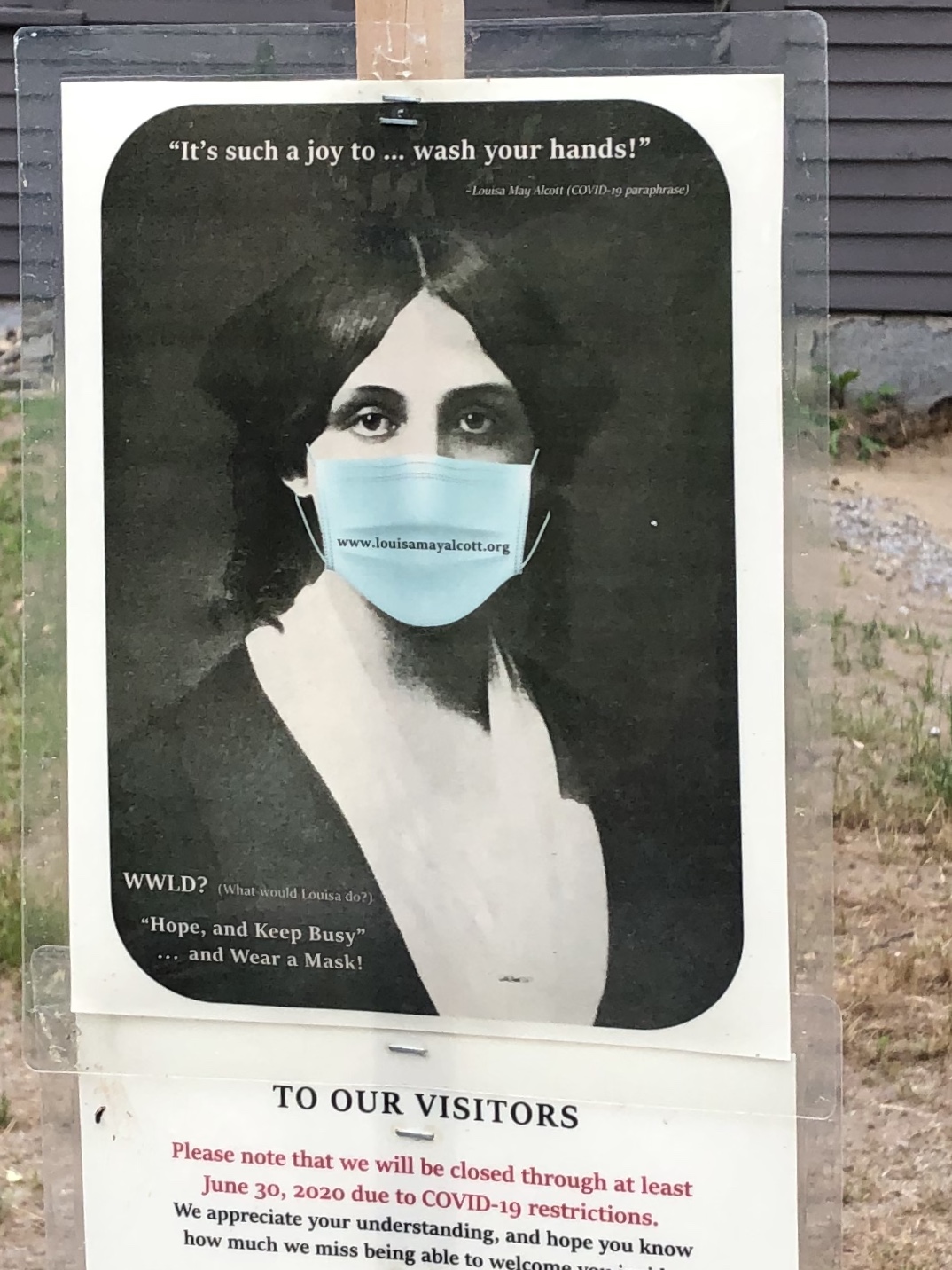
The tippy old wooden building is next to Orchard House, a childhood home of author Louisa May Alcott. The building was named the School of Philosophy by Louisa’s hippy father Bronson and continues to offer presentations and lectures in normal times. (I put up my photo of Louisa in her coronavirus face mask for yesterday’s post.)

Speaking of adapting to the times, you will note that the Colonial Inn (founded in 1716) has marked off six-foot segments on its brick walk for safe distancing.

The Art Deco frieze on the old Emerson school building welcomes visitors to what is now the Umbrella Center for the Arts.

I don’t think I need to explain the last three. Sometimes readers give me their reactions to one or two pics. I do get a kick out of that — should you feel moved to comment.

Read Full Post »

Photo: Rik Pierce/Concord Players
The 2002 cast of Little Women at the Concord Players. Katie Lynch, standing, played Jo (the author’s alter ego). Jan Turnquist, front left, is in real life the director of Louisa May Alcott’s home, Orchard House, in Concord, Massachusetts.

In the town where I have lived nearly four decades, we get a lot of tourists. One of the main attractions is the home of the Little Women author, Louisa May Alcott. Her book remains popular worldwide. Many movie adaptations have been made. I have friends from Japan who were beyond thrilled to see Alcott’s home because of a popular Japanese television series. And at the theater that Alcott helped to set up, Little Women productions have been staged every ten years for generations. I even helped to cast one production.

Needless to say, I couldn’t resist Hillel Italie’s recent story for the Associated Press about an unfinished bit of Alcott juvenalia.

The current issue of Strand Magazine will give readers the chance to discover an obscure and unfinished Louisa May Alcott work of fiction, and to provide a conclusion themselves.

“Alcott’s ‘Aunt Nellie’s Diary’ has rarely been seen since she drafted what may have been a novel or novella, and set it aside, as a teenager in the late 1840s. The 9,000 word fragment is narrated by the 40-year-old title character, and follows her observations as a romantic triangle appears to unfold among her orphaned, fair-haired niece Annie Ellerton, Annie’s dark-haired friend Isabel Loving and the visiting Edward Clifford, ‘a tall, noble-looking’ young man with a complicated past.

Strand managing editor Andrew Gulli found a reference to the manuscript during an online search of Alcott’s archives, stored at Harvard University’s Houghton Library. ‘Aunt Nellie’s Diary’ appears in the Strand’s spring issue, delayed until now because of the coronavirus. …

“ ‘What struck me was the maturity of the work,’ says Gulli … ‘Here was Alcott, who was on the cusp of adulthood, creating a complex work, where her main character is a single woman in her 40s, who defies many of the stereotypes of how women were portrayed in mid-19th century America.

“Because ‘Aunt Nellie’s Diary’ ends with various storylines unresolved, Gulli is inviting readers to complete the narrative. ‘…

“Alcott scholar Daniel Shealy says that ‘Aunt Nellie’s Diary’ reflects what the author called her sentimental phase, her early immersion in such British authors as Charles Dickens and Sir Walter Scott.

“ ‘You can see her picking up on some of the romanticized, even sensationalized material from those books. It’s a tough time for her, because the family was short of money, but it’s also a creative time. She’s beginning to develop and mature as a writer,’ says Shealy, a professor of English at the University of North Carolina-Charlotte.

“ ‘If I had to compare this to Little Women, I’d say that you can see her ability to create characters that you can take an interest in. And you see her ability to have several strands of the story going off in different directions, and you’re wondering how she going to tie this all together. Clearly, this story is building to a big reveal, and we’re going to learn new things about the characters’ pasts.’ ”

That is, we are going to learn things from Strand readers who send in the best endings. Maybe you.

More at Yahoo, here.

How Louisa has been adapting.

062220-Louisa-May-in-facemask

Read Full Post »

Twenty years ago I helped out on what local people jokingly refer to as the Concord Passion Play: Little Women. It’s performed every 10 years by the Concord Players because (a) author Louisa May Alcott lived at Orchard House in Concord and (b) she was a founder of the theater group that became the Concord Players.

Kate Clarke is directing the show this year, and she just got some great publicity in the Boston Globe.

“ ‘Preparing to direct the play, I started to do some research and was fascinated to discover just how meaningful the book is to so many people,’ Clarke said.

“ ‘Even the rock star Patti Smith wrote in her recent memoir that “Little Women” was what made her feel as a young high school student that she could be an artist. It motivated her to go to New York and become a performer. I started thinking, “Good Lord, Jo March is everywhere! Why do people find her so compelling?”

“ ‘That’s the question I’ve been tackling with this group of actors. Yes, it’s about the Civil War era, and the societal restrictions that females were under at that time. But the fact that the book’s popularity has endured reflects what compelling characters these young women were.

“ ‘This story is so uniquely Concord and yet reaches far beyond the boundaries of Concord, just as it is a story about the 1860s that also brings up a lot of contemporary issues,’ Clarke said.” Read more.

Here’s photo by Jon Chase for the Boston Globe. Pat Kane, an incredible costume designer, is in the middle. (I don’t think she remembers, but the first time she worked for the Concord Players was when I sought her help on a one-act I directed, Stoppard’s After Magritte.)

Read Full Post »

Even people who think they know all about Thoreau, Emerson, Hawthorne, Alcott and other Concord worthies often seem not to know Margaret Fuller. She was a key member of the “genius cluster” that author Susan Cheever has called the “American Bloomsbury.”

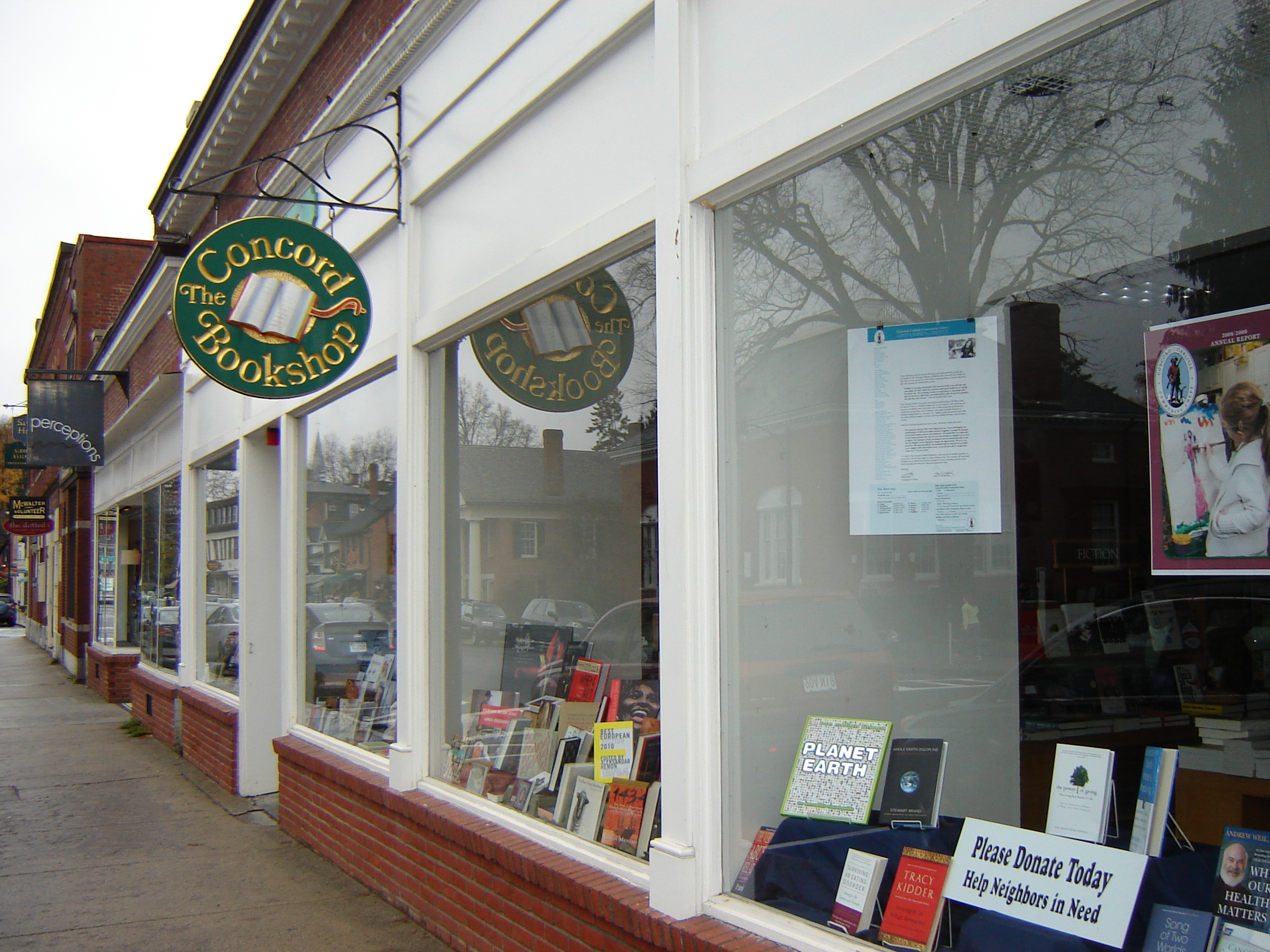
Although Fuller has passed from public awareness, in Concord it is different. Which is why a reading at the Concord Bookshop on January 29 was standing room only. Fuller’s latest biographer, John Matteson, was there to read about her “many lives” and engage in discussion about such abstruse topics as what Fuller thought of Emerson’s second wife. (Answer: Not much.)

It’s always amusing to attend a reading of a book about one of the Concord greats, as participants have such passionate feelings. Especially the Bronson Alcott fan base, who cannot bear to hear a word said against Louisa May
Alcott’s innovative but impractical father. I have been to a couple readings of books in which Louisa appears, and you can see Bronson’s partisans stiffening their spines, baring their fangs, and rising to the bait.

But who was Margaret Fuller? She was a first in many realms, including first female editor of the highly regarded 19th century literary magazine The Dial and the first overseas war correspondent. Matteson bemoaned the fact that she was probably best known, however, for the way she died, having perished in 1850 at age 40 in a shipwreck off Point o’ Woods, Fire Island.

That fact touches a nerve in me, I admit, since I spent all my childhood summers on Fire Island, and it is still a mystery why many of the ship’s passengers were saved while Margaret Fuller, her husband, and her baby drowned. Fortunately, interest in her life has been renewed, with Matteson’s book only one of several in which she plays a significant role.

Read Full Post »