Feeds:
Posts
Comments

Posts Tagged ‘meadow’

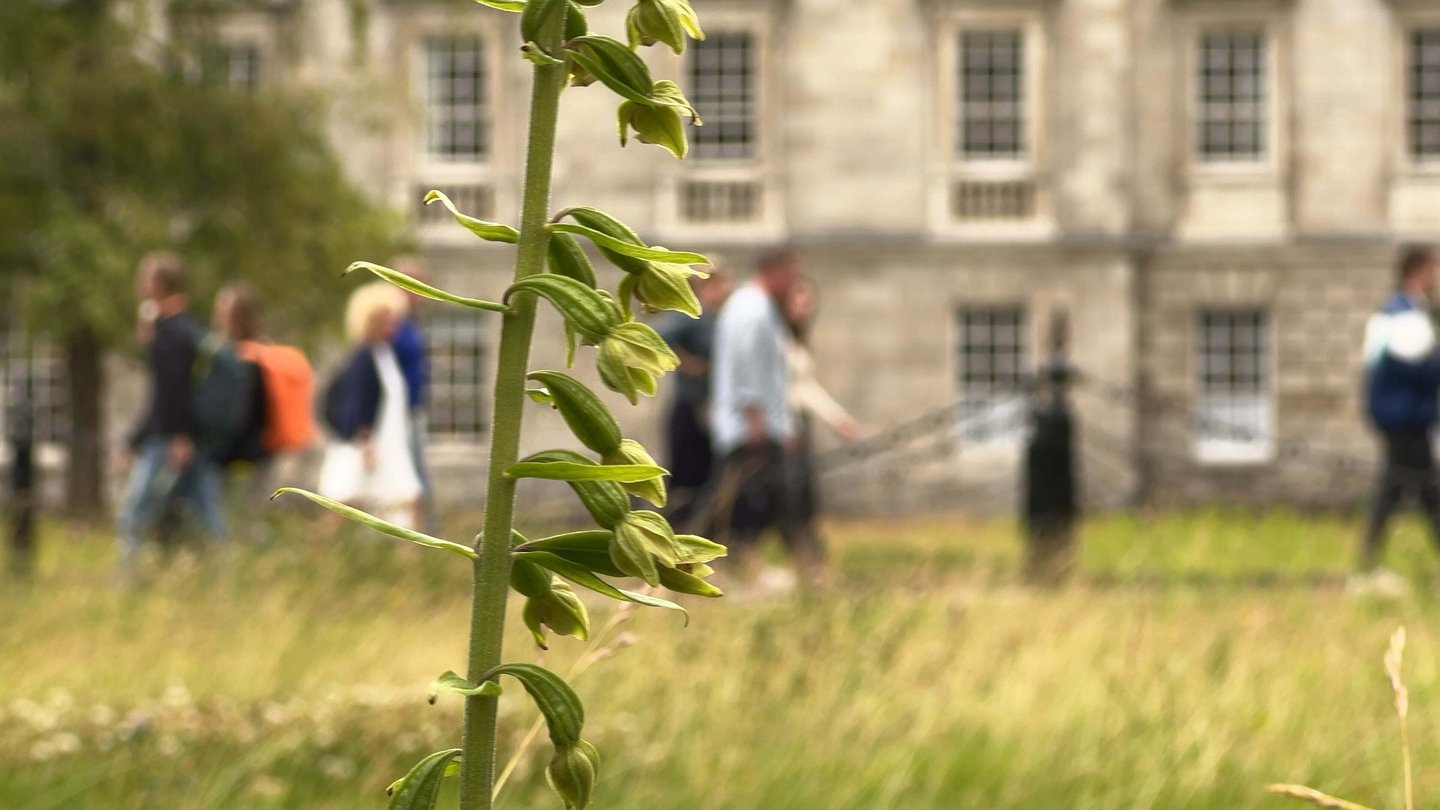
Photo: RTÉ.ie (Raidió Teilifís Éireann), Ireland’s National Public Service Media.
One of the broad-leaved helleborines near the front arch of Trinity College in Dublin. Good things are growing in the city after No Mow May.

John made a good point about No Mow May the other day. The initiative to give a chance to plants that pollinators love has been growing, but why destroy the improved ecosystem by mowing in June?

Philip Bromwell writes at RTÉ (Ireland’s National Public Service Media) about an approach in Dublin.

“Two species of orchids have been discovered growing on the campus of Trinity College in Dublin city centre, much to the surprise and delight of botanists.

“The wild plants — a broad-leaved helleborine and a pyramidal orchid — have popped up in a lawn next to Trinity’s iconic Front Arch.

“Inspecting the 60cm [~2 foot] broad-leaved helleborine, Professor Jennifer McElwain, from TCD’s School of Natural Sciences, said … ‘It’s really unusual to find this orchid anywhere. It’s rare. It’s extra unusual to find it in the middle of Trinity, right in Front Square, in the middle of the city.’

“There are around 30 different species of wild orchids in Ireland. Some thrive in fields, others prefer bogs, woods or mountains.

“Professor McElwain believes the appearance of the orchids in Trinity are the result of the university’s participation in ‘No Mow May’ – the annual campaign that encourages gardeners to not mow their lawn during the month of May so that plants and pollinators benefit.

” ‘We wanted to implement a positive measure for biodiversity. So, we just simply stopped mowing this lawn in May. And that was difficult to do, because a lot of people really like finely cut lawns. But we stopped mowing, and this wonderful orchid began to emerge. And there’s not just one — there are three orchids, including another species. So, we actually have an orchid-rich meadow.

‘That’s a botanist’s dream and our only intervention has been to stop mowing the lawns.’

“Orchids have the smallest seeds of all flowering plants, with a typical seed the size of a speck of dust.

” ‘A seed could have blown in by wind. It could have come in on the feet of people, or been brought in by a bird,’ Professor McElwain explained. ‘Alternatively, this seed could have been in this lawn for decades. Underground, just waiting for the right conditions to allow nature to thrive. And the right conditions in this case happened to be not mowing the lawns.’

“Flower-rich, grassland habitats are rapidly disappearing from the island of Ireland and one third of our wild bees are threatened with extinction.

“Trinity installed wildflower meadows on College Green in 2020 after thousands of students, staff and members of the public voted to replace the manicured lawns at the front entrance to the university with the more nature-friendly alternative. …

” ‘I think this a really hopeful demonstration that biodiversity and nature can thrive if we just give it time and space. We are in the midst of biodiversity and climate crises. It can seem overwhelmingly complex to solve it, but it’s our responsibility to show what’s possible.

” ‘In this lawn alone, more than 35 plant species have come up. And if you think each one of those plant species supports one or two species of pollinators, that’s 90-odd species. If this lawn was a mown, clipped lawn, you would have a species diversity of one.

” ‘This demonstrates how simple measures can lead to really spectacular results. Never in our wildest dreams did we expect this,’ she said.”

More at Ireland’s National Public Service Media, here. No firewall. For more insight on the importance of meadows, see my friend Jean’s Devine Native Plantings, here.

How do you feel about giving up lawns? We have not had one for years, initially because neighborhood dogs kept destroying ours, but nowadays because we like the look of vinca. I do think that while a family’s kids are young, a lawn for outdoor games is pretty necessary, but not with weed- and bug-killers.
Read Full Post »

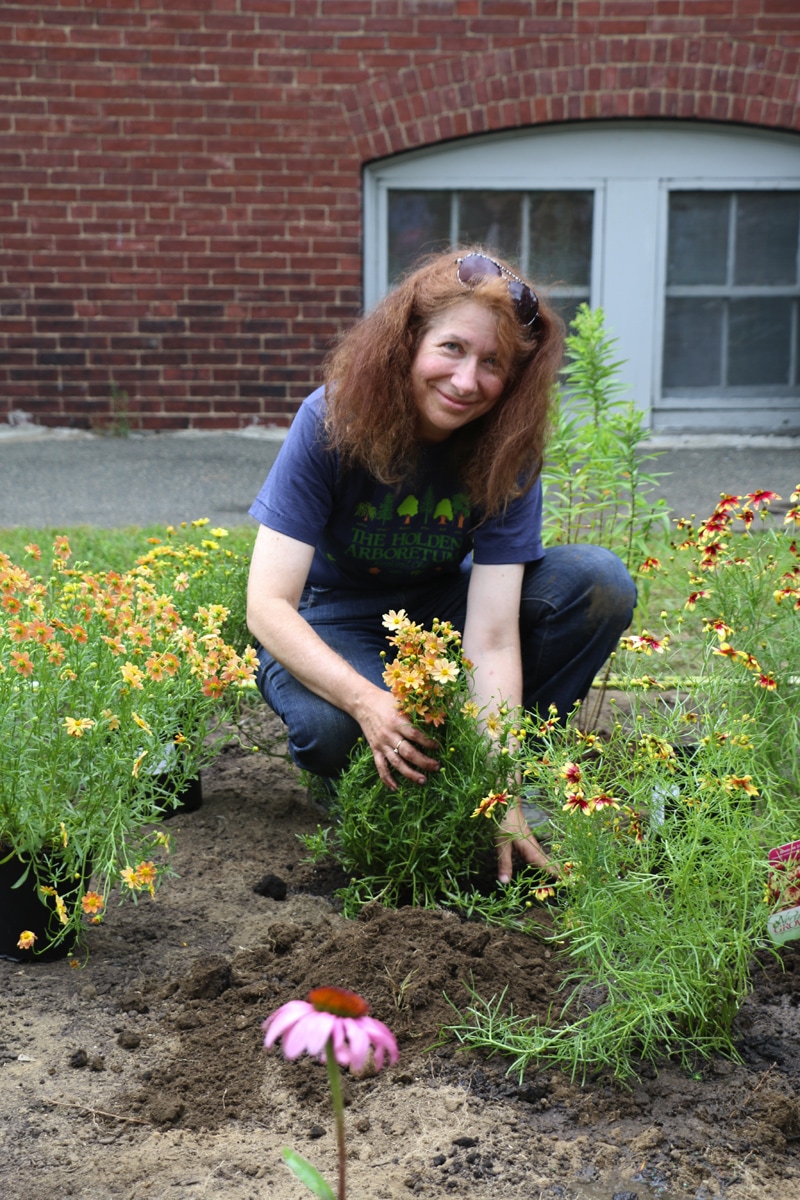
Photo: Meadowscaping for Biodiversity.
Laura D. Eisener, Massachusetts landscape architect and Meadowscaping design consultant, believes in giving people the skills to create their own environmentally sound landscapes.

For years now, my friend Jean has been spreading the word on biodiversity and the problems posed by our lawns. I think that Jean and her business partner, Barbara, have been especially savvy in teaching the principles of biodiversity to middle school kids in particular. It’s one way to influence a generation of parents addicted to lawn chemicals and at the same time raise the consciousness of a generation that will be responsible for the planet’s future.

Tik Root writes on biodiversity and lawns at the Washington Post: “For many Americans, [summer] means blankets of grassy green for kids to play in, or families to picnic on.

“There are an estimated 40 million to 50 million acres of lawn in the continental United States — that’s nearly as much as all of the country’s national parks combined. In 2020, Americans spent $105 billion keeping their lawns verdant and neat. But our grass addiction comes at an environmental cost.

“According to the Environmental Protection Agency, maintaining those lawns also consumes nearly 3 trillion gallons of water a year as well as 59 million pounds of pesticides, which can seep into our land and waterways.

“Department of Transportation data shows that in 2018, Americans used nearly 3 billion gallons of gasoline running lawn and garden equipment. That’s the equivalent of 6 million passenger cars running for a year.

“As these issues are becoming more prominent in climate change discussion, there are steps you can take to more sustainably manage the impact of your lawn. … Having less grass and more plants is among the most important factors in keeping a yard eco-friendly.

“ ‘Lawn, ecologically, is dead space,’ said Doug Tallamy, an entomologist at the University of Delaware and author of ‘Nature’s Best Hope: A New Approach to Conservation That Starts in Your Yard.’

“The solution, he says, is ultimately less lawn. He recommends people aim to cut the amount of turf grass in their yard in half. … Laying down mulch is one place to start. It quickly kills grass and offers a blank canvas for planting. … Invasive plants, Tallamy said, ‘are ecologically castrating the land around us.’ Native plants, on the other hand, often have deep root structures, making them good for storing water or providing drainage. They have also co-evolved for local conditions. …

“Eric Braun, the water resources manager for the town of Gilbert, Ariz., is quick to emphasize that water-friendly landscapes, also known as xeriscapes, don’t have to look like moonscapes.

“ ‘Xeriscape doesn’t mean one saguaro and a cow skull. It can be very lush and inviting,’ said Braun. ‘The number one thing was showing people that it can be a beautiful landscape.’ he said. …

“More broadly, Tallamy said native landscapes can help refocus our gardens on the ecological purpose of plants, which is to produce food. Plant energy gets passed up the food chain, often via insects. But many insects only eat one native plant species, or group of related plants. So, if we are planting nonnative plants, that food doesn’t necessarily transfer from creature to creature, and the ecosystem can stall.

Monarch butterflies, for example, famously rely on milkweed, and as the plant has become less abundant, the monarch population has plummeted. Bird species are also in decline, as are more than 40 percent of insect species. The United Nations estimates that, globally, 1 million plant and animal species are under threat of extinction.

“Tallamy said native flora better supports native fauna and, as a result, helps combat these declines. Tallamy is a fan of oak trees, which come in 91 native species, grow almost everywhere in the country and attract caterpillars, a key species for supporting other wildlife — to raise a clutch of chicks, a pair of robins needs between 6,000 caterpillars and 9,000 caterpillars in just 16 days, Tallamy said. …

“Others put less emphasis on nativity, and more on the diversity of species and types of plants in a yard.

” ‘Yes, we want natives but let’s be inclusive and not exclude plants that have come from somewhere,’ said Juliet Stromberg, a professor at Arizona State University, who was one of more than a dozen ecologists who wrote a letter arguing that a plant’s origin is less important than its environmental impact.

“ ‘What I would suggest is just loosening the reins a little bit,’ she said. ‘If you’re bringing in the plant that’s the same genus, the insects are going to be fine.’ “

More at the Post, here.

Read Full Post »

Photo: Aram Boghosian for The Boston Globe
Jean Devine (left) and Jayden Pineda, 7, make a meadow at the Waltham Y.

I’m excited that today the Boston Globe caught up with my friend Jean’s terrific biodiversity-education outreach. Readers may recall that I blogged here and here about how she and Barbara Passero got started on “meadowscaping” — hoping to ween homeowners from using pesticides and herbicides that harm the environment and contribute to global warming.

Debora Almeida reports on the educators’ latest work with kids: “Swimming, crafting, and playing games are staples of day camp, but kids at the Waltham YMCA are doing something new this summer.

“They’re learning how to plant and cultivate a meadow — and why they should.

“ ‘We just want to save the world, that’s all,’ said Barbara Passero, cofounder of Meadowscaping for Biodiversity, an outdoor environmental education program for students of all ages, which has partnered with the Y for the project.

“Over the course of the summer, Passero and program leader Jean Devine are teaching children the fundamentals of meadow upkeep and the importance of planting exclusively native plants. They are the best hosts for pollinators, such as bees, butterflies, and moths. In turn, the insects attract other wildlife such as birds and rabbits, building biodiversity.

“While some people’s first instinct would be to spray pesticides to protect their hard work from leaf-munching insects, Passero knows that birds will take care of the insects on their own. She also refuses to use any toxic substances around the children, who truly get their hands dirty digging in the meadow. Seth Lucas, program administrator at the Waltham Y, said kids love the activity. …

“The meadow started as a patch of weedy grass, but is in the process of becoming a 10-by-60-foot flourishing garden. Passero and Devine are setting the meadow up for success with native plants that come back year after year. The plants are self-sustaining and spread on their own.”

Such a happy story! Do read the whole thing here.

Read Full Post »