Feeds:
Posts
Comments

Posts Tagged ‘messages’

Photo: Artist in homeless project.
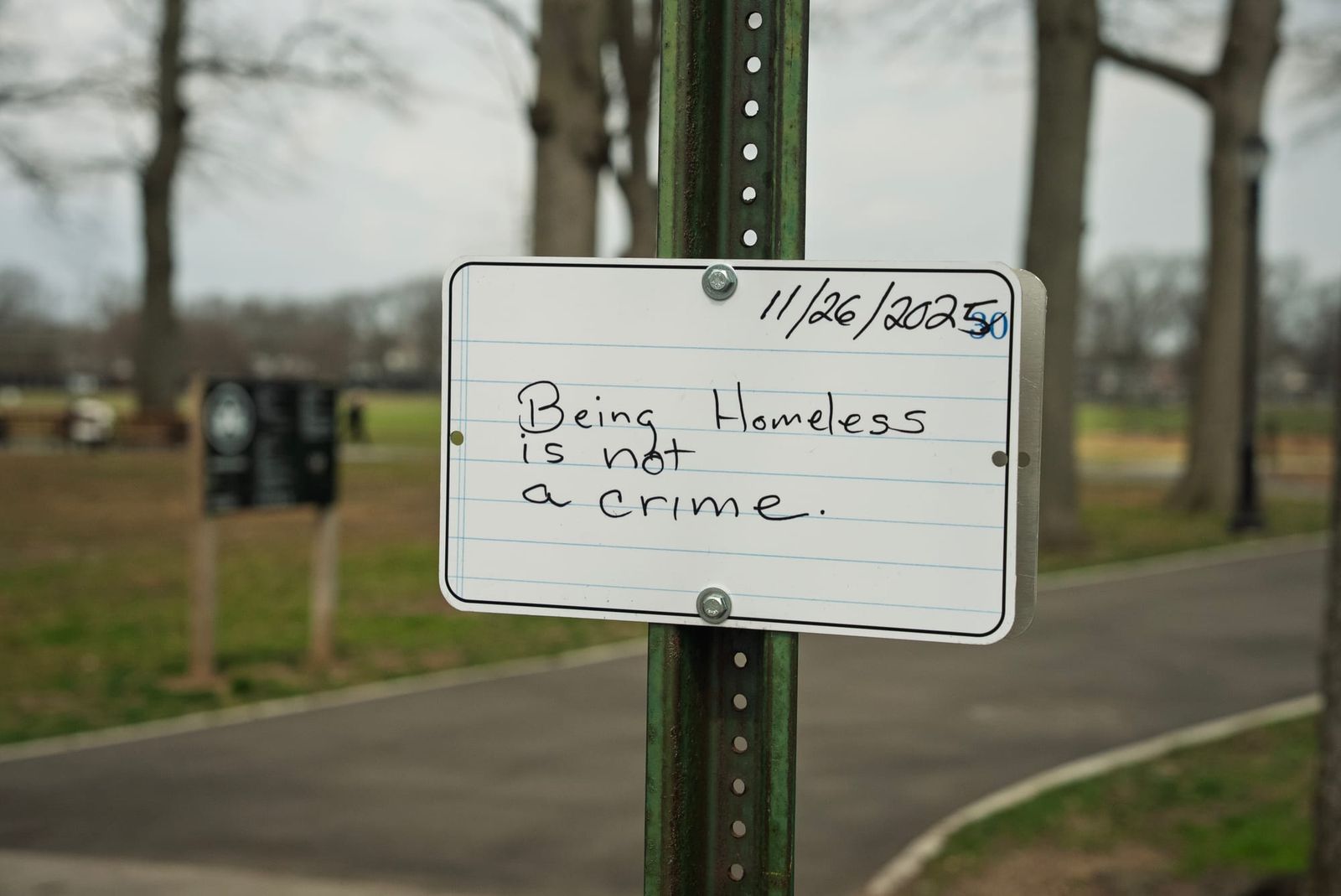
The “Public Address” art installation brings handwritten testimonies from over 400 New York shelter residents and frontline staff to a dozen locations across a borough in New York City.

Can you imagine yourself ever becoming homeless? Yes, you have friends and family who would take you in. For a while. But what if there’s a natural disaster that affects everyone around? I’m sure the victims of California wildfires never imagined having no home. Or those with flooded houses in North Carolina after Hurricane Maria.

An art installation in New York hopes to generate empathy and show how close anyone can get to the edge.

Anna Lee writes at Hyperallergic, “Alex Strada’s ‘Public Address’ opened in the Bronx on Monday, September 14, bringing handwritten testimonies from over 400 New York shelter residents and frontline staff to a dozen locations across the borough.

“Using log entries from workshops held across New York City shelters, Strada, public artist-in-residence with the NYC Department of Homeless Services and Department of Cultural Affairs since 2022, translated these messages onto aluminum signs from the Department of Transportation. Visible on street corners, parks, and other high-traffic areas, the long-term installation debuted in Manhattan in October 2025 and will have appeared in all five boroughs by March 2027.

“ ‘My hope for this project is that it functions as a jumping off point to work towards more just realities that are not mired in stereotype or misperception, or in the acceptance of homelessness as an unavoidable byproduct of New York City life,’ Strada told Hyperallergic.

“The project includes depictions of an Ecuadorian mother fleeing to New York with her two daughters, an assemblage of multicolored hearts, and intimate letters detailing experiences with homelessness. Bikes, houses, and faraway stretches of land convey privileges often taken for granted, and letters touch on lesser-known aspects of homelessness: the impossible prospect of finding housing as an undocumented immigrant, balancing high school without shelter, and the unforeseen circumstances that bring about eviction at a moment’s notice.

“ ‘Some of us that work at the shelter system are a part of the homeless population,’ writes a single father to a seven-year-old girl. ‘We work, pay taxes, and still can’t afford an apartment.’ …

“Much like her previous work with ‘Collective Mobilities,’ a project on wheels that brings resources to people experiencing homelessness, Strada is working with the Bronx Museum and Storefront for Art and Architecture to introduce programs that combat ‘extractive real estate practices and eviction’ in the South Bronx.

“Strada’s engagement with the policies, infrastructures, and surroundings of each borough informed the earlier iterations of ‘Public Address’ in Manhattan and Brooklyn. When the project debuted in Petrosino Square in SoHo, the signs responded to the lack of shelters in the pricey community district. In Brooklyn, the installation’s symbolic proximity to Borough Hall and the Kings County Supreme Court tapped into the complexities between homelessness, policy, and migration.

“ ‘Part of what isn’t necessarily evident in the work itself as someone encounters it is the hundreds of people have come together to make this project happen,’ Strada stated, emphasizing the citywide collaboration between cultural organizations such as the Storefront for Art and Architecture and Bronx Museum, government entities, and residents and staff in the shelters. …

“While grappling with the abuse, discrimination, and hardships that often come tethered to homelessness, some participants offered glimpses of hope.

“ ‘Good news, I finally got accepted to a supportive housing opportunity that I have been trying to get into for almost a year,’ one letter reads. ‘I officially move into my very own apartment in a month.’ ”

Collaboration and art that humanizes the people forced to live rough can be meaningful steos in making change. At least I hope so. More at Hyperallergic, here.
Read Full Post »

island-scene-on-Painted-Rock


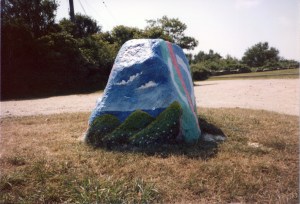
Feeling the cold setting in?  Well here’s a summery scene on New Shoreham’s famed Painted Rock, one of my favorite pictures of the island’s constantly changing bulletin board. Wish I knew who the artist was.

John is behind the new tumblr blog featuring the Painted Rock in as many iterations as folks can dig out of the albums and send along.

Here’s what John had to say about it on the island e-board:

“Thanks for the kind comments and great pics submitted to paintedrockbi.tumblr.com The ‘mini cooper rock’ and the ‘hamburger rock’ are especially cool.

“There was also a question about me and the reason for the blog, so here goes.

“About 20 years ago my mother painted the rock early one morning to celebrate my sister turning 16 and my turning 21. Our summer home is a only short walk down Mohegan Trail from the rock, but if you took careful note of our ages, you might guess that my sister and I were not really morning people.

“So by the time we had rolled out of bed and made it down the street to look, it was already painted over. No photos were taken, but I know it’s there buried under all the layers. Now I am a parent, and it kind of reminds me of the many things we do for our children that no one ever really sees, but we keep doing anyhow.

“For many years I’ve been thinking about how best to document the many cool rock paintings. And last week I finally got around to doing something about it; hopefully the page will continue to get submissions and we can save the many small memories behind each coat of paint.”

Check it out: http://paintedrockbi.tumblr.com/

Read Full Post »

This week I heard Mahzarin Rustum Banaji, a Harvard psychology professor, speak about unconscious bias, or blind spots. She conducted experiments with the audience to show (a) that there are things we see but simply don’t register consciously and (b) that we have unconscious biases that we may not want to have.

She showed a video of a basketball game, with two blurry films superimposed. Audience members were supposed to concentrate hard on how many times the ball got passed. After showing it, Banaji asked if anyone had seen anything unusual, and only one person mentioned seeing a woman walk through the basketball game carrying an umbrella. Most of us had no memory of that.

Banaji said a colleague at Yale has observed some brain activity in people who are “not seeing” that woman, but registering her presence doesn’t rise into the conscious zones. (Apparently only 1 to 10 percent of our brain function is conscious.) If Banaji hadn’t pointed out the woman by showing the video a second time and if I was still unaware of her walking through the game, I wonder if the next time I saw a woman with an umbrella I would think of a basketball game and wonder why.


Banajee said that our eyes have not evolved past 500,000 years ago, when people did not deal with 2-D representations, so some 2-dimensional info cannot be processed even today. None of the audience could believe, for example, that in a slide showing two perspectives of a table, the table was the same size in each drawing. We could not see it even when she proved it was true.

Other tests showed that we associate women more with household tasks, and men more with the office, even though we think we have left those views behind. In one slide the same AP editor had described a black Katrina victim swimming with a loaf of bread as “a looter” and a white couple doing the same as having “found” supplies in a a store.

You probably also know that until people auditioned for orchestras behind a screen, without the judges knowing anything about the candidates, there were few women selected. The judges had no idea that they had been deciding on the basis of unconscious bias. They believed they’d been really trying to find qualified women musicians. I asked if in a workplace it would help to point out to people in a nice way when something they said might unintentionally have sounded biased. She said people don’t like to hear that about themselves, but she recommends people from one minority group advocating for people from another group. For example, a gay person might advocate for a woman’s right or a white woman might advocate for an Asian immigrant.

I have always loved puzzling out subliminal messages and asking myself why I react in a mysterious way to certain innocuous things. Even when I was a child, I sensed something about hidden messages. I once pointed out a model in a magazine to my mother and said I thought the woman was beautiful. My mother said it was more important for the woman to have a “beautiful character.” For a couple years afterward, if I could get my mother sitting down, I’d point out women in magazines and ask if she thought they were “beautiful by character.” (She got tired of this game pretty fast.)

Even today, when I see an ad for Calvin Klein, say, or Tanqueray gin, I study the models and ask myself what daily life we are supposed to intuit from the photo. Drug addict who is very creative but depressed? Ad company CEO? Saxophonist?

Someone is sending nonverbal messages to my unconscious mind. What are they?

Mahzarin Rustum Banaji does experiments online, and you may participate at Project Implicit.

Read Full Post »