Feeds:
Posts
Comments

Posts Tagged ‘methane’

Photo: Melanie Stetson Freeman/CSM.
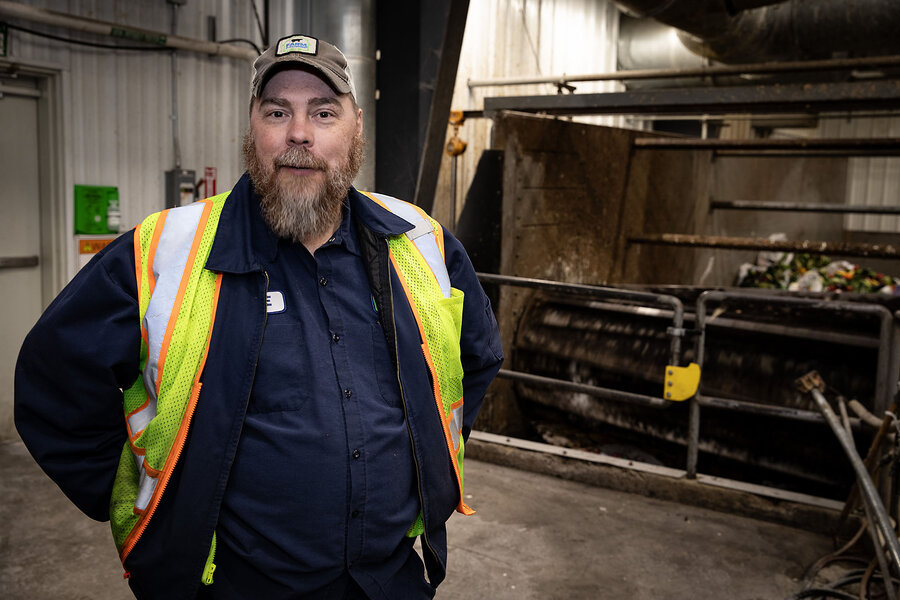
Abe Marciniec is the site manager of Vanguard Renewables, an organics recycling facility in Agawam, Massachusetts. It processes food waste from supermarkets, distribution centers, universities, and residential drop-offs, turning it to fuel.

Today’s story about Massachusetts being the only state to reduce food waste would seem to be a triumph, and in terms of intentions, it is. But I am ambivalent about the value of turning food waste into gas. Methane, after all, is one of the worst. See what you think.

Troy Aidan Sambajon reports at the Christian Science Monitor, “On a recent Thursday, Abe Marciniec unloads two dozen pallets of ice cream – enough to fill 31 refrigerators – into a machine that transforms it into fuel.

“Today’s flavor is room-temperature rocky road, but this facility handles all kinds of food waste from supermarkets, distribution centers, universities, and even residential drop-offs.

“ ‘We get everything you can find in Aisles 1 through 12,’ says Mr. Marciniec, site manager of the Agawam Organics Recycling Facility, owned and operated by Vanguard Renewables. Mr. Marciniec’s recycling facility is one of six in the commonwealth and only one of 25 nationwide.

“As the expired ice cream funnels into a turbo separator, Mr. Marciniec watches the machine strip food from its packaging. The organic waste is then trucked to a dairy farm, where it’s mixed with cow manure and processed into renewable natural gas.

“ ‘It’s really a great circle,’ says Mr. Marciniec. ‘Food starts at the farm, and our farms turn it back into energy. Farm to table, then back to farm.’ …

“Facilities like this one, which can process up to 250 tons of food waste daily, replace manual work typically done by hand or not done at all. That’s a crucial step in diverting waste away from landfills. Americans throw out about 40% of food annually – a waste of both money and natural resources. Reducing food waste can increase food security, promote resource and energy conservation, and address climate change.

“The Bay Sate has become a leader in reducing food waste. In fact, it’s the only state to significantly do so – to the tune of 13.2% – according to a 2024 study. Massachusetts was among the first five states to enact a food waste ban in 2014. (The others were California, Connecticut, Rhode Island, and Vermont.)

“ ‘The law has worked really well in Massachusetts,’ says Robert Sanders, an assistant professor of marketing and analytics at the University of California San Diego and co-author of the study. ‘That’s due to three things: affordability, simplicity, and enforcement.’

“[Food waste is] the largest category of waste – at 25% – sent to landfills in the United States. In 2019, 66 million tons of food waste came from retail, food service, and households. Around 60% of this waste was sent to landfills, according to the Environmental Protection Agency.

“Vanguard Renewables specializes in turning organic waste into renewable energy. The Massachusetts-based company partners with dairy farms to convert food scraps and manure into biogas through anaerobic digestion.

Microorganisms in cow manure digest organic matter, releasing biogas – a mix of methane and carbon dioxide. 

“The gas is captured in large steel vats on the farm and refined into renewable natural gas, which can be used to heat homes and power buildings. … Since 2014, Vanguard has processed more than 887,000 tons of food waste in New England, producing enough natural gas to heat 20,000 homes for a year. By 2028, the company plans to have more than 50 systems across the country.

“In western Massachusetts, Amherst College has become a model for limiting food waste at the source. Last year, it was recognized as the winner in the zero waste category in the Campus Race to Zero Waste Case Study Competition.

“ ‘The goal has been to push us aggressively to make sure everything is compostable,’ says Weston Dripps, director of sustainability. To achieve that, the school has phased out single-use plastics, to-go boxes, and even canned water, replacing them with refill stations and compostable materials.

“In 2023, Amherst College generated 238 tons of food waste – roughly 4 to 5 tons per week. But instead of ending up in landfills, Vanguard collected 100% of that waste and processed it at its Agawam facility.

“That total includes both pre-consumer waste – such as kitchen scraps from food prep – and postconsumer waste, like leftovers scraped off plates in the dining hall and campus cafés. ‘To really have a clean waste stream, we have to focus on the front end,’ says Mr. Dripps.

“Amherst’s approach goes beyond composting. Each month, the school donates 2,000 to 3,000 pounds of frozen surplus food to the the Food Bank of Western Massachusetts, ensuring edible food reaches those in need.

“Commercial businesses, too, are finding ways to cut down on waste. Maura Duggan, founder and CEO of Fancypants Baking Co., knows firsthand how much food can go to waste in the food industry. Her company produces hundreds of thousands of cookies each week.

“At its Walpole facility, Fancypants has large totes from Vanguard, which collect burnt cookies, food scraps, and anything that can’t be donated or sold. Last year alone, Fancypants diverted about 22 tons of waste. …

“Back in Agawam, Mr. Marciniec passes by 275-gallon totes full of leafy vegetables. Every day, he faces the reality that Americans waste 92 billion pounds of food a year – enough to make 145 million meals.

“ ‘It really makes you think about the things we take for granted,’ he reflects.

“ ‘Millions of people are starving everywhere, and the amount of food waste in this country is substantial,’ says Mr. Marciniec. ‘I’m sure we can do a better job.’ ”

Although I hate to quibble with this effort to at least do something, I know that enforcement has not reached my residential facility yet. Moreover, I’m pretty sure what we really need is not to have so much waste in the first place. What do you think? Is this a good first step?

Note Earle’s comment on my earlier post about this process, here.

More at the Monitor, here.
Read Full Post »

Photo: ItalianNotes.
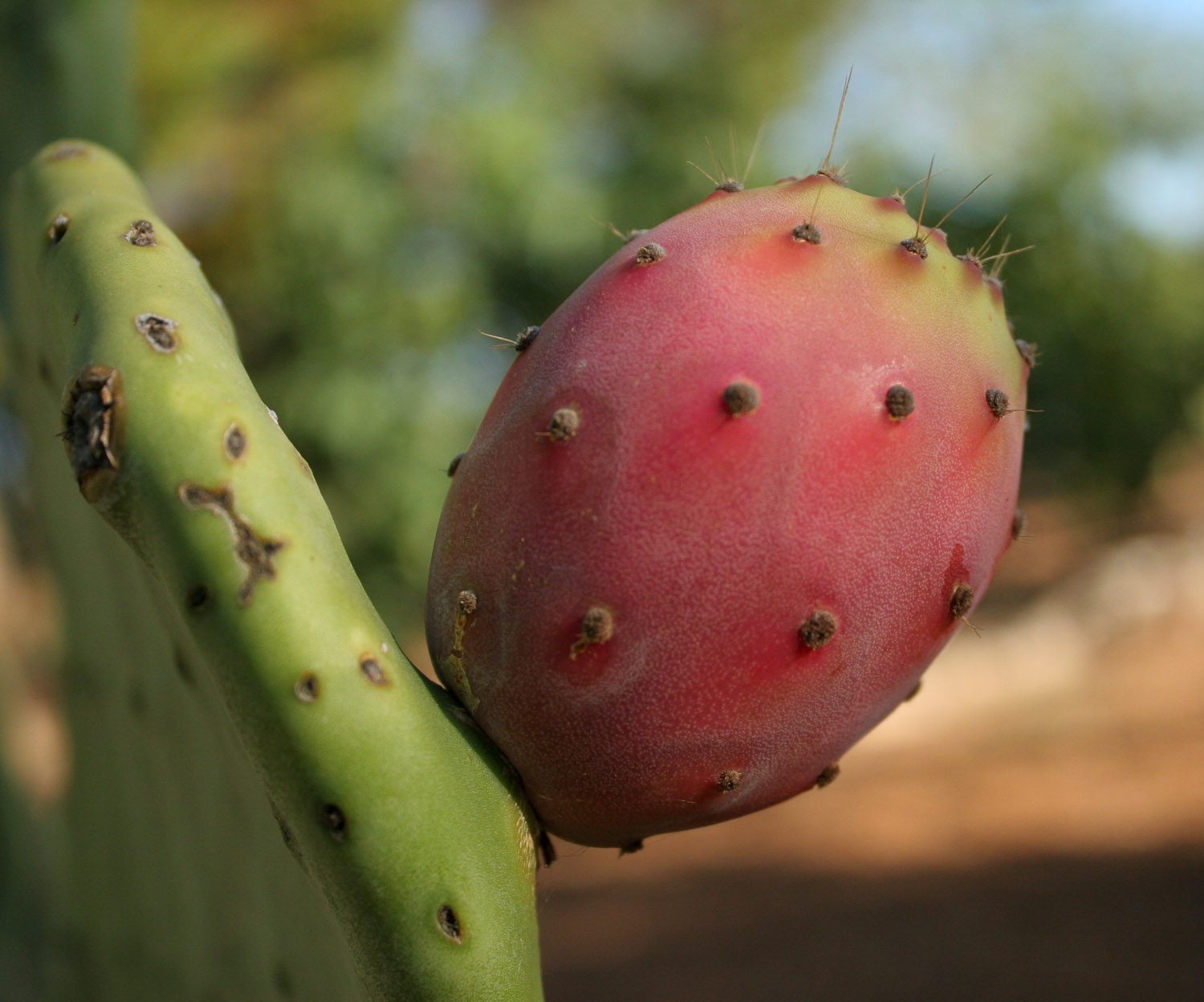
Prickly pear, or cactus pear. When Italy suffers from drought, some people turn to an edible cactus.

A while ago I posted photos I’d taken in New England and was surprised to see a cactus this far north. Hannah called it “prickly pear” and told me it was known for its versatility. It’s apparently the same cactus that Italy is looking to as a reliable food source.

Stefano Bernabei and Gavin Jones write at Reuters, “Global warming, drought and plant disease pose a growing threat to agriculture in Italy’s arid south, but a startup founded by a former telecoms manager believes it has found a solution: Opuntia Ficus, better known as the cactus pear.

“Andrea Ortenzi saw the plant’s potential 20 years ago when working for Telecom Italia in Brazil, where it is widely used as animal feed. On returning to Italy he began looking at ways to turn his intuition into a business opportunity.

“He and four friends founded their company, called Wakonda, in 2021, and began buying land to plant the crop in the southern Puglia region where the traditionally dominant olive trees had been ravaged by an insect-borne disease called Xylella.

“The damage from the plant disease has been compounded by recurring droughts and extreme weather in the last few years all over Italy’s southern mainland and islands, hitting crops from grapes to citrus fruits.

“Ortenzi is convinced the hardy and versatile cactus pear, otherwise called the prickly pear or, in Italy, the Indian fig, can be a highly profitable solution yielding a raft of products such as soft drinks, flour, animal feed and biofuel. …

” ‘As an industry, cactus pear production is growing rather quickly, especially for fodder use and as a source of biofuel,’ said Makiko Taguchi, agricultural officer at the United Nations’ Food and Agriculture Organization headquartered in Rome.

“The cactus produces a tasty fruit eaten in much of Latin America and the Mediterranean, while in Mexico the flat green pads that form the arms of the cactus, are used in cooking. In Tunisia, where it covers around 12% of cultivated land, second only to olive trees, the cactus pear is a major source of income for thousands, particularly women who harvest and sell the fruit.

“In Brazil, which has the world’s largest production, it is mainly cultivated in the north-east for fodder, while Peru and Chile use it to extract a red dye known as Cochineal, used in food and cosmetic production.

Sportswear group Adidas and carmaker Toyota have recently shown interest in using the cactus to produce plant-based leather sourced mainly from Mexico.

“The cactus pear is not yet included in the FAO’s agricultural output statistics, but Taguchi cited the rapid expansion of CactusNet, a contact network of cactus researchers and businesses worldwide which she coordinates. …

“The plant, native to desert areas of south and north America, thrives in the increasingly arid conditions of Italy’s south, and needs ten times less water than maize, a comparable crop whose byproducts also include animal feed and methane. …

“Of the roughly 100,000 hectares of olive trees destroyed by Xylella in southern Puglia, only 30,000 will be replanted in the same way, [Ortenzi] told Reuters in an interview. ‘Potentially 70,000 could be planted with prickly pears,’ he said. …

“Wakonda’s business model discards the fruit and focuses instead on the prickly pads, which are pressed to yield a juice used for a highly nutritious, low-calorie energy drink. The dried out pads are then processed to produce a light flour for the food industry or a high-protein animal feed.

“Wakonda’s circular, ecological production system also includes ‘biodigester’ tanks in which the waste from the output cycle is transformed into methane gas used as a bio-fuel either on site or sold. …

“Under Ortenzi’s business plan, rather than buying up land to plant the cactus, Wakonda aims to persuade farmers of its potential and then license out to them, in return for royalties, all the equipment and know-how required to exploit it.

” ‘The land remains yours, you convert it to prickly pears and I guarantee to buy all your output for at least 15 years,’ Ortenzi said.”

Hmmm. I have two issues. Throwing out the fruit seems super wasteful. And methane may be a biofuel, but it’s no better for the environment than fossil fuel. What do you think?

More at Reuters, here. No firewall.

Read Full Post »

Livestock produces a lot of methane, which is unlikely ever to be balanced out by carbon captured in the soil. The Soil Association Exchange wants you to know about a few positive effects, however. 

It’s an ongoing process to keep up on the latest, especially when it comes to protecting the planet. I myself once thought that massive tree planting had the biggest bang for the charitable buck. Then I learned that, although trees are important, they can’t help much without due consideration given to where and how they are planted, and what varieties of trees they are.

Today I’m trying to bone up on the situation with cows, which we all know (including a young grandson who has cut beef out of his diet) produce too much climate-warming methane gas.

James Tapper reports at the Guardian, “New data shows [cows] may play an important role in renewing farm soil. Research by the Soil Association Exchange shows that farms with a mixture of arable crops and livestock have about a third more carbon stored within their soil than those with only arable crops, thanks to the animals’ manure.

“This also has an effect on biodiversity: mixed arable and livestock farms support about 28 grassland plant species in every field, compared with 25 for arable-only and 22 for dairy-only.

“Joseph Gridley, chief executive of SAE, which was set up by the Soil Association in 2021 to support and measure sustainable farming, said it was unlikely that carbon captured in soil would balance out the enormous amounts of methane created by cattle. Farm livestock around the world creates about 14% of human-induced climate emissions.

“ ‘It’s pretty unequivocal in the data that having livestock on your farm does mean you have more emissions – five or six times more emissions,’ he said. ‘But if you integrate livestock into the system, on every metric on soil health, there’s an improvement, and on a lot of the biodiversity measures as well.’

“Soils are degrading, but by how much exactly is unclear. In 2015, the UN Food and Agriculture Organization claimed that the world had only 60 harvests left, but researchers at Oxford University and Our World In Data said in 2021 that there was a complex picture. …

“Lee Reeves, UK head of agriculture at Lloyds bank, which helps fund SAE … suggested ministers should create a decarbonization strategy, and a standardized carbon calculator, so that farmers and other businesses could use a single tool to calculate their carbon impacts.

“ ‘Moving from traditional to regenerative farming can see a dip in profitability for the first five years, so the government needs to support farmers and banks in that,’ he said.

“[In the UK] the Department for the Environment, Food and Rural Affairs has been investigating so-called methane blockers as a way to reduce emissions. Adding substances such as essential oils, probiotics and even seaweed to cattle feed can reduce the amount of burps and wind they generate.

“Last month the Green Alliance charity said that feeding Bovaer, a methane blocker, to a third of the UK’s dairy cows would cut the country’s emissions by about 1%. Yet this is not happening, the campaign group warned, because farmers were unwilling to pay extra for something they did not benefit from. It said methane blockers should be subsidized, as other green farming schemes were.”

More at the Guardian, here. The Natural Resources Defense Council explains more about regenerative farming here.

Read Full Post »

Photo: Melanie Stetson Freeman/CSM.
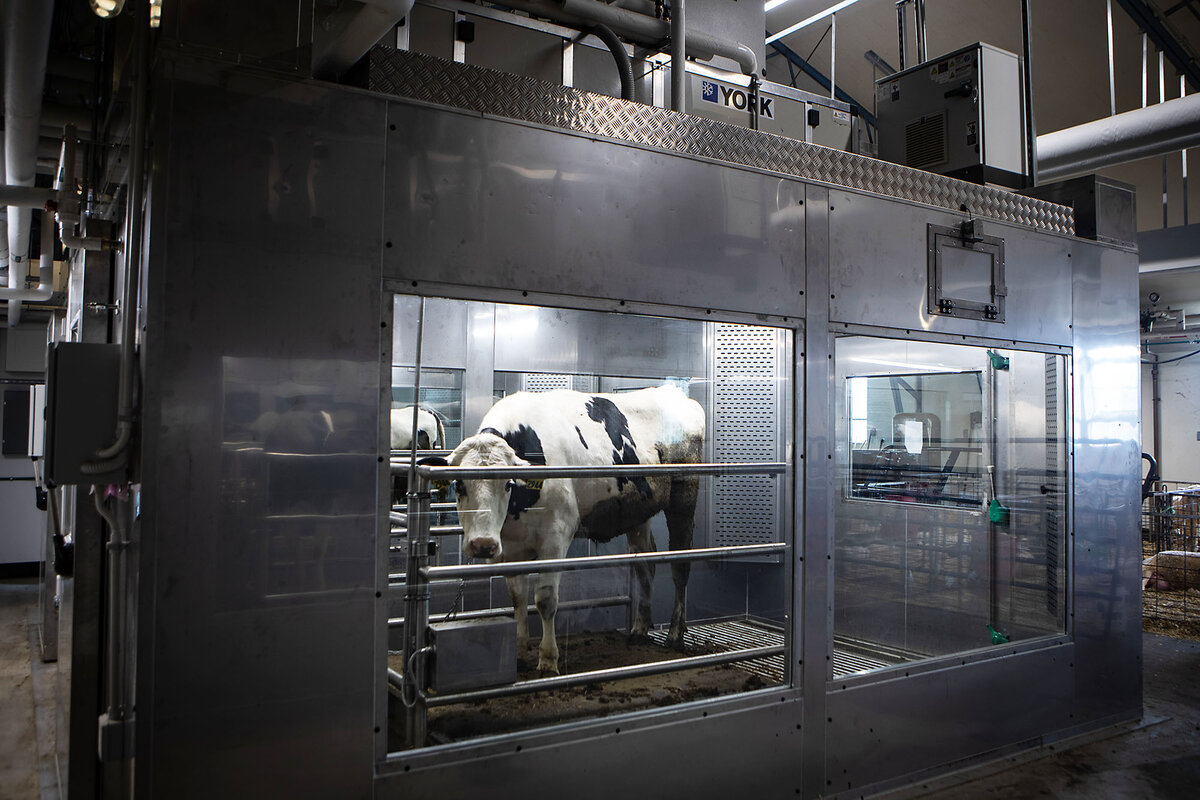
A heifer stands inside a methane chamber at Cornell University, June 7, 2024, in Ithaca, New York. Researchers are studying how to reduce methane emissions from dairy cows.

When he was only 11, one of my grandsons gave up eating beef after learning in school about the effects of cows’ methane emissions on global warming.

I guess it’s fortunate that there are people researching ways to make cows “less gassy.” But some of the research sounds like it’s not much fun for the cow.

Stephanie Hanes of the Christian Science Monitor reported recently on work at Cornell.

“On the campus of Cornell University, within an intricately monitored and carefully sealed chamber, there is a cow. Scientists carefully record what this cow eats and what she drinks. They open the chamber only once a day, so as to limit disturbances to her environment. Every breath she takes – or more crucially, exhales – is also measured to its molecular level. There is hydrogen. There is carbon, recorded down to its isotopic composition. There is oxygen. And, most important to this state-of-the-art study, there is methane.

“Methane is a naturally occurring gas that comes from a variety of biological and industrial sources, from oil- and gas-well leaks to decomposing garbage to, well, cow burps. It is also one of the world’s most potent greenhouse gases – far more heat-trapping than carbon dioxide. …

“ ‘There is growing awareness amongst environmental advocates, policymakers, that reducing methane emissions is the fastest way to reduce warming,’ says Dan Blaustein-Rejto, director of food and agriculture at the nonprofit Breakthrough Institute. …

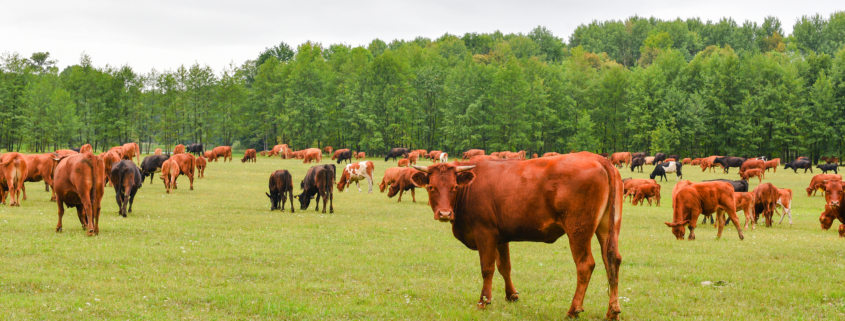
“Although exact percentages are difficult to determine, researchers estimate that cows are responsible for around 30% of U.S. methane emissions. This is largely because cattle, like goats or sheep, are ruminants: animals with four-chambered stomachs that ferment grass and other vegetation into consumable food. And a natural by-product of rumination is methane. …

“According to the U.S. Department of Agriculture, there are 28.2 million beef cattle in the U.S., along with 9.36 million dairy cows and 33.6 million calves. And those numbers pale in comparison to countries such as India, which has an estimated 61 million milk cows, or Brazil, with around 234 million beef cattle. 

“With growing pressures from policymakers and climate advocates, then, agribusiness and scientists are trying to figure out how to make individual dairy cows more productive, which could lead to smaller herds, while at the same time trying to find ways to make cow burps — the body function that produces the most methane — less gassy.

“The first step to doing that, says Cornell associate professor Joseph McFadden, is to get good measurements of bovine methane in the first place. …

“ ‘The challenge comes in capturing the methane,’ says Joe Rudek, lead senior scientist at the Environmental Defense Fund. ‘Cows are breathing out this methane. You’ve got them walking around in a pasture, how do you capture that methane that’s coming out of the cows’ mouth and nostrils?’

“So instead of individually measuring each cow, scientists are trying to build up a robust sample size of measurements that would let them statistically predict methane emissions, both broadly and specifically. One contraption they use now is called the GreenFeed – basically a high-tech box with cow treats. When the cow puts her head into it to eat, the box measures methane and other gases. These instruments are portable, so theoretically farmers can use them in different locations.

“But, Dr. McFadden says, those measurements are not always exact. That’s why his respiration chambers are important. Because the pods are highly accurate, closed systems, they can calibrate other machines. … The chambers can help him monitor other inputs and outputs that can give clues about animal health and well-being, and about how the animal uses energy – as well as about other greenhouse gases, such as nitrous oxide. …

“Across the country, at the University of California, Davis, professor Ermias Kebreab is also working with dairy cows, and has his eye on some solutions. In addition to feed additives, he is measuring what happens when cows eat local agricultural by-products, such as the grape residue from winemaking. GreenFeed measurements are finding some promising initial results, he says.   

“ ‘We found a 10% to 12% reduction in emissions,’ he says. ‘Animals were happy to eat it … and it avoids the emissions from putting it into a landfill.’ Not only that, he says, but grape pomace — the fruit’s leftover skin, seeds, or stems — seems to improve milk quality. 

“ ‘It’s a win-win kind of situation,’ he says.”

More at the Monitor, here.

Read Full Post »

Photo: matusgajdos17/500px.
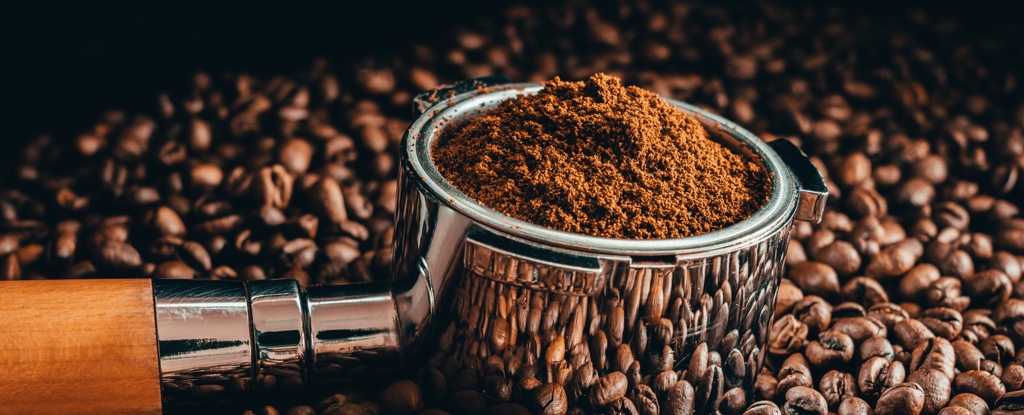
Australian researchers say concrete could be 30 percent stronger with charred coffee grounds.

Longtime coffee drinkers know that coffee is good for all sorts of things besides waking you up. Coffee grounds are great in compost, for example, and provide useful nutrients for your garden — nitrogen, potassium, and phosphorous.

But coffee grounds for construction projects? At ScienceAlert, Tessa Koumoundouros describes new research showing the possibilities.

“We could be producing concrete that’s 30 percent stronger by processing and adding charred coffee grounds to the mix, researchers in Australia discovered. Their clever recipe could solve multiple problems at the same time.

“Every year the world produces a staggering 10 billion kilograms (22 billion pounds) of coffee waste globally. Most ends up in landfills. ‘The disposal of organic waste poses an environmental challenge as it emits large amounts of greenhouse gases including methane and carbon dioxide, which contribute to climate change,’ explained RMIT University engineer Rajeev Roychand.

“With a booming construction market globally, there’s also an ever increasing demand for resource intensive concrete causing another set of environmental challenges too.

” ‘The ongoing extraction of natural sand around the world – typically taken from river beds and banks – to meet the rapidly growing demands of the construction industry has a big impact on the environment,’ said RMIT engineer Jie Li. … ‘With a circular-economy approach, we could keep organic waste out of landfill and also better preserve our natural resources like sand.’

“Organic products like coffee grounds can’t be added directly to concrete because they leak chemicals that weaken the building material’s strength. So using low energy levels, the team heated coffee waste to over 350 °C (around 660 °F) while depriving it of oxygen.

“This process is called pyrolyzing. It breaks down the organic molecules, resulting in a porous, carbon-rich charcoal called biochar, that can form bonds with and thereby incorporate itself into the cement matrix. …

“The researchers [are now] testing how the hybrid coffee-cement performs under freeze/thaw cycles, water absorption, abrasions and many more stressors. The team is also working on creating biochars from other organic waste sources, including wood, food waste and agricultural waste. …

“Said RMIT engineer Shannon Kilmartin-Lynch, ‘Inspiration for my research, from an Indigenous perspective, involves Caring for Country, ensuring there’s a sustainable life cycle for all materials.’ “

The research was published in the Journal of Cleaner Production.

More at Science Alert, here.

Read Full Post »

Photo: Stuff.
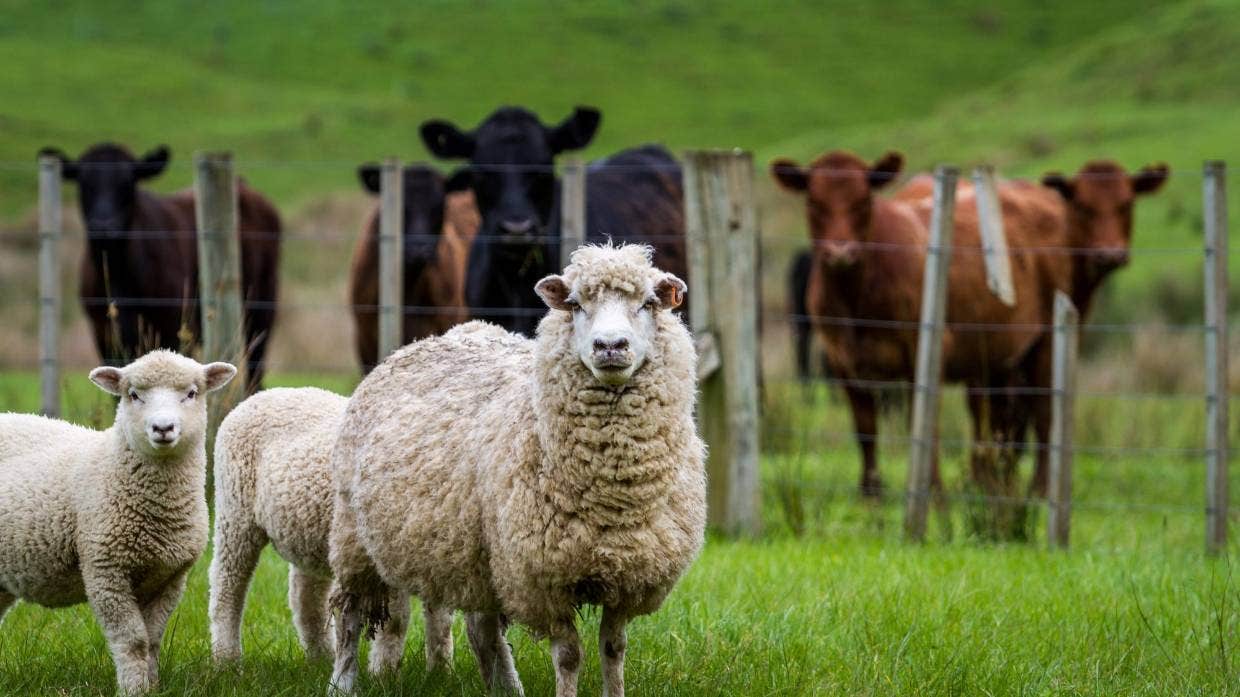
To meet methane goals, New Zealand must cut the number of sheep and cows by 15 per cent, the Climate Change Commission’s decarbonisation blueprint says.

Although I’m eating a vegetarian meal tonight, I’m disappointed in myself for not coming up with lots of interesting vegetarian recipes during lockdown. I had plenty of time to think about it. Part of my problem is that my Covid-era delivery services didn’t offer many prepared vegetarian meals, but it’s a weak excuse. Fortunately, my daughter-in-law knew I was interested in anything vegetarian and often added me to her shopping.

Meanwhile, in New Zealand, they’re way ahead of everyone as usual — not only in terms of trying to cut back on livestock emissions but addressing many other aggressive climate-change goals.

Olivia Wannan writes at Stuff, “Whether you work on the land, in a factory, an office or are still in school, life in 2035 will look significantly different under the Climate Change Commission’s decarbonisation blueprint.

“[If] the Government follows it to the letter., by 2025, you’ll be eligible for a public transport card offering discounted fares until you’re 25, to encourage low-carbon transport habits that may last a lifetime. …

By 2023, the Government’s emissions standards will start to bring lower-carbon cars into the country. The ban on petrol and diesel cars will also be in place as early as 2030. By 2035, both restrictions will also be influencing the second-hand car market, so if you do become an owner, the vehicle will be a lot greener than the cars on the road today. …

“Between now and 2035, you may be one of the thousands of employees that will transition out of carbon-intensive industries and into new jobs. … If you work in an at-risk industry, you’ll be eligible for government support to be re-trained for other roles. If you’re tangata whenua, you’ll be able to opt for education and training developed by Māori. By 2035, many Māori workers will have already transitioned to new industries, with the job gains outweighing losses. …

“The renewable electricity sector will be busy – the country requires one new wind farm to be built almost every year to meet the increased demand for power, plus new transmission lines. …

“By 2035, most truck drivers will be behind the wheel of a low-emissions vehicle, after the battery technology has developed enough to cover longer distances. But there will be fewer trucking jobs, as more freight will travel by rail or sea. … You’ll be twice as likely to head to the office by bike or on public transport, compared to today. If you still want to drive to the CBD, you may have to pay a congestion charge, with your cash helping to fund lower-carbon forms of travel. …

“By 2035, your office must be a pleasant place to be in all seasons, courtesy of energy efficiency standards for new and existing buildings. Building owners will have ditched coal in all heating systems by 2030. Natural gas will be phased out after that. …

“Across the country, dairy and meat farmers will reduce animal numbers by 15 per cent between 2020 and 2030. However, this isn’t an across-the-board cut. The efficiency gains you’ll make on your farm will probably differ to what your neighbours achieve. It’s the collective effort that matters.

“This could mean changing your farm management. You’ll need to use the plans, advice and tools developed by the agricultural industry partnership with Government, He Waka Eke Noa – though this guidance won’t be finalised until 2022. You may require reliable internet to precision-manage your farm, so you should have access to broadband by 2023 at the latest. …

“A farm might take a look at the efficiency gains required and choose to replace its cows and sheep with horticulture. An additional 20,000 hectares of land will grow grain, fruit and vegetables by 2035.

“Farmers staying in the meat or dairy business will carefully manage their use of nitrogen fertiliser (which creates the greenhouse gas nitrous oxide) and supplementary feed, which will cut expenses. Some will try their hand at regenerative farming, which aims to create healthier soil and land.

“Sheep farms will select rams that carry the genes to produce less methane when food is digested. The widespread uptake of low-methane sheep breeds will cut the country’s agricultural methane by 3 per cent by 2035. …

“If you have unproductive land sitting around, you’ll be able to access public funding to plant it with native trees. Nearly 250,000 additional hectares of sheep and beef farmland will be afforested by 2035. Combined with a ban on native deforestation in 2025, you’ll more frequently spot native birds and lizards, particularly if you fence off your bush and undertake pest control.

“Collective action will allow New Zealand to continue to promote the comparatively low-carbon credentials of its dairy and meat to international markets. …

“Buildings will be increasingly constructed using timber, which is less emissions-intensive than concrete and steel. By 2025, new natural gas connections will be banned. A decade after that, remaining gas appliances for cooking or heating will be increasingly costly. Because the domestic carbon price will steadily rise, the average annual gas bill will cost $150 more in 2035 compared to 2020.

“In comparison, the price of electricity will drop during the 2020s, after the Tiwai smelter closes. It’ll gradually rise again towards the end of the decade but should stay lower than today’s costs. …

“Remote and Māori communities will be able to access funds to build their own solar generation.”

It will likely to be hard to achieve all that, even with the less environmentally friendly biomass use and burning of “renewable” wood. But I think they are taking this seriously.

More at Stuff, here. Hat tip: Svein Tveitdal, @tveitdal, on twitter.

Read Full Post »

Photo: robertharding/Alamy.
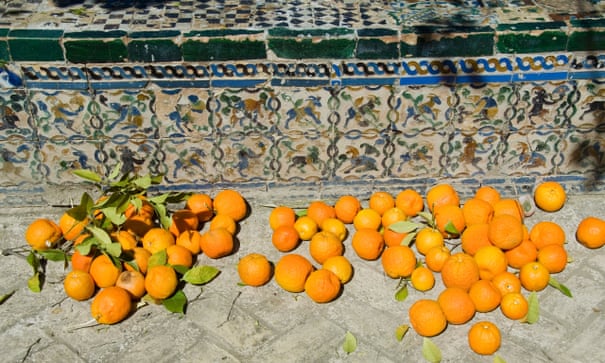
Ripe oranges in the gardens of Seville’s Real Alcazar. The city council employs about 200 people to collect the fruit after it falls and starts to rot. It’s now being used to produce electricity.

In sunny Spain, a pilot project to covert methane from fermenting fruit into clean power for a city water plant is creating hope for supporters of sustainable energy.

Stephen Burgen writes at the Guardian, “In spring, the air in Seville is sweet with the scent of azahar, orange blossom, but the [bitter] fruit the city’s 48,000 trees deposit on the streets in winter are a hazard for pedestrians and a headache for the city’s cleaning department.

“Now a scheme has been launched to produce an entirely different kind of juice from the unwanted oranges: electricity. The southern Spanish city has begun a pilot scheme to use the methane produced as the fruit ferments to generate clean electricity.

“The initial scheme launched by Emasesa, the municipal water company, will use 35 tonnes of fruit to generate clean energy to run one of the city’s water purification plants. The oranges will go into an existing facility that already generates electricity from organic matter. As the oranges ferment, the methane captured will be used to drive the generator.

“ ‘We hope that soon we will be able to recycle all the city’s oranges,’ said Benigno López, the head of Emasesa’s environmental department. …

‘It’s not just about saving money. The oranges are a problem for the city and we’re producing added value from waste.’

“While the aim for now is to use the energy to run the water purification plants, the eventual plan is to put surplus electricity back into the grid. The team behind the project argues that, given the vast quantity of fruit that would otherwise go into landfill or be used as fertiliser, the potential is huge. They say trials have shown that [2,000 pounds will] provide electricity to five homes for one day, and calculate that if all the city’s oranges were recycled and the energy put back into the grid, 73,000 homes could be powered

” ‘Emasesa is now a role model in Spain for sustainability and the fight against climate change,’ Juan Espadas Cejas, the mayor of Seville, told a press conference at the launch of the project. ‘New investment is especially directed at the water purification plants that consume almost 40% of the energy needed to provide the city with drinking water and sanitation.’ …

“The oranges look pretty while on the tree but once they fall and are squashed under the wheels of cars the streets become sticky with juice and black with flies. … The bitter oranges, which originate in Asia, were introduced by the Arabs around 1,000 years ago and have adapted well to the southern Spanish climate.

” ‘They have taken root here, they’re resistant to pollution and have adapted well to the region,’ said Fernando Mora Figueroa, the head of the city’s parks department. …

“The region produces about 15,000 tonnes of the oranges but the Spanish don’t eat them and most of the fruit from the surrounding region is exported to Britain, where it is made into marmalade. Seville oranges are also the key ingredient of Cointreau and Grand Marnier. …

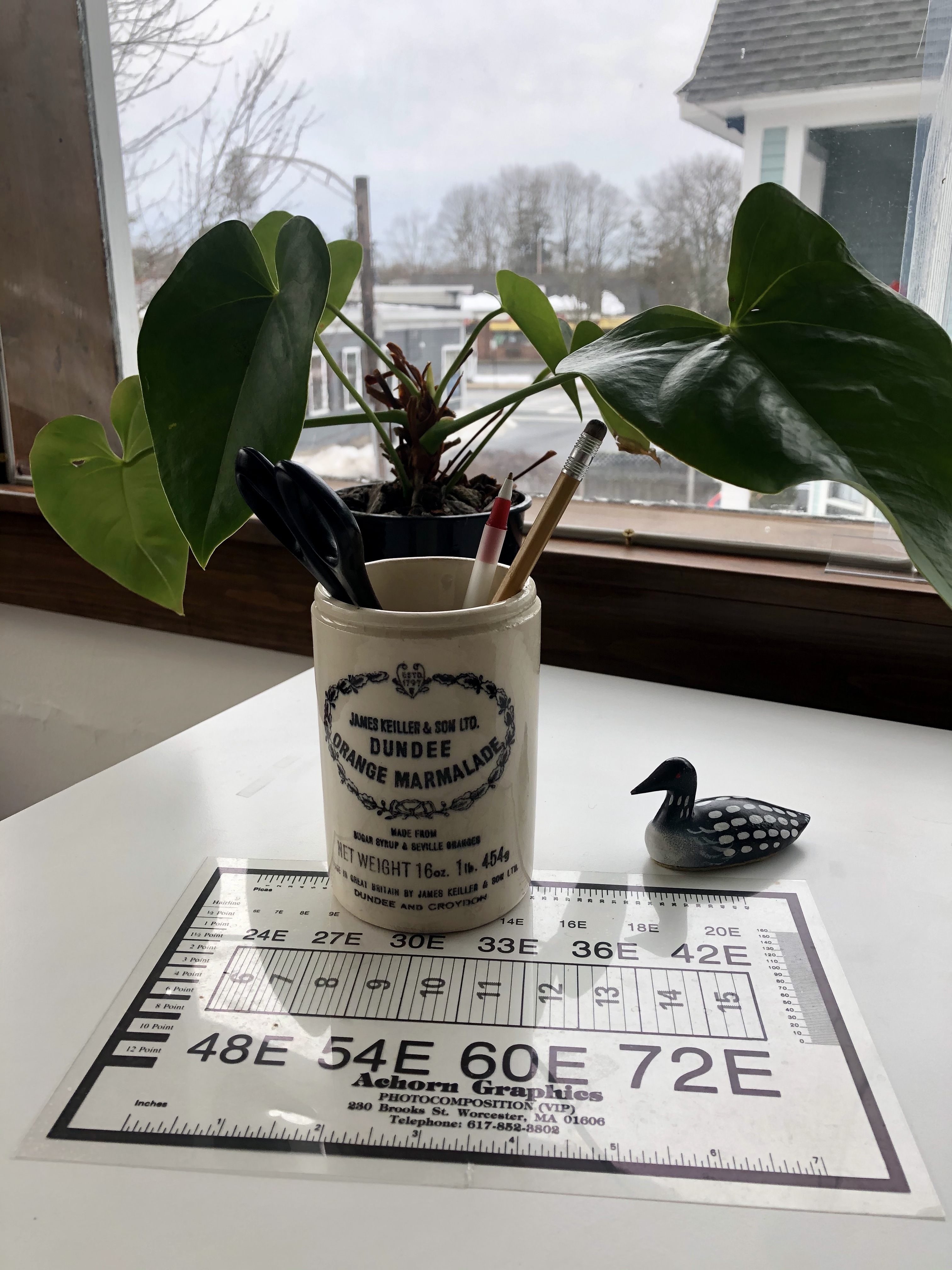
“A handwritten recipe for marmalade dating from 1683 was found in Dunrobin castle in Sutherland in the Scottish Highlands. Legend has it that a ship carrying oranges from Spain took refuge in Dundee harbour and local confectionery maker James Keiller was the first to find a use for the otherwise inedible fruit. This may be a myth, but in 1797 Keiller did produce the first commercial brand of marmalade.”

More at the Guardian, here.

When I was a child, we saved all our Dundee Seville marmalade jars. Clay ones like these are now collectors’ items.

Read Full Post »

Erik’s running buddy passed along a BBC story suggesting that cutting back on meat could have value for the planet.

Interestingly, that was the premise of Frances Moore Lappé‘s 1971 bestseller, Diet for a Small Planet, which my sister got me interested in when she was a vegetarian.

At the BBC, environment analyst Roger Harrabin notes research that confirms some of Lappé’s predictions.

“Research from Cambridge and Aberdeen universities estimates greenhouse gases from food production will go up 80% if meat and dairy consumption continues to rise at its current rate. That will make it harder to meet global targets on limiting emissions.

“The study urges eating two portions of red meat and seven of poultry per week. However that call comes as the world’s cities are seeing a boom in burger restaurants. …

“If [the trend] continues, more and more forest land or fields currently used for arable crops will be converted for use by livestock as the world’s farmers battle to keep up with demand.

“Deforestation will increase carbon emissions, and increased livestock production will raise methane levels and wider fertiliser use will further accelerate climate change. The lead researcher, Bojana Bajzelj from the University of Cambridge, said: ‘There are basic laws of biophysics that we cannot evade.’

“The average efficiency of livestock converting plant feed to meat is less than 3%, and as we eat more meat, more arable cultivation is turned over to producing feedstock for animals that provide meat for humans.” Read more here. And consider going in for mushroom burgers.

I only ever made the eggplant casserole Diet for a Small Planet, but it sure was yummy.

Photo: CiteLighter-Cards
In 1971, Frances Moore Lappé wrote that raising animals for food takes resources better used elsewhere. It can also put too much methane into the atmosphere.

Read Full Post »

At the radio show Living on Earth, Steve Curwood recently interviewed Gary Cook of Greenpeace about an effort to get tech companies to be greener.

CURWOOD: “Back in 2012, you criticized Apple for using carbon-intensive energy from coal plants to power its servers. …

COOK: “Just after we spoke, they made a commitment to be 100 percent renewably powered, and as the end of last year, they even made that goal. So, it’s been quite a big shift.

CURWOOD: “100 percent renewable energy. How’s that possible?

COOK: “It requires some effort. Apple has done a lot in North Carolina where they have their largest data center in terms of deploying two different solar farms and an onsite fuel cell that’s powered with biogas energy, so it’s all renewable. They have several other data centers. … In Oregon they’re using wind; in Nevada they’re using solar.

“So they’ve actually shown a commitment from the top, been very aggressive, probably the most aggressive of any of the brands to make sure as they grow, they’re using clean energy.

CURWOOD: “Biogas. Where are they getting that from?’

COOK:” Currently, they’re getting that from landfill and some other renewable sources. The landfill is methane capture in the southeast, and they’re having that piped to where their data center is in North Carolina.”

The radio interview covers several other efforts tech companies are making. It’s a good thing, too, when you consider, as Living on Earth points out, “If the Internet were a country, it would be the sixth largest consumer of electricity in the world.” More here.

Photo: George Nikitin, Greenpeace
The Greenpeace Airship A.E. Bates flies over Facebook headquarters with a banners reading “Building a Greener Internet” and “Who’s The Next To Go Green?” Apple, Facebook and Google have committed to powering their data centers with renewable energy.

Read Full Post »