Feeds:
Posts
Comments

Posts Tagged ‘migrants’

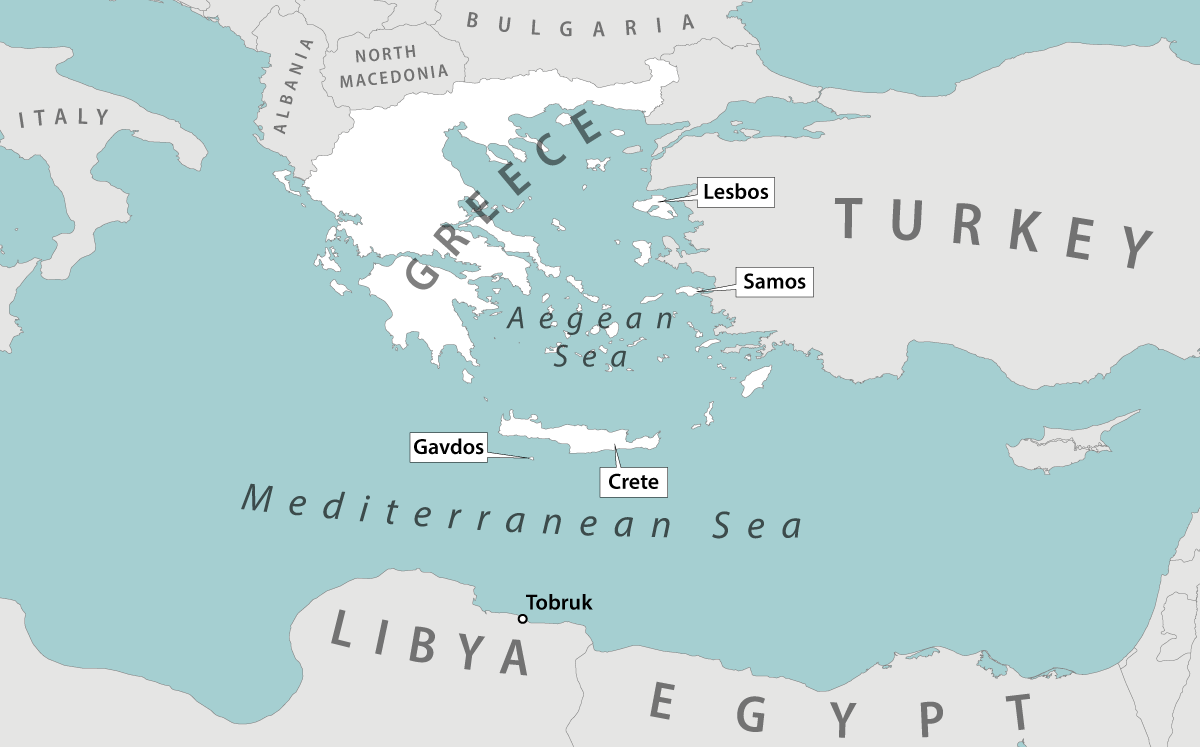
Map: Jacob Turcotte/CSM Staff.
Little islands with big responsibilities.

Because world leaders are not dealing effectively with the causes of mass migration, sometimes tiny communities and a handful of sympathetic residents are left holding the bag.

Christian Science Monitor contributor Nick Squires has a report from the little island of Gavdos in Greece.

“A tawny smudge on the blue horizon of the Mediterranean, it is the southernmost point of Europe, a sun-baked outpost of deserted beaches, gnarled juniper trees, and flocks of shaggy goats. The tiny Greek island of Gavdos, which lies to the south of Crete, [is thought to be] the place where Odysseus was shipwrecked and held captive by the nymph Calypso. …

“The island finds itself thrust to the forefront of Europe’s migration crisis, which erupted in 2015 when more than 1 million asylum-seekers reached the Continent.

Islanders may be sympathetic, but they want the migrant arrivals to stop as soon as possible, especially as the summer tourist season approaches.

“Since the beginning of the year, around 1,200 migrants have arrived on Gavdos by boat, with most of them setting out from Tobruk on the coast of Libya. In the same period last year, there were no arrivals at all. …

“The impact on such a small island is huge. The population of Gavdos is just 70 – on one occasion recently, islanders were outnumbered by the 91 migrants who arrived on a single boat from the Libyan coast.

“Most of the arrivals are economic migrants from Egypt. They are fleeing poverty and political tensions. There is a smattering of other nationalities, including Pakistanis, Bangladeshis, Syrians, and Sudanese.

“It is an influx that Gavdos is totally unprepared for. There are no facilities for the migrants – no reception center, no soup kitchen, no nongovernmental organizations. Unlike Greek islands in the Aegean such as Lesbos and Samos, which have been dealing with migrant arrivals from nearby Turkey for years, there are no personnel from charities such as the Red Cross or Doctors Without Borders.

“The task of dealing with the migrants is left to just three men – the deputy mayor, his twin brother, and the island’s sole police officer. …

“Says Lefteris Lougiakis, the deputy mayor, ‘We have the responsibility of providing them with shelter and food. During the winter, we cut wood to keep them warm. It’s a very difficult situation.’

“Islanders do what they can to care for the migrants and many feel empathy for them. ‘They travel for 20 hours in very small boats with no life jackets. It’s just by luck that we are not in their position. I feel sorry for them,’ says Stella Stefanaki, who runs a small bakery on the island. She provides sandwiches for the new arrivals, for which she is reimbursed by the council.

“Islanders may be sympathetic, but they want the migrant arrivals to stop as soon as possible, especially as the summer tourist season approaches. …

“The migrants have to cross 170 nautical miles of open sea to reach the island from North Africa. It is highly dangerous, but that has not stopped smugglers from promoting it as an effective way of getting into Europe by the back door. Each migrant pays up to $5,000 for the crossing. …

“The ‘capital’ of the island is the village of Kastri, a cluster of about a dozen houses on a ridge. The other main settlement, Sarakiniko, consists of a few cottages and tavernas hidden among sand dunes and facing a huge sweep of beach.

“There are just four children living on the island. Three of them belong to Efi Georgaka, who sells honey; keeps sheep, pigs, and goats; and, during the summer, works in the ferry ticket office in the island’s minuscule harbor.

“ ‘If things keep going like this then the island will change,’ she says, sitting on the harbor wall. ‘There will be a need for police and coast guard officers and the navy, like on other Greek islands. We don’t want [the authorities] here. We treasure the freedom and tranquillity that we have,’ says Ms. Georgaka. …

“Gavdos has emerged as a new migrant destination because of pressures elsewhere: a crackdown onmigrant boats by Greek authorities and the EU border agency Frontex in the Aegean, twinned with the hard-line policies pursued in Italy by Prime Minister Giorgia Meloni, who has staked much political capital on stopping the boats coming from North Africa.

“Earlier this month, Greece’s government promised to provide money and personnel to help Gavdos and its much larger neighbor, Crete, deal with the dramatic rise in migrant arrivals.

“ ‘Crete will not be left alone, and even more so Gavdos,’ said Dimitris Kairidis, the migration minister, after paying a visit to both islands.” More at the Monitor, here.

To me, this is a failure of leadership at a national and international level. People don’t leave home and throw themselves into danger because home is safe. It’s not fair for the little guys to have to fix what they have no power to fix.
Read Full Post »

2019-11-04-nest_51

Photo: Erin Siegal McIntyre/the World
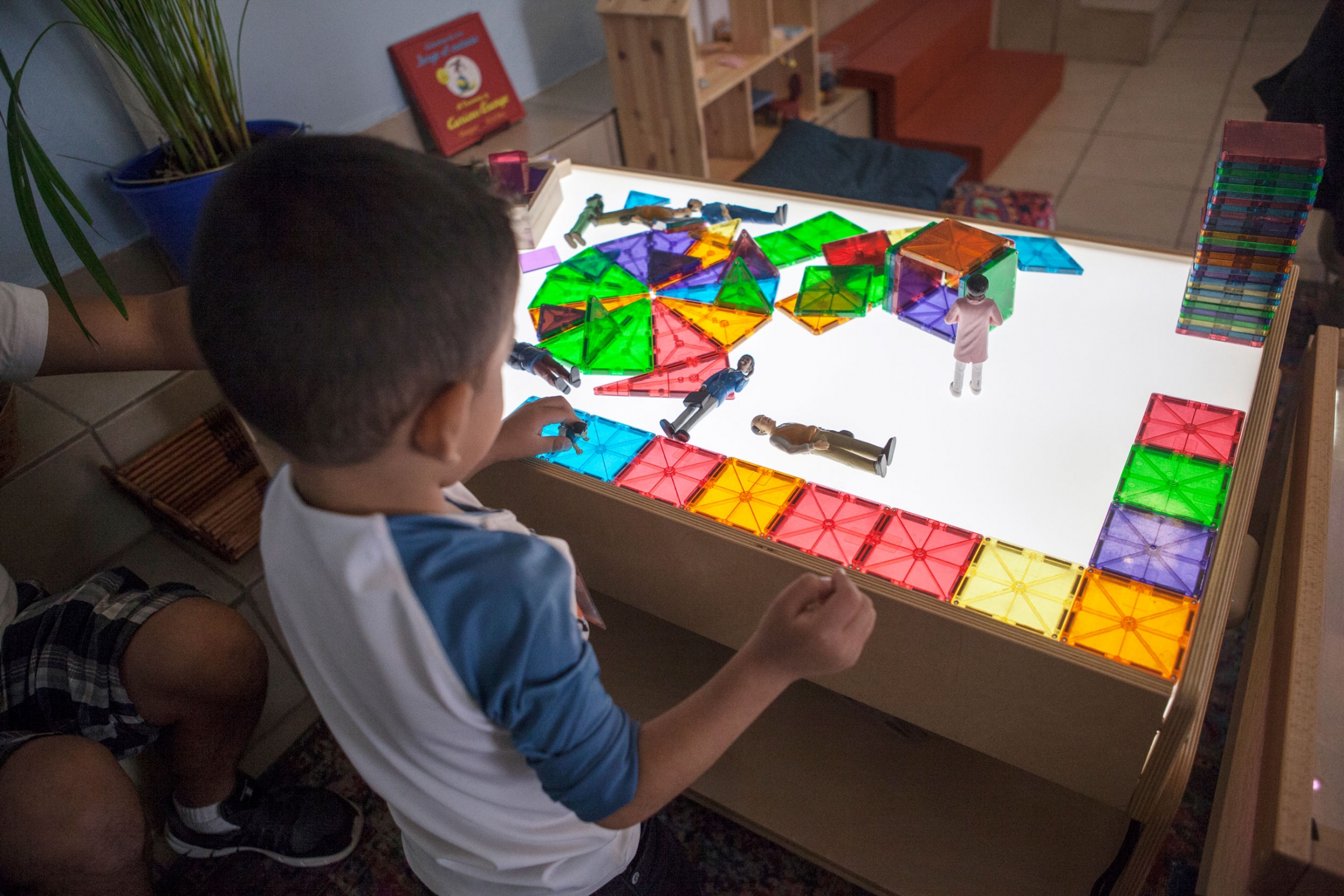
Three-year-old Kevin, whose family fled cartel violence in Michoacán, Mexico, plays at the light table with magnetic blocks at the Nest Tijuana, an informal preschool set up by a California educator.

Speaking of migrant kids who can’t register for school at the border, here’s a related story about an informal preschool that kind hearts have set up in Tijuana. The story comes from a show I like called the World at Public Radio International (PRI).

Sasha Khokha reports, “Classical music plays, silk curtains blow in the wind, and comfy couches offer a place to curl up with a book. There are wooden toys, colorful magnetic blocks and crayons organized by color in glass jars. Children use light projectors to make patterns and shapes on the walls.

“It may sound like a high-end early childhood education center in California, but this is Tijuana.

“Most students and their parents come from other parts of Mexico where there have been recent surges in drug cartel violence. They are waiting for their numbers to be called to enter the United States at the San Ysidro port of entry and hope to lodge claims for asylum. For many, the wait can last several weeks or longer, during which children have little to do.

“Alise Shafer Ivey, a longtime early childhood director from Santa Monica, California, opened this informal preschool, the Nest, in September. It’s attached to a migrant shelter in this Mexican border city. Nothing else like it exists. …

“Patricia’s 2-year-old daughter is one of the new students at the Nest. On the journey to Tijuana, Patricia said her two girls kept asking where their dad was. But how could Patricia tell them? They couldn’t even go to the funeral. It was too dangerous to show up to bury her husband, she said. …

“‘These kids have seen things no child should see,’ Ivey said. ‘They’ve been stripped of their homelands, they’ve left their families behind. They’ve been stuffed in trunks of cars and crossed over borders. … To think we’re going to deliver them to a kindergarten in the US and think it’s going to go well? Not necessarily.’ …

“The idea for the Nest began with a trip Ivey took to Lesbos, Greece, after retiring from decades of directing the Evergreen Community School in Santa Monica. She met a relief worker who invited her to visit a refugee camp, which then housed mostly Syrian refugees.

“Children were ‘digging in the dirt, playing with nails in their pockets,’ Ivey said. ‘They had old cigarette lighters that they had found. There was nothing for children.’

“Ivey offered to set up a space for refugee kids to play. She returned to California and raised $10,000 through a nonprofit she helped found, the Pedagogical Institute of Los Angeles. She went on to set up Nests on another Greek island called Samos, then two more in the Congo. …

“The Tijuana Nest got its start after Ivey visited the shelter across the street, where Patricia and her girls sought refuge. Ivey said she instantly connected with Leticia Herrera Hernández, who runs the shelter. They’re both believers in prioritizing the needs of children, especially when parents are going through trauma, Ivey said. …

” ‘The kids would just spend their days playing on their parents’ phones, having tantrums, and we’d be trying to get them to play to entertain themselves,’ Herrera said in Spanish. …

“At parent orientation night at the Nest, Ivey did what she would do back at her former school in Santa Monica: She laid out a spread with wine and cheese. She talked to the parents about brain science and neural pathways, and explained why memorizing ABCs is not enough.

“ ‘The more we talk to children about their ideas and ask them “I wonder how that would work?” Not quizzing them, but just wondering with them, the more all of those parts of the brain are activated,’ Ivey told the parents, many of whom had never been able to send their kids to preschool in their hometowns. …

“Julieta and Kevin fled cartel violence in Michoacán. When they arrived in Tijuana in August, he had a really hard time accepting the shelter as home. He would hit other kids, yell at them. The Nest has helped him to adjust.

“ ‘Now he doesn’t fight. He plays with the other kids,’ Julieta said in Spanish (The World isn’t using her real name to protect her identity since she is fleeing violence). ‘I used to have to grab him so he would turn and listen to me. Now he turns and looks at me. He reaches for my hand.’ …

“Waiting, watching and letting kids problem-solve has been eye-opening for some parents.

“ ‘I’ve learned to be a better dad,’ said Alfredo, another asylum-seeker who has been volunteering at the Nest (The World isn’t using his real name to protect him from being located by a cartel he said had targeted his family). ‘I used to tell them, “No, do it this way. Because I said so.” And I learned that I was wrong. Having them do things on their own gives them more confidence in their decisions.’ ”

More at the World, here.

Read Full Post »