Feeds:
Posts
Comments

Posts Tagged ‘mining’

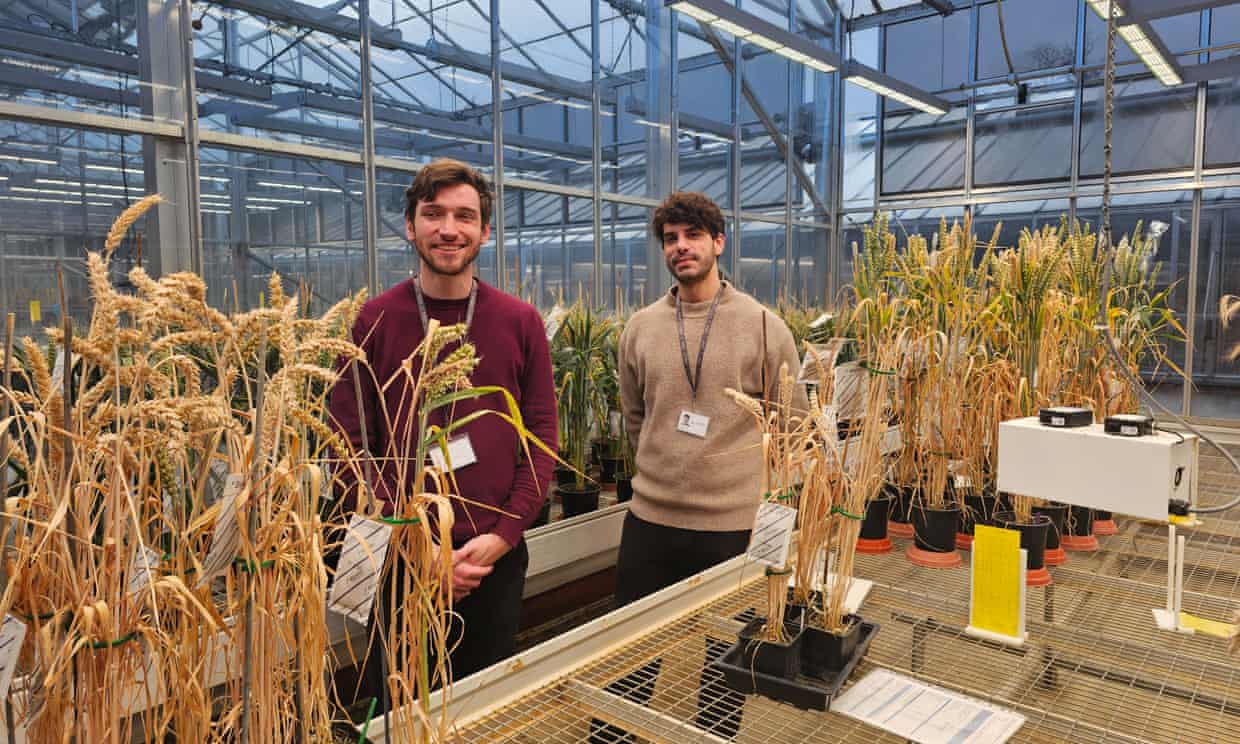
Photo via the Guardian.
Imperial College researchers Franklin Keck, left, and Ion Ioannou are seeking a biological approach to mining copper with less danger to the environment. 

Can mining be made greener? I know it sounds implausible, but you have to love people who will tackle questions like that. Especially as the modern world is demanding more and more metals.

Robin McKie writes at the Guardian that copper “faces an uncertain future as manufacturers prepare to expand its use to make the electric cars, renewable power plants and other devices that will help the planet move towards net zero. Unrestricted extraction could cause widespread ecological devastation, scientists have warned.

“The issue is to be the prime focus for the new Rio Tinto Centre for Future Materials, based at Imperial College London in partnership with several international university groups. …

“ ‘The world needs to electrify its energy systems, and success will absolutely depend on copper,’ materials scientist and Imperial vice-provost Prof Mary Ryan, one of the centre’s founders, told the Observer last week. ‘The metal is going to be the biggest bottleneck in this process. So, in setting up the centre, we decided copper would be the first challenge that we dealt with.’ …

“Copper has become essential for powering devices ranging from smartphones to electric vehicles because it transmits electricity with minimal loss of power and is resistant to corrosion. Around 22m tons of copper were mined in 2023, a 30% increase from 2010, and annual demand will reach around 50m tons by 2050, say analysts.

“Such an output will have enormous environmental consequences because copper mining uses acids that poison rivers, contaminate soil and pollute the air. Producers such as Peru, Chile and the Democratic Republic of the Congo have seen natural habitats destroyed, wildlife populations wiped out and human health damaged near mines. Deep-sea mining has been proposed, but the idea horrifies marine biologists, who say such enterprises would devastate sea life.

“The aim of the new centre is to find ways round these problems and help provide the materials the world will need to reach net zero. It is funded by the mining group Rio Tinto and hosted by Imperial College London in partnership with the University of British Columbia in Vancouver, the University of California, Berkeley, the Australian National University and the University of the Witwatersrand, Johannesburg.

“One key project is seeking new ways to mine copper. ‘We typically extract it from minerals that have crystallized out of very saline, copper-rich brines,’ said Professor Matthew Jackson, chair in geological fluid dynamics at Imperial College. ‘However, this process requires huge amounts of energy to break open the rocks and bring them to the surface and also generates a lot of waste as we extract copper from its source ores.’

“To get round this issue, Jackson, working with international partners, has been searching for underground sites where copper-rich brines are still in liquid form. These brines are created by volcanic systems which can, crucially, provide geothermal energy for extraction.

“ ‘That means we can extract the copper by pumping the brines to the surface via boreholes – which is relatively easy – and also use local energy to power the mine itself and possibly provide excess energy for nearby communities,’ Jackson said. ‘Essentially, we are seeking to build self-powered mines and have already pinpointed promising sites in New Zealand, and there is potential to explore conventionally barren areas such as Japan.’

“A different approach is being followed by another Imperial project where a company, RemePhy, has been started by Imperial PhD students Franklin Keck and Ion Ioannou.

“They have used GM technology to develop plant-bacterial systems that have an enhanced ability to extract metal from the soil. ‘Essentially, you will be able to grow these crops on land contaminated by waste left over from the mining of metals such as copper, and they will extract that metal,’ said Keck.

“The importance of these techniques was stressed by Ryan. ‘The world will need more copper in the next 10 years than has been mined in the whole of the last century. [We] need to both reduce our demand for copper and work out how to extract it in the most sustainable way possible.’ “

More at the Guardian, here. No firewall. Donations support reliable journalism.
Read Full Post »

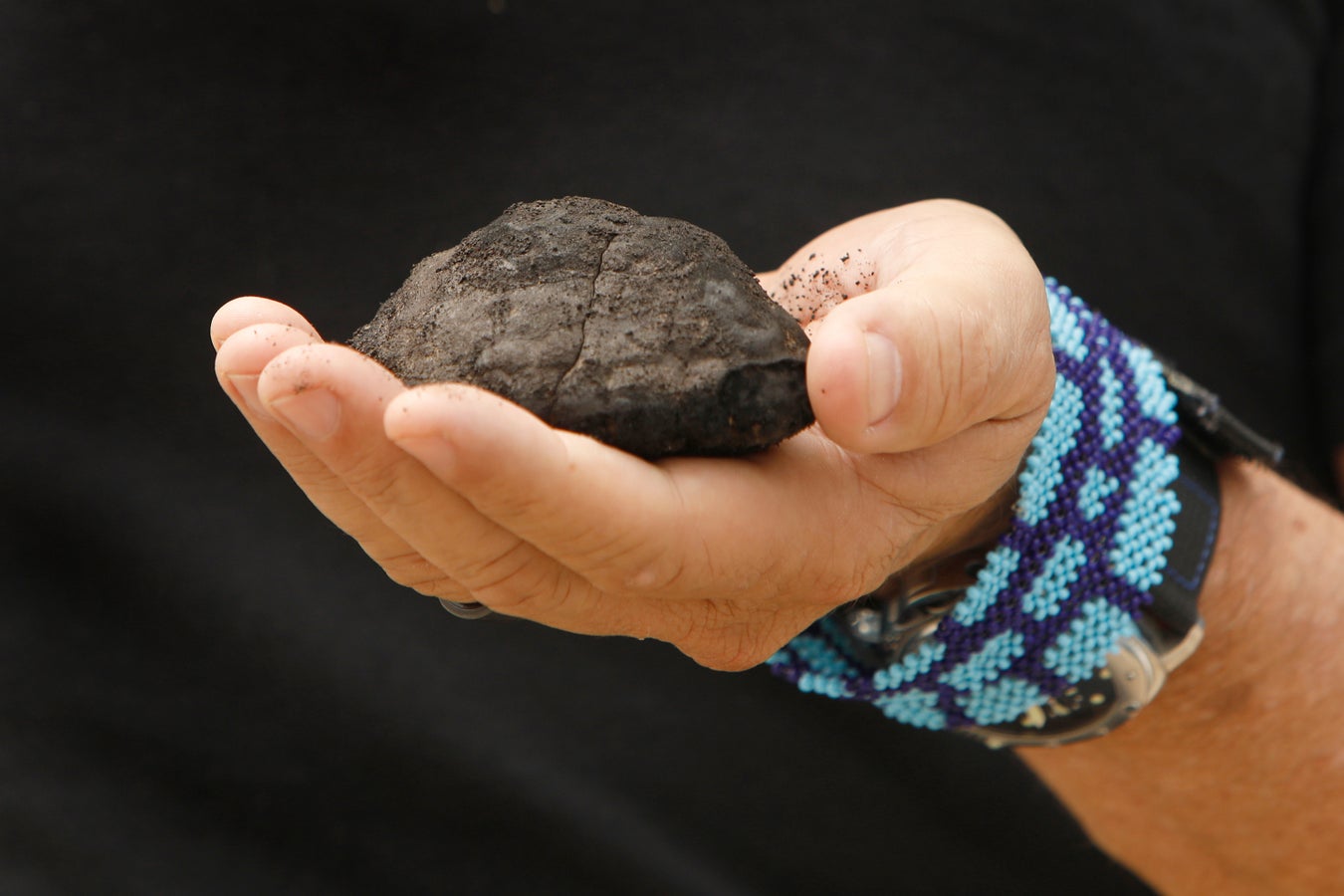
Photo: Carolyn Cole/Los Angeles Times via Getty Images.
Metal deposited over millions of years forms these nodules, which can somehow generate oxygen.

Sometimes it seems like scientists have all the fun. In today’s story, certain researchers of the deep ocean thought their instruments were at fault and complained to the manufacturer. Then one day, ironically, an ad from a deep-sea mining company struck a chord in one scientist and led to some creative thinking.

Allison Parshall writes at Scientific American that some rocklike mineral deposits in the deep sea may have more to them than meets the eye.

“The dark seabed of the Pacific Ocean’s Clarion-Clipperton Zone (CCZ) is littered with what look like hunks of charcoal. These unassuming metal deposits, called polymetallic nodules, contain metals such as manganese and cobalt used to produce batteries, marking them as targets for deep-sea mining companies.

“Now researchers have discovered that the valuable nodules do something remarkable: they produce oxygen and do so without sunlight. ‘This is a totally new and unexpected finding,’ says Lisa Levin, an emeritus professor of biological oceanography at the Scripps Institution of Oceanography, who was not involved in the current research.

“According to Boston University microbiologist Jeffrey Marlow, the idea that some of Earth’s oxygen gas may come not from photosynthesizing organisms but from inanimate minerals in total darkness ‘really strongly goes against what we traditionally think of as where oxygen is made and how it’s made.’ Marlow is a co-author of the new study, which was published in Nature Geoscience.

“The story of discovery goes back to 2013, when deep-sea ecologist Andrew Sweetman was facing a frustrating problem. His team had been trying to measure how much oxygen the organisms on the CCZ seafloor consumed. The researchers sent landers down more than 13,000 feet and created enclosed chambers on the seabed to track how oxygen levels in the water fell over time.

“But oxygen levels did not fall. Instead they rose significantly. Thinking the sensors were broken, Sweetman sent the instruments back to the manufacturer. ‘This happened four or five times’ over the course of five years, says Sweetman, who studies sea­floor ecology and biogeochemistry at the Scottish Association for Marine Science. …

“Then, in 2021, he returned to the CCZ on a survey expedition sponsored by the Metals Company, a deep-sea mining firm. Again, his team used landers to make enclosed chambers on the seafloor and monitor oxygen levels. They used a different technique to measure oxygen this time but observed the same strange results: oxygen levels increased dramatically. …

“The researchers initially thought deep-sea microbes were producing the oxygen. That idea once might have seemed far-fetched, but scientists had recently discovered that some microbes can generate ‘dark oxygen‘ in the absence of sunlight.

In laboratory tests that reproduced conditions on the seafloor, Sweetman and his colleagues poisoned seawater with mercury chloride to kill off the microbes. Yet oxygen levels still increased.

“If this dark oxygen didn’t come from a biological process, then it must have come from a geological one, the scientists reasoned. They tested a few possible hypotheses — such as that radioactivity in the nodules was decomposing seawater molecules to make oxygen or that something was pulling oxygen from the nodules’ manganese oxide — but ultimately ruled them out.

“Then, one day in 2022, Sweetman was watching a video about deep-sea mining when he heard the nodules referred to as ‘a battery in a rock.’ That bit of marketing was only a metaphor, but it led him to wonder whether the nodules could somehow be acting as natural geobatteries. If they were electrically charged, they could potentially split seawater into hydrogen and oxygen through a process called seawater electrolysis. (A battery dropped in salt water produces a similar effect.)

“ ‘Amazingly, there was almost a volt [of electric charge] on the surface of these nodules,’ Sweetman says; for comparison, an AA battery carries about 1.5 volts. The nodules may become charged as they grow, as different metals are deposited irregularly over the course of millions of years and a gradient of charge develops between each layer. Seawater electrolysis is currently the researchers’ leading theory for dark oxygen production, and they plan to test it further.”

More at Scientific American, here. No firewall.

Read Full Post »

Photo: Adri Salido.
From the Christian Science Monitor: “Elsa Cerda (with spear) leads Yuturi Warmi, a group of Indigenous women who guard against illegal mining in the community of Serena in the Ecuadorian Amazon.”

As a group of indigenous women in the Ecuadorian Amazon have shown, when something is wrong in your neighborhood, it pays to join with others and fight.

Al Jazeera wrote a good report on this last year.

“As a child, Leo Cerda would spend his mornings helping his family cultivate cassava, plantains and other fruits and vegetables in their chakra, a traditional garden in Kichwa communities.

“In the Ecuadorian village of Napo, traditions form a large part of family and spiritual life. At around 3 am each morning, before heading to their chakras, many families take part in a traditional tea ceremony. Once freed from his farming duties at around midday, Cerda recalled running to the river to swim and fish with friends. Fish would later be grilled on an open fire and eaten with large amounts of fruit.

“ ‘As a kid, I got to enjoy nature,’ Cerda told Al Jazeera.

“These days, however, the 34-year-old spends his days chasing gold miners from his community and campaigning against those who threaten to destroy his ancestral lands. …

“ ‘Within three years, everything changed,’ Cerda said. ‘The land has been poisoned. There are no more fish, except ones that are contaminated. People eat them, and they get sicker and sicker.’

“A recent study carried out in mining areas of the northeastern Andean foothills of the Ecuadorian Amazon, close to where Cerda lives, revealed high concentrations of toxic metals. They are up to 352 times above permissible limits established by environmental guidelines. …

“Mariana Capparelli, a researcher who contributed to the study, told Al Jazeera it was ‘very sad to see the conditions these communities are exposed to as well as the total degradation of an ecosystem that is so important for the entire planet.’ …

“Due to what critics say is an absence of sufficient government regulation, mining in Ecuador has led to environmental pollution and adverse effects on the health of Indigenous communities. In recent months, authorities have carried out several raids against illegal miners.

But with widespread state corruption and tip-offs given to miners, machinery is sometimes withdrawn immediately before police operations take place, activists say. …

“Ecuador has a national system of protected areas that aims to safeguard biodiversity and local ecosystems in national parks, wildlife refuges, marine reserves and other designated areas throughout the country. Although the government has taken some steps to protect local water systems, rivers have traditionally not been included in this system. …

“According to Andres Tapia, a spokesperson for the Confederation of Indigenous Nationalities of the Ecuadorian Amazon, illegal mining has become ‘uncontrollable’ in parts of the country. …

“ ‘I thought I would always be able to drink from this river,’ Eli Virkina, a member of an Indigenous Kichwa community in Napo, told Al Jazeera. ‘Now I’m at this point where maybe I shouldn’t even swim in the water. That is really heartbreaking for me.’ …

“Across Napo, Indigenous communities and organizations have been monitoring, mobilizing and resisting mining activities. To defend their land, they have formed alliances and connections across riverine communities, including the Amazon’s first women-led Indigenous guard.

“In February 2022, a landmark Constitutional Court ruling recognized the rights of Indigenous communities to have a final say over extractive projects that affect their territories. The ruling ‘offers one of the strongest legal precedents in the world, which upholds the rights of Indigenous peoples to decide on the futures of their ancestral territories,’ according to the Amazon Frontlines advocacy group.

“But in December [2022], the ruling was disregarded when the government approved a mining project in Las Naves in Bolivar province without gaining the consent of affected communities.

“In the meantime, Napo has installed four alarm systems around the village to signal when miners are close by.

“ ‘In our territory, spears were not used anymore, but now we have one in at least every house because it’s part of the way we have to defend ourselves,’ said Majo Andrade, a member of the female-led Indigenous guard Yuturi Warmi. …

“Virkina says Indigenous resistance is vital to the region’s future. ‘Once [Indigenous people] disappear, it is way easier for miners and people to come in and access the river,’ she said. ‘When we have stronger Indigenous communities, we have stronger forests and a stronger river.’ More at Al Jazeera, here.

Adri Salido has a collection of beautiful pictures at the Christian Science Monitor and adds a few more comments to the story of Yuturi Warmi: “Yuturi Warmi refers to a type of ant (Paraponera clavata) that will attack when an enemy enters its territory.

“The group, which formed in 2020, joined with other Ecuadorian and international organizations to urge the government to enforce laws against illegal extraction and to restore habitat. But officials have not acted, according to Yuturi Warmi. Since then, the group has worked to ensure that no illegal mining takes place in its community. It patrols the riverbank, conducts canoe inspections, and maintains constant surveillance. So far, it has kept intruders out of Serena. 

“The situation is far different upstream, in Yutzupino, where illegal extraction has destroyed the basin of the Jatunyacu River, a tributary of the Amazon River.”

More at the Monitor, here. No firewall. Great collection of photos.

Read Full Post »

Photo: Oscar Espinosa.
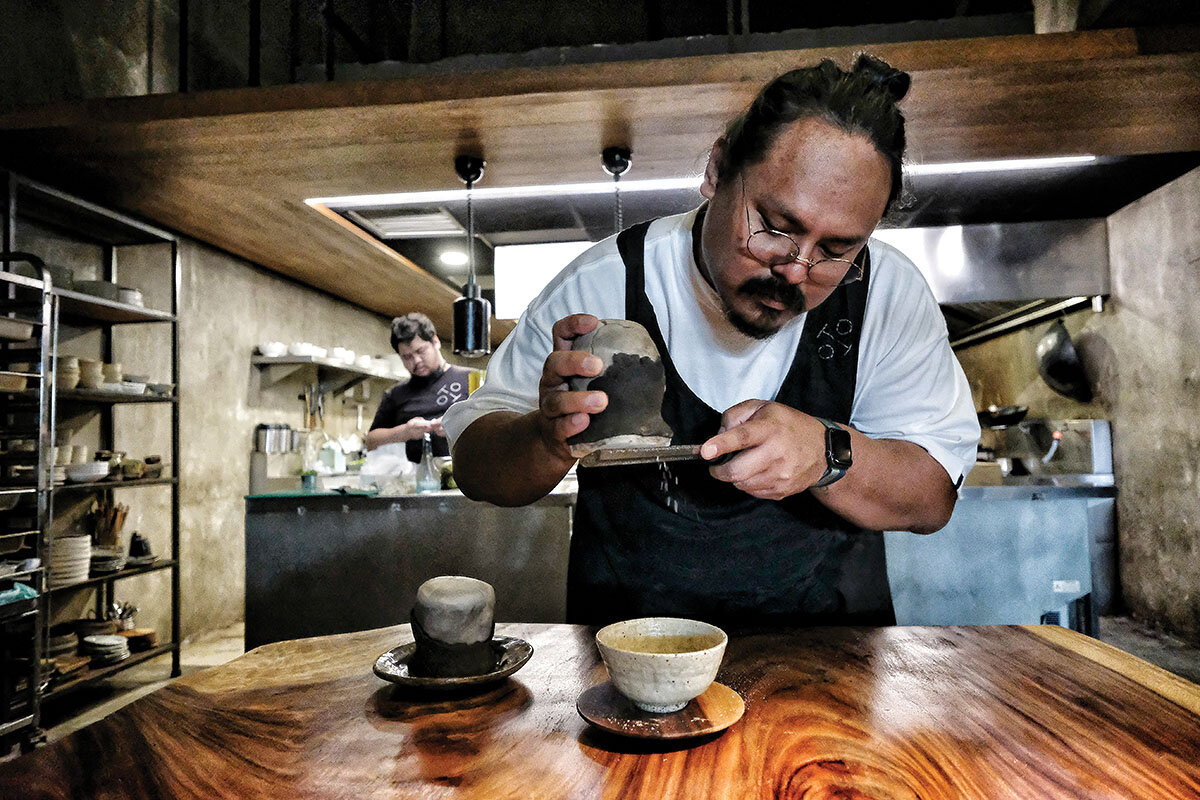
“Jordy Navarra, chef at Toyo Eatery in Manila, Philippines, delicately grates a bit of ‘asin tibuok salt on top of flan de leche ice cream, one of his restaurant’s signature desserts,” reports the Monitor.

When Fuji Xerox brought the Kinoshita family over to Rochester years ago, I spent a lot of time with Yuriko. She had lots of questions about the US but spoke great English and soon was advising other Fuji Xeros families, even making a guide book for the women.

One day Yuriko asked me why Morton Salt said “with iodine” on the label. I told her Americans didn’t get enough of that essential ingredient in their typical diets. But it got me interested in salt.

Oscar Espinosa and Laura Fornell have a report at the Christian Science Monitor on a particularly unusual salt.

“Smoke escapes from a hut in front of the mangroves of Alburquerque, on the Philippine island of Bohol. The pleasant smell of wood, coconut, and salt burning over a slow fire signals that the making of artisanal salt has begun. 

“The process, which had been passed down for generations, results in a product known as asin tibuok. It’s an oval piece of salt compacted into a clay mold that has been partially broken by the intense heat of the fire. Asin tibuok is only produced in this small coastal town of about 11,000 inhabitants. 

“ ‘For the next few days, we’ll be taking turns so that we can watch the fire 24 hours a day,’ says Nestor Manongas, who keeps his eyes on the pile of smoldering wood in the center of the hut. ‘We will have to be pouring seawater [in] to prevent the flame from igniting so that the coconut shells are slowly consumed,’ he says. ‘We can’t get distracted because the process could be ruined.’

“This controlled combustion will result in gasang, a highly salt-concentrated ash, which is then placed in a funnel-shaped tank made of bamboo, where the salt is filtered out of the ash by pouring in more seawater. The resulting brine, called tasik, will be used to cook the asin tibuok pieces.

“Mr. Manongas is one of the last remaining makers of this salt. But thanks to the determination of his family, this old trade, which had fallen into oblivion, has been revived.

“ ‘Against all odds, we kept going because we were determined to give it a new life,’ says Crisologo Manongas, Nestor’s brother. He recalls how, little by little, asin tibuok became known, with university students making it the subject of their research, chefs from Manila discovering it, documentaries being made, and in 2017 a Filipino American entrepreneur based in California deciding to import the product to the United States.” Fascinating pictures at the Monitor, here. No paywall.

For more on the production of salt, particularly the production of sea salt, I turned to Malden Salt, here. Of course, it’s self-promoting, but I think you may learn a few things, as I did. Those of you who are cooking bloggers might be especially interested.

The website says, “Salt production is one of the oldest practices dating as far back to 6,000 BC. Used for various trading and religious offerings, empires such as the ancient Romans actually used salt as a means of commerce, with Rome deriving the word ‘salary’ from salt. … Not only does it enhance flavors within dishes and allows you to season to perfection, it is an element in which the human body can’t live without – sodium. …

“Sea salt is made by seawater from the ocean entering into shallow ground or a ‘salt works’ (man-made salt water pools) where by time the sun will begin to evaporate the water, leaving behind sea salt crystals – this is called solar evaporation.

“Now this is is the easiest and preferred method for warmer climates with a low rainfall and high evaporation rate. But what about the other climates like the UK that aren’t graced with regular hot weather? This is where countries like ourselves get creative with sea salt production.

“[It’s] a naturally occurring element, containing less iodine than table salt and obtains traces of minerals/nutrients including magnesium and potassium. …

“Although it’s safe to say Maldon is sea salt’s biggest fan – there are other salts. Table salt [is] mined from natural salt deposits (older bodies of seawater which have dried long ago) the salt is then processed and manufactured into smaller crystals. Unlike sea salt, which is produced through natural methods, table salt production involves chemicals after being mined. It’s purified and striped of minerals and infused with anti-caking substances.

“Mineral salt [is] similar to table salt, but this type of salt is specifically mined from areas such as Pakistan, near the Himalayas. Did you know it’s colors are influenced from the additional minerals, such as calcium, potassium, and magnesium. You may know this as ‘Rock Salt.’ Here at Maldon we stock Tidman’s Natural Rock Salt. [Unlike] other salts, Tidman’s is also additive free. …

“Since 1882, our world-famous salt flakes have been made with the same traditional artisan methods from the coastal town of Maldon, Essex. Our salt works are run by the fourth generation Osborne family, currently in the hands of Steve Osborn, following his father’s footsteps Clive, grandfather Cyril and great grandfather James.

“Seawater from the the Blackwater Estuary in Maldon is carefully harvested on the spring tide, where there is an appreciated art to the temperature and timing, which is a family secret. Master of salt makers have been hand harvesting the naturally formed pyramid-shaped crystals that have since became Maldon’s signature.

“Maldon Salt is created through an evaporation process. Brine is evaporated in our salt pans over flames to form the unique salt crystals. [Our] salt makers use the same time-honored techniques with skilled hands poised over every batch. You can find out more where Maldon Sea Salt comes from by heading over to our YouTube channel.” Read more here.

Read Full Post »

Photo: Goldman Environmental Prize.
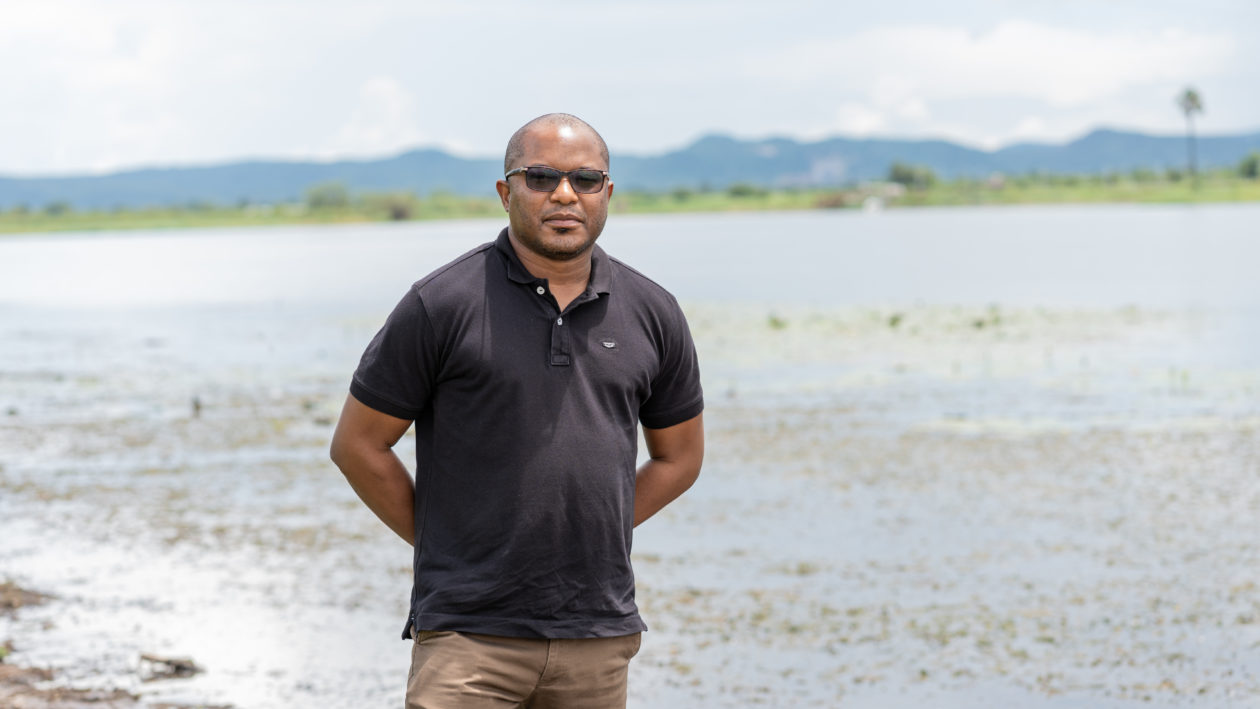
Chilekwa Mumba took on a UK mining giant that was polluting Zambia — and won.

Today’s story shows how one person can make a difference, even when the goal is considered impossible. It’s also a cautionary tale, because you can win the battle and not the war. The irony is that powerful entities can excuse polluting a region in order to meet “green economy” needs.

Jocelyn C. Zuckerman reported at Yale Environment 360, “The southern African nation of Zambia is home to a wealth of minerals — in particular, lots of the copper and cobalt that the world will require to power a green economy. Among its largest operations is the Konkola Copper Mines (KCM), located in the country’s Copperbelt Province.

“In 2004, U.K.-based Vedanta Resources acquired the controlling stake in KCM, whose operations span 11 square miles along the Kafue River. Soon after, residents noticed that the Kafue was emitting foul odors. Fish began dying. Crops began to wither.

Livestock fell ill. And villagers came down with mysterious headaches, nose bleeds, rashes, and burns.

“Chilekwa Mumba, who had grown up in the region but since moved to the Zambian capital, Lusaka, learned of the problem and vowed to do something about it. In an interview with Yale Environment 360, he talks about how he spent the next several years facilitating meetings between the communities and British lawyers, gathering water samples, and convincing former mine workers to provide evidence for a lawsuit that made its way through the British court system. Finally, in 2019, its Supreme Court found that KCM’s parent company could be held accountable in the U.K. for environmental damage from the mine’s operations.

“Not only had Mumba, 38, who was awarded a Goldman Environmental Prize [in April], helped win significant financial compensation for the 2,000 villagers involved, but his case set a legal precedent that British companies can be held accountable for the environmental fallout of their operations overseas. …

Yale Environment 360: KCM was already a presence when you were growing up in the town of Chingola. … You did your primary schooling in Chingola, so you got a good education in part thanks to the mine, which funded the schools? …

Mumba: They had excellent schools. We moved to Lusaka when I was 15, but I still went to school under the mine system. I went to a boarding school that was supported by the mines, including KCM.

e360: In 2004, Vedanta Resources, which is headquartered in the U.K., acquired a controlling stake in KCM. What happened after that?

Mumba: When they took over, there was too much collusion with government. They were not being held to account on many different issues. Based on what I was reading in the media, I started talking to residents in Chingola. We’ve got family and friends there, and my parents still maintain a home there. I used to go back occasionally, but it became almost a permanent home when I started to find out about the reports [of pollution]. I began realizing that what I’d been hearing was correct. And I started to do my own investigation. …

“I went to the same spot I used to go to as a child to fish. … There were basically no fish, and the smell of chemicals was quite evident. The soil makeup was different from what I remembered when I was young.

e360: Did you confront the company? …

Mumba: I had a couple of meetings with a local lawyer representing the villagers, and he was telling me that nothing would happen, that I shouldn’t waste my time. But he did give me quite a bit of information, and I put it in my file.

e360: You wrote letters to something like 100 law firms?

Mumba: A combination of law firms and environmental NGOs, all over the world. I was just randomly sending them out from my Yahoo address. I got a lot of automatic replies. And then there was an automatic reply from [British law firm] Leigh Day, followed up with an actual email from a person, Katie Gonzalez. I can never forget that name. I happened to find it in my email and was surprised. They told me they would be there in two weeks.

e360: How did the community respond to this British lawyer coming in? Did they trust him?

Mumba: Not immediately. But the way he is — Oliver Holland, I have to absolutely mention him — he was a white guy in a remote village, but he has this aura about him where he is very friendly, so they warmed up to him.

e360: What sort of evidence did you bring to court?

Mumba: We gathered water samples and soil samples and found that copper, iron, cobalt, and dissolved sulfates were present far beyond legal limits. We also took in — though we did not put that to the court — blood tests for various clients, to test for the presence of heavy metals. We already had overwhelming evidence from the water and the soil.

e360: Did you have help from anybody inside the company?

Mumba: A former mine manager, who knew the whole process and how there was gross negligence on the part of pollution control, gave us a lot of documents. He, of course, did not want to be named, so we videoed his testimony using certain means where his identity could be withheld. …

“Because of my connection to the case, I would get random calls and they would say, ‘Can we meet you? We want to help you. But protect our identity.’ So I would meet as many as possible. I would talk to everyone. It was part of the investigation, to get all that evidence together. …

“At the time, funnily enough, I was working for a local law firm, as a business development consultant. But I abandoned that work and decided to do this. I honestly didn’t even think that I was doing an investigation per se. It all came together when I was just simply inquiring into all these issues. …

e360: We know that copper and cobalt will be critical to the new green economy. Lots of people, including in the United States, want Zambia’s minerals. How does that help or hinder your position?

Mumba: I see it as a very dangerous position, especially the thirst for cobalt. I feel like the communities around the mines have never gotten a fair share of the deal. America says the end game of mining is they want clean energy. Cobalt is one of the components for that. So right now we need to be more watchful about how these mining operations are taking place and what benefit goes to the community.”

More at Yale Environment 360, here. No firewall.

Read Full Post »

Photo: Nick Roll via CSM.
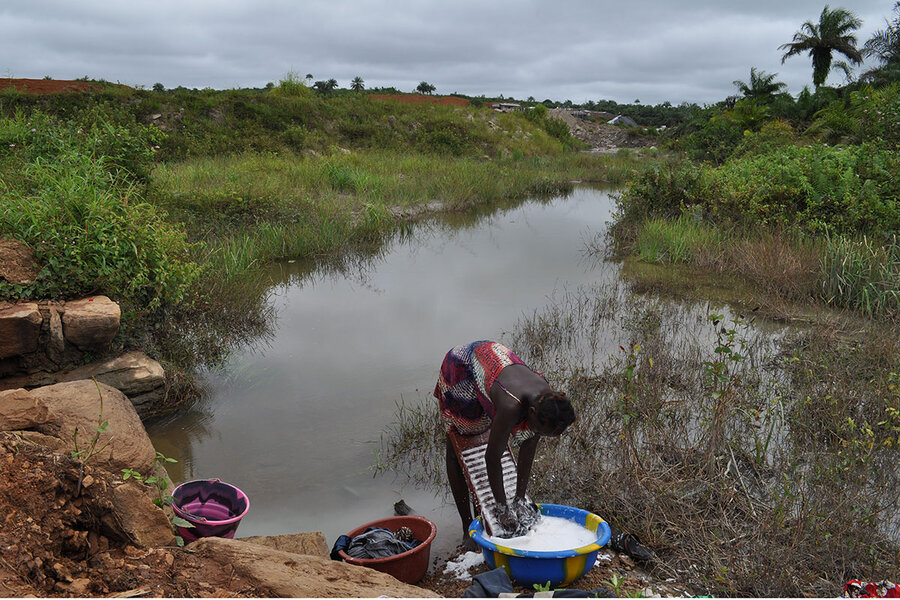
Washing in polluted water. Under new laws, “firms wishing to mine or establish industrial agriculture operations must henceforth strike deals with the ordinary Sierra Leoneans who depend on the land for their survival,” says the Monitor.

I don’t know about you, but I always feel hopeful when ordinary people stick up for themselves. The powerful and selfish don’t always have to win. Capitalism has gotten out of hand and now resembles nothing so much as the monarchies of old.

Meanwhile, in Sierra Leone, folks suffering from the excesses of mining giants and agribusiness are not going to take it anymore.

Nick Roll has the story at the Christian Science Monitor.

“Solomon K. Russell walks down a narrow dirt path, surrounded by teak trees that block out the sunlight and cool the afternoon air. He leaps over a column of fat black ants running across the trail, and the forest suddenly, unnaturally, ends. A denuded strip of beige earth stretches over an area the size of several football fields, pockmarked by pits full of wastewater. 

“Machinery belonging to the Afro-Asia Mining Corp., a Chinese firm, rumbles in the distance. The remnant of a stream, polluted and diverted by the industrial operations, idles underneath a small wooden bridge. 

“ ‘This river really sustained the life of the people,’ says Mr. Russell, who remembers, as a boy, jumping off the bridge into the water just a few feet below. Now, it’s barely ankle-deep. …

“Mr. Russell and his fellow villagers had no say in Afro-Asia’s arrival, nor in its operations. The company signed its lease with the local ‘paramount chief’ who was empowered by a century-old colonial law.

“But a sweeping package of land-rights bills, which went into effect in September, is set to change all that, giving local people who own and live off the land the authority to decide how it is used.

“ ‘Those laws will help,’ says Mary Tommy, a farmer living in this 500-strong farming community made up of brightly painted concrete houses and mud brick homes with traditional high-pitched thatch roofs. ‘For us, the destruction has already been caused, but for other areas that have not witnessed this kind of destruction, I think it will be good.’

“Many parts of Sierra Leone have been ravaged by foreign mining firms seeking gold, diamonds, and bauxite, among other minerals, and by palm oil plantations. Such natural resources accounted for over 75% of Sierra Leone’s exports in 2020, reaping around $400 million in income, according to official figures.

“Yet the wealth has been slow to trickle down. The latest figures on poverty in the country, from 2018, showed that 60% of the rural population was living on less than $1.90 a day.

“People say ‘our land is our bank, our land is our future,’ ” says Eleanor Thompson, deputy director of programs at the Freetown office of Namati, a legal advocacy and land-rights organization. …

“Until last month, only local chiefs and the national government could strike land use and leasing deals with foreign investors. The people whose land was taken could do little about it, and often had to accept rents amounting to only $5 an acre.

“Mr. Russell, for example, says his rent is ‘too meager’ to be able to buy from the market the fish he can no longer catch in the village stream.

“But under the new laws, firms wishing to mine or establish industrial agriculture operations must henceforth strike deals with the ordinary Sierra Leoneans who depend on the land for their survival – and who, for the first time, will have the right to negotiate, or reject, their proposals.

“September’s Customary Land Rights Act and the National Land Commission Act transfer the power to make decisions about land to those actually owning or using it. Companies seeking a lease must win the consent of 60% of a family’s male and female adults.

“Where land is communally held, firms must persuade 60% of the adults in the community to agree to a lease. In the newly created land committees that are supposed to help negotiate those leases, made of local community members, 30% of members are to be women.

“The new laws are not popular with foreign investors, many of whom are especially wary of a provision setting aside shares in international projects for Sierra Leoneans.

‘Nobody will invest in Sierra Leone anymore,’ says Gerben Haringsma, country director for the Luxembourg-based palm oil company Socfin. …

“Ms. Thompson, the land rights activist, says the laws might, however, help investors more than they realize. ‘It’s in the investors’ interest to have the consent of people,’ she says. …

“Acts of sabotage and deadly protests against agribusiness and mining companies have erupted in the past.

“ ‘If people had a say in negotiations they would sell their land for a … value that will enrich them and change their lives, maybe,’ says Emmanuel Saffa Abdulai, executive director of the Freetown-based Society for Democratic Initiatives.

“In Largo, villagers say that Afro-Asia promised to build them a health clinic, a school, and paved roads. Four years after mining operations started, none of that has come to pass, and the locals who have found jobs at the mine earn little more than $50 a month.

“Afro-Asia did not respond to a request for comment. But the company’s lease in Largo is in its final year. To keep operating, it will have to renegotiate – this time with the local community under the new laws.”

More at the Monitor, here. No firewall.

Read Full Post »

Photo: The American Chestnut Foundation via Living on Earth.
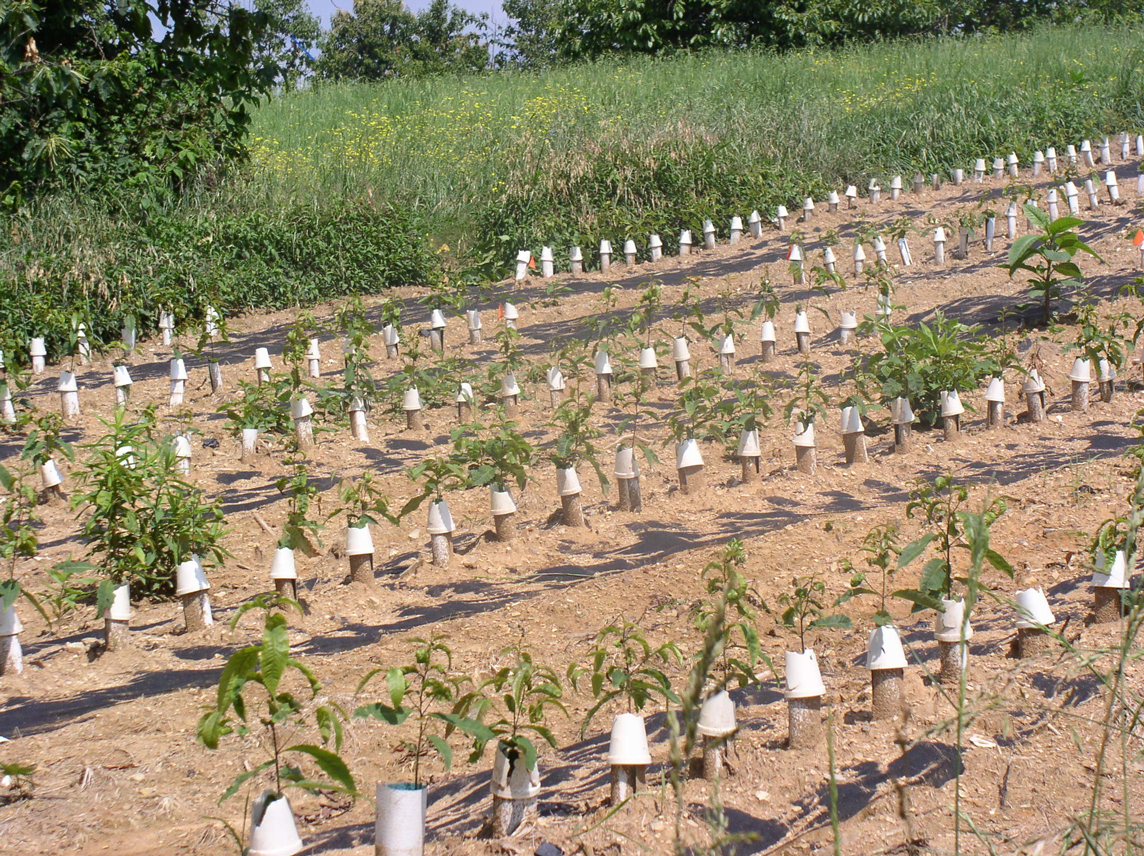
Towering American Chestnuts were once a staple of life for people across Appalachia and elsewhere in the Eastern United States. An initiative in mining country aims to bring them back.

Growing up, I heard from my father about how sad he was as a kid when American Chestnuts began to die off. Children really do not like loss. Thomas Brannon in today’s article was a kid who loved chestnuts, too. He is one of the people working to restore the trees that covered his grandparents’ land before they sold the mining rights.

Elena Shao starts the New York Times story with the director of operations at a tree-planting nonprofit.

“Michael French trudged through a thicket of prickly bramble, unfazed by the branches he had to swat away on occasion in order to arrive at a quiet spot of hilly land that was once mined for coal. Now, however, it is patched with flowering goldenrods and long yellow-green grasses and dotted with tree saplings.

“The sight, he acknowledged, would seem unimpressive to most. Yet it might be Mr. French’s most prized accomplishment. To him, the young trees symbolize what could be a critical comeback for some of the country’s vanishing forests, and for one tree in particular, the American chestnut.

‘I don’t see it how most people see it,’ he said. ‘I look at this and I see how it’s going to be in 80 to 100 years.’

“By then, Mr. French envisions that the chestnut, a beloved tree nearly wiped out a century ago by a blight-causing fungus, will be among those that make up an expansive forest of native trees and plants.

“Billions of chestnuts once dominated Appalachia, with Americans over many generations relying on their hardy trunks for log cabins, floor panels and telephone poles. Families would store the trees’ small, brown nuts in attics to eat during the holiday season.

“Now, Mr. French and his colleagues at Green Forests Work, a nonprofit group, hope to aid the decades-long effort to revive the American chestnut by bringing the trees back onto Appalachia’s former coal mines. Decades of mining, which have contributed to global warming, also left behind dry, acidic and hardened earth that made it difficult to grow much beyond nonnative herbaceous plants and grasses.

“As coal continues to decline and many of the remaining mines shut down for good, foresters say that restoring mining sites is an opportunity to prove that something productive can be made of lands that have been degraded by decades of extractive activity, particularly at a moment when trees are increasingly valued for their climate benefits. Forests can capture planet-warming emissions, create safe harbor for endangered wildlife species and make ecosystems more resilient to extreme weather events like flooding.

“The chestnut is a good fit for this effort, researchers say, because the tree’s historical range overlaps ‘almost perfectly’ with the terrain covered by former coal mines that stretched across parts of eastern Kentucky and Ohio, West Virginia and western Pennsylvania.

“Another advantage of restoring mining sites this way is that chestnut trees prefer slightly acidic growth material, and they grow best in sandy and well-drained soil that isn’t too wet, conditions that are mostly consistent with previously mined land, said Carolyn Keiffer, a plant ecologist at Miami University in Ohio. …

“ ‘We humans brought in the nonnative fungus that killed the tree,’ Dr. Keiffer said, referring to the parasitic fungus that was accidentally introduced to North America in the late 1800s on imported Japanese chestnuts. … ‘Maybe we can be the ones to bring the trees back.’

“That calling has always motivated Thomas Brannon, even as a third grader in the 1940s planting trees with his siblings on his family’s land in eastern Ohio, the property that Mr. French visited in August.

“ ‘If I can make that 230 acres look better, then that’s enough for me,’ Mr. Brannon said.

“His grandparents sold mining rights to parts of the property in 1952, and nearly four decades of coal mining followed. In 1977, the federal government passed the Surface Mining Control and Reclamation Act, requiring mining companies to return land to the general shape it had before the mining activity.

“As a result, mining companies would backfill excavated land, packing rock material tightly against the hillside so it wouldn’t cause landslides, said Scott Eggerud, a forester with the Office of Surface Mining Reclamation and Enforcement, the agency that enforces the mining law. To prevent erosion, mining companies would plant aggressive, mostly nonnative grasses that could tolerate the heavily compacted soil. …

“In theory, compacting land and greening it up quickly was a good idea, in terms of preventing erosion and water contamination, said Sara Fitzsimmons, chief conservation officer at The American Chestnut Foundation. But it made re-establishing forests difficult. …

“When Green Forests Work arrived on the Brannon property in 2013, they focused on undoing some of the damage done to the land, bringing in bulldozers with giant ripping shanks that dig three to four feet deep into the soil, loosening up the dirt and pulling up rocks.

“By springtime, the group had planted upward of 20,000 seedlings, a mix of 20 different native tree species including the American chestnut, the Virginia pine and a variety of oaks.

“They also planted 625 chestnuts in a one-acre space they called a progeny test to evaluate the health of hybridized chestnut trees — fifteen-sixteenths American chestnut and one-sixteenth Chinese chestnut — that were crossbred by scientists at the American Chestnut Foundation, a nonprofit group formed in the 1980s.”

More at the Times, here. Still more at the environmental radio show Living on Earth. No firewall.

Read Full Post »

Today I’m putting the idea of mining on Mars out there not because it’s imminent but because I’d appreciate hearing folks’ views on that sort of thing. I know we use rare minerals such as those on Mars for all our electronics, but on Earth the mining leads to exploitation and pollution in places like Africa and Afghanistan.

Here’s what Kenneth Chang at the New York Times has to say about the potential of Mars and how certain microbes could perform a cleaner kind of mining.

“Microbes may be the friends of future colonists living off the land on the moon, Mars or elsewhere in the solar system and aiming to establish self-sufficient homes.

“Space colonists, like people on Earth, will need what are known as rare earth elements, which are critical to modern technologies. These 17 elements, with daunting names like yttrium, lanthanum, neodymium and gadolinium, are sparsely distributed in the Earth’s crust. Without the rare earths, we wouldn’t have certain lasers, metallic alloys and powerful magnets that are used in cellphones and electric cars.

“But mining them on Earth today is an arduous process. It requires crushing tons of ore and then extracting smidgens of these metals using chemicals that leave behind rivers of toxic waste water.

“Experiments conducted aboard the International Space Station show that a potentially cleaner, more efficient method could work on other worlds: let bacteria do the messy work of separating rare earth elements from rock. …

“On Earth, such biomining techniques are already used to produce 10 to 20 percent of the world’s copper and also at some gold mines; scientists have identified microbes that help leach rare earth elements out of rocks.

“[Charles S. Cockell, a professor of astrobiology at the University of Edinburgh,] and his colleagues wanted to know whether these microbes would still live and function as effectively on Mars, where the pull of gravity on the surface is just 38 percent of Earth’s, or even when there is no gravity at all. So they sent some of them to the International Space Station last year.

“The results, published [Nov. 10] in the journal Nature Communications, show that at least one of those bacteria, a species named Sphingomonas desiccabilis, is unfazed by differing forces of gravity. …

“At the space station, Luca Parmitano, a European Space Agency astronaut, placed some of [Bacteria and basalt samples] in a centrifuge spun at speeds to simulate Mars or Earth gravity. …

“For two of the three types of bacteria, the results were disappointing. But S. desiccabilis increased the amount of rare earth elements extracted from the basalt by roughly a factor of two, even in the zero-gravity environment. … The results were even somewhat better for the lower Mars gravity. …

“ ‘Certainly this isn’t a demonstration of commercial biomining. … [But] I think eventually, you could scale this up to do it on Mars,’ Dr. Cockell said.” More here.

I wonder — by the time countries are capable of doing mining on Mars, will we even be using those minerals?

Photo: ESA & MPS for OSIRIS Team
Planet Mars, the “red planet.”

Read Full Post »

Sometimes the worst offenders against the public good are the first to test a new course. As today’s story shows, it does help if they get a nudge from government regulation.

Sara Miller Llana reports at the Christian Science Monitor about a big polluter in a Canadian mining town that’s decided to cooperate with greening efforts.

“When the Superstack was constructed in 1972, it was the tallest structure in Canada – and the tallest smokestack in the world. At 1,250 feet, it’s visible from every vantage point in the area [and] has long stood as a reminder of the environmental devastation that mining wrought here. But this year the chimney is being fully decommissioned. …

“Whether or not the structure remains a fixture on the skyline when it’s taken out of operation, it tells a powerful tale of renewal. The stack was built as part of an industrial complex that denuded the land here of any kind of vegetation, leaving blackened rocks and lakes without fish. The landscape drew comparisons to moonscapes and barren Martian worlds. At one time the smelters in Sudbury were the largest point source of sulfur dioxide in the world.

“It got so bad that scientists, politicians, industry officials, and the community finally came together to halt the pollution, replant the trees, and restock the lakes. It has been 40 years of toil and triumph, and the story is not over yet. But today Sudbury enjoys some of the cleanest air quality in Ontario. Residents swim and fish in the 330 lakes inside the city’s boundaries.

And those here say the community of 165,000, at the gateway of northern Ontario, offers a lesson in how to break the cycle of conflict that the current climate crisis often creates, pitting industry against the environment. …

“Says David Pearson, an earth scientist and driving force in turning around Sudbury, ‘When one speaks of the Sudbury story, [it] somehow seems local and isolated, and it’s not local and isolated. It’s an example of what we need to modify in order to be able to live alongside a thriving environment.’ …

“Dr. Pearson, who arrived from a coal mining town in northern England, remembers distinctly how bad the air smelled one day in 1969. … ‘I parked in the parking lot, and I had to run in order to be able to hold my breath long enough to get into a building because the smell of the sulfur dioxide was so powerful even in my car. … I had never experienced anything nearly as penetrating a pollution as this.’

“For a child in Sudbury back then, fun didn’t involve climbing trees or playing hide-and-seek in the forest. Young people like Dave Courtemanche, who went on to become mayor, clambered over rocks. There was no greenery to be found in his neighborhood or at his school. …

“On a hillside, he and classmates carved out an acre of land and limed and fertilized it. As tufts of grass began to poke through, he recalls a feeling that might be comparable to children of the tropics seeing their first snowflakes. ‘Looking up and seeing a green patch emerging from the dead earth was nothing short of a miracle,’ he says. … Mr. Courtemanche was unwittingly among the first volunteers in one of the largest regreening efforts in Canadian history. …

“Laurentian University was established in 1960. ‘Nobody was going to say anything against the company, essentially,’ says Peter Beckett, an ecologist at the university and chair of the city’s advisory panel on regreening. ‘And so the university was kind of the first independent thing in the town, and people started asking questions: “Can one do anything about the landscape?” ‘ … 

“Dr. Beckett and Graeme Spiers, another scientist from Laurentian University, … have traveled the world [with a roadshow] called ‘Sudbury, 40+ Years of Healing.’ 

“None of this would have been possible without tough regulations, though. When the Superstack was built, mining’s motto for the era was ‘Dilution is the solution to pollution.’ New technology and evolving processes helped reduce emissions in Greater Sudbury, but the Superstack dispersed them further afield, to neighboring provinces, and as far as the United States and Greenland. …

“The provincial government developed the Countdown Acid Rain program, which forced Inco and other major polluters in 1985 to cut emissions by more than 60% in under a decade. The companies balked at first.”

Read how they eventually not only got on board but decided to do more than required, here.

Read Full Post »

Photo: Kacper Pempel/Reuters
In the top photo jeweler Katarzyna Depa, 26, holds a silver ring with coal at her atelier in Katowice, Poland. Below, Grzegorz Chudy, 36, paints at his atelier in Katowice, where affordable rents have drawn artists.

Having recently watched the devastating 1976 documentary Harlan County, USA about a Kentucky mining strike, I’ve become a little more skeptical about longtime miners’ ability to transition to a new kind of life. Although I have blogged about efforts to help miners learn programming skills, for example, or be trained for jobs in the solar industry, such things may attract only younger people.

In this story from Public Radio International (PRI), we learn about recent changes in Poland, where the conservative government still supports the mining despite climate-change issues.

“When the Wieczorek mine, one of the oldest coal mines in Poland, closed [last] March, Grzegorz Chudy noticed for the first time the neighborhood was vibrant with trees in the full bloom of spring. The smell was heady.

” ‘It was incredible. You never knew all those trees were there,’ he told Reuters in his art studio in a housing estate for mining families in the southwestern Polish city of Katowice. ‘The smell wasn’t there while coal was being transported on trucks. The dust covered it up.’

“The Wieczorek mine in Katowice, with its towering brick shaft, is among dozens closing down throughout Poland, home to one of the most polluted coal mining regions in Europe. …

“Poland has had a painful and difficult experience with the economic transition from coal. Even as it counts down to [November 2018 climate talks], it announced plans for a new coal mine in the south of the country.

“Its government drew support in part from those with an emotional attachment to the job security, social fabric and national pride associated with mining that overlooked the downsides for health and the planet. …

“Chudy, 36, whose paintings often depict the life and architecture of Nikiszowiec, is one of hundreds of people who have moved to the area, drawn by its industrial feel and affordable housing.

“Built to house the families of miners at the start of the 20th century, Nikiszowiec was designed as a self-sufficient neighborhood with its own communal bread ovens and pigsties, as well as a bath house for miners and laundry facilities. …

“Those in the artistic community say their work could only exist with the inspiration provided by decades of mining.

” ‘For me using coal in a different way than it used to be, which was energy, shows its completely new face, so we can call it our new, cool black gold,’ said Katarzyna Depa, who makes jewelry from coal.

“But for those with mining in the blood, moving on is harder and the smell of coal dust is as sweet as blossom. Above all, they miss the community spirit even if it meant shared danger and hardship.”

More at PRI — which is, by the way, an amazing window on the world. Check it out if you don’t know it.

Read Full Post »

Funny how things work out.

If Suzanne hadn’t spoken to a woman speaking Swedish to her little girl after toddler music class, I probably would never have known about the Australian mining community Tom Price and the Chinese opera written about it by the Swedish woman’s American husband. But there you are.

Ben Collins, Vanessa Mills, and Hilary Smale put together a story about the opera for ABC Australia.

“It’s a contender for the most unlikely arts even of all time,” they write, “the story of a small North West Australian iron ore mining town told in Chinese operatic style.

“It’s the attention grabbing work of an American artist called Daniel Peltz, who says he aims to provoke ruptures in the socio/cultural fabric through which new ways of being may emerge. In this case that means Chinese opera in a remote Australian mining town.

” ‘I look at Chinese opera as something that’s embedded in the landscape of China, just as iron ore is embedded in the Western Australian landscape. And I think of the gesture of the piece as a way of extracting this resource from China, digging it up and bringing it to Tom Price to tell a story of the town,’ Mr Peltz says. …

“The opera follows the story of Thomas Moore Price, who is said to have died at his desk just before the deal was completed that led to the mine which the town serves.

” ‘I did find an out-of-print book on Tom Price that was produced by Kaiser Steel which confirmed that component of the narrative. But my aim is not to write historically accurate narrative, it’s actually quite the opposite… I’m really looking at extracting elements of the story of this place and sending them to China to be transformed into this opera,’ Mr Peltz says.

“In the opera, Thomas Moore Price’s only daughter, Shirley, has an encounter with the ghost of her father at the summit of Mt Nameless. A 30 minute film of the opera being performed in China will be presented at the Tom Price Community Centre.

” ‘I’ve done a lot of work to make sure that it’s well subtitled so that people can access the narrative,’ says Mr Peltz.”

Wish I had known all this when Dan and his wife (the artist Sissi Westerberg) brought their daughter to my grandson’s two-year-old birthday party a few weeks ago.

The missed opportunities of life!

Read more here and listen to a clip of the traditional-style Chinese opera.

Read Full Post »