Feeds:
Posts
Comments

Posts Tagged ‘misinformation’

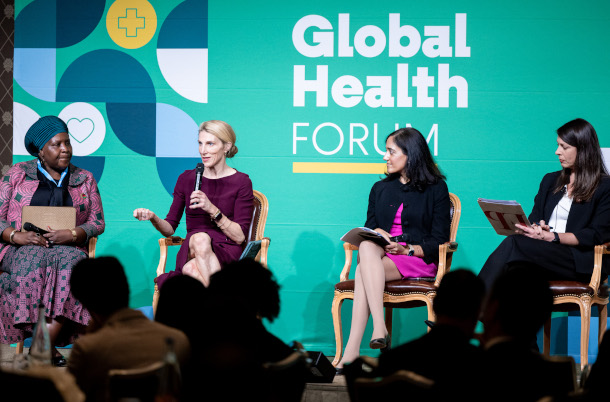
Photo: Seed Global Health.
Dr. Vanessa Kerry (second from left) speaks at the Foreign Policy event at the World Health Assembly in Geneva in May 2025. Under her leadership, Seed Global Health has helped educate more than 45,000 doctors, nurses, and midwives in seven countries.

We humans are inconsistent critters. Today we’re panicking that the latest stupid war is messing up our oil markets (and I get it: we still need oil), but we seem to downplay just how bad oil really is for us.

At the environmental radio show Living on Earth, we learn what fossil fuels are actually doing to our health.

“The burning of fossil fuels is linked to some 300,000 deaths in America every year, not to mention the related carbon emissions that promote global warming. Dr. Vanessa Kerry directs Global Health and Climate Policy and teaches at the Harvard T H Chan School of Public Health. She is also the World Health Organization Special Envoy for Climate Change and Health and joins host Steve Curwood to discuss the major health costs and lost opportunities linked to pollution.

Steve Curwood
“There’s been a shift in messaging from environmental groups regarding the impact of air pollution on environmental health. Discuss what that means in terms of the effectiveness of helping people understand the impact of the environment on their daily lives.

Vanessa Kerry
“There’s a group that calls [climate change] the greatest hoax of our time, and there are others that are really trying to think strategically about what is happening on this earth in ways that aren’t just degrees Celsius. Health has been a really important piece — how extreme heat puts you at risk of flaring your diabetes or your lung disease or your heart disease. …

“But I think there’s another step that we can also take to help people really understand what we’re up against in climate change, which is that these health impacts that we’re seeing cost us money, because if you are too sick to go to work, or you can’t breathe, or your child has an asthma attack, and you can’t go to work because you’re taking them to hospital, that’s lost income. We know, for example, that the United States is losing 100 billion in productivity from extreme heat already now, and that’s supposed to go to 500 billion in the next 20 years. So these, it’s very real. And I think for those that can’t even think about health, understanding the economic bottom line and how it affects your pocket is something that I think is universally related and understood and very real.

Curwood
“If it’s that much of a health danger, climate change is almost an aside. …

Kerry
“Without question, the burning of fossil fuels is driving our risk through multiple pathways. Particulate matter is co-emitted with the greenhouse gasses and … not only do you breathe it in and can it cause issues in your lungs, but actually particulate matter can cross into your bloodstream, lead to increased risk of heart attacks, worsen your blood pressure, increased risk of strokes, cause all sorts of other problems. …

“Beyond the direct impacts of fossil fuels, people who are paying out of pocket for catastrophic health costs related to this are therefore losing access to nutrition, ability to send their children to school, access to other resources. … We know that we’re going to see upwards, you know, 44 million people are going to fall into poverty from the health impacts of climate change alone, according to the World Bank, in the next 20 years.

Curwood
“If air pollution has such a tremendous impact on us, health-wise and economically as well, why aren’t we talking about this more in America?

Kerry
“The Harvard School of Public Health and Department of Environmental Health is actually looking at that exact question. … And there’s lots of data out there that tells us that investments in health actually have higher returns.

Curwood
“To what extent are the massive impacts of air pollution on public health part of the reason that we have such a huge economic divide in this country? …

Kerry
“When you look at who lives in urban cities, in heat deserts, where it can be absolutely crippling to live in high heat, it’s often people of color or people in poverty. And so there’s a massive divide that is happening where we are exacerbating inequity, not just in the United States, but globally. …

Curwood
“The Heritage Foundation in Washington claims that climate change alarmism (quote, unquote) is discouraging families from having children. …

Kerry
“It’s really actually the perpetuation of misinformation. … How we communicate a conversation which is fact-based, scientific, ground in truth … is a really critical question.”

More at Living on Earth, here. And whiled we’re on the subjec t, I want to be sure everyone knows about the heeroes of Cancer Alley in Louisiana, who just dont’ care if fighting the Power is impaossible, They do it and succeed. (Click here.)
Read Full Post »

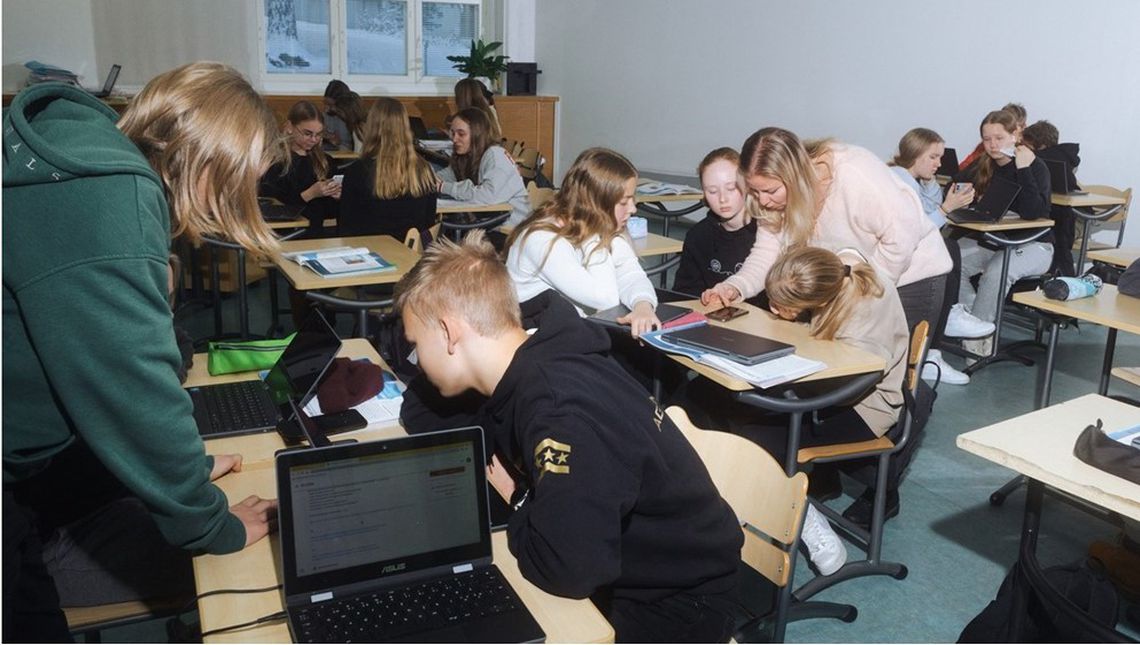
Photo: Vesa Laitinen for the New York Times via the Jordan News.
Teacher Saara Martikka (in pink sweater) works with students to identify misinformation. Media literacy is taught in Finland starting in preschool.

I have long admired Finland for its educational system, but this beats all. The country starts teaching children how to identify misinformation at a very young age. That’s why it “ranked No. 1 of 41 European countries on resilience against misinformation for the fifth time in a row in a survey published in October by the Open Society Institute in Sofia, Bulgaria.”

Jenny Gross has the story at the New York Times.

“A typical lesson that Saara Martikka, a teacher in Hameenlinna, Finland, gives her students goes like this: She presents her eighth graders with news articles. Together, they discuss: What’s the purpose of the article? How and when was it written? What are the author’s central claims?

“ ‘Just because it’s a good thing or it’s a nice thing doesn’t mean it’s true or it’s valid,’ she said. In a class last month, she showed students three TikTok videos, and they discussed the creators’ motivations and the effect that the videos had on them.

“Her goal, like that of teachers around Finland, is to help students learn to identify false information. … Officials say Finland’s success is not just the result of its strong education system, which is one of the best in the world, but also because of a concerted effort to teach students about fake news. Media literacy is part of the national core curriculum starting in preschool.

“ ‘No matter what the teacher is teaching, whether it’s physical education or mathematics or language, you have to think, “OK, how do I include these elements in my work with children and young people?” ‘ said Leo Pekkala, the director of Finland’s National Audiovisual Institute, which oversees media education. …

“The survey results were calculated based on scores for press freedom, the level of trust in society and scores in reading, science and math. The United States was not included in the survey, but other polls show that misinformation and disinformation have become more prevalent since 2016 and that Americans’ trust in the news media is near a record low. …

“Finland has advantages in countering misinformation. Its public school system is among the best in the world. College is free. There is high trust in the government, and Finland was one of the European countries least affected by the pandemic. Teachers are highly respected.

On top of that, Finnish is spoken by about 5.4 million people. Articles containing falsehoods that are written by nonnative speakers can sometimes be easily identified because of grammatical or syntax errors. …

“While teachers in Finland are required to teach media literacy, they have significant discretion over how to carry out lessons. Mrs. Martikka, the middle school teacher, said she tasked students with editing their own videos and photos to see how easy it was to manipulate information. A teacher in Helsinki, Anna Airas, said she and her students searched words like ‘vaccination’ and discussed how search algorithms worked and why the first results might not always be the most reliable. Other teachers also said that in recent months, during the war in Ukraine, they had used Russian news sites and memes as the basis for a discussion about the effects of state-sponsored propaganda.

“Finland, which shares an 833-mile border with Russia, developed its national goals for media education in 2013 and accelerated its campaign to teach students to spot misinformation in the following years. Paivi Leppanen, a project coordinator at the Finnish National Agency for Education, a government agency, said the threat of Russian misinformation on topics such as Finland’s bid to join the North Atlantic Treaty Organization ‘hasn’t changed the basics of what we do, but it has shown us that this is the time for what we have been preparing.’

“Even though today’s teenagers have grown up with social media, that does not mean that they know how to identify and guard against manipulated videos of politicians or news articles on TikTok. In fact, a study published last year in the British Journal of Developmental Psychology found that adolescence could be a peak time for conspiracy theorizing. …

“For teachers of any age group, coming up with effective lessons can be challenging. ‘It’s so much easier to talk about literature, which we have been studying for hundreds of years,’ said Mari Uusitalo, a middle and high school teacher in Helsinki.

“She starts with the basics — by teaching students about the difference between what they see on Instagram and TikTok versus what they read in Finnish newspapers. … During Ms. Uusitalo’s 16 years as a teacher, she has noticed a clear decline in reading comprehension skills, a trend she attributes to students’ spending less time with books and more time with games and watching videos. With poorer reading skills and shorter attention spans, students are more vulnerable to believing fake news or not having enough knowledge about topics to identify misleading or wrong information, she said.

“When her students were talking this summer about leaked videos that showed Finland’s prime minister, Sanna Marin, dancing and singing at a party, Ms. Uusitalo moderated a discussion about how news stories can originate from videos circulating on social media. Some of her students had believed Ms. Marin was using drugs at the party after watching videos on TikTok and Twitter that suggested that. Ms. Marin denied having taken drugs, and a test later came back negative.

“Ms. Uusitalo said her goal was to teach students methods they could use to distinguish between truth and fiction. ‘I can’t make them think just like me,’ she said. ‘I just have to give them the tools to make up their own opinions.’ ”

More at the Times, here.

Read Full Post »