Feeds:
Posts
Comments

Posts Tagged ‘oil’

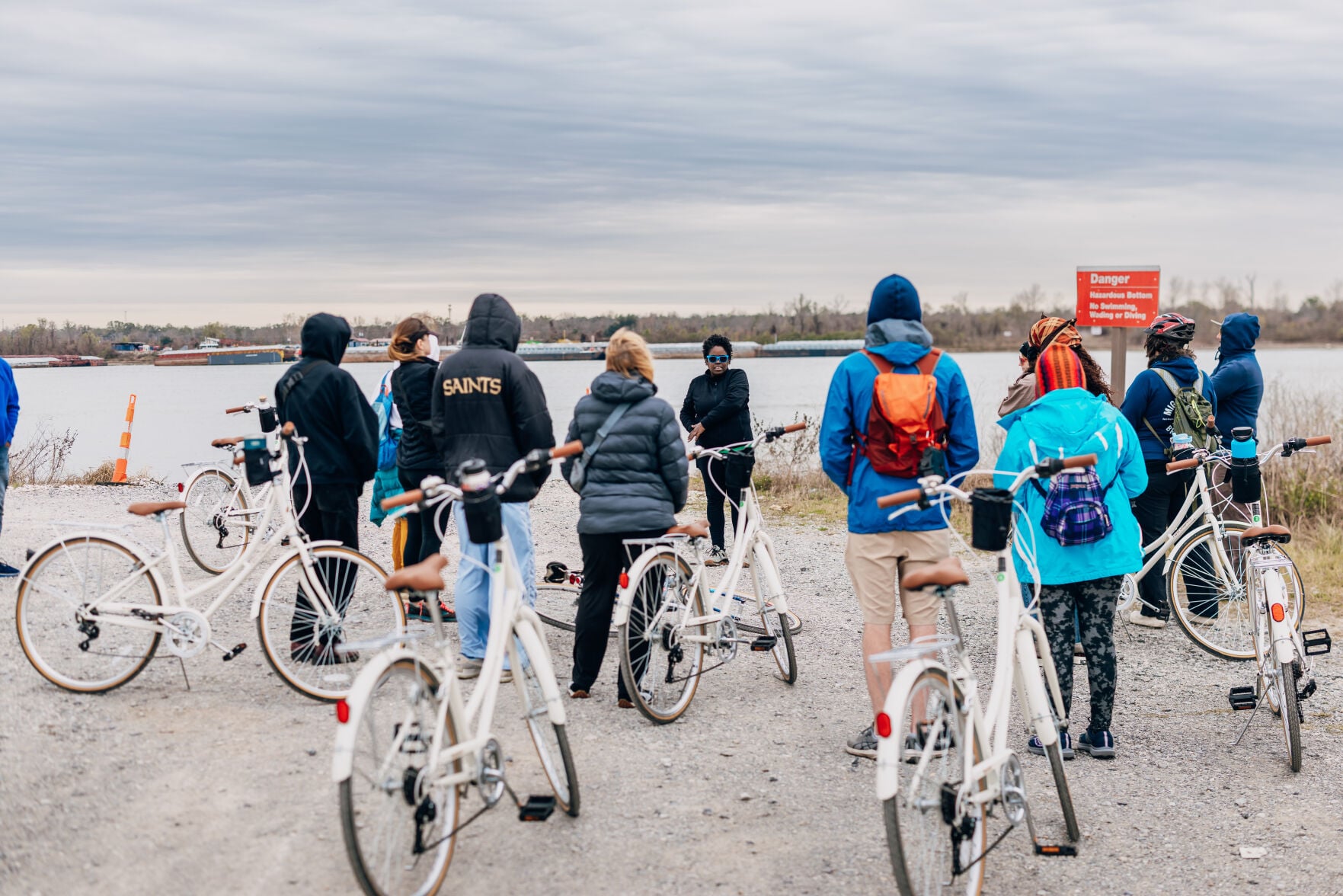
Photo: Rhonda Dumas / PieFace Photography.
Cyclists gathering along the Mississippi Riiver are protesting fossil fuels and chemical plants in low-income Louisiana neighborhoods.

Sometimes it’s funny how we light upon a worthy cause that we end up supporting for years. Finding the Louisiana Bucket Brigade and being really impressed with the courage and success of people who appeared to have no resources was like that. It was a textile artist I was following on Instagram who introduced me to them. Here’s the latest from the Louisiana Bucket Brigade.

Sara Ravits writes at Gambit, “Cathy Laurino leads a group of cyclists to an ancient oak tree, just a few blocks from a massive Shell chemical plant along the Mississippi River in Norco, Louisiana. It’s the first stop along the seven-mile Down by the River Bike Ride in St. Charles Parish, a roving, interactive history lesson hosted by the environmental nonprofit and watchdog organization, the Louisiana Bucket Brigade.

“Along the way, the group learns about the region’s history of slavery, Jim Crow, and the acceleration of climate change caused by the fossil fuel industry in the region known as ‘Cancer Alley.’ It culminates at the site of the largest uprising by enslaved people in U.S. history, which took place along the Mississippi River in 1811.

“The bike ride is pretty much for anyone, says Laurino, the program’s director, especially people interested in the petrochemical industry’s history in Louisiana and the people fighting against it. …

“In the shaded green space sandwiched between a chemical plant and its affiliated refinery, Laurino kicks off the ride on a somber note, telling the tragic story of Leroy Jones, a 16-year-old Black teenager who was killed following an industrial explosion in 1973. Unbeknownst at the time to the residents in the tight-knit Black neighborhood known as Diamond, there was a gas leak at the nearby plant, which had been in operation for about two decades. So when Jones went to rev up his mower and help his elderly neighbor Helen Washington with her lawn, the engine instantly ignited and engulfed him in flames. Washington’s house exploded, killing her instantly.

“Jones, meanwhile, ran toward the oak tree and collapsed as neighbors rushed to douse him, but he ultimately died as a result of his injuries. Fifteen years later, there was another deadly explosion.

“Laurino tells the group that following Jones’ death, his mother Ruth was given a $500 check ‘for her troubles.’

“That insulting act eventually became a galvanizing point in the Diamond community’s long— and ultimately successful fight — for relocation away from the plant, though it would take decades.

“ ‘It ignited a fire in the community,’ Laurino tells the group. ‘They were like, “Absolutely not. We will not let this go. That’s completely unacceptable.” ‘

“The Louisiana Bucket Brigade has long conducted ‘toxic tours’ of the region for journalists, environmental lawyers and other activists, but in 2010 Executive Director Anne Rolfes decided to turn it into a bike-forward event and open it up to the public. The program has since grown its curriculum and partnered with local universities and professors, including Lisa Flanagan from Xavier and Tulane’s Laura Murphy and Kristen Wintersteen. …

“The ride has two tracks: an exploration of history and the telling of present-day environmental justice work. That latter track is updated by Harry ‘Pastor Joe’ Joseph, an activist and nearby resident who is involved in rallying against a petrochemical complex taking shape in nearby Ascension Parish. …

“The Down by the River Ride also leans into the activism and leadership of Margie Richard, a former resident of Norco and a retired teacher who led the charge against Shell for years. … Throughout the next five stops along the way, much more of Richard’s story comes to light. That includes the tales of her enslaved ancestors, who participated in the 1811 slave revolt and whose energy Richard has long channeled in the fight for environmental and racial justice.

“In 1989, Richard founded the group Concerned Citizens of Norco, which eventually teamed up with the Louisiana Bucket Brigade. She was also behind the successful push to get the residents of the Diamond community finally resettled in 2002.

“She remains legendary when it comes to organizing against the petrochemical industry. She famously once showed up to an international meeting in the Netherlands to confront a Shell executive while carrying a sealed container of air that she’d collected in her hometown.

“ ‘She said, “You’re polluting us, and you’re pretending like it’s not happening” … . And she singled out this executive specifically and said, “You’re going to do something about this, right?” And he said (in front of everyone at the meeting) “Yes.” And that’s when she knew the relocation was going to happen,’ Laurino says.”

Lots more at the Gambit, here.
Read Full Post »

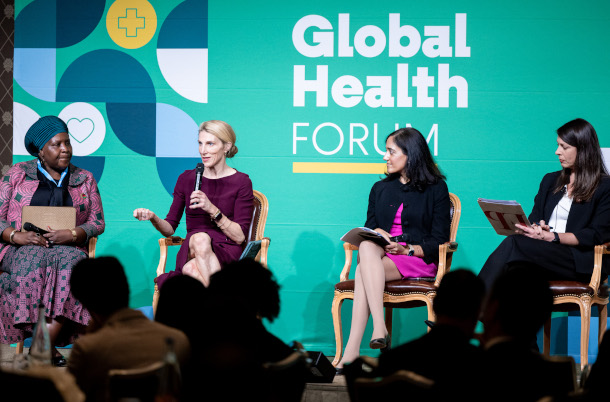
Photo: Seed Global Health.
Dr. Vanessa Kerry (second from left) speaks at the Foreign Policy event at the World Health Assembly in Geneva in May 2025. Under her leadership, Seed Global Health has helped educate more than 45,000 doctors, nurses, and midwives in seven countries.

We humans are inconsistent critters. Today we’re panicking that the latest stupid war is messing up our oil markets (and I get it: we still need oil), but we seem to downplay just how bad oil really is for us.

At the environmental radio show Living on Earth, we learn what fossil fuels are actually doing to our health.

“The burning of fossil fuels is linked to some 300,000 deaths in America every year, not to mention the related carbon emissions that promote global warming. Dr. Vanessa Kerry directs Global Health and Climate Policy and teaches at the Harvard T H Chan School of Public Health. She is also the World Health Organization Special Envoy for Climate Change and Health and joins host Steve Curwood to discuss the major health costs and lost opportunities linked to pollution.

Steve Curwood
“There’s been a shift in messaging from environmental groups regarding the impact of air pollution on environmental health. Discuss what that means in terms of the effectiveness of helping people understand the impact of the environment on their daily lives.

Vanessa Kerry
“There’s a group that calls [climate change] the greatest hoax of our time, and there are others that are really trying to think strategically about what is happening on this earth in ways that aren’t just degrees Celsius. Health has been a really important piece — how extreme heat puts you at risk of flaring your diabetes or your lung disease or your heart disease. …

“But I think there’s another step that we can also take to help people really understand what we’re up against in climate change, which is that these health impacts that we’re seeing cost us money, because if you are too sick to go to work, or you can’t breathe, or your child has an asthma attack, and you can’t go to work because you’re taking them to hospital, that’s lost income. We know, for example, that the United States is losing 100 billion in productivity from extreme heat already now, and that’s supposed to go to 500 billion in the next 20 years. So these, it’s very real. And I think for those that can’t even think about health, understanding the economic bottom line and how it affects your pocket is something that I think is universally related and understood and very real.

Curwood
“If it’s that much of a health danger, climate change is almost an aside. …

Kerry
“Without question, the burning of fossil fuels is driving our risk through multiple pathways. Particulate matter is co-emitted with the greenhouse gasses and … not only do you breathe it in and can it cause issues in your lungs, but actually particulate matter can cross into your bloodstream, lead to increased risk of heart attacks, worsen your blood pressure, increased risk of strokes, cause all sorts of other problems. …

“Beyond the direct impacts of fossil fuels, people who are paying out of pocket for catastrophic health costs related to this are therefore losing access to nutrition, ability to send their children to school, access to other resources. … We know that we’re going to see upwards, you know, 44 million people are going to fall into poverty from the health impacts of climate change alone, according to the World Bank, in the next 20 years.

Curwood
“If air pollution has such a tremendous impact on us, health-wise and economically as well, why aren’t we talking about this more in America?

Kerry
“The Harvard School of Public Health and Department of Environmental Health is actually looking at that exact question. … And there’s lots of data out there that tells us that investments in health actually have higher returns.

Curwood
“To what extent are the massive impacts of air pollution on public health part of the reason that we have such a huge economic divide in this country? …

Kerry
“When you look at who lives in urban cities, in heat deserts, where it can be absolutely crippling to live in high heat, it’s often people of color or people in poverty. And so there’s a massive divide that is happening where we are exacerbating inequity, not just in the United States, but globally. …

Curwood
“The Heritage Foundation in Washington claims that climate change alarmism (quote, unquote) is discouraging families from having children. …

Kerry
“It’s really actually the perpetuation of misinformation. … How we communicate a conversation which is fact-based, scientific, ground in truth … is a really critical question.”

More at Living on Earth, here. And whiled we’re on the subjec t, I want to be sure everyone knows about the heeroes of Cancer Alley in Louisiana, who just dont’ care if fighting the Power is impaossible, They do it and succeed. (Click here.)

Read Full Post »

Permission to Stay Warm

Photo: Henry Nicholls/Reuters.
Residents take shelter inside London’s Roehampton Library, Dec. 14, 2022. The library is being used as a “warm bank,” according to CSM, welcoming members of the community to spend time there in the winter months as an alternative to heating their homes amid increased energy costs.

After Russia invaded Ukraine a year ago, oil prices and heating costs went up for everyone. And rather than help people out, oil companies gave their windfall profits back to themselves. In the long run, that can only help to spur alternative energy development. But meanwhile, folks are just trying to keep warm.

Natasha Khullar Relph writes at the Christian Science Monitor, “String lights, boxes full of postcards to share a story, or a sign on the door that lists the top five David Bowie songs with the message, ‘Come in and argue’: There are many ways to make people happy to come out of the cold and into a public warm space, says Maff Potts. The key, he adds, is to make sure they feel welcome and not judged.

“ ‘What gets people in is that it’s not a church. It’s not a charity,’ says Mr. Potts, who founded Camerados, a social movement that’s been opening public living rooms in communities across the United Kingdom since 2015. ‘There’s no fixing, no answer. There’s just permission.’ …

“While the U.K. Health Security Agency is encouraging people to warm their homes to at least 18 degrees Celsius (64.4 F), more than 3 million low-income households cannot afford to heed this advice.

According to analysis by the Joseph Rowntree Foundation, around 710,000 households across the U.K. cannot pay for warm clothing, heating, and food, with approximately 2.5 million households – a fifth of all low-income households – going without both food and heating.

“And with power prices hitting record levels and energy costs double what they were last year, warm spaces have popped up all over the country. To avoid any potential stigma, they’re being presented as communal spaces where people can come to chat rather than charitable offerings of heat or food. While the main reason someone would go to a warm space or public living room is most likely to be warmth, it’s the camaraderie and conversation that keeps people there. …

“Britain’s poor people face the worst winter in living memory, tweeted former Prime Minister Gordon Brown in December. ‘A year ago we talked about people having to choose between heating and eating, now many can’t afford either,’ he wrote. Two-thirds of the country will be in fuel poverty come April, which includes 70% of pensioners [retirees] and 96% of single-parent families with two or more kids, he noted. …

“If you’re struggling to pay to heat your home, you only really have three options, says Matt Copeland, NEA’s head of policy: You could rack up debt with your energy supplier, ration your energy and use less than you need to stay warm, or simply turn off the heating, the impact of which can be significant. Research shows that more people die from cold homes than they do from alcohol’s short- and long-term effects, Parkinson’s disease, or traffic accidents.

“ ‘We know of households with prepayment meters who just can’t afford to top them up at all,’ says Mr. Copeland. ‘They’re going days, weeks, and sometimes months without access to energy.’ …

“Where the government is failing, communities are stepping up. ‘It is completely absurd that one of the 10 richest countries in the world can’t put a sufficient priority on things and make the right choices so that we have somewhere to keep people warm,’ says Mr. Potts of Camerados, whose public living rooms are now being used as templates for warm spaces around the country. After almost 30 years of working with people at the margins, Mr. Potts says he doesn’t have faith that the solution lies in the civil service. …

“An LGBTQ+ community space in Brighton. A bakery in North Yorkshire. A gaming cafe and ‘geek culture’ store in Ipswich. A vegetarian restaurant in Tunbridge Wells. A brewery in Devon. A former shoe store in Worcestershire. Warm spaces are popping up all around the country, in all manner of ways, in a community effort that started organically, from the grassroots, without a central organizer.

“In addition to community halls and churches, hotels, hairdressers, and cricket clubs are opening up their doors for anyone who needs some warmth, some company, and perhaps even a drink. Even legendary soccer club Manchester United has gotten in on the action and is offering Old Trafford, the club’s stadium, as a free warm hub, with its restaurant, the Red Café, opening its doors on Monday and Wednesday evenings ‘to help those facing difficult months ahead.’

“The Warm Welcome campaign, an organization that has encouraged thousands of faith groups, charities, and businesses to provide such public spaces, said they’d seen 80,000 people use their facilities during December’s cold snap. The campaign notes that there are now warm spaces in every town and city in the country, and lists over 3,200 venues on their website, which include spaces run by local authorities, charities, and businesses. …

“ ‘What we have in Brighton and Hove is a tremendous community-mindedness among residents. Despite the stark reality facing residents this winter, people have stuck together and they’ve really helped each other through some of the starkest problems,’ says Brighton and Hove City Council Leader Phélim Mac Cafferty, who notes there are more than 40 warm spaces available to the public across the city. …

“This nationwide response to the energy crisis is unique in how much of a community effort it is. The effort to create warm spaces was neither government- nor council-led, nor the work of any one particular organization. As the need became obvious, first volunteers, then organizations, and later local councils jumped in feet first.”

More at the Monitor, here. No firewall.

Read Full Post »

Photo: AP Images/Associated Press

You can’t make these things up.

Jenni Ryall writes at Mashable, “Australia’s oldest man has spent a lot of his days knitting sweaters for little penguins. Alfred ‘Alfie’ Date spoke to 9 Stories about how his inability to say ‘no’ to favours got him into making the miniature animal clothes.

“The jerseys were requested from Victoria’s Phillip Island Penguin Foundation in 2013, to assist the survival of little penguins after an oil spill. Little penguins are a species of penguin only found in southern Australia and New Zealand, with a lone colony of 32,000 remaining on Phillip Island.

“The 109-year-old, who lives in a retirement home on the New South Wales Central Coast, was asked by two nurses to help make the sweaters, as they had heard he was an experienced knitter. It was a request he could not refuse. Using heavy wool provided by the nurses, Alfie put his 80 years of knitting skills to good use and got to work. …

“When oiled penguins arrive at the foundation, they are given a jacket to wear so that they don’t consume the toxins or preen their feathers. In 2001, 438 penguins were affected in an oil spill at Phillip Island and by using the knitted outfits, 96% of the penguins were rehabilitated at the clinic, according to the foundation’s website.”

More at Mashable, here.

Photo: PINP/AAT Kings/Spotlight/Rex Feat
Penguin sweaters worn by stuffed toys at Phillip Island.

Read Full Post »