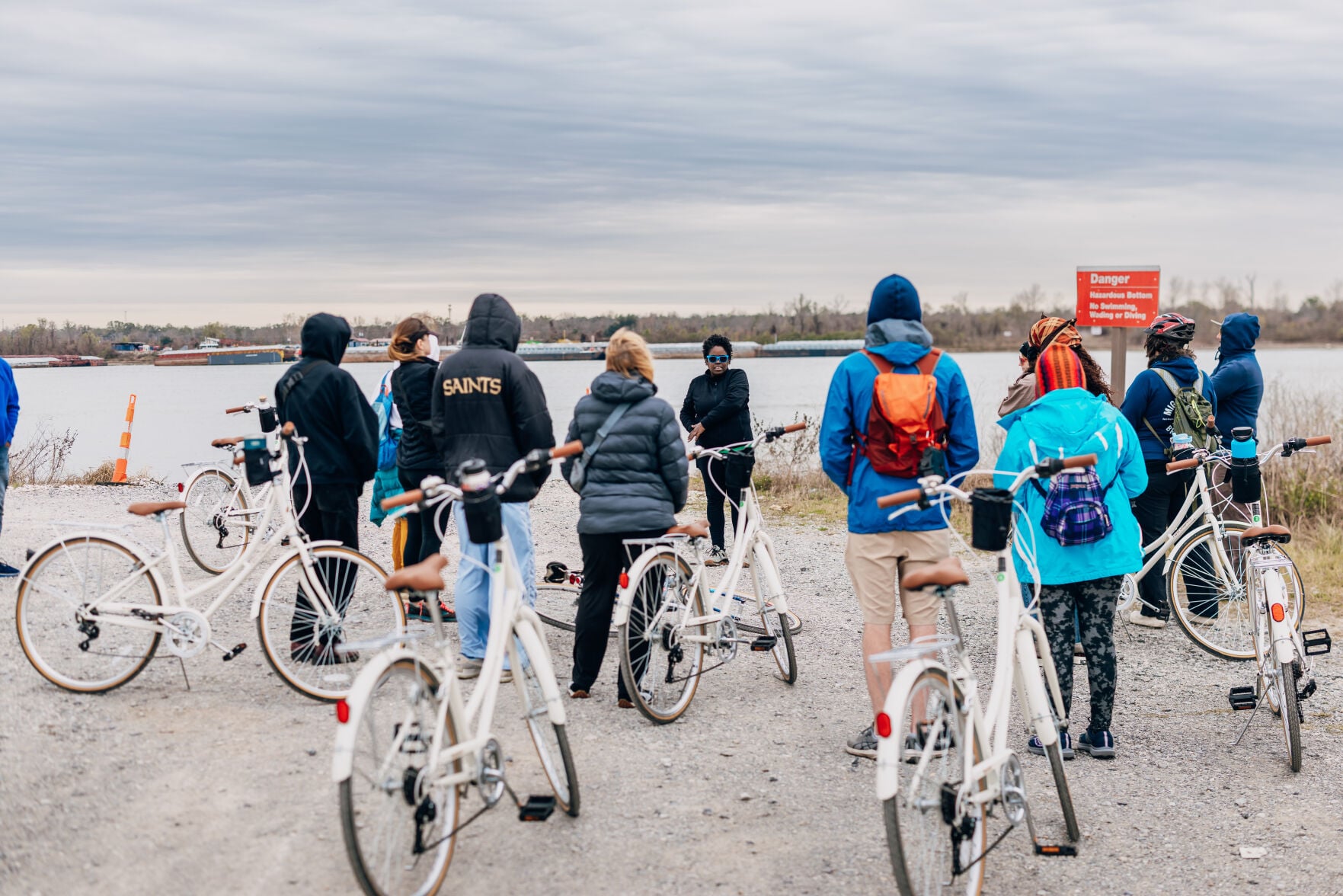
Photo: Rhonda Dumas / PieFace Photography.
Cyclists gathering along the Mississippi Riiver are protesting fossil fuels and chemical plants in low-income Louisiana neighborhoods.
Sometimes it’s funny how we light upon a worthy cause that we end up supporting for years. Finding the Louisiana Bucket Brigade and being really impressed with the courage and success of people who appeared to have no resources was like that. It was a textile artist I was following on Instagram who introduced me to them. Here’s the latest from the Louisiana Bucket Brigade.
Sara Ravits writes at Gambit, “Cathy Laurino leads a group of cyclists to an ancient oak tree, just a few blocks from a massive Shell chemical plant along the Mississippi River in Norco, Louisiana. It’s the first stop along the seven-mile Down by the River Bike Ride in St. Charles Parish, a roving, interactive history lesson hosted by the environmental nonprofit and watchdog organization, the Louisiana Bucket Brigade.
“Along the way, the group learns about the region’s history of slavery, Jim Crow, and the acceleration of climate change caused by the fossil fuel industry in the region known as ‘Cancer Alley.’ It culminates at the site of the largest uprising by enslaved people in U.S. history, which took place along the Mississippi River in 1811.
“The bike ride is pretty much for anyone, says Laurino, the program’s director, especially people interested in the petrochemical industry’s history in Louisiana and the people fighting against it. …
“In the shaded green space sandwiched between a chemical plant and its affiliated refinery, Laurino kicks off the ride on a somber note, telling the tragic story of Leroy Jones, a 16-year-old Black teenager who was killed following an industrial explosion in 1973. Unbeknownst at the time to the residents in the tight-knit Black neighborhood known as Diamond, there was a gas leak at the nearby plant, which had been in operation for about two decades. So when Jones went to rev up his mower and help his elderly neighbor Helen Washington with her lawn, the engine instantly ignited and engulfed him in flames. Washington’s house exploded, killing her instantly.
“Jones, meanwhile, ran toward the oak tree and collapsed as neighbors rushed to douse him, but he ultimately died as a result of his injuries. Fifteen years later, there was another deadly explosion.
“Laurino tells the group that following Jones’ death, his mother Ruth was given a $500 check ‘for her troubles.’
“That insulting act eventually became a galvanizing point in the Diamond community’s long— and ultimately successful fight — for relocation away from the plant, though it would take decades.
“ ‘It ignited a fire in the community,’ Laurino tells the group. ‘They were like, “Absolutely not. We will not let this go. That’s completely unacceptable.” ‘
“The Louisiana Bucket Brigade has long conducted ‘toxic tours’ of the region for journalists, environmental lawyers and other activists, but in 2010 Executive Director Anne Rolfes decided to turn it into a bike-forward event and open it up to the public. The program has since grown its curriculum and partnered with local universities and professors, including Lisa Flanagan from Xavier and Tulane’s Laura Murphy and Kristen Wintersteen. …
“The ride has two tracks: an exploration of history and the telling of present-day environmental justice work. That latter track is updated by Harry ‘Pastor Joe’ Joseph, an activist and nearby resident who is involved in rallying against a petrochemical complex taking shape in nearby Ascension Parish. …
“The Down by the River Ride also leans into the activism and leadership of Margie Richard, a former resident of Norco and a retired teacher who led the charge against Shell for years. … Throughout the next five stops along the way, much more of Richard’s story comes to light. That includes the tales of her enslaved ancestors, who participated in the 1811 slave revolt and whose energy Richard has long channeled in the fight for environmental and racial justice.
“In 1989, Richard founded the group Concerned Citizens of Norco, which eventually teamed up with the Louisiana Bucket Brigade. She was also behind the successful push to get the residents of the Diamond community finally resettled in 2002.
“She remains legendary when it comes to organizing against the petrochemical industry. She famously once showed up to an international meeting in the Netherlands to confront a Shell executive while carrying a sealed container of air that she’d collected in her hometown.
“ ‘She said, “You’re polluting us, and you’re pretending like it’s not happening” … . And she singled out this executive specifically and said, “You’re going to do something about this, right?” And he said (in front of everyone at the meeting) “Yes.” And that’s when she knew the relocation was going to happen,’ Laurino says.”
Lots more at the Gambit, here.