Feeds:
Posts
Comments

Posts Tagged ‘mississippi’

Photo: Noah Stewart.
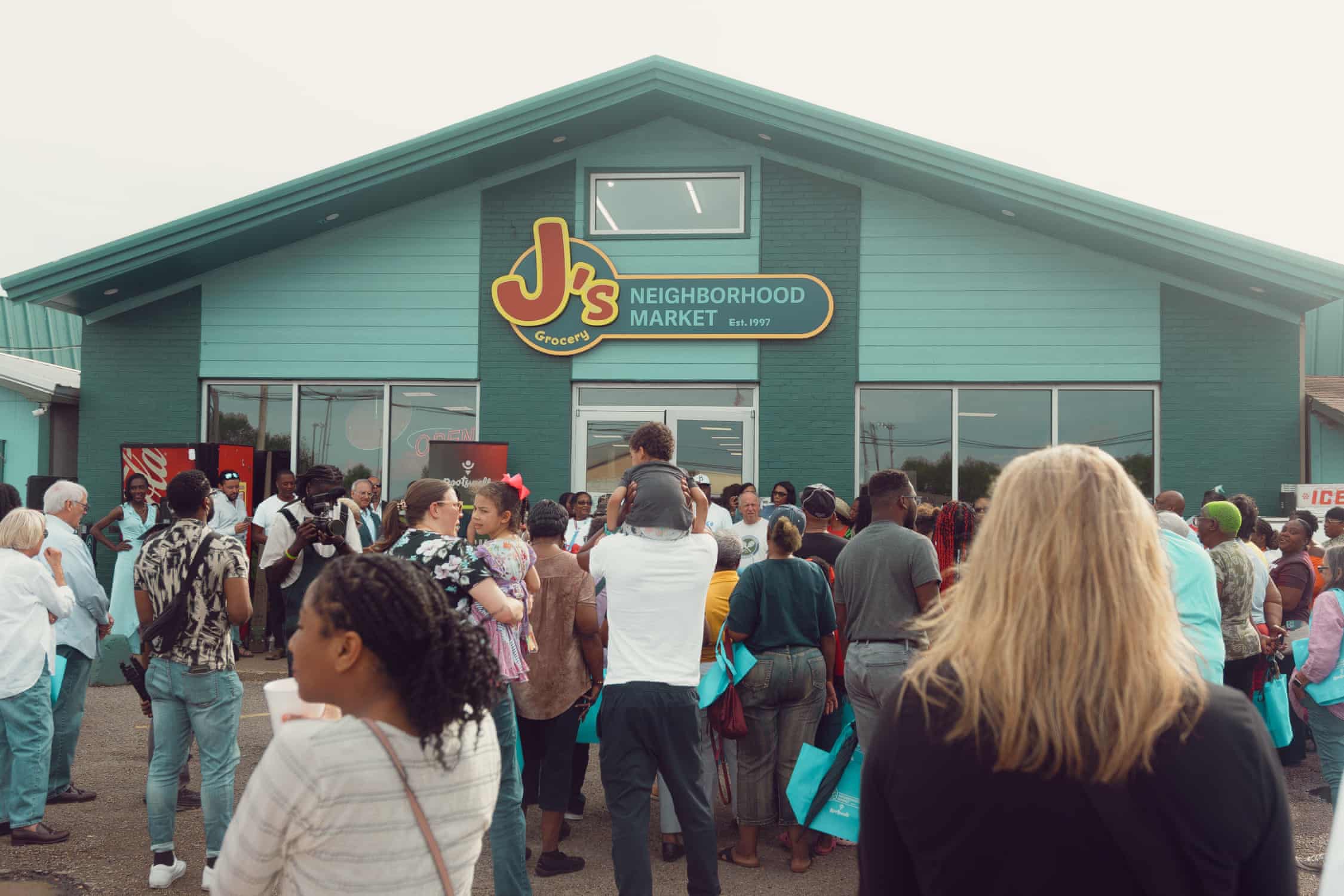
On 2 May, J’s Grocery in Clarksdale, Mississippi, reopened after a yearlong renovation. Through a new food-access initiative, J’s Grocery provides its mostly Black community with hard-to-come-by fresh produce.

The best medicine is often a healthful diet. But in many communities around the US, nourishing food is hard to access. That’s why a community in Mississippi is rejoicing about a newly renovated grocery store.

Adria R Walker writes at the Guardian about J’s Grocery revitalizing its majority-Black town with fresh produce.

“With the recent release of Ryan Coogler’s Sinners, Clarksdale, Mississippi, known as the home of the blues, has been thrust into the spotlight. But while the nation and world are captivated by a version of Clarksdale from more than 90 years ago, residents today are focused on the future.

“On 2 May, rain and warnings of thunderstorms were not enough to keep people in Clarksdale’s Brickyard neighborhood away from the reopening of J’s Grocery, a local staple since 1997 that had been under renovation for the last year.

“A collaboration between the store owner, Al Jones, and local farmers, J’s, the only Black-owned supermarket in the area, now carries fresh produce. …

“The new stock and collaboration was made possible by a deal among Jones; Partnership for a Healthier America (PHA), a nonprofit that works to provide access to nutritious food; Rootswell, a Mississippi Delta-based group that was formed to ‘shift the paradigm of food apartheid‘; Novo Nordisk, a pharmaceutical company; and other groups.

“ ‘At a time in our country when the federal government is just pulling money back everywhere, we invested in people and community,’ Noreen Springstead, PHA’s president and CEO said at the opening. …

“Jarvis Howard of Tunica, Mississippi, a visual artist who goes by DudeThatDraw, painted a mural, a smaller version of one he is installing at nearby George H Oliver elementary school. ‘Food is medicine,’ the mural reads over vibrantly colored vegetables. …

“Clarksdale, which today has a population of nearly 14,000 people, is primarily Black. The grocery store is in a walkable, mixed-income community, with an elementary school almost right across the street. A middle school, a Head Start center, a nursing home and senior citizen housing, low-income apartments and single-family homes are all in close proximity. In addition to the newly offered produce, the store also features a third space: a seated, shaded area surrounded by raised beds planted with herbs, where residents can gather and chat.

“The Mississippi Delta is abundant in fertile land and crops; agriculture is the state’s No 1 industry. Though some 30% of the state is farmland, most of that land is dedicated to cash crops, which are exported. In 2022, nearly 20% of Mississippians were food-insecure.

“Farms in the region ‘produce a lot of commodity crops, like corn, soybean, cotton. They don’t produce a lot of food that we eat,’ said Robbie Pollard, one of the farmers whose produce is now sold at J’s. ‘We’re trying to change the landscape to start producing more food in the Delta, like converting some of that land that’s used for row-crop production.’ …

“Pollard said that while the Mississippi Delta region is abundant in farmland, there’s a gap in what reaches the community. His initiative, Happy Foods Project, which is part of his farm, Start 2 Finish, is working to remedy that by collaborating with other farmers, and introducing youth to farming through farm visits and farm-to-school programs.

“J’s Grocery reopening will be a gamechanger for the neighborhood, he said. Some residents lack transportation to be able to get to big box stores that sell imported produce. Rural counties in the Mississippi Delta, like Coahoma county in which Clarksdale is the largest town, average one supermarket per 190.5 sq miles . …

“After Clarksdale lost its Kroger in 2017, residents initially pushed for another big box store to move in. But Tyler Yarbrough, the director of Mississippi Delta Programs for PHA, and others wanted the town to be able to return to its locally owned, locally operated roots. …

“Yarbrough said that stories from his grandmother and other older residents of shopping in the 1960s provided inspiration for what they might be able to bring back to the town. At the time, locals didn’t need to leave their communities to procure groceries. Instead, they went to the local grocery stores, which, like J’s, had a butcher who sold chicken, pork, freshly sliced bacon and produce.

“ ‘It is in our food-system history of having these neighborhood corner stores,’ he said, noting that the Brickyard and downtown Clarksdale once had 12 such shops. ‘This project is honoring that legacy and reminding us that we can own our food and the stores that we shop from.’ ”

More at the Guardian, here. No paywall, but donations keep this reliable news source alive. Help if you can.
Read Full Post »

Photo: Fatih Aktas / Anadolu Agency / Getty via the Atlantic.
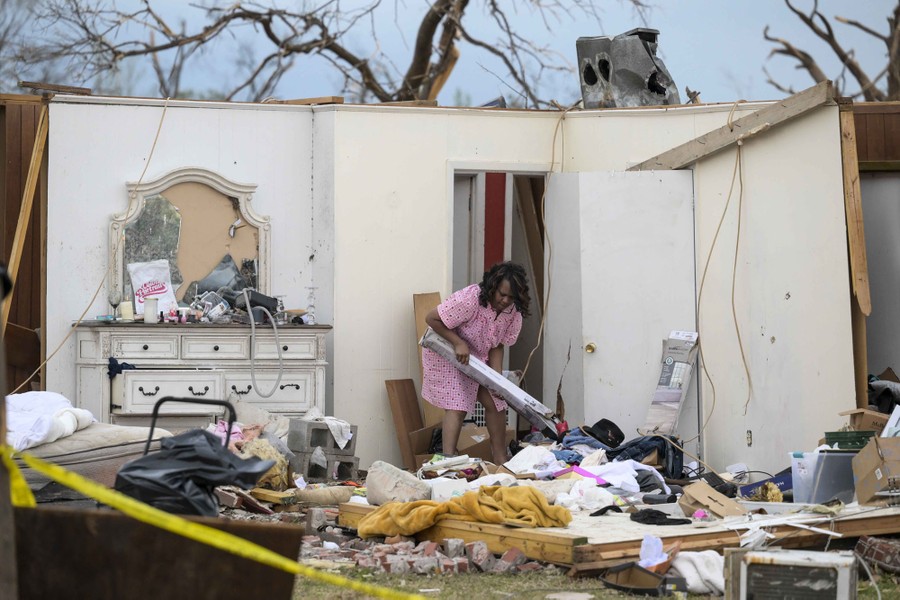
Cleaning up from the fierce tornado that struck Mississippi in March 2023.

Sometimes people who have suffered become hardened to the misfortunes of others. But very often when they see suffering, they want to reach out and help.

Daniel Wu reported recently at the Washington Post about refugees from Ukraine, currently living in Minnesota, who rushed to provide assistance in Mississippi after the March tornado.

“The seven Ukrainians set out just before midnight to make the long drive to their destination,” Wu wrote. “They were on an aid mission to a grimly familiar scene of devastated communities and leveled homes.

“But the refugees were thousands of miles from their homeland and the war that changed their lives. Their journey wound down Interstate 55, starting in Minnesota, where they had resettled just months earlier, and ending in a disaster zone wracked not by bombs, but by the wind: several towns in Mississippi recovering from a devastating tornado that killed at least 25 in late March.

“Dmytro Fedirko, a 34-year-old former van driver, puzzled through American road signs on his first road trip in the country. With him were couple Denys Pavliuk and Viktoriia Hasiuk, 19 and 18, who had arrived in the United States 10 days before. Iryna Hrebenyk, a 51-year-old hairdresser turned forklift operator for Home Depot, tried to stay awake — she joined the group after a night shift, with only a few hours of sleep in between.

“They had all been in the United States for a few months at most, thrust by war from cities and towns across Ukraine into new lives in Minnesota that had not yet settled — they had immigration forms to complete, job interviews to prepare for and families to support.

“But they said they decided, without hesitation, to put that on hold last week upon hearing news of the tornado that leveled towns in Mississippi. They made the 16-hour drive south to donate bottled water and volunteer with aid workers, buoyed by the idea that they could help a community facing a similar struggle to theirs.

“ ‘We had to leave our home,’ Pavliuk told the Washington Post in Ukrainian, in an interview interpreted by Hrebenyk. ‘And they don’t have a place to go back, either.’ …

“Pavliuk’s group had all been helped by the same nonprofit organization, the American Service. Aswar Rahman, a Minneapolis-based digital producer, founded the agency in March 2022 after visiting the Polish-Ukrainian border and seeing the challenges facing refugees there, he said. A month later, when the Biden administration’s Uniting for Ukraine program created a path for Ukrainians with an American sponsor to secure two-year stays in the United States, the American Service started helping refugees resettle in Minneapolis.

“Rahman said he was struck by the kinship that grew in the apartment building where the American Service found housing for Ukrainian refugees. Those who had been there for a few weeks or months were quick to help with the myriad challenges facing new arrivals: like buying SIM cards, applying for Social Security numbers and completing post-arrival immigration forms.

“ ‘I feel like I have a big family,’ said the American Service’s Minnesota director, Sofiia Rudenko, who arrived in the United States from Ukraine in late December. ‘realized that last week, I didn’t even cook because my neighbors kept feeding me every day.’

“That spirit convinced Rahman that the refugees wouldn’t hesitate to help other communities in need, too. When he saw news of the March 24 tornadoes that devastated Mississippi towns, he pitched the idea of taking a team to deliver aid. Rudenko, 22, thought it was a great idea. …

“Everyone leaped at the proposal. The team of eight — seven recent Ukrainian arrivals, accompanied by Rahman — had to turn down additional volunteers because they no longer had room in their cars, Rahman said. None of the Ukrainians had been in the United States for longer than three months. Pavliuk and Hasiuk didn’t mind that it had been less than two weeks since they arrived. …

“The group piled into two cars late Monday night and drove to Memphis, where they rented a U-Haul van and bought several pallets of water bottles from a Costco. The Ukrainian group paid for the water themselves against Rahman’s protests, he said. …

“Rahman contacted the nonprofit Volunteer Mississippi to ask where the group could be of use. A coordinator directed them to a school being used as a distribution center in the city of Belzoni. They distributed the water in Belzoni on Wednesday. In the afternoon, the group drove farther south to Silver City and helped unload additional trucks of aid and supplies. …

“Rahman said their donation, about 13,000 bottles of water, probably wasn’t much compared with those by large corporate donors. But the backstory of the Ukrainian volunteers resonated, both in teary exchanges with other workers on the ground and with Volunteer Mississippi’s coordinators. …

“The group returned to Minneapolis on Thursday evening, just in time for several people to make their shifts at the Home Depot and for Pavliuk to make a weekend job interview.

“Now, the seven Ukrainians will resume the new starts they’re pursuing for themselves. All of them are grappling with the devastating toll that the war is taking on Ukraine and their family members there. But the trip to Mississippi lifted their spirits, Rudenko said, and the American Service is looking for other ways that the refugee community can volunteer in Minneapolis.

“ ‘That’s something that is special about our community,’ Rudenko said. ‘Because we want to share, to give, and to keep doing that because we feel better, and we feel that we are not alone.’ ”

More at the Post, here.

Read Full Post »

Photo: Kirk Siegler/NPR.
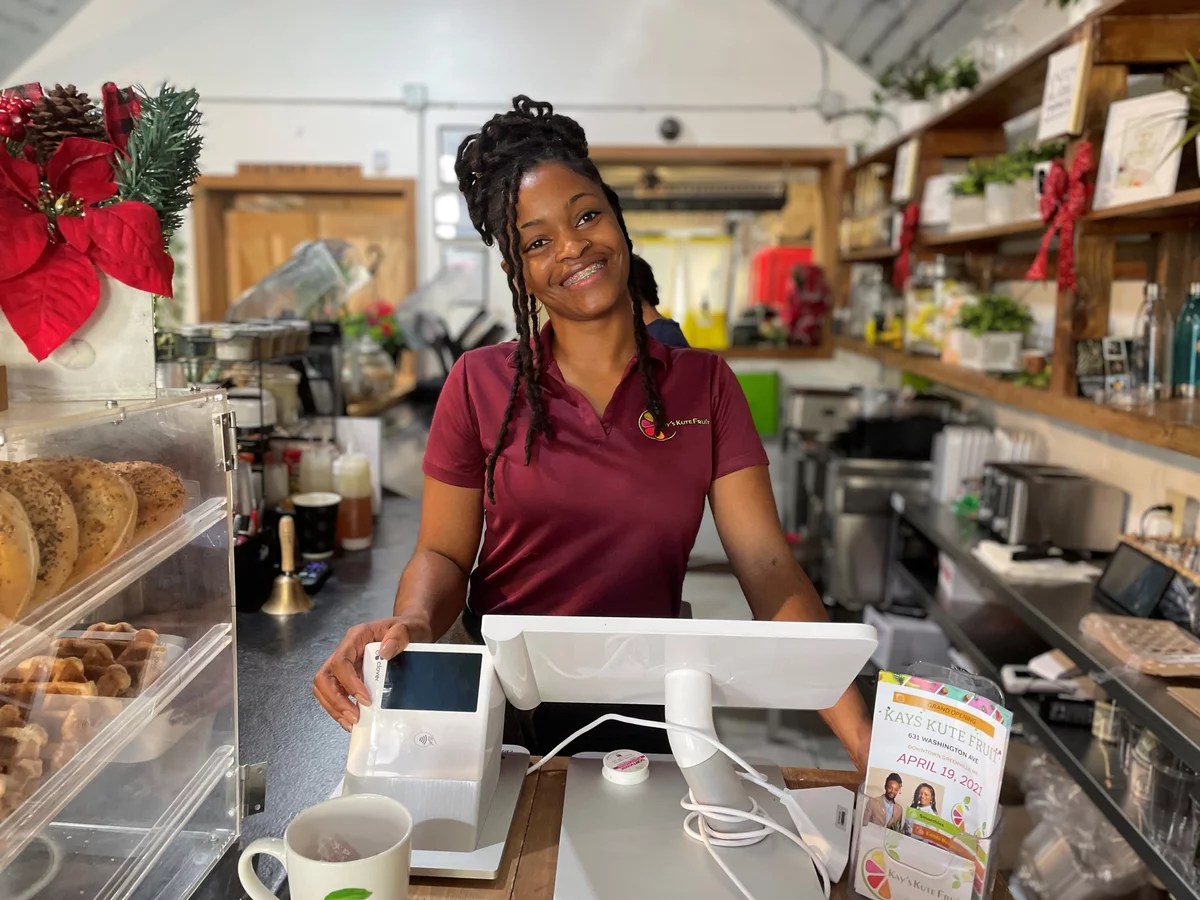
Kenesha Lewis, 30, opened a juice and smoothie shop in her hometown of Greenville, Miss. where fresh and healthy food options are hard to find.

Why do valuable communities get forgotten? Because they are rural? Because they are minority? Because they are very small businesses? Well, watch out, World! Remember the Mouse That Roared. In two years of stepping back and taking stock, we are starting to see more people refuse to be sidelined.

Kirk Siegler has a report at National Public Radio (NPR) one one example: Black businesses in rural Mississippi.

“In Greenville, Miss., pop. 27,000, a modern, brightly lit juice bar stands out in the small downtown lined with mostly mom and pop businesses and a few taverns near the town’s riverbank casino. …

“Turning heads is the owner of Kay’s Kute Fruit, 30 year-old Kenesha Lewis.

” ‘I’m really excited for the young people to walk in, and they say, who’s the owner, and they’re like, what? I had somebody do that to me,’ Lewis says laughing.

“Growing up here, she can’t recall any prominent Black-owned businesses like hers (today the town is about 81% Black). She and her husband Jason Lewis opened up this brick and mortar last Spring after a few years of making edible fruit arrangements and smoothies and selling them out of their home on the side of their regular jobs. …

“The Delta is known the world over for its delicious comfort food, but fresh produce and even regular grocery stores are few and far between. At Kay’s the blenders appear to always be running, churning up pineapple or mango smoothies with the popular add-ons of chia seeds or turmeric. …

“Lewis got the idea to start a business after her husband kept getting on her case for eating too much sugar.

” ‘I lost two teeth and he said, “wait a minute now, you’re too young to be losing these teeth,” ‘ she recalls, laughing. [So] we created smoothies together, and I said, okay, this is good for me.’

“And it turns out, it was also good for business. Lewis exceeded her projected annual sales in her first month after opening. Growing up, she says people in her community were good entrepreneurs but they usually worked out of their homes. …

” ‘Our Black people are waking up, they know that they can do this,’ Lewis says. ‘I think that we have helped them to understand that they can do this, they can succeed.’ …

“Hundreds of new Black-owned businesses like Lewis’s are starting to spring up in this region long seen as being dismissed or ‘forgotten’ by outsiders.

“Drive south of Memphis, near the massive river levees, and a lot of small town store fronts are boarded up. … So when Tim Lampkin, 35, moved back to his hometown of Clarksdale after college and a stint working in corporate America, he had an idea.

” ‘When I came back I noticed that a majority of the businesses in [Coahoma County] are white owned,’ Lampkin says. Like in nearby Greenville, more than 80% of Clarksdale’s 15,000 residents are African American.

“In 2016, Lampkin started what he calls an economic justice non-profit. Higher Purpose Co. helped Kenesha Lewis in Greenville from start to finish, applying for a loan, prepping her for meetings with bankers. And they follow up frequently with her today, all things Lampkin says would probably be a given for aspiring white business owners in the area.

” ‘If we’re going to make special exceptions for entrepreneurs because, you know, they’re a white farmer and we know their family, why can’t a Black entrepreneur get the same level of access and understanding and patience when it comes to getting access to capital?’ Lampkin asks.

“A mentorship program Higher Purpose started in late 2019 is now helping some 300 Black entrepreneurs across Mississippi take their business acumen to the next level. The non-profit helps them do things like find grants to cover closing costs or tap into donations and seed money for renting or buying spaces and storefronts. …

“At Delta State University in Cleveland, Miss., Rolando Herts, director of the Delta Center for Culture and Learning, says the region is a microcosm for the country’s broader racial and economic inequality.

” ‘In the consciousness of America, this is considered to be one of, if not the most, racist states in the union,’ Herts says. ‘Everybody’s able to look at Mississippi and say, “at least we’re not Mississippi.” ‘

“Ever since the Delta was plowed up into plantations mostly after the Civil War, Herts says there’s been a permanent Black underclass. Many don’t trust the banks, for good reason, he says, and in turn many banks traditionally haven’t done business in the still segregated Black communities. …

“For Herts, it will take hundreds more groups like Higher Purpose to really right the wrongs of the past. But he does see momentum behind their work, which is driven by mostly young, energetic and social media savvy people.

“And the businesses they’re supporting are filling a need. One of Higher Purpose’s biggest success stories is Dr. Mary Williams in Clarksdale. She opened what was then the town’s first urgent and primary care facility about three years ago. Before then, she says, working people had to drive 45 miles or go to the local ER just to get routine care after hours.

“She soon discovered there were many untreated cases of hypertension, high blood pressure, diabetes and obesity in her community. …

” ‘A lot of them … didn’t know their blood pressure was up, they didn’t know they were diabetic,’ Williams says.

“But getting to where she is today, weathering the pandemic with a clinic that now serves some 3,000 patients, wasn’t easy.

“While working as a nurse practitioner at the local hospital, Williams got ‘no’ after ‘no’ from banks when she applied for loans to start her business. One told her she may be a good health care provider, but that didn’t mean she was a good business owner. Another said there was no business like hers in Clarksdale to base her proposal on, so she’d have to put up her house as collateral.

” ‘I mean, the whole idea for this loan was for community development,’ Williams says. ‘Here I am bringing in a clinic to develop the community and improve our health care and I got a hard “no” unless I give them my house.’

“That lit a fire in her: she was going to help her underserved community if it took everything she had.” Read more at NPR, here.

Read Full Post »

cali_wwfus

Photo: Julia Kurnik, World Wildlife Fund
WWFUS hopes that a research-based pilot project could identify the best crops to grow in the mid-delta Mississippi region as climate change forces California to reconsider what it should grow
.

As changes in weather patterns damage agriculture in California, scientists are wondering if the Mississippi Delta could pick up the slack. The potential benefits of moving some farming to Mississippi include employment, better distribution systems, and less waste.

Radio show Living on Earth says,”Droughts and extreme weather are already taking a toll on the produce grown in the Central Valley of California. Now researchers from the World Wildlife Fund have found that the mid-Delta region of the Mississippi River, where rich soils currently mostly grow commodity crops like rice, corn, and soybeans, is ripe for growing more specialty crops such as fruits and vegetables.

“Jason Clay of WWF spoke with Host Steve Curwood about how the types of crops now grown in California could also be grown in the Mississippi mid-Delta region to enhance climate resilience and address poverty, food waste and food insecurity in America’s Heartland.

“CURWOOD: When you take a juicy bite out of a honeydew melon or chomp down on a handful of almonds, chances are that food came from the central valley of California. This region has perhaps the world’s largest patch of Class 1 soil, with abundant sunlight and no winter snow. But as the climate has changed, the flow of water from the Sierra Mountains has become less reliable. There have also been more heat waves and choking smoke from wildfires. So scientists and economists from the World Wildlife fund [say] the Mid-Mississippi river delta region is ripe for a switch from commodity crops such as cotton, rice and soy, to more high value specialty crops such as fruits and vegetables. …

“So how did you get into this study of farming and food?

“CLAY: I actually grew up on a farm, a very small farm in northern Missouri. And we lived on less than $1 a day. And so, as you might imagine, I couldn’t get away from farming fast enough. But everything I’ve done in my life has kind of led me back to farming. And about 20 years ago or so I started to work with WWF and convince them that, in fact, the biggest threat to the planet to biodiversity to ecosystem services is where and how we produce food. And from that point on, we begin to develop a program around agriculture, around livestock, around aquaculture, seafood. …

“CURWOOD: So Jason, what’s the importance of California to our food systems?

“CLAY: For the last hundred years or so California has become the major source of the fresh food that we eat. About a third of all vegetables about two thirds of the fruits and nuts all come from California. So, almonds and pistachios and things like that, but also cling peaches and olives and Kiwi and honeydew. California is just very important to the food system. 100 years ago it wasn’t, but it is today. …

“CURWOOD: What are some of the risks to this system? Looking ahead?

“CLAY: Well, it’s actually not even looking ahead. We’re already seeing that California is being affected by droughts, by fires, by freezes late in the spring, [also] by winters that are too warm to actually allow the fruit trees to bloom well and [we’re seeing] below normal snowfall in the mountains. And then in the summer, the snow melts too fast so that we don’t have enough water all year round to irrigate the crops. We’re losing at least the last of four crops and maybe the last two, depending on where you are. …

“CURWOOD: So I understand that you and your colleagues at the World Wildlife Fund have just released a report that identifies the potential of the Mississippi River mid-Delta region, that’s near Memphis, as I understand it, as perhaps an agricultural engine for fruits and vegetables. You’re calling it the Next California plan. …

“CLAY: Could we actually begin to shift production in a logical, organized way into this region without major disruptions in the food system? Because if we can anticipate this change, we can can make it happen much more smoothly, much more efficiently and a lot cheaper. …

“Fruit trees, for example, which require cold winters, are perfect for this area. In fact, they’re better than in California. There’s also the fact that in this region, there’s a lot of poverty, a lot of unemployment. …

“We’re probably going to get back to a much more distributed food system with the impacts of climate change. [One] of the things that struck me about farming in the Midwest is that most of the farming areas are actually food deserts. …

“They don’t have access to fresh food all year round. And this is no exception. In fact, people in the mid-Delta region are like number 49 or 50, in terms of [eating] fresh fruits and fresh vegetables.

“CURWOOD: Jason, some folks point out that we waste about 1/3 of our food. …

“CLAY: What the Next California does is reduce the transportation involved in food. It increases the quality of food on the shelf by having it more local. [We] can really take advantage of how close this region is to Chicago and St. Louis and Kansas City and New Orleans and [through] the intercoastal canal up to the East Coast. And so those things all should reduce food waste.”

More here.

Read Full Post »

henry-danton-today-main-1-190910_26e176561866dbafd4741d502c270891.fit-1240w

Photo: David Sprayberry / Belhaven University
“Henry Danton was born on March 30, 1919. At 100, the former ballet star turned master teacher still drives around Mississippi teaching ballet,” reports NBC.

I’m always impressed by people who enjoy their work so much that they are still doing it at an advanced age. The 100-year-old ballet teacher in this story is a great example. I definitely don’t want to be driving at his age, but I admire him for continuing to make a contribution in the world and having fun while doing it.

A. Pawlowski at Today.com reports, “At 100 years old, Henry Danton is still the center of attention in the ballet studio, now full of students one-fifth his age.

“The former dancer once pirouetted on premier stages around the world, then became a master teacher, training new generations of ballet dancers. He continues to teach today, and says he has no intention of retiring.

“The British-born centenarian said he has a healthy body and mind, lives on his own, loves his smartphone, hasn’t been to the doctor in 10 years and still travels the world. … He recently completed a residency at the Belhaven University Dance Department in Jackson, Mississippi, and teaches ballet around the state. …

“ ‘You have to take care of yourself,’ Danton told TODAY. ‘This body is the only thing you’ve got. You’ve been given this wonderful instrument, you have to look after it. …

‘I see people who retire and they become so bored, they don’t know what to do with themselves,’ Danton said. ‘That’s when their health starts to go down. I love teaching, I don’t want to stop. Children are my vitamin.’ …

“These are the factors Danton credits for his long life and wellness:

“Diet: Danton said he became a vegetarian more than 50 years ago when he was diagnosed with Hodgkin’s lymphoma, the same illness that took his brother’s life. … He stopped eating red meat, fish and poultry at age 49 and hasn’t consumed any animal flesh since, he said.

“Danton likes to ‘live on seeds and nuts,’ enjoys organic vegetables, drinks lots of carrot juice and consumes dairy including cheese and milk. He also occasionally eats chocolate, but stays away from other sweets in his regular diet. He likes beer — ‘like a good Englishman’ — but skips other alcoholic drinks.

“Exercise: Danton credits constant movement as a dancer as one of the main factors that’s kept him healthy and helped him reach the age of 100.

“ ‘I really, absolutely believe exercise is the answer to everything,’ he said. Swimming is the best workout after ballet, Danton said. He still gets some of his exercise from teaching and composing his class for the day. He also has an extensive morning routine centered on a deep tissue massage he gives himself before getting out of bed. Starting with his scalp, then moving down to his neck, shoulders, arms, legs and feet, the one-hour-plus massage stimulates blood circulation, Danton noted.

“ ‘With your thumb, you go as deep as you can into the muscle,’ he said. ‘It works because my body is in incredible condition for my age.’

“Another part of his busy morning routine involves stretching with an elastic resistance band. After all his morning exercises, he said he never eats breakfast before 11 a.m.

“Positive [outlook]: Danton is an optimist, which he called a ‘very important’ factor in his longevity.

“ ‘There’s absolutely no point in making your life miserable,’ he said. ‘Your mood affects you physically, absolutely.’ …

“Danton stays curious about the world and said he is still learning. He has a computer and an iPhone, immediately suggesting that a caller switch to FaceTime during a recent conversation. And he loves his phone’s virtual assistant.

“ ‘Siri amazes me. She answers you immediately,’ he said. …

“Lifestyle: In his whole life, Danton said he has only smoked one cigarette. … Danton hasn’t been to see a doctor in a decade, he said, only running into his primary care physician a few years ago when he was getting a flu shot. The doctor has since retired.”

More at NBC’s Today show, here.

Read Full Post »

Photo: Jackson Food and Art Festival
A food festival in Mississippi incorporates the arts to address nutrition issues.

It’s a good thing that philanthropies are able to support projects that improve lives in communities, because low-income municipalities can’t afford to tackle as many concerns as they’d like. Among the initiatives that Bloomberg Philanthropies supports are arts programs that address human needs.

As ArtForum reports, “Jackson, Mississippi, is the latest city to be awarded a $1 million Public Art Challenge Grant from Bloomberg Philanthropies. … The funds will support the project ‘Fertile Ground: Inspiring Dialogue About Food Access,’ which aims to inform policy related to nutrition by using art as a medium to communicate the complexities of the issue in the city. Local and national artists, landscape architects, filmmakers, farmers, chefs, nutritionists, and community members will be invited to collaborate on a citywide exhibition featuring installations and performances, as well as other programming.

“The initiative will activate public streets, community gardens, a local elementary school, and a vacant building, which will be converted into exhibition space and a food lab with a pop-up kitchen, to address challenges stemming from the proliferation of fast food restaurants in the area. According to the Clarion-Ledger, many areas of Jackson are considered food swamps where there is almost no access to grocery stores.

Due to the overabundance of fast food, the city has the second highest obesity rate in the nation and the highest rate for children between the ages of ten and seventeen.

“ ‘The city is overjoyed to have been selected in this process,’ Jackson Mayor Chokwe Antar Lumumba said in a statement. ‘This was a highly competitive grant.’ …

“Among those participating in the project are artists Adrienne Domnick and Kara Walker; filmmakers Keegan Kuhn and Roderick Red; Mark Bittman, the country’s first food-focused op-ed columnist for the New York Times and a faculty member of Columbia University’s Mailman School of Public Health; chef Nick Wallace; clean eating advocate Ron Finley; and landscape architect Walter Hood.

“In February [2018], Bloomberg Philanthropies invited mayors of US cities with thirty thousand residents or more to submit proposals for temporary public art projects that address important civic issues.” More here.

And click here to read descriptions of other winning projects, including one to help heal the community after the Parkland school shooting: “The City of Coral Springs in partnership with the City of Parkland proposes developing five temporary installations to bring the community together in collective healing and reflection following the Marjory Stoneman Douglas High School shooting in February of 2018. The artworks will serve as the community’s vision of change and hope for the future. The project will draw on and support Coral Springs Museum of Art’s ‘Healing with Art,’ an art therapy program which began as an immediate response to the shooting.”

Read Full Post »

This was such a nice story. It’s about idealistic young adults who join Teach for America , get sent to poor, rural areas, and decide they like the simpler life. When they settle down, they bring new energy and business — while receiving in return local wisdom and friendship.

Bret Schulte writes from Helena-West Helena, Arkansas, for the NY Times, “If you are from around here, you know Doug Friedlander is not.

“Born in New York City and reared on Long Island, Mr. Friedlander is Jewish and vegetarian and has a physics degree from Duke.”

He and others who fell in love with the Delta “arrived through Teach for America and stayed beyond their two-year commitment.

“Mr. Friedlander is now the ambitious director of the county’s Chamber of Commerce. He frets over the kudzu that is devouring abandoned buildings. He attends Rotary Club meetings, where he sidesteps the lunch offerings for carnivores. He organizes workshops to modernize small businesses and pushes tourism and the development of a decimated downtown along the banks of the Mississippi. …

“Matty Bengloff, 28, is one of [the new] people. He grew up in an apartment on the Lower East Side of Manhattan. Now he owns a three-bedroom home in Cleveland, as well as a hip new yogurt shop called Delta Dairy, with his fiancée, Suzette Matthews. …

“Residents cured Mr. Bengloff of his Yankee ways. Soon after arriving in the South with Teach for America, Mr. Bengloff was in a school speaking to a receptionist. When he could not hear the man’s words, Mr. Bengloff asked, ‘What?’ The receptionist said: ‘I can tell you’re not from around here. When you don’t understand something, you say, “Excuse me, sir?” Or, “Sir?” ‘ ”

More.

Photo: William Widner for the NY Times
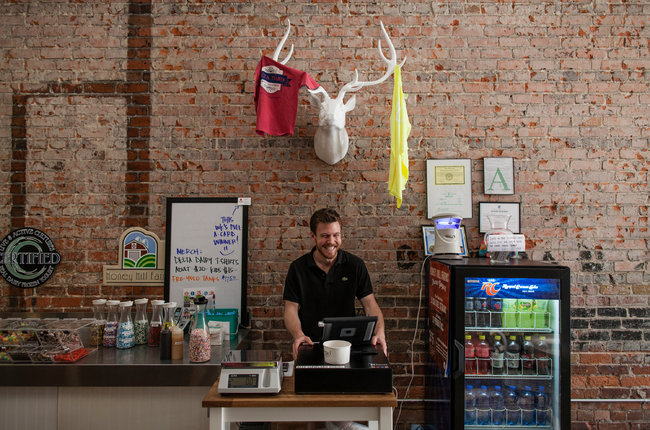
Matty Bengloff, who grew up in Manhattan, in his frozen yogurt shop in Cleveland, Miss. The unofficial motto is “Keep Cleveland Boring.”

Read Full Post »