Feeds:
Posts
Comments

Posts Tagged ‘missouri’

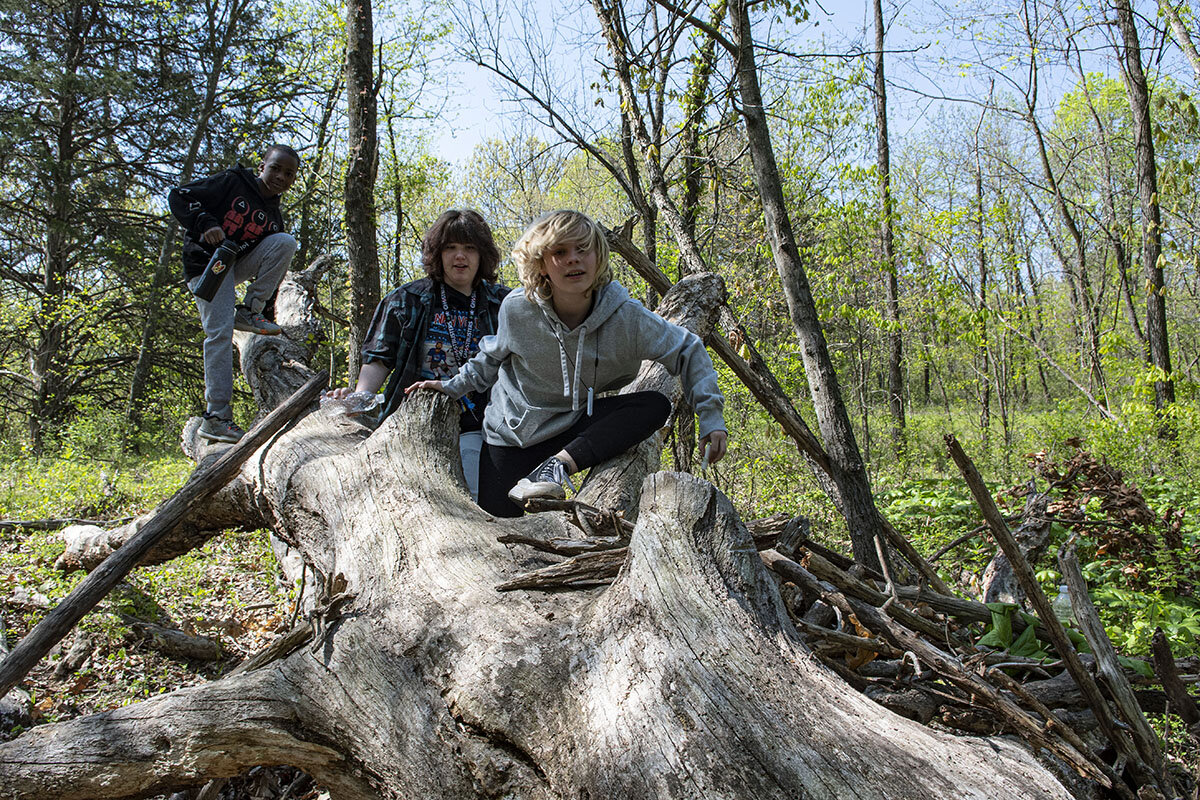
Photo: Alfredo Sosa/CSM Staff.
Students from Thorpe Gordon Elementary in Jefferson City, Missouri, at the Runge Conservation Nature Center in April.

It’s not a new idea, but it’s gaining traction: Getting kids outside into nature benefits their learning.

Jackie Valley writes at the Christian Science Monitor, “Down a hiking path and through the woods, giggles and chatter echo from a clearing where elementary students have just finished constructing makeshift shelters.

The challenge blended environment with engineering, hence this visit to the Runge Nature Center from third, fourth, and fifth graders. They’re part of a STEM (science, technology, engineering, and math) club at nearby Thorpe Gordon Elementary in Jefferson City, Missouri. …

“A boy announces he saw a turkey, while another student proclaims ‘teamwork’ her favorite part. The scene portrays what conservation leaders and educators in Missouri are hoping to instill in the state’s youngest residents: an appreciation for the outdoors, a new experience, and some learning along the way.

“ ‘I think it’s so important,” says Melanie Thompson, a librarian from the elementary school who’s leading the STEM group on this day. ‘Kids don’t spend enough time playing outside.’

“In Missouri, efforts to connect children with nature date back to 1939. That’s when the Nature Knights program launched, giving children recognition for conservation practices. Three years earlier, the state’s residents approved an amendment that created an apolitical conservation agency.

“Today, terms such as nature education, outdoor learning, and environmental education refer to instruction that, in many ways, takes students out of traditional classroom settings. Subtle nuances exist, though, depending on the location and programming. The Environmental Protection Agency defines environmental education as a type of learning that allows people to ‘explore environmental issues, engage in problem solving, and take action to improve the environment’ – while also not advocating a particular viewpoint.

“The Missouri Department of Conservation, meanwhile, sees nature education as a way to ‘inspire and educate individuals about nature so they appreciate and ultimately protect our resources and wild places,’ says Brian Flowers, a regional supervisor for the agency’s education branch. …

“ ‘You introduce them to it,’ says Mr. Flowers, referring to conservation, natural resources, and wildlife. ‘You show them why it’s important, and, eventually, that leads to that they care about it. They protect it.’

“A study called The Nature of Americans, conducted in 2015 and 2016, found that more than 80% of children surveyed said time in nature made them feel creative, happy, healthy, and smarter. …

“ ‘Once they’re there, there’s so much that happens – curiosity and creativity and just enjoyment of being outside,’ [Megan Willig, a program coordinator for the National Environmental Education Foundation] says. It can also introduce students to career pathways in the natural resource, conservation, and STEM fields.

“In a grassy field not far from an elderberry patch, a sustainably designed building with large windows and a gently sloping roofline is under construction. It’s the future Boone County Nature School, which occupies land in the Three Creeks Conservation Area and will welcome a rotating cast of 12,000 to 13,000 students each year, says Mr. Flowers.

“The project represents a partnership among the Missouri Department of Conservation, Columbia Public Schools, community organizations, and other school districts in Boone County.

“Columbia Public Schools has hired a teacher to lead instructional efforts at the Boone County Nature School, which fits into the district’s overall mission to pour more resources into place-based learning, says Michelle Baumstark, the chief communications officer. About half of the district’s students qualify for free or reduced-price lunch.

“ ‘These may not be experiences that they would have any other way and when you can create an access to an enriching opportunity, that can change the trajectory of a kid,’ she says.

“The land surrounding the nature school will feature a food forest, pollinator plots, a prairie restoration area, trails, a pavilion, and a council house with three tiers of stadium seating. The karst topography of the conservation area – caves, springs, and hills – is typically only found in southern Missouri near the Ozarks, making it an ideal exploration area for local children, Mr. Flowers says. …

“The Missouri Department of Conservation also operates programs that teach students archery and how to fish, among other things. And, in St. Louis, pavement will be removed and replaced with a green schoolyard at Froebel Literacy Academy. Picture a park-like setting with trees and wildflowers, where students can play and learn through STEM activities.

“The schoolyard project represents a step toward outdoor equity for children who grow up in urban areas that have more concrete and asphalt than lush, green recreation space, says Aaron Jeffries, deputy director of the Missouri Department of Conservation. …

“There’s no national standard for outdoor learning or environmental education, says Ms. Willig of NEEF, which was congressionally chartered in 1990 to complement the work of the EPA. So efforts differ by state and local jurisdiction, though she has seen more interest in making it a formal part of the curriculum.

“If barriers such as time or transportation exist, Ms. Willig recommends that school systems seek community partnerships. For instance, a local nonprofit that supports watershed health, she says, may be keen on helping with programming.

“ ‘The school doesn’t need to reinvent the wheel or start from scratch,’ she says.”

More at the Monitor, here. No firewall, nice pictures.

You can read another of my posts on kids benefiting from nature at school, here.

Read Full Post »

Did you read the Ancient Greek tragedy Antigone, by Sophocles, in school? I was actually in a college production — performed in Greek. It was much too hard for me, even with my bit part.

But in high school, the play really captured my imagination with its young heroine insisting that the higher laws required her to give her rebel brother a proper burial and the king determined to make an example of rebels.

Anyway, that’s how I remember dinner discussions — my aunt and uncle arguing for the power of the state and me arguing for rebels.

So you may imagine how intrigued I was when I saw that a theater troop was enlisting big stars to bring Antigone (in English) to Ferguson, Missouri, to generate a community dialogue. Ferguson was where the majority of Americans first became aware of the issues that have led to the Black Lives Matter movement.

National Public Radio alerted listeners to the event, here.

“WILLIS RYDER ARNOLD (REPORTER): Bryan Doerries is a director who puts on ancient Greek plays. He says his productions aren’t boring classroom exercises.

“BRYAN DOERRIES: These are readings on steroids, and spit is flying and tears are projectile crying off the stage, and sounds are coming up out of the actors that they’ve never heard themselves make before.

“ARNOLD: After the performance, Doerries asks the audience to react. He leads a conversation that can take as long as the actual play. For him, the performance is a chance to ask some deeper questions.

“DOERRIES: How many different ways can we give you, as the audience, permission to have a conversation that wouldn’t otherwise be possible, to speak your personal truths, to be acknowledged and heard?

“ARNOLD: A local resident urged Doerries to bring his project to Ferguson. Doerries will present ‘Antigone.’ ”

The plan for “Antigone in Ferguson,” developed by Outside the Wire and the PopTech Institute, and co-presented by the Onassis Foundation USA, was as follows:

“Screening of selected segments from the documentary Antigone in Ferguson, followed by a dramatic reading of scenes from Antigone with Reg E. Cathey (House of Cards, The Wire), Gloria Reuben (ER), Glenn Davis (24, The Unit), and Samira Wiley (Orange Is the New Black).

“The reading will be followed by a town hall discussion, framed by remarks from community panelists — including members of law enforcement, activists, and concerned citizens — facilitated by Bryan Doerries, with the goal of generating powerful dialogue and fostering compassion, understanding, and positive action.”

I managed to find twitter reactions the day after the Sept. 17 performance:

Sep 18 Amazing! brought the community together through art and our own human experiences!
Sep 18 All of tonight’s was incredible. Thank you . Wow.
Sep 17 I wish everyone I know could have been at the reading of Antigone in Ferguson by . Church choir as Greek chorus? Amen

Read Full Post »

You never know what you will pick up from twitter. I started following Ferguson Library tweets after the death of Michael Brown. The library has wonderful tidbits about books, among other topics.

A tweeted tidbit on the antiquity of fairy tales is from Science magazine.

David Shultz writes, “A new study, which treats these fables like an evolving species, finds that some may have originated as long as 6000 years ago.

“The basis for the new study, published in Royal Society Open Science, is a massive online repository of more than 2000 distinct tales from different Indo-European cultures known as the Aarne–Thompson–Uther Index, which was compiled in 2004. Although not all researchers agree on the specifics, all modern Indo-European cultures (encompassing all of Europe and much of Asia) descended from the Proto-Indo-European people who lived during the Neolithic Period (10,200 B.C.E.–2000 B.C.E.) in Eastern Europe. Much of the world’s modern language is thought to have evolved from them.

“To conduct the study, Jamshid Tehrani, an anthropologist at Durham University in the United Kingdom, and colleagues scanned the repository. They limited their analysis to tales that contained magic and supernatural elements because this category contained nearly all the famous tales people are familiar with. This narrowed the sample size to 275 stories, including classics such as Hansel and Gretel and Beauty and the Beast. …

“Tehrani says that the successful fairy tales may persist because they’re ‘minimally counterintuitive narratives.’ That means they all contain some cognitively dissonant elements—like fantastic creatures or magic—but are mostly easy to comprehend.

“Beauty and the Beast, for example contains a man who has been magically transformed into a hideous creature, but it also tells a simple story about family, romance, and not judging people based on appearance. The fantasy makes these tales stand out, but the ordinary elements make them easy to understand and remember. This combination of strange, but not too strange, Tehrani says, may be the key to their persistence across millennia.”

More.

(from a Ferguson Library tweet)

An illustration of Beauty and the Beast from 1913.

Read Full Post »

icki Houska is a woman of many gifts. But one of the first things that her friends and colleagues will tell you about her is that she is a hugger.

“ ‘No one leaves her without a hug and a smile,’ says Michelle Barron, a work crew supervisor for the St. Charles County Juvenile Justice Center. …

“On this busy Saturday, though, Ms. Houska is getting ready to dispense more than just hugs. She’s moving briskly through the jampacked rented rooms that house the operation she runs for FAST (Foster Adoption Support Team), a support organization for foster and foster adoptive families caring for children who are wards of the state of Missouri.

“Houska’s making sure that packages of frozen pork chops, fresh loaves of bread, and tiny snowsuits are all properly shelved and stacked, ready for the families who are about to arrive and lay claim to them. …

“A foster parent herself since 1998, she has fostered 12 children over the years and, of those 12, adopted three. ‘It’s the hardest thing you’ll ever do,’ she says of foster parenting. The emotional challenges ‘will bring you to your knees.’

“But one thing that doesn’t have to be so hard on foster parents, she decided some years ago, is the financial burden. …

“Foster families are expected to provide food, clothing, and household items like toothbrushes and hairbrushes, and to cover school expenses and any additional treats, lessons, or outings.

“From her own experiences and those of other foster families she has met, Houska came to feel that financial challenges were one of the biggest obstacles to the foster-parenting experience. So in 2005, to help alleviate the strain, she lined her own basement with industrial freezers and shelving, sought out donations, and began distributing food, diapers, and toiletries each Saturday, free to all local foster families. …

“Eventually, the OASIS Food Pantry, a local nonprofit, notified Houska that it had rental space available near its own operation in a nearby strip mall. …

“Houska’s pantry offers not only household items but emotional and social support. …

“Foster families arrange play dates, with pickups and drop-offs scheduled at the food pantry. Sometimes, for siblings who have been assigned to separate families, a trip to the food pantry is a chance to reunite in the pantry’s backyard, where the children are invited to romp on the playground equipment donated by a local church and other well-wishers. …

“ ‘Poverty doesn’t take a vacation,’ [Houska] says. ‘Kids in need don’t take a vacation. So neither do I.’ ”

Read what happened to Houska at age 21 that is one reason she is so dedicated, here.

Read Full Post »

Panera Bread has set up a foundation to fund Panera Cares, a pay-what-you-can opportunity for buying baked goods, sandwiches, and meals.

“The concept was born during the tough days of the recession. [Panera co-chief executive Ron] Shaich saw a television story about a cafe in Colorado that fed everyone at whatever price they could afford, which he said inspired him to find ways for Panera to address ‘food insecurity.’ …

“By May 2010, the first Panera Cares had opened in Clayton, Mo., a suburb of St. Louis. For the first one and others since then in Dearborn, Mich., Portland, Ore., and Chicago, Panera Cares sought locations that are easily accessible by public transportation and that attract economically diverse customers. …

“Panera’s vendors contributed to the [Boston] effort, giving about $80,000 worth of free furniture and lighting, along with cameras and and coffee. The rest of the money needed to open the store, an estimated $1 million, is being absorbed by Panera Bread’s corporate operations.

“ ‘It is a community cafe of shared responsibility,’ [Kate Antonacci, project manager of Panera Cares] said. ‘One of the goals of this charitable program is to help ensure that everyone who needs a meal gets one and to raise the level of awareness about food insecurity in the country.”

The Boston Globe’s Jenn Abelson has more here, with a follow-up on the successful first week in Boston, here. See the Christian Science Monitor‘s take, here.

Will you go? Will you pay full price or a bit more for others?

Photograph: John Tlumacki / Globe Staff
The Panera Cares Community Cafe opened in Center Plaza on January 24 with a pay-as-you-can approach.

Read Full Post »