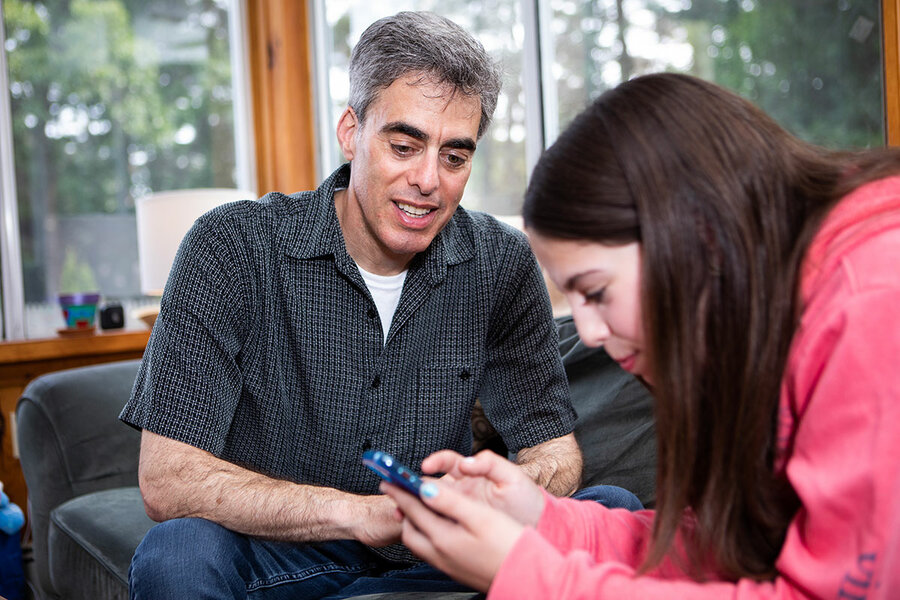
Photo: Melanie Stetson Freeman/CMS Staff.
Andy Saks of Southborough, Massachusetts, says he is concerned about the constant presence of technology and its effect on children’s minds. His daughter Cara got an iPhone only after negotiating limits on social media use with her parents.
Our oldest grandson turned 13 this year and was able to get a phone, the first of our grandchildren to do so. He was already using an iPod for many of the same purposes and took a lot of nice pictures with it, so he wasn’t a neophyte. But as American children seem to get phones at younger and younger ages, his parents decided to go slowly.
Other parents are exercising caution, too, as Sophie Hills reports at the Christian Science Monitor.
She writes, “When Tanvi Chawla got a phone in fifth grade, she wanted access to ‘everything’ – all social media. But her parents said no until she was 13. Now in 10th grade at an all-girls school in Pasadena, California, Tanvi’s views on social media have almost entirely reversed.
“In early 2020, when Tanvi – along with the rest of the world – found herself stuck at home, social media became her ‘entire life,’ she says. ‘I didn’t post much but it was a means of communication with my friends.’ …
“But after a few months of life online, Tanvi deleted Instagram in the beginning of eighth grade. She hasn’t replaced it with any other social media. ‘I just saw how harmful it was to my mental health and I think it was negatively impacting my peers, too,’ she says. ‘So I made that decision for myself to stop using it.’ …
“Many students enter high school with their phones seemingly glued to the palms of their hands. And rates of anxiety and depression, particularly among girls, have skyrocketed since 2010.
“ ‘[Technology] is just so present that it’s impossible to completely disconnect and function for many people,’ says Liz Kolb, a clinical professor of education technologies and teacher education at the University of Michigan. …
“As a teacher, Ms. Kolb understands the inclination to go straight to cellphone bans. But whether a school bans phones or not, it’s worth taking the time to teach students good habits, she says. …
“In May, the U.S. surgeon general issued a public warning about the risks posed by social media to youth mental health. … A new poll found that most Americans, regardless of age, would like to return to a time when society was unplugged. The desire was highest among Americans ages 35-54 (77%), but 63% of 18- to 34-year-olds said they’d prefer to live in a simpler era, too.
In Ireland, parents and schools in the town of Greystones implemented a townwide voluntary cellphone ban for children.
“Rachel Harper, principal of St. Patrick’s primary school in Greystones, has noticed increasing anxiety among her 8-, 9-, and 10-year-old students. Parents report the same, adding that it’s hard to get their kids to sleep at night. Students are concerned about their bodies and self-image in a way Ms. Harper hasn’t noticed in that age group before. …
“Both parents and teachers are concerned for students’ online safety. ‘They’re just not emotionally ready to maneuver everything on a smart device,’ she explains.
“So she reached out to the principals of the other seven schools in Greystones. Together with parents, they started a community-led initiative to shelter children by agreeing that, across the town, students wouldn’t have phones until after primary school.
“The collective effort makes all the difference, says Ms. Harper. ‘From a kid’s point of view, there’s that sense of fairness, that it’s not just them’ without a phone.
“The voluntary ban has attracted positive attention from all around the world, says Ms. Harper. She’s heard from many educators saying they’ve wished to implement a similar approach in their schools, though they didn’t think it was possible. …
“The Buxton School, a private day and boarding school in northwestern Massachusetts, last year banned cellphones entirely during the semester. Buxton offered students an alternative: the Light Phone, which texts, calls, and offers basic functions like a calculator, but has no capacity for email or accessing the internet.
“After one full school year, the experiment appears ‘largely successful,’ says assistant head of school John Kalapos, who also teaches English and wood shop. … Students do say they want to be on their phones less, he says, though not all of them love Buxton’s no-smartphone policy. …
“When students’ whole lives suddenly shifted online in 2020, Mr. Kalapos became much more aware of cyberbullying. It tends to be based on exclusion, which is challenging for teachers to mediate when it takes place in the form of ‘likes’ – or the lack thereof – online.
“It’s countercultural to not have a smartphone, says Joe Hollier, co-founder of Light. And while something like the Light Phone is a useful product, actually cutting back on technology exposure ‘takes user will.’
“Fear of missing out is what prevents most people – himself included – from moving away from smartphones, says Mr. Kalapos of the Buxton school. But once you do it, ‘you realize it’s not as valuable as you think.’ ”
In the anecdote from Ireland, kids were glad that it wasn’t just their school setting limits. All the schools in town did it. The importance of fairness made me think. Real fairness would involve parents agreeing to phone restrictions, too — maybe certain times of day when no one in the family uses their phone. What about that?
More at the Monitor, here. No firewall. Subscriptions encouraged.



 Suzanne's Mom's Blog