Feeds:
Posts
Comments

Posts Tagged ‘modern art’

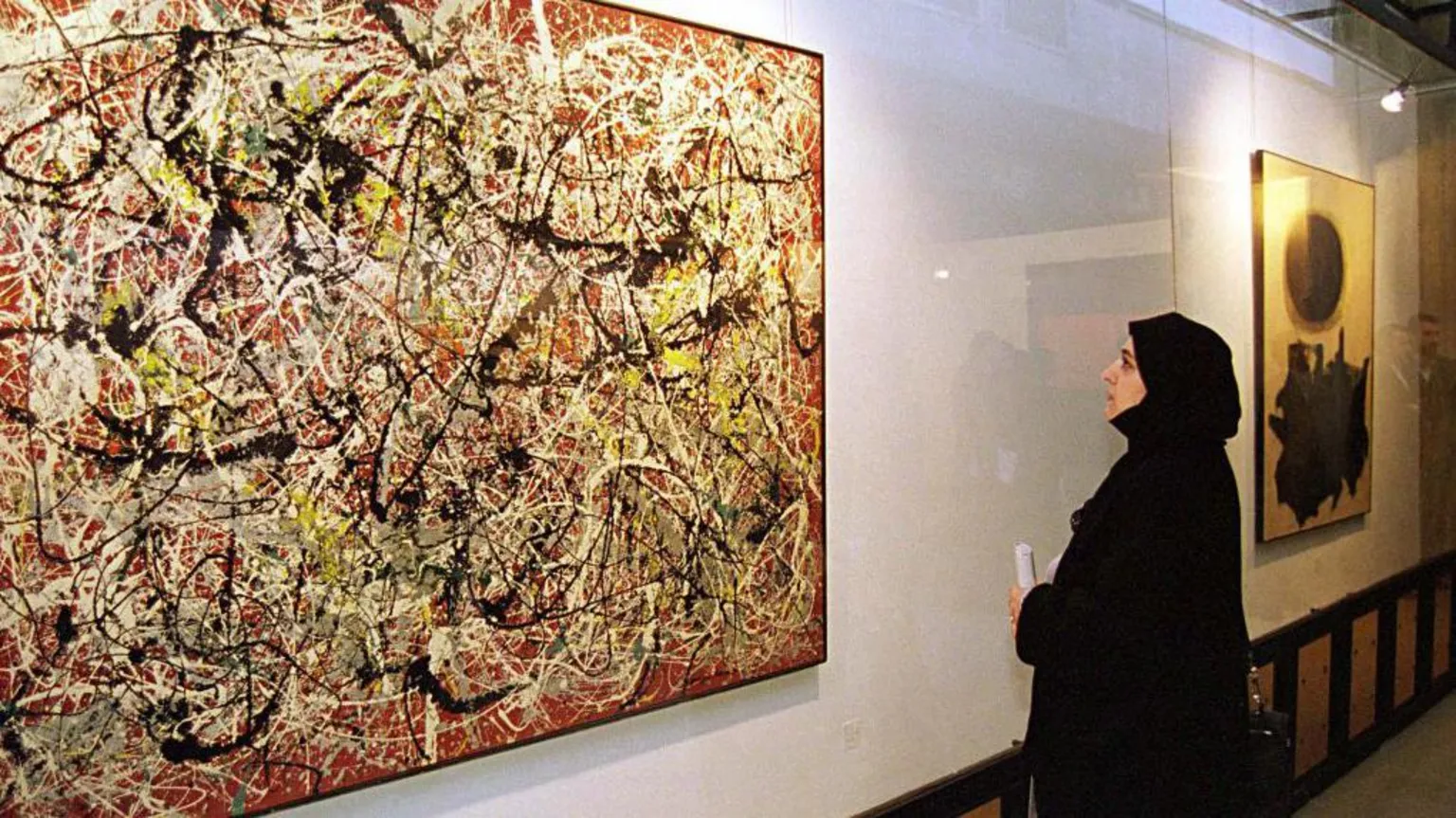
Photo: Kaveh Kazemi/Getty Images.
The family of Iran’s former shah collected modern art, including Jackson Pollock’s “Mural On Indian Red Ground.”

A recent BBC story about modern art in Iran (modern like Picasso, Jackson Pollock) took me by surprise. There is so much we don’t know about other countries — especially “enemy” countries.

The art described was collected by the Westernized, pre-Ayatollah Pahlavi family, but what’s interesting to me is the enthusiasm of contemporary Iranians — and the fact they’re allowed to see it.

Armen Nersessian writes, “It has been dubbed one of the world’s rarest treasure troves of art but few people outside its host country know about it. For decades, masterpieces by the likes of Pablo Picasso, Vincent Van Gogh, Andy Warhol and Jackson Pollock have been kept in the basement of a museum in Iran’s capital Tehran, shrouded in mystery. …

“Only a small portion of the work has been exhibited since the 1979 Iranian Revolution but in recent years, the Tehran Museum of Contemporary Art has been showcasing some of its most captivating pieces.

The Eye to Eye exhibition at the Tehran Museum of Contemporary Art, which opened in October 2024, was extended twice due to overwhelming public demand, running until January 2025.

“The display was widely regarded as one of the most significant exhibitions in the history of the museum, and it also became its most visited. …

“Among the artwork is Warhol’s portrait of Farah Pahlavi – Iran’s last queen – a rare piece blending his pop art flair with Iranian cultural history. Elsewhere, Francis Bacon’s work called ‘Two Figures Lying on a Bed with Attendants’ shows figures appearing to spy on two naked men lying on a bed.

“On the opposite wall in the basement of the museum, a portrait of Ayatollah Ruhollah Khomeini, the founder of the Islamic Republic of Iran, is on display in juxtaposition.

“The museum was built in 1977 under the patronage of Pahlavi, the exiled widow of the last Shah of Iran who was overthrown during the revolution. Pahlavi was a passionate art advocate and her cousin, architect Kamran Diba, designed the museum.

“It was established to introduce modern art to Iranians and to bridge Iran closer to the international art scene.

“The museum soon became home to a stunning array of works by luminaries including Picasso, Warhol and Salvador Dali, alongside pieces by leading Iranian modernists, and quickly established itself as a beacon of cultural exchange and artistic ambition.

“But then came the 1979 revolution. Iran became an Islamic republic as the monarchy was overthrown and clerics assumed political control under Ayatollah Khomeini. Many artworks were deemed inappropriate for public display because of nudity, religious sensitivities or political implications.

“Pierre-Auguste Renoir’s ‘Gabrielle with Open Blouse’ was deemed too scandalous. And Warhol’s portrait of the former queen of Iran was too political. In fact, Pahlavi’s portrait was vandalized and torn apart with a knife during the revolutionary turmoil.

“After the revolution, many of the artworks were locked away, collecting dust in a basement that became the stuff of art world legend. It was only in the late 1990s that the museum reclaimed its cultural significance during the reformist presidency of Mohammad Khatami. …

“Some pieces were loaned to major exhibitions in Europe and the United States, briefly reconnecting the collection with the global art world.

“Hamid Keshmirshekan, an art historian based in London, has studied the collection and calls it ‘one of the rarest treasure troves of modern art outside the West.’

“The collection includes Henry’s Moore’s ‘Reclining Figure’ series – an iconic piece by one of Britain’s most celebrated sculptors – and Jackson Pollock’s ‘Mural on Indian Red Ground.’ …

“Picasso’s ‘The Painter and His Model’ – his largest canvas from 1927 – also features, a strong example of his abstract works from the post-cubism period. And there is Van Gogh’s ‘At Eternity’s Gate’ – one of the very rare survivals of his first printmaking campaign during which he produced six lithographs in November 1882. …

“Challenges remain for the museum which operates under a tight budget. Shifting political priorities mean that it often functions more as a cultural hub than a traditional museum. Yet it continues to be a remarkable institution — an unlikely guardian of modern art masterpieces in the heart of Tehran.”

More at the BBC, here.
Read Full Post »

6000

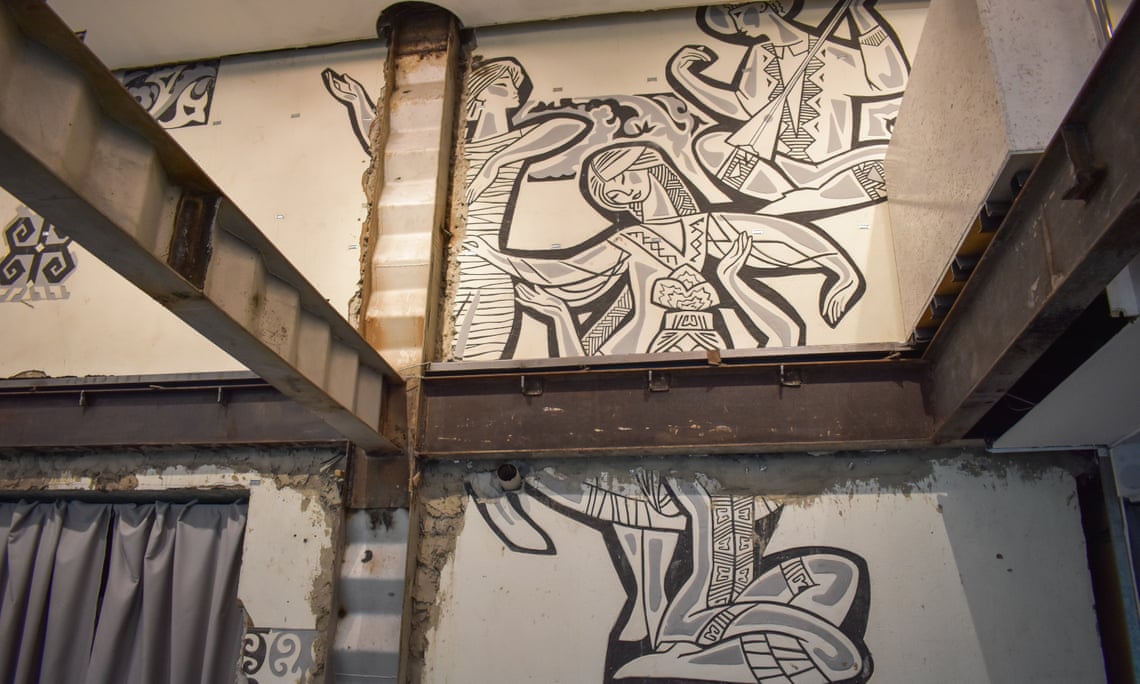
Photo: Daryl Mersom
A piece of a sgraffito by the Kazakhstan graphic artist Eugeny Sidorkin (1930-1982) was discovered behind a wall at a cinema in the former Kazakhstan capital. 

Modern art was considered degenerate in the former Soviet Union. It was dangerous to make it, dangerous to own it. Much was destroyed.

But as I wrote in this 2011 post about the wily collector of the “Desert of Forbidden Art” documentary, it could be hidden away in Central Asia without Moscow noticing.

More recently, approved Soviet art, no longer popular, was revealed behind a cinema wall in Almaty, the former capital of Kazakhstan. Nothing is ever completely lost.

Daryl Mersom wrote at the Guardian, “When Jama Nurkalieva and a small group of colleagues conducted a site survey of a disused Soviet-era panoramic cinema in Almaty, the former capital of Kazakhstan, they had no idea what lay behind the internal plasterboard wall that faces out towards the street – until someone spotted a narrow gap.

“As the caretaker shined a light into the darkness behind, the group caught a glimpse of a man’s head. Out came the toolbox and the rest of the artwork was slowly revealed: a Soviet-era sgraffito by the graphic artist Eugeny Sidorkin that had been lost and forgotten for decades.

“From the Italian graffiare, to scratch, sgraffito is a technique that involves placing one layer of plaster or cement over another, and then scratching through the superficial layer to reveal contours or patterns beneath.

“Built to a standardised design in 1964, the cinema was one of the largest in the USSR. It was fronted entirely by large panels of glass that offered an unobstructed view of the sgraffito to passersby. …

“While there is little incentive now to cover or remove Soviet-era artworks depicting folklore and natural landscapes, they were sometimes controversial in their day due to supposed hidden meanings.

“Ekaterina Golovatyuk, curator of an exhibition on Soviet modernist architecture at the Tselinny, recounts an anecdote in which an architect and an artist worked together to create a mosaic for a cafe. It was a straightforward depiction of a lake with a tiger on one side and goats on the other. ‘The [local communist] party was asking them, “What’s the meaning of this?” They were saying, “Nothing, it’s just a natural landscape” – but they couldn’t convince them that there was no hidden political message.’

“Golovatyuk believes Almaty has as many surviving mosaics as it does because Kazakhstan’s president, Nursultan Nazarbayev, changed the country’s capital from Almaty to Astana in 1997.

“With much of the country’s subsequent investment and development directed at this new ‘city of the steppes,’ Almaty escaped relatively unchanged.”

More at the Guardian, here. It’s interesting that although “degenerate” art is now accepted, actual Soviet art is forbidden in former Soviet republics relieved to be free of the yoke of communism. If you want to see the Lenin mosaic in Almaty, hidden behind a curtain, you have to make an appointment.

As the 16th century poet says, “Times Go By Turns.”

Read Full Post »

Today it’s a bit hard to imagine Cezanne, Matisse, Duchamp, and Van Gogh shocking anyone, but at the Armory art show in New York City 100 years ago, they did. Tom Vitale at National Public Radio has the story.

“On Feb. 17, 1913, an art exhibition opened in New York City that shocked the country, changed our perception of beauty and had a profound effect on artists and collectors.

“The International Exhibition of Modern Art — which came to be known, simply, as the Armory Show — marked the dawn of Modernism in America. It was the first time the phrase ‘avant-garde’ was used to describe painting and sculpture. …

“It was the Europeans — Van Gogh, Gauguin, Cezanne, Picasso, Matisse, Duchamp — that caused a sensation.

“American audiences were used to seeing Rembrandts and Titians in their galleries — ‘a very realistic type of art,’ says Marilyn Kushner, the co-curator of an exhibition called ‘The Armory Show at 100’ that opens in October at the New York Historical Society. …

“The most talked-about painting in the 1913 Armory Show deconstructed a human figure in abstract brown panels in overlapping motion. Marcel Duchamp’s Cubist-inspired Nude Descending a Staircase was famously described by one critic as ‘an explosion in a shingle factory.’

“In 1963, on the 50th anniversary of the Armory Show, Duchamp was interviewed by CBS reporter Charles Collingwood. The audio is now at the Smithsonian’s Archive of American Art.

“When Collingwood asked Duchamp if he had realized that the piece would create ‘such a “furor,” ‘ the artist responded: “Not the slightest.” …

“Duchamp went on in the 1963 interview to say that, at the time, artists had lost the ability to surprise the public.

” ‘There’s a public to receive it today that did not exist then. Cubism was sort of forced upon the public to reject it. You know what I mean?’ Duchamp said. ‘Instead, today, any new movement is almost accepted before it started. See, there’s no more element of shock anymore.’ ” More.

Photograph: Marcel Duchamp’s Cubist-inspired Nude Descending a Staircase was famously described by one critic as “an explosion in a shingle factory.” (Copyright succession Marcel Duchamp / ADAGP, Paris / Artists Rights Society (ARS), New York 2013)

Read Full Post »