Feeds:
Posts
Comments

Posts Tagged ‘tehran’

Photo: Nicola Forenza/Alamy.
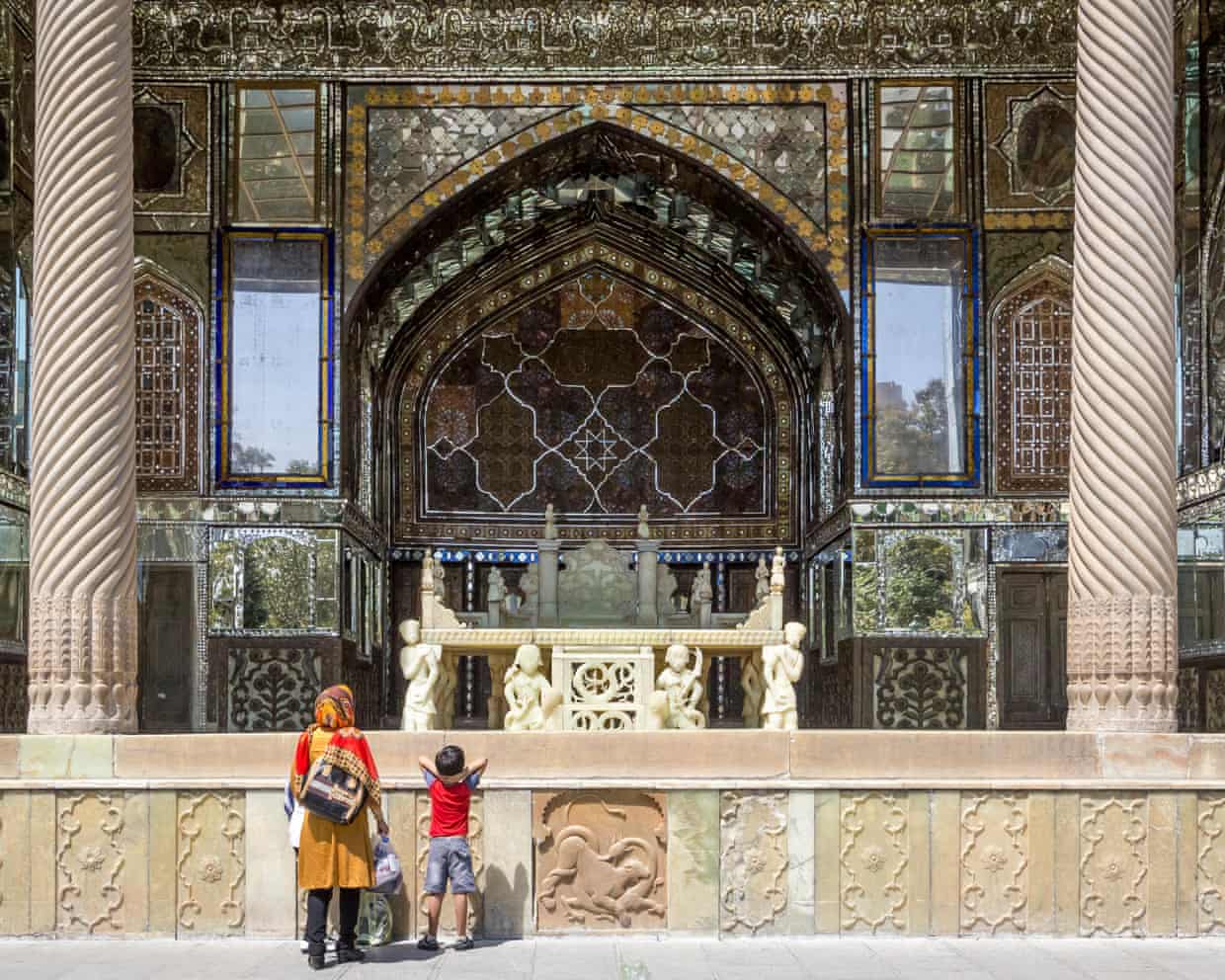
Iran’s Golestan Palace photographed in 2016. This Unesco World Heritage site has been damaged in the latest war.

I once read a wonderful book by Jason Elliot about his travels in Iran, highlighting the country’s art and architecture. So it makes me sad to read today’s story. How do you protect beauty in wartime?

Julian Borger and Deepa Parent are reporting at the Guardian that Golestan Palace, a world heritage site in Tehran, has been damaged in the new war despite Unesco sending coordinates. A palace in Isfahan also suffered.

“The most serious confirmed damage to date has been to Tehran’s Golestan Palace, dating to the 14th century, and the 17th-century Chehel Sotoon Palace in Isfahan. Judging from videos and public statements, neither historic building was hit by a missile directly but the shock wave from nearby blasts and possibly some missile debris shattered glass and brought down tiles and masonry.

“Video from the scene showed that Golestan Palace’s celebrated hall of mirrors had been shattered, with shards of intricate mirrorwork scattered across its floor.

“The palace is a world heritage site under the protection of the UN’s cultural body, Unesco, which issued a statement of concern after it was damaged on 2 March. …

“Iran’s foreign minister, Abbas Araghchi, criticised Unesco for not being more vociferous. …

“One of the damaged sites was Falak-ol-Aflak Castle in the city of Khorramabad, in Lorestan province. According to the head of the province’s heritage department, Ata Hassanpour, a strike hit the castle’s perimeter on Sunday, destroying his department’s offices as well as adjacent archaeological and anthropological museums, and injuring five members of staff.

“ ‘Fortunately, the main structure of Falak-ol-Aflak Castle was not damaged,’ Hassanpour said in a statement posted on the Telegram messaging platform.

“Cultural treasures in Kurdistan province in north-west Iran were also affected, according to local media. In Sanandaj, the country’s second biggest Kurdish city, reports said the 19th-century Salar Saeed and Asef Vaziri mansions, which serve as Kurdish museums and heritage sites, had suffered damage to their doors and intricate stained-glass windows.

“In the past few days, there have been major explosions in the centre of Isfahan, Iran’s capital in three historical eras, where much of the architecture dates back to the Safavid dynasty era, from the 16th to 18th centuries.

“Chehel Sotoon suffered the worst impact but broken windows and doors, as well as dislodged tilework, have been reported in the Ali Qapu Palace and several mosques around the vast Naqsh-e Jahan Square. Videos filmed by residents from inside the square showed plumes of smoke rising from nearby airstrikes.

“The Isfahan governor, Mehdi Jamalinejad, said the damage had been inflicted even after coordinates of the historic sites had been circulated among the warring parties and after blue shield signs – denoting historical treasures under the 1954 Hague convention for the protection of cultural objects in war – had been put on the roofs of important buildings.

“ ‘Isfahan is not an ordinary city, it’s a museum without a roof,’ Jamalinejad said in a speech posted on social media. ‘In none of the previous eras, not in the Afghan wars, not in the Moghul conquest, not even during [the 1980-88 Iran-Iraq war] was this ever done.’ …

“An Iranian geologist who worked in Isfahan for many years said in a message forwarded to the Guardian that the ancient capital was particularly vulnerable. ‘Isfahan has long been attacked from below, by land subsidence that is destroying the Safavid-era structures, and now from the above, by the Americans,’ the geologist said. ‘Isfahan seems to have fewer friends than ever today.’

“The US Committee of the Blue Shield, a not-for-profit organization dedicated to upholding the Hague convention, issued a statement saying that Iran’s historic sites ‘belong not only to the Iranian people, but to all of humanity.’ The organization said it was ‘disturbed’ by the US defense secretary’s declaration on the third day of the war that there would be no ‘stupid’ rules of engagement.”

Man, who even talks like that? It’s embarrassing.

More at the Guardian, here.
Read Full Post »

Photo: Kaveh Kazemi/Getty Images.
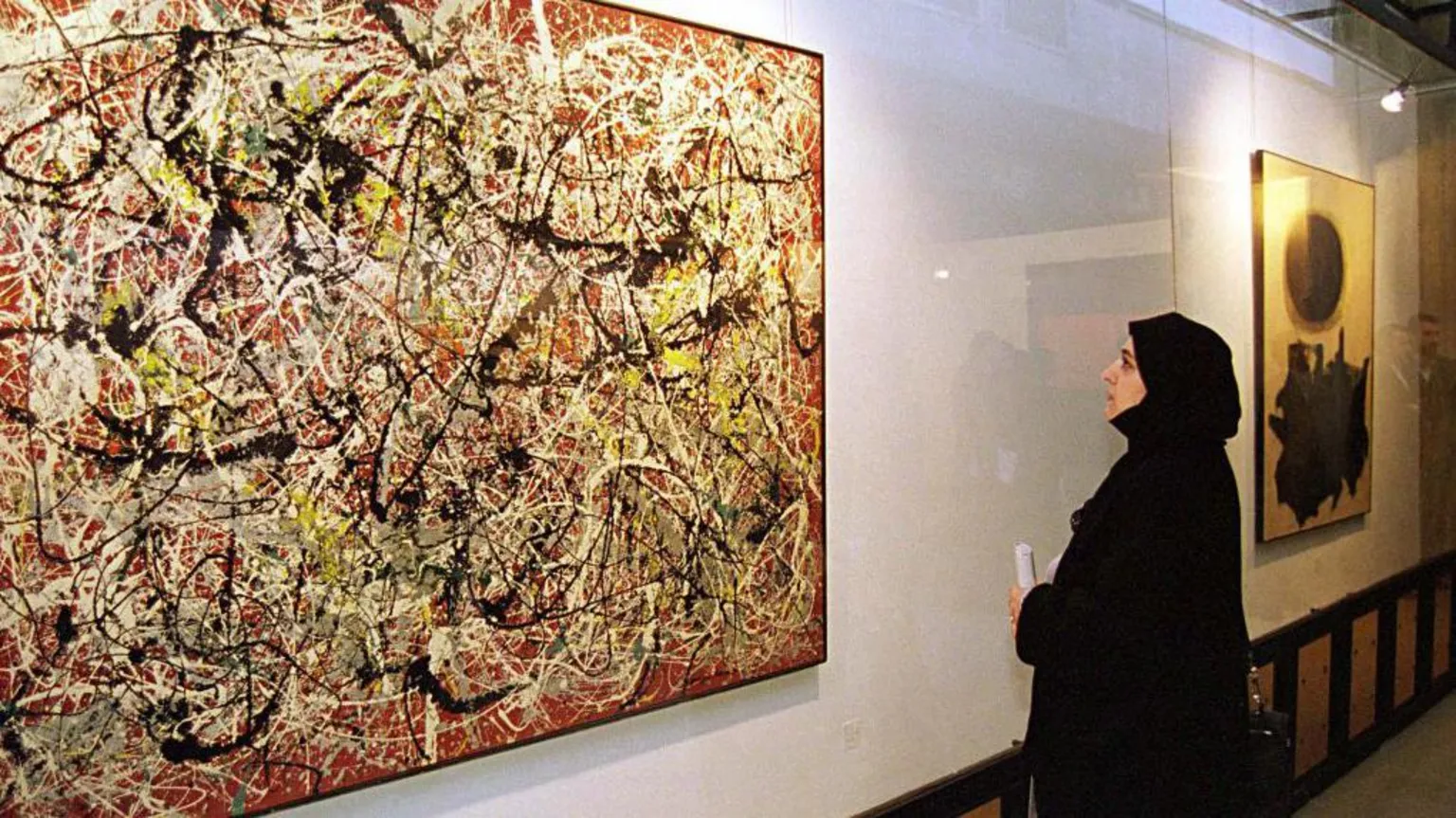
The family of Iran’s former shah collected modern art, including Jackson Pollock’s “Mural On Indian Red Ground.”

A recent BBC story about modern art in Iran (modern like Picasso, Jackson Pollock) took me by surprise. There is so much we don’t know about other countries — especially “enemy” countries.

The art described was collected by the Westernized, pre-Ayatollah Pahlavi family, but what’s interesting to me is the enthusiasm of contemporary Iranians — and the fact they’re allowed to see it.

Armen Nersessian writes, “It has been dubbed one of the world’s rarest treasure troves of art but few people outside its host country know about it. For decades, masterpieces by the likes of Pablo Picasso, Vincent Van Gogh, Andy Warhol and Jackson Pollock have been kept in the basement of a museum in Iran’s capital Tehran, shrouded in mystery. …

“Only a small portion of the work has been exhibited since the 1979 Iranian Revolution but in recent years, the Tehran Museum of Contemporary Art has been showcasing some of its most captivating pieces.

The Eye to Eye exhibition at the Tehran Museum of Contemporary Art, which opened in October 2024, was extended twice due to overwhelming public demand, running until January 2025.

“The display was widely regarded as one of the most significant exhibitions in the history of the museum, and it also became its most visited. …

“Among the artwork is Warhol’s portrait of Farah Pahlavi – Iran’s last queen – a rare piece blending his pop art flair with Iranian cultural history. Elsewhere, Francis Bacon’s work called ‘Two Figures Lying on a Bed with Attendants’ shows figures appearing to spy on two naked men lying on a bed.

“On the opposite wall in the basement of the museum, a portrait of Ayatollah Ruhollah Khomeini, the founder of the Islamic Republic of Iran, is on display in juxtaposition.

“The museum was built in 1977 under the patronage of Pahlavi, the exiled widow of the last Shah of Iran who was overthrown during the revolution. Pahlavi was a passionate art advocate and her cousin, architect Kamran Diba, designed the museum.

“It was established to introduce modern art to Iranians and to bridge Iran closer to the international art scene.

“The museum soon became home to a stunning array of works by luminaries including Picasso, Warhol and Salvador Dali, alongside pieces by leading Iranian modernists, and quickly established itself as a beacon of cultural exchange and artistic ambition.

“But then came the 1979 revolution. Iran became an Islamic republic as the monarchy was overthrown and clerics assumed political control under Ayatollah Khomeini. Many artworks were deemed inappropriate for public display because of nudity, religious sensitivities or political implications.

“Pierre-Auguste Renoir’s ‘Gabrielle with Open Blouse’ was deemed too scandalous. And Warhol’s portrait of the former queen of Iran was too political. In fact, Pahlavi’s portrait was vandalized and torn apart with a knife during the revolutionary turmoil.

“After the revolution, many of the artworks were locked away, collecting dust in a basement that became the stuff of art world legend. It was only in the late 1990s that the museum reclaimed its cultural significance during the reformist presidency of Mohammad Khatami. …

“Some pieces were loaned to major exhibitions in Europe and the United States, briefly reconnecting the collection with the global art world.

“Hamid Keshmirshekan, an art historian based in London, has studied the collection and calls it ‘one of the rarest treasure troves of modern art outside the West.’

“The collection includes Henry’s Moore’s ‘Reclining Figure’ series – an iconic piece by one of Britain’s most celebrated sculptors – and Jackson Pollock’s ‘Mural on Indian Red Ground.’ …

“Picasso’s ‘The Painter and His Model’ – his largest canvas from 1927 – also features, a strong example of his abstract works from the post-cubism period. And there is Van Gogh’s ‘At Eternity’s Gate’ – one of the very rare survivals of his first printmaking campaign during which he produced six lithographs in November 1882. …

“Challenges remain for the museum which operates under a tight budget. Shifting political priorities mean that it often functions more as a cultural hub than a traditional museum. Yet it continues to be a remarkable institution — an unlikely guardian of modern art masterpieces in the heart of Tehran.”

More at the BBC, here.

Read Full Post »

I finished Jason Elliot’s book about Iran, Mirrors of the Unseen. It was hard work but rewarding.

I bought the book because I really liked Elliot’s An Unexpected Light about the history, culture, and daily life of Afghanistan back when the mujahideen were still fighting the Soviets. (I’m reasonably sure that Tony Kushner’s prophetic play Homebody/Kabul was partially based on that book.)

Mirrors of the Unseen is a challenging read at times because it is very intellectual. It has lots of words and history and concepts that were new to me, but it also has wonderful stories about the ordinary people Elliot met. Even though he wrote it a few years before the the June 20, 2009, Green Revolution, you can get a sense of the attitudes of normal Iranians and what might have led to the unsuccessful revolt.

Elliot does not focus on politics, but rather on Persian art and architecture, which inspired him at a deep level.

I was reading a passage to my friend Claire on the train, and she said, “No wonder it has taken so long to read! It’s poetry!”

So for my last post on the book, I will give a few examples of Elliot’s style. He describes some English tourists as looking “very sad, and it seemed quite likely they had arrived in Iran by accident, like fish that are said to be swept up in hailstones and deposited hundreds of miles away.”

As he travels toward the southern part of Tehran toward the train station, “the surroundings grew steadily more decrepit, as if an old witch was being shed of her make-up.” And the train itself “had the air of a dragon straining at its leash.”

Here’s my favorite, from a discussion of whether the fascination that all religions seem to have with flame is passed from ancient cultures to modern or is something innate in humans: “Had the sanctity of flame erupted irresistibly into human consciousness as mysteriously as the hexagon into the intelligence of the bee?”

My other posts on the book are here, here, and here.

Read Full Post »