Feeds:
Posts
Comments

Posts Tagged ‘monastery’

Photo: Museo Nacional del Prado, “El Greco. Santo Domingo el Antiguo.”
El Greco’s iconic altarpieces are reunited for the first time in nearly 200 years.

It’s impressive that museums not only preserve the wonders of the past but keep finding pieces of the past and reintroducing them. Consider how the Prado in Spain is currently uniting dispersed panels of El Greco’s first major commission.

Adam Schrader writes at Artnet that an exhibit at Spain’s Prado Museum “brings together the works the Greek painter Doménikos Theotokópoulos, better known as El Greco, completed for the Monastery of Santo Domingo el Antiguo in his first major commission.

“The exhibit reunites works that El Greco, a master of the Spanish Renaissance, made for the church, and marks the first time they have been brought together since their dispersion, thanks to to the loan of the main altarpiece, ‘The Assumption,’ by the Art Institute of Chicago which has owned it since 1906.

“In ‘The Assumption,’ the Virgin Mary ascends to heaven on a crescent moon over Jesus’s open tomb while aided by a group of angels. It has a companion, made for the attic of the altarpiece, titled ‘The Trinity,’ that visually connects above it. …

“In the main altarpiece, ‘The Assumption’ is flanked by four other canvases which depict John the Baptist and St. Bernard on the left side and John the Evangelist and St. Benedict on the right side, which were meant to act as intermediaries between the earthly realm and the divine. Those works are housed at the monastery and in private collections.

“Other works El Greco made for the altarpieces include a depiction of the ‘Adoration of the Shepherds,’ a scene from the nativity; the ‘Resurrection’; and ‘The Holy Face,’ an iconographic depiction of [a legend] in which a woman obtained the ‘true image’ of Jesus from a cloth he had wiped his face on. …

“For the works that are housed at the monastery, a team from the Prado Museum had to convince the nuns to let them borrow the paintings.

” ‘It was difficult,’ Leticia Ruiz, the head of the Prado’s Spanish Renaissance painting collection, told the newspaper. She added that the monastery also lives off of its visitors and from the sale of ‘delicious marzipans’ that they make. So, the museum agreed to restore one of its pieces by the painter Eugenio Cajés in exchange for the loan.

“Funnily, the Prado Museum’s exhibit comes several years after France’s Louvre Museum tried, and failed, to borrow three works by El Greco from them. …

“El Greco was first documented in Spain in June 1577 and quickly received the commission for the new monastery, which was designed and jointly paid for by a powerful dean of the cathedral named Diego de Castilla and a Portuguese woman named Doña María de Silva. According to the museum, the two benefactors were buried at the monastery. The Greek artist was appointed to make the altarpieces at the suggestion of Diego’s son Luis de Castilla, who had met him in Rome a few years earlier. He completed it in 1579.

“ ‘The result could not have been more dazzling. He revealed himself as a perfectly developed artist, with a creative maturity that linked him to some of the best painters of the Italian Renaissance,’ the Prado Museum said on its website.

“ ‘El Greco. Santo Domingo el Antiguo‘ is on view at Museo Nacional del Prado, Madrid, through June 15, 2025.”

Some of El Greco’s works look strikingly modern, and I’m always suprised that they were painted in the 16th century — and especially that patrons back then could appreciate them.

Here’s more from Wikipedia: “El Greco was born in the Kingdom of Candia (modern Crete), which was at that time part of the Republic of Venice, Italy, and the center of Post-Byzantine art. He trained and became a master within that tradition before traveling at age 26 to Venice, as other Greek artists had done. 

“In 1570, he moved to Rome, where he opened a workshop and executed a series of works. During his stay in Italy, El Greco enriched his style with elements of Mannerism and of the Venetian Renaissance taken from a number of great artists of the time, notably Tintoretto and Titian.

“In 1577, he moved to Toledo, Spain, where he lived and worked until his death. In Toledo, El Greco received several major commissions and produced his best-known paintings, such as View of Toledo and Opening of the Fifth Seal. El Greco’s dramatic and expressionistic style was met with puzzlement by his contemporaries but found appreciation by the 20th century.”

More at Artnet, here.

Read Full Post »

Photo: Tulsi Rauniyar.
Climate-ravaged monasteries in Lo Manthang, Tibet, have been meticulously restored by the local community with guidance from experts.

Tulsi Rauniyar wrote recently at the BBC about ordinary Tibetans learning to restore Tibetan monasteries, rescuing them from the consequences of climate change.

“Extreme weather is threatening these intricate 15th Century Tibetan monasteries,” Rauniyar reports, “but local people are rising to the challenge to preserve them.

“Tashi Kunga stands before the Kag Choede monastery, built into the Dhaulagiri mountain range on the Tibet-Nepal border. The monk’s carmine robes glint in the rain, as he recounts the ancient legend of Guru Rinpoche’s battle with a demon.

“The legend goes that centuries ago, a demon wreaked havoc on a monastery in Tibet. Guru Rinpoche chased it south to Upper Mustang in Nepal and defeated the demon following a ferocious battle, burying the demon’s remains across the mountain range. The people of Mustang hono The people of Mustang honoured the sacred grounds by building monasteries atop the demon’s body parts.

” ‘And right on the demon’s heart, the capital of Lo Manthang [was built] in 1380,’ says Kunga, pointing towards the narrow alleys, ancient monasteries, and flat roofs adorned with prayer flags of one of the last medieval walled cities in the world.

“For centuries, Lobas, the indigenous people residing here, have thrived in this remote region situated on top of the Tibetan Plateau. One thing that has remained constant is the monasteries, locally known as ‘Gonpas,’ the most treasured heritage of the region. But almost two decades ago, many of these monasteries, which date back to the 15th Century, started crumbling.

Experts sounded the alarm, attributing the collapse to the severe impacts of climate change. Data indicates a significant increase in the intensity of storms and rainfall across the region. Increased rainfall saturates the rammed-earth buildings, as moisture in the soil is drawn upward into the walls, leading to issues such as leaking roofs and rising damp.

” ‘For us, Buddhists, the paintings and the artifacts in the monasteries are embodiments of the gods themselves, and we can’t worship a half-damaged idol,’ says Kanga.

‘There was no one to repair it. Our heritage was slowly decaying away. We thought the deities were angry.’

“Buddhist monasteries have long been revered as the foundation of Tibetan culture, serving as a vital hub for the creation and safeguarding of both tangible artifacts and profound intellectual traditions. But as unprecedented weather patterns pose a threat to their cultural heritage, local community members have stepped up to restore them. Local people have gained diverse skills, from reinforcing walls to crafting metal statues and restoring paintings.

“Over the past 20 years, a team of local Lobas trained by Western art conservationists have replaced the old, leaky roofs of the temples with round timbers, river stones, and local clay for waterproofing, and have restored the wall paintings, statues, sculpted pillars and the ceiling decorations, giving these centuries-old monuments a new life.

“Luigi Fieni, the lead art conservator at Lo Manthang, has spearheaded the restoration project. Transforming a community of farmers into conservators has been challenging, he says. Most of the Lobas had never held a pen or a paint brush before, and undertook extensive training before they began restoring the 15th Century paintings.

” ‘But it all worked out,’ says Fieni. ‘Tourists visiting Mustang were keenly interested in religion. So we felt these sacred artifacts needed preservation not only for their historical significance but also for sustaining livelihoods here.’

“The team, initially made up of 10 members, has grown to 45 conservators, mostly women, although there was initial reluctance to accept any women in the group. According to local tradition, women are prohibited from touching sacred objects. However, women did eventually take part in the Lo Manthang restoration project.

” ‘It took years of discussion and negotiation with the local clergy and community, but we succeeded in including local women in the wall-painting conservation team,’ says Fieni. …

“Tashi Wangmo, 40, used to spend her time herding yak, collecting and selling herbs, and doing various odd jobs, but it never provided much income. When she received the opportunity to pursue new training and earn a daily wage in the restoration project, she jumped at it.

” ‘It enabled many of us [women] to break free from the limits of our homes, expand our skillsets, and find new opportunities,’ she says.”

More at the BBC, here. No paywall.

If you want to learn about Tibet through some wonderful fiction, check out the Tibet mysteries by Eliot Pattison, starting with The Skull Mantra.

Read Full Post »

Photo: Thanassis Stavrakis/AP.
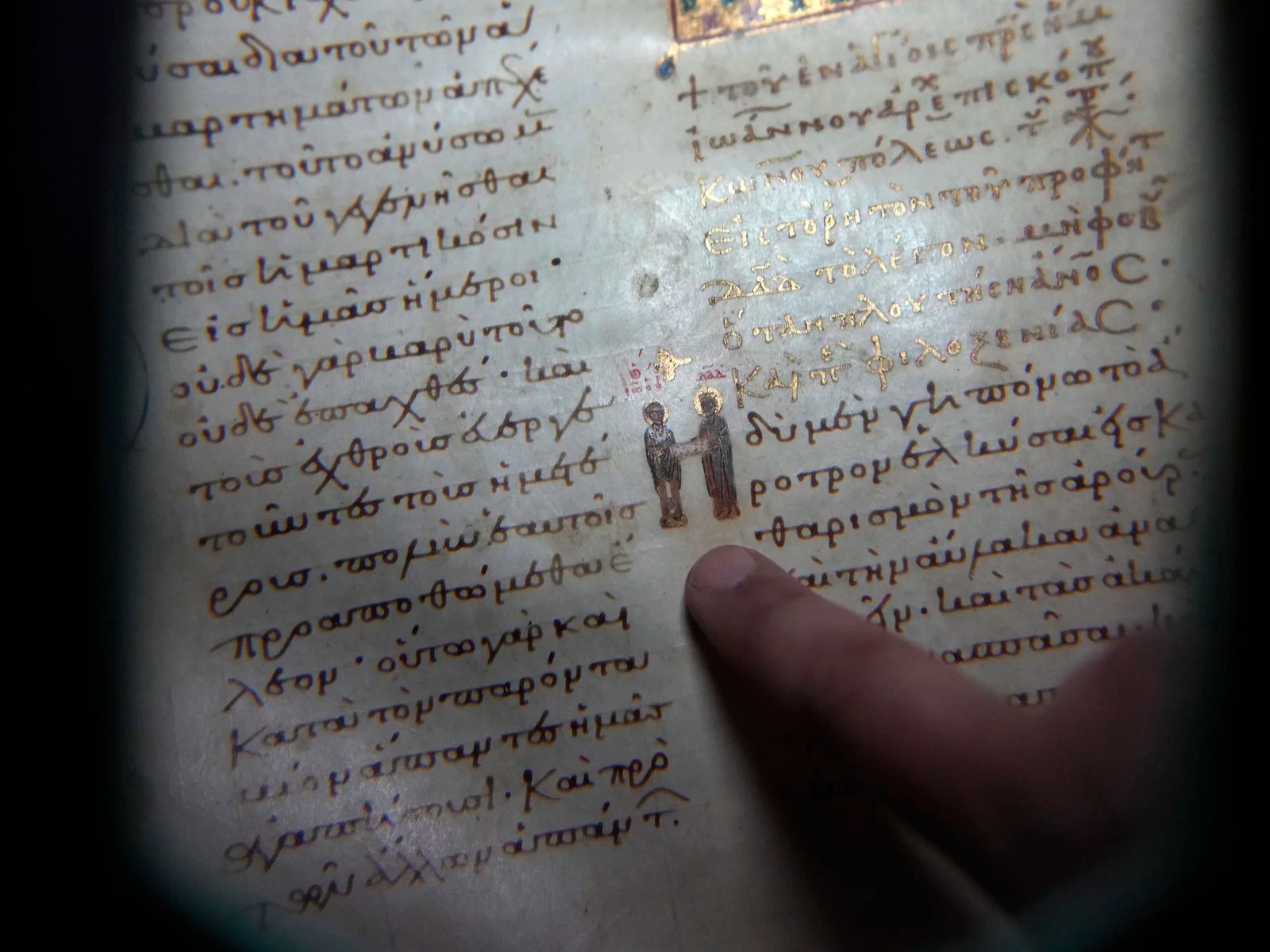
Enlightened Ottoman rulers once allowed a religion that wasn’t theirs to flourish in peace. Above is a manuscript created in those days. It’s at the library of Pantokrator Monastery in the Mount Athos, northern Greece.

Tolerance of people who are different is not always a quality associated with powerful leaders in history. But there are exceptions.

Consider this Associated Press (AP) story about the Ottoman Empire and a monastery in Greece.

“High in the great tower of Pantokrator Monastery, a metal library door swings open. There, deep inside the medieval fortified monastery in the Mount Athos monastic Orthodox Christian community, researchers are for the first time tapping a virtually unknown treasure — thousands of Ottoman-era manuscripts that include the oldest of their kind in the world.

“The libraries of the self-governed community, established more than 1,000 years ago on northern Greece’s Athos peninsula, are a repository of rare, centuries-old works in several languages including Greek, Russian and Romanian.

“Many have been extensively studied, but not the Ottoman Turkish documents, products of an occupying bureaucracy that ruled northern Greece from the late 14th century — well before the Byzantine capital, Constantinople, fell to the Ottomans in 1453 — until the early 20th when the area became Greek again.

“Byzantine scholar Jannis Niehoff-Panagiotidis says it’s impossible to understand Mount Athos’ economy and society under Ottoman rule without consulting these documents, which regulated the monks’ dealings with secular authorities.

” ‘Ottoman was the official language of state,’ he told the Associated Press from the library of the Pantokrator Monastery, one of 20 on the heavily wooded peninsula.

“Niehoff-Panagiotidis, a professor at the Free University of Berlin, said the oldest of the roughly 25,000 Ottoman works found in the monastic libraries dates to 1374, or 1371. That’s older than any known in the world, he said, adding that in Istanbul, as the Ottomans renamed Constantinople when they made the city their own capital, the oldest archives only go back to the late 15th century.

” ‘The first documents that shed light (on the first period of Ottoman history) are saved here, on Mount Athos,’ he said, seated at a table piled with documents and books. Others, the more rare ones, are stored in large wooden drawers. These include highly ornate Sultans’ firmans — or decrees — deeds of ownership and court decisions. …

“The manuscripts tell a story at odds with the traditional understanding in Greece of Ottoman depredations in the newly conquered areas, through the confiscation of the Mount Athos monasteries’ rich real estate holdings. Instead, the new rulers took the community under their wing, preserved its autonomy and protected it from external interference. …

” ‘The monks’ small democracy was able to gain the respect of all conquering powers,’ [Anastasios Nikopoulos, a jurist and scientific collaborator of the Free University of Berlin] said. …

‘Mount Athos was seen as a cradle of peace, culture … where peoples and civilizations coexisted peacefully.’

“Nikopoulos said that one of the first actions of Murad II, the Ottoman ruler who conquered Thessaloniki — the closest city to Mount Athos — was to draw up a legal document in 1430 protecting the community. …

“Even before that, Niehoff-Panagiotidis added, a sultan issued a mandate laying down strict punishment for intruders after a band of marauding soldiers engaged in minor thieving from one of the monasteries.

” ‘It’s strange that the sultans kept Mount Athos, the last remnant of Byzantium, semi-independent and didn’t touch it,’ he said. ‘They didn’t even keep troops here. … Mount Athos was something like a continuation of Byzantium.’ …

“Father Theophilos, a Pantokrator monk who is helping with the research, said the documents show the far-flung influence of Mount Athos.

” ‘Their study also illuminates examples of how people can live with each other, principles that are common to all humanity, the seeds of human rights and respect for them, democracy and the principles of social coexistence,’ he told the Associated Press.”

More of the AP story at NPR, here. No firewall.

Read Full Post »