Feeds:
Posts
Comments

Posts Tagged ‘movie’

Photo: Waterworld/City of Tea Tree Gully.
Chlorine cinema … Zootopia screens at the “dive-in” cinema at Waterworld Aquatic Centre in South Australia.

Back in the day, drive-in movies were a thing — watching a feature from your parked car, a box for the sound hooked inside, probably ordering food delivered to your window. There are not too many active drive-ins any more, but in Australia, “dive-ins” (you read that right) are a cherished tradition showing no signs of being mothballed.

Chris Baker writes at the Guardian, “Imagine you’re lying on an inflatable [raft], fingers and toes dangling in warm, rippling water. It’s almost dusk and the early evening calm is shattered by a piercing scream. Suddenly a great white shark appears, mouth agape with enormous, monstrous teeth. Nearby swimmers who were quietly chatting a moment ago are now flailing in terror.

“You’re at Aquamoves pool in Shepparton, central Victoria, watching Jaws while paddling in the pool at their dive-in movie night.

“Dive-ins are a time-honoured tradition in landlocked Australia, where residents can’t easily access what much of the nation takes for granted on a hot summer day: proximity to the coast or an air-conditioned cinema. …For a little more than the price of a regular swim, locals get to watch a movie on a screen next to the pool while they splash, bob or float. …

“Often, as in Shepparton, the film screened has some connection to the sea, water or swimming. Think Penguins of Madagascar, Finding Dory or Moana.

“My first experience of a dive-in was as an adult at Mount Druitt in western Sydney during the January school holidays. I had scheduled an evening catch-up with old friends in the area, and their kids had insisted we go to the local pool. As night fell, Lightyear, an origin myth of the Buzz Lightyear character from the Toy Story franchise, was projected on to a large screen. …

“The kids’ excitement, like mine, was apportioned between the pool and Lightyear, and we applauded wildly with pruny fingers as the credits rolled.

“Dive-ins harness many of the best things about Australian summers: balmy evenings, the relief of a refreshing dip, and the novelty (for children) of being able to stay up later than normal because it’s school holidays. …

“Many Australians who experienced dive-ins as kids carry nostalgic memories into adulthood. Thirty-something Angus Roth grew up in Canberra and was a regular at the Big Splash water park dive-ins in the early 90s. He continued the tradition by taking his two kids to wet screenings. He associates some of his favorite Pixar movies with ‘the smell of chlorine’ and says he ‘loved the free-range nature of the evenings where the usual rules of “sit down and be quiet” didn’t apply.’

“A hint of anarchy pervades the best dive-in experiences. The managers of Aquamoves pool in Shepparton recognized this and showed terrifying genius in programming Jaws to a floating audience in 2019. It was such a hit that swimmers plunged back into shark-infested cinematic waters a year later to see Blake Lively pursued by a great white in The Shallows.

“Bikash Randhawa, the chief operating officer at Village Roadshow Theme Parks, agrees the best dive-in evenings combine fun with a sense of occasion. At the Wet’n’Wild water park in Oxenford in Queensland’s Gold Coast, the park’s ‘giant wave pool transforms into a floating cinema featuring a 45 meter [~148 foot] squared screen.’ …

“Dive-ins are also a much-loved institution at Waterworld Aquatic Centre in Ridgehaven, South Australia. They host one screening in January and another in February, often with a theme. When Barbie screenedkids and grownups donned hot pink bathers and lurid accessories to channel their inner Barbie and Ken, while their ‘Splash for a cure’ dive-in for The Incredibles brought staff and patrons out in spandex and capes to raise funds for the Leukemia Foundation. …

“Dive-in sessions don’t always end when summer nights are over. The University of Newcastle’s Students Association holds a free winter dive-in July at the heated pool at its Callaghan campus as part of its midyear welcome back week. …

“Not to be outdone, Griffith University in Queensland presents its dive-in at the Mount Gravatt campus at the start of the academic year. A giant inflatable screen commands pride of place; popcorn, fairy floss and snow cones are on the house, and students are encouraged to come in costume. …. Psychology student Abbie Chen says “watching a Hunger Games movie in a floating inflatable doughnut was fun and pretty surreal, and the silliness of the evening brings people together”.

“For Jen Curtis, a farmer who lives in Victoria’s central highlands wine country, a movie at the local pool brings respite from the summer heat and is a welcome distraction from physical labor. But more importantly, she says: ‘It’s about connection, making our own fun, and looking after each other.’ ”

More at the Guardian, here. Np paywall. Fun pictures.

Read Full Post »

Photo: Everett Collection.
A de-aged version of actors Tom Hanks and Robin Wright, created by artificial intelligence for the 2024 film Here.

We are well into the age of AI, and I certainly hope that doesn’t mean we’re going to realize the dire warnings of one of its pioneers but just use it in relatively harmless ways.

Today’s story is about using AI to “de-age” actors in a movie covering 60 years.

Benj Edwards writes at Wired, “Here, a $50 million Robert Zemeckis–directed film [used] real-time generative AI face transformation techniques to portray actors Tom Hanks and Robin Wright across a 60-year span, marking one of Hollywood’s first full-length features built around AI-powered visual effects.

“The film adapts a 2014 graphic novel set primarily in a New Jersey living room across multiple time periods. Rather than cast different actors for various ages, the production used AI to modify Hanks’s and Wright’s appearances throughout.

“The de-aging technology comes from Metaphysic, a visual effects company that creates real time face swapping and aging effects. During filming, the crew watched two monitors simultaneously: one showing the actors’ actual appearances and another displaying them at whatever age the scene required.

“Metaphysic developed the facial modification system by training custom machine-learning models on frames of Hanks’ and Wright’s previous films. This included a large dataset of facial movements, skin textures, and appearances under varied lighting conditions and camera angles. …

“Unlike previous aging effects that relied on frame-by-frame manipulation, Metaphysic’s approach generates transformations instantly by analyzing facial landmarks and mapping them to trained age variations. … Traditional visual effects for this level of face modification would reportedly require hundreds of artists and a substantially larger budget closer to standard Marvel movie costs.

“This isn’t the first film that has used AI techniques to de-age actors. ILM’s approach to de-aging Harrison Ford in 2023’s Indiana Jones and the Dial of Destiny used a proprietary system called Flux with infrared cameras to capture facial data during filming, then old images of Ford to de-age him in postproduction. By contrast, Metaphysic’s AI models process transformations without additional hardware and show results during filming. …

“Meanwhile, as we saw with the SAG-AFTRA union strike [in 2023], Hollywood studios and unions continue to hotly debate AI’s role in filmmaking. While the Screen Actors Guild and Writers Guild secured some AI limitations in recent contracts, many industry veterans see the technology as inevitable. …

“Even so, the New York Times says that Metaphysic’s technology has already found use in two other 2024 releases. Furiosa: A Mad Max Saga employed it to re-create deceased actor Richard Carter’s character, while Alien: Romulus brought back Ian Holm’s android character from the 1979 original. Both implementations required estate approval under new California legislation governing AI recreations of performers, often called deepfakes. …

“Robert Downey Jr. recently said in an interview that he would instruct his estate to sue anyone attempting to digitally bring him back from the dead for another film appearance. But even with controversies, Hollywood still seems to find a way to make death-defying (and age-defying) visual feats take place onscreen — especially if there is enough money involved.”

What could go wrong?

The first thing I think of is fewer job opportunities for actors who play younger versions of stars. Still, I’d love to see an AI child version of the actress who plays Astrid in the French crime show of the same name, because I think it would look more natural than the mimicking girl they’ve got. (Awesome tv, by the way. Check it out on PBS Passport.)

More at Wired, here. This story originally appeared on Ars Technica.

Read Full Post »

Photo: Sony Pictures Classics/Manolo Pavon/Allstar.
From left: Asier Flores, Penélope Cruz, and Raúl Arévalo in a scene from Pain and Glory (2019), a film by Pedro Almodovar.

Today’s story is about how Spanish film director Pedro Almodóvar wrote a collection of short stories as a kind of memoir. And it zeroes in on his mother’s influence on his life’s work.

Sam Jones writes at the Guardian, “One day when he was nine years old and living in a small Extremaduran town of makeshift adobe houses, steep slate streets and dusty, meagre horizons, Pedro Almodóvar caught his mother out in a lie.

“The family had recently moved south from La Mancha and Francisca Caballero was making ends meet by reading and writing letters for her illiterate neighbors. As he read over his mother’s shoulder, Almodóvar realized the words on the page did not correspond to the words on her lips.

“ ‘She was improvising and saying things that weren’t in the letters,’ he says. ‘My mum knew all the neighbors – she knew the grandmother and the granddaughter and how they got along. And so she made stuff up. For example, if she noticed that no one had asked after the grandmother, she’d say, “I hope Granny is very well and knows that I think about her a lot.” That wasn’t in the letter.’

“When they got home, he asked why she had made up the reference to the grandmother. His mother looked at him and replied: ‘Did you see how happy it made her?’

“At the time, Almodóvar was most struck by the fact of the lie. But, as the years passed and he began writing stories on the Olivetti typewriter his mother gave him when he was 10, he came to understand the meaning of her actions. ‘I realized just what a huge lesson she’d taught me: that life needs fiction to make it bearable. We need fiction so that we can live a bit better.’

“The truth his mother imparted that day lies at the heart of El último sueño, the short-story collection-cum-memoir now published in English as The Last Dream. Almodóvar, 74, has travelled an almost unfathomable distance from the house in Orellana La Vieja whose bare earth floors would turn to mud under his mother’s mop. The smart central Madrid offices of his production company, which sit near a yoga studio and a short walk from the neo-Moorish splendor of the city’s Las Ventas bullring, are lined with film posters – Tie Me Up! Tie Me Down!, High Heels, Live Flesh, All About My MotherVolver – that describe a singular director now in the sixth decade of his career.

“Just as those films have become time capsules of his life and his era, so the dozen stories that make up The Last Dream, which has been translated by Frank Wynne, are snapshots of his development as a person, a writer and a filmmaker. … There are fictional tales of misfits, outsiders, actors and the odd supernatural entity.

“One tells of a writer whose life is lived backwards, beginning with his burial … another of a wounded soul out for revenge on the priest who abused them as a child; another of a world-weary vampire seeking solace in a monastery. There is a cult film director in the throes of a crisis … and, at the book’s conclusion, a melancholic sense of the director’s retreat from the hedonism and delightful chaos of the 1970s, 80s and early 90s, as chronicled in his early films. …

“A mix of fiction, observation and autobiography, the collection exists largely thanks to the care and efficiency of Almodóvar’s long-serving assistant Lola García, who assiduously grabbed and filed the pieces over the decades, preserving them from house move to house move. Some were written in his late teens and early 20s, others during his first years in Madrid, and some as recently as last year. …

“As the collection progresses, you can almost see the artist develop: the kitsch, riotous and transgressive early work giving way to something calmer, sadder and increasingly self-reflective. Over the course of 211 pages, the exuberant, coal-haired enfant terrible of Spanish cinema becomes the salt-and-pepper-haired auteur of the late 90s and then, finally, the thoughtful, white-haired sage who sits on the other side of the desk on a merciless Madrid summer afternoon and explains, over bottled water, why the 12 tales tell a more honest story than would a straightforward memoir.

“ ‘There’s a biographical line that runs through them, even though some of them are pure fiction,’ he says. ‘It’s a way of looking back at something I found interesting, because I recognized myself in all those stories: even if some were written when I was 17 or 18, I’m still the same person. Yes, things change, time passes and biology changes – there’s nothing you can do about that – but I’m exactly the same person now as I was when I came to Madrid forty something years ago.’ …

“Although Almodóvar is modest about his literary abilities, writing was his initial vocation and one that he has pursued from the early days of tapping away on his Olivetti ‘under a grapevine with a skinned rabbit hanging from a string, like one of those revolting flycatchers,’ to the scripts he wrote on the sly while working for Telefónica in Madrid.

“ ‘I’ve wanted to write from the very beginning, and I thought about devoting myself to literature, but from the time I was about 18 or 19 – when I’d bought a Super 8 camera – I immediately turned all those literary ideas into images,’ he says. ‘I also discovered that I was better at telling stories with images than with words. Very often, I’d start writing a story but it would end up as a film script.’

“Cinema had long been an escape from the claustrophobic confines of his provincial upbringing. ‘I’d already learned from living in small communities that I was different,’ he says. ‘People made me see that I was different. Life there horrified me. I started going to the cinema when we lived in Orellana and I continued going when we moved to a nearby village. From the moment I discovered cinema, I discovered a parallel reality that interested me far more than daily reality.’ …

“ ‘My references still come from outside – from a book I read, or a conversation I overhear, or something I see on TV – but over the past few years, I’ve been resorting much more to myself as inspiration,’ he says. ‘Well, perhaps not for inspiration, but as a document store.’ …

“That autumnal, autobiographical approach is most apparent in the collection’s titular story, which sees Almodóvar seeking to make sense of his mother’s life, death, and the epiphany contained in her embellished letter readings. The Last Dream is also a letter of love, gratitude and a belated effort to settle an old debt.

“ ‘My mother always used to get very worked up when people talked about Pedro Almodóvar or just Almodóvar,’ he remembers. ‘She used to say, “You’re Pedro Almodóvar Caballero because I’m the one who gave birth to you!” She wanted me to use my full name in my films.’ …

“Better late than never – the six pages that make up ‘The Last Dream’ are signed: Pedro Almodóvar Caballero.”

More at the Guardian, here.

Read Full Post »

Photo: Magnolia Pictures/AP.
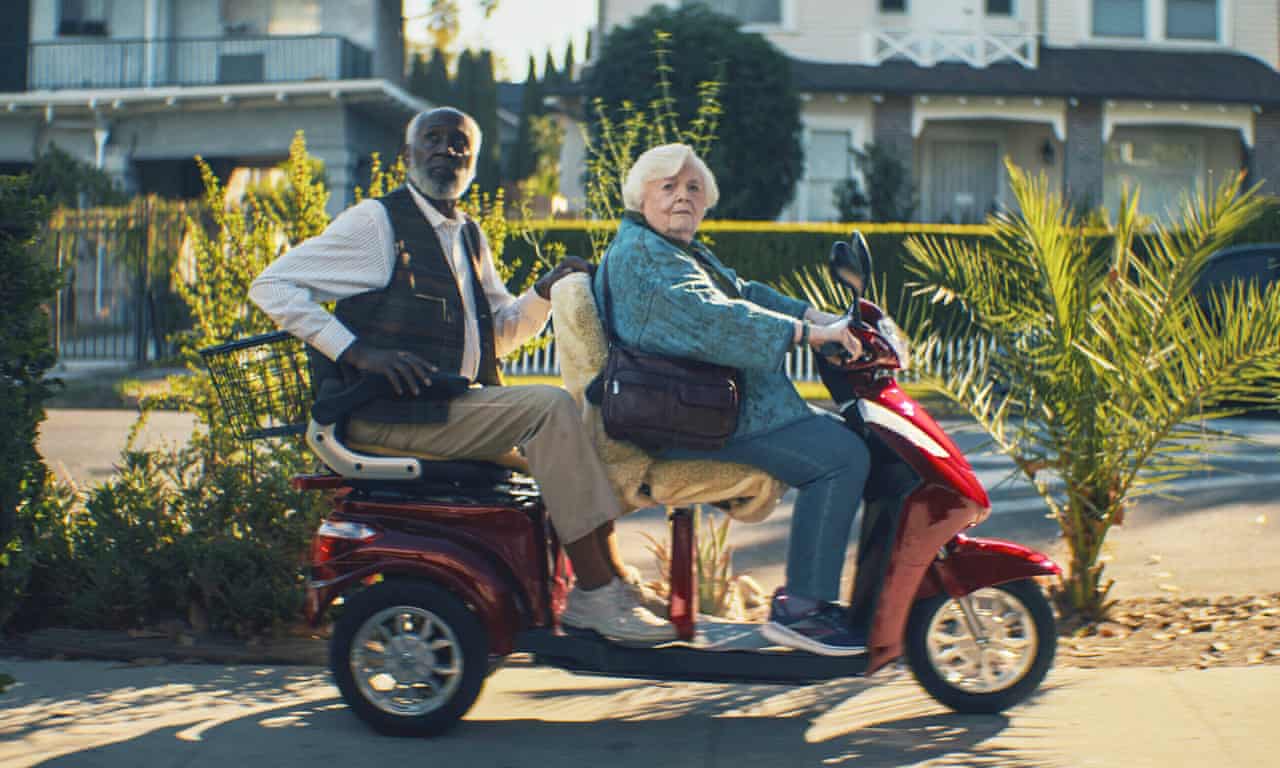
Actor June Squibb with Richard Roundtree in the movie Thelma. 

I’ve been wanting to see this movie since I first read about it, but I have trouble accessing movies these days. Some get shown on the tv network in our retirement community, but we may not get this one for a while as it’s not available yet.

What’s cool about Thelma is that the lead actor is 94 and also that she has glowing reviews.

Fiona Sturges writes at the Guardian, “There’s a new action hero in town. In Josh Margolin’s wildly entertaining Thelma, an elderly widow is duped out of $10,000 by a scammer masquerading as her grandson. Realizing her error, she resolves to track him down, retrieve her cash and dispense some rough justice.

If summer blockbusters are about the action, then Thelma has it all: guns, explosions and mobility scooter-based stunts.

“When the 94-year-old actor June Squibb read the script, with its mischievous nods to Mission: Impossible, she knew she had to do it. She also knew she would do lots of the stunts herself. ‘I have more security in my physicality than a lot of people do, and I thought riding around on that scooter was going to be great fun,’ she beams. …

“She says she is in excellent health, even though, ‘I should be doing pilates more than I am, because I’ve had such a crazy schedule. I was doing it for one hour a week with a trainer, and it makes a huge difference. I’m in good shape.’

“Extraordinarily, Thelma is Squibb’s first ever starring role. Until now, she has been viewed as a character actor, someone you’re more likely to know by face (or by voice: she is Nostalgia in Inside Out 2) than by name. She has spent decades quietly propping up lead actors playing their wives, mothers and grandmothers in films such as Scent of a WomanAbout Schmidt and Palm Springs. 

“While Thelma is primarily a comedy, it is underpinned by a more serious theme: the way society treats its elderly. We see Thelma’s well-meaning family talking about her when she’s still in the room and pondering whether to move her into a home. … But she is happy to report that, in her 10th decade, she has had nothing but love and respect from her family and has retained her independence. She lives in an apartment complex in the San Fernando Valley. … ‘And I have a wonderful assistant without whom I couldn’t keep working,’ Squibb says. ‘I have two cats and I make sure that, first thing in the morning, they’re taken care of. And then I have most of the day to myself if I’m not filming. I have no trouble getting around, though I do get tired. Tiredness is real when you get to my age.’

“Yet Squibb has rarely been in such demand. She credits her increased workload to a ‘greater interest in the aging process. There’s more work for people my age than ever before. … When I was a young, good-looking actor in New York, I was constantly aware that people looked at me as an object.’ She and her contemporaries had their coping mechanisms, ‘but I got mad too. When #MeToo happened, all of us in our 80s were amazed. We were, like, “Oh my God, we’ve lived this our whole lives.” ‘ …

“Squibb learned her craft in the 1950s at the Cleveland Play House, where she met Jack Lee, who went on to become a leading musical director on Broadway. ‘He decided I had to sing. So, I began singing and I did all the comedienne roles in all the musicals. … My first 20 years in New York were all musicals.’ Then came a gear-change after she met her second husband, Charles Kataksakis, an acting coach. Kataksakis thought she had it in her to play more serious roles (he and Squibb were together for 40 years until his death in 1999). …

“Squibb was 61 when she made the move from stage to screen. … ‘I went to my agent and said, “I think I should be doing this too.” The next week I was auditioning for Woody Allen.’ That film was Alice, a romcom starring Mia Farrow in which Squibb played a maid. The casting director, Ellen Lewis, took an instant shine to Squibb and set her up for a meeting with Martin Brest, who cast her in his new Al Pacino vehicle, Scent of a Woman. …

“After that came roles in TV shows . … [Alexander] Payne brought her on board for 2013’s Nebraska, in which she played the abrasive and unfiltered Kate, wife of Bruce Dern’s delusional Woody. The role earned her an Oscar nomination for best supporting actress. …

“Squibb just wrapped another film, playing the lead in Eleanor the Great, about a 90-year-old who moves back to New York after decades in Florida. It is the directorial debut of Scarlett Johansson, who Squibb describes as ‘so bright, so smart.’ Being No 1 on the call sheet, she says, means ‘going into it with a feeling of responsibility that you don’t have with a supporting role. I always felt what I did was important. But as the lead you’re kind of responsible for the whole film.’ ”

More at the Guardian, here. Have you seen this movie yet? (Looking at Laurie, who seems to see everything.)

Read Full Post »

Photo: Sharon Kinney via ArtsMeme.
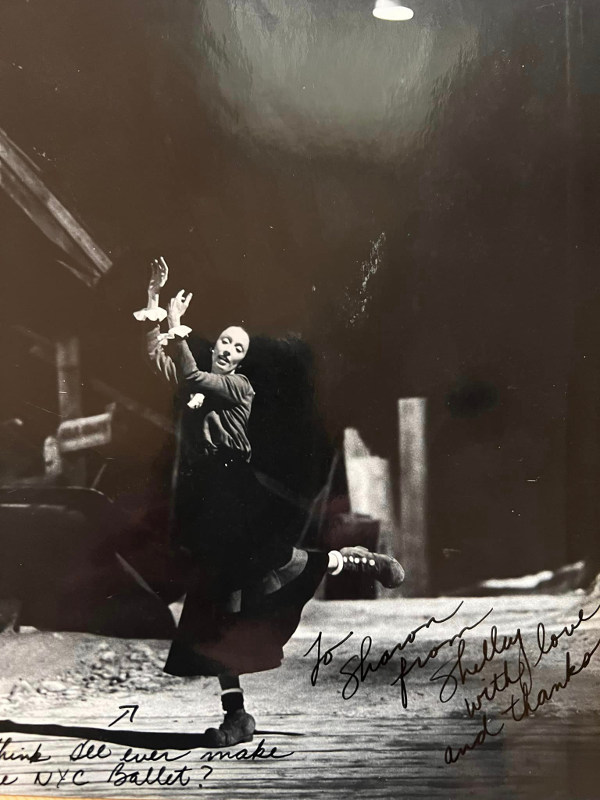
The recently deceased actress Shelley Duvall dancing as Olive Oyl in director Robert Altman’s Popeye (1980). 

One of the films that the late, versatile actor Shelley Duvall was best known for was her wistful interpretation of a cartoon character — Popeye’s girlfriend Olive Oyl.

Website ArtsMeme says, “Duvall (1949-2024), who recently passed away, led a long and memorable career primarily as a character actress, but in this case she played a full leading role countering Robin Williams as Popeye. …

Sharon Kinney … the creator/choreographer/coach of Shelley’s special dance, tells us that Duvall did her own singing in the number. She was not dubbed, which would be common in this circumstance.

“The dance world reveres Sharon for having been one of choreographer Paul Taylor‘s original dancers in his iconic dance company. But since retiring from performance, she has led a fruitful career as an instructor at Cal State Long Beach, as a filmmaker and indeed as a dance-film choreographer/coach living in Los Angeles. Sharon shared with Facebook friends her memories of working with the lanky Ms. Duvall in staging a solo song ‘He Needs Me,’ in the Altman film.

“Sharon reminisced, ‘She was so professional, so invested and really wanted to personify Olive Oyl and her love for Popeye! She did great things before with Altman and had just finished The Shining with Stanley Kubrick! She then went on to do some other great work with Faierie Tale theater!’

“Shelley Duvall’s inscription to Sharon Kinney on the glossy photo [above] is good natured. ‘Think I’ll ever make New York City Ballet?’ she mused. Dance ‘people’ will recognize the innate beauty of her pose that is rooted in the cartoon version of OO as gangly. Even in her clodhopper shoes, this Olive Oyl is luscious.” Check out YouTube videos of Duvall singing “He Needs Me” and “He’s Large,” in which she’s defending an early attachment to the character Bluto.

In a comprehensive reminiscence after her death, Owen Gleiberman at Variety notes, “In Robert Altman’s Popeye, an early visionary/cracked comic-book musical. With goldfish eyes, pursed lips, and a Victorian knot of hair set off by her dainty clenched-fist pose of adoration, Duvall gave a performance as Olive Oyl that was so perfect it was almost a joke.

“As an actor, Duvall could seem naturally stylized, which made Olive a role she was born to play. Yet within all that, she found a reservoir of heart. The highlight of Popeye might be Duvall’s performance of ‘He’s Large,’ in which Olive explains her devotion to the oversize Bluto with a girlish defiance that’s indelible.

“And indelible, make no mistake, was the word for Shelley Duvall. She imprinted her presence upon you; once you’d seen her, you couldn’t forget her. It was Altman who first had that reaction. In 1970, a few months after MASH came out and made Altman the hottest director in Hollywood (a status that wouldn’t last long — he was far too independent an artist), he was shooting his next feature in Houston, a fantasy comedy called Brewster McCloud, when he met Duvall at a party and, encouraged by a handful of crew members, decided to cast her in the movie.

“She’d had no experience as an actor. What they were all reacting to was what you can only call Duvall’s being — the eyes that were like something out of anime, her rabbity two front teeth, and a quality that could make you laugh or break your heart: the softness of her gaze, the tender passive radiance with which she looked out at the world.”

More at ArtsMeme, here, amd at Variety, here.

Read Full Post »

Photo: San Francisco Silent film festival.
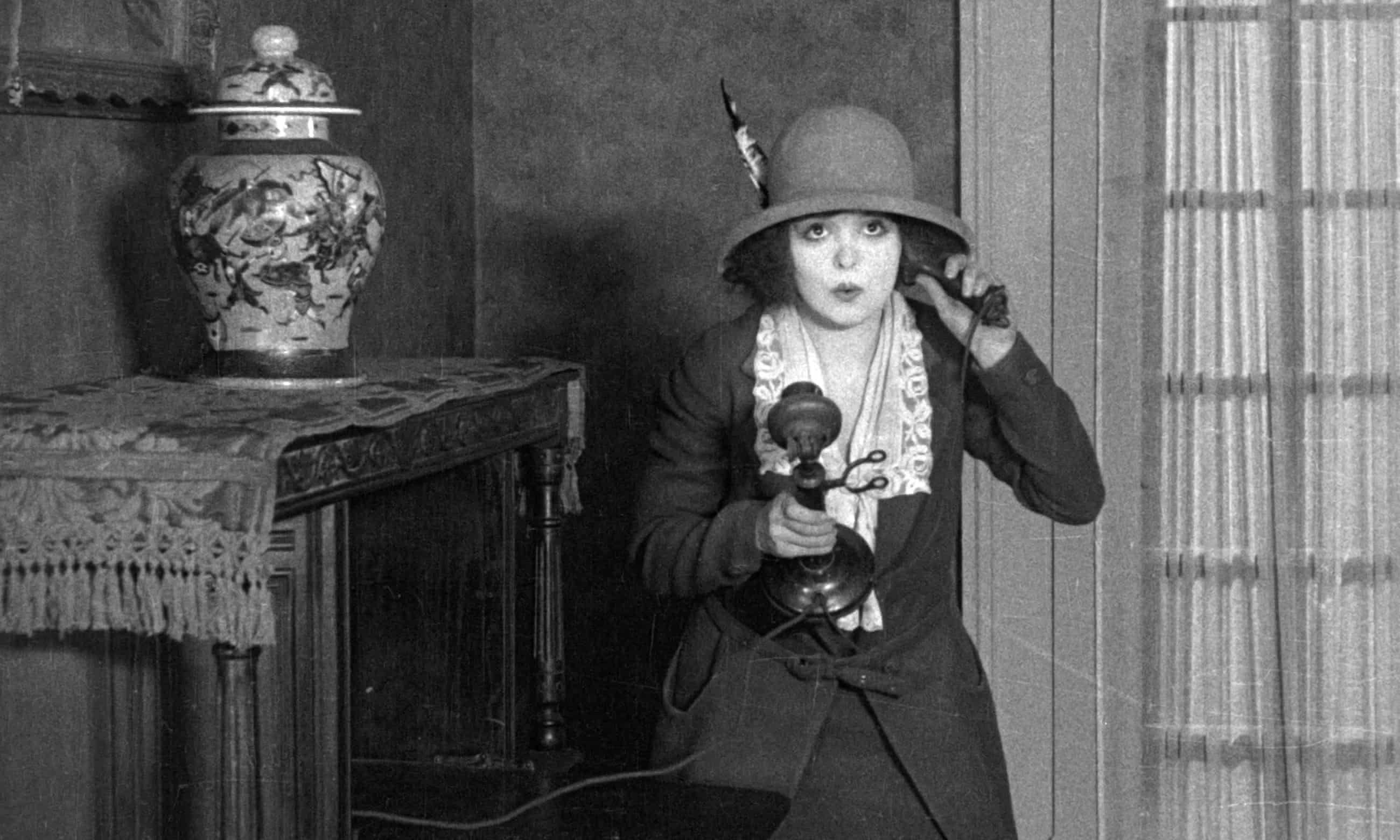
Clara Bow in newly rediscovered The Pill Pounder, a 14-minute film. 

We had one of the first televisions (1948? 1949?) because my father was writing a story for Fortune. It was a Dumont, a big wooden box with a tiny black and white screen. There wasn’t much content available at the time, so we watched lots of silent movies. I can’t remember if I ever saw any of starlet Clara Bow’s films, but I wouldn’t be surprised. I was too young to register names of actors.

Pamela Hutchinson writes at the Guardian, “A century after she first began to turn heads, Clara Bow is ‘It’ once more. The iconic flapper of the silent film era inspired Margot Robbie’s character Nellie in Damien Chazelle’s Hollywood epic Babylon, is name checked on Taylor Swift’s forthcoming album ‘The Tortured Poets Department,’ and yesterday at the San Francisco Silent Film Festival, one of her earliest films was shown for the first time since the days of bathtub gin.

“The story of the film’s discovery has already caused excitement online. Film-maker Gary Huggins inadvertently snapped up a slice of lost silent film history at an auction in a car park in Omaha, Nebraska, that was selling old stock from a distribution company called Modern Sound Pictures. Hoping to bid on a copy of the 1926 comedy Eve’s Leaves that he had spotted on top of a pile, Huggins was informed that he could only buy the whole pallet of movies, not individual cans. The upside? The lot was his for only $20.

“Huggins soon discovered that his new pile of reels included 1923’s The Pill Pounder, a silent comedy that had been thought to be lost for decades. It is a short, two-reel film, shot on Long Island, New York. … The film stars rubber-faced vaudeville veteran Charlie Murray, the so-called ‘Irish comedian’ who was actually from Laurel, Indiana. He plays a hapless pharmacist, the ‘pill pounder’ of the title, who is trying to host a clandestine poker game in the back room of his drugstore.

“What few realized until Huggins watched the film, was that it also features 17-year-old Bow in a supporting role. She plays the girlfriend of Murray’s son, played by James Turfler, who had already appeared with Bow in her second film Down to the Sea in Ships, directed by Elmer Clifton and screened in 1922. …

“In this, one of her earliest surviving performances on film, Bow looks even younger than her years. Although she lacks the sleek Hollywood glamour she later acquired, she has the charisma to turn a thankless bit-part into something of a scene-stealer. The critics took note: based on the evidence of this film, the Exhibitors’ Trade Review described her as ‘perhaps the most promising of the younger actresses.’ …

“The film, which has been restored by the festival’s organizers and was screened with accompanying music from composer Wayne Barker, now looks remarkably good for its age. The festival’s senior film restorer, Kathy Rose O’Regan, said it was in great shape when they received it. She added: ‘We imagined it was screened maybe a few times, but there’s hardly any damage.’ …

“It is still incomplete, being in what Stenn called a ‘beta version.’ That’s because the copy Huggins found was not from the 1920s, but a 35mm print from the 1950s or 1960s of an edit of the film that was destined to become part of a 16mm compilation of old silent films with a comic voiceover poking fun at its archaic aspects. The intertitles have been removed and there are a few scenes and shots missing, too. This process is deeply unflattering to old movies, but it has been responsible for preserving versions of silent films that would otherwise have been lost. …

“ ‘For me, it is a pretty perfect 14-minutes of fun,’ says O’Regan. ‘It would be nice to know what the titles were, but you can certainly get the gist without them.’

“Stenn called the tale of the film’s discovery ‘miraculous’ and … explained that there was reason to believe that some of the discarded material was among the other cans that were sold at the Omaha auction. The hunt is on to round out The Pill Pounder, and several people have joined in the search, combing through thousands of reels.”

More at the Guardian, here. No paywall.

Read Full Post »

Photo: Adrian Susec/Unsplash.

Film buffs, it turns out, are not only creative about making movies, they’re creative about ways to screen movies. That’s because a different locale can lend a whole new feeling to the movie-going experience.

Bryn Stole writes at the New York Times, “Some of international cinema’s biggest names gathered on [a Tuesday in February] at the Berlin International Film Festival as the event honored Martin Scorsese with a lifetime achievement award. Before accepting his trophy, Scorsese listened as the German director Wim Wenders gave a laudatory speech to an audience including celebrities and local dignitaries.

“Just around the corner, parked in the middle of a busy thoroughfare, a group of Berlin’s taxi drivers crammed into the back of a worn-out taxi van to watch a double-feature capped by Scorsese’s 1976 movie Taxi Driver.

“Klaus Meier, who has been driving a cab in Berlin since 1985, handed out bottles of soda and beer, popping the caps with the blade of a pocketknife. Irene Jaxtheimer, who runs a taxi company, passed around homemade popcorn. A generator outside the cab powered a modest television, a DVD player and a small electric heater.

“The unconventional screening, just outside a centerpiece event for one of Europe’s most prestigious film festivals, was part of the makeshift TaxiFilmFest. Running through Sunday, it is partly a protest over the miserable state of the taxi industry these days and partly a counterfestival to celebrate the taxi cab’s iconic place in the urban cultural landscape.

“It’s also in objection to an exclusive partnership deal between the festival, known locally as the Berlinale, and the ride-hailing giant Uber to ferry filmmakers between the city’s movie theaters during the event. … Beeping horns from the busy street outside — some of them coming from sleek black Uber vehicles emblazoned with the Berlinale logo — blended with the street scenes from Taxi Driver playing on the tinny television speakers. ‘Ah, I really miss those mechanical fare boxes!’ Meier said as the fares ticked away in the onscreen cab of the movie’s unhinged antihero, Travis Bickle, who drives around mid-’70s New York with growing hatred and menace.

“The back-seat festival is showing only taxi-themed flicks, and the potential repertoire is deep. Meier polled friends and fellow taxi drivers about which films to show, and said he had received dozens of suggestions about movies in which a cab plays a starring role.

“The early feature on Tuesday was Barry Greenwald’s 1982 quirky slice-of-life documentary Taxi! about some odd characters driving cabs in Toronto. The previous evening, a small rotating crowd beat the rain to catch portions of the 1998 French action-comedy Taxi, a lighthearted flick from the director Gérard Pirès about sinister, Mercedes-driving German gangsters, hapless Marseilles cops and a lead-footed rookie cabdriver who turns out to be the only person fast enough to catch the criminals.

“An early hit at the TaxiFilmFestival, which kicked off last Thursday, was Under the Bombs, a Lebanese drama set during the 2006 conflict between Hezbollah and Israel. In the movie, a Beirut taxi driver is hired to drive a woman into the war-torn south of Lebanon in hopes of finding her sister and son. Meier described it as ‘Shakespearean’ and ‘a masterpiece,’ and Berndt said it was clearly the ‘most moving taxi film’ he’d ever seen.

“But the clear favorite among attendees was Jim Jarmusch’s Night on Earth, a quirky, episodic 1991 film about taxi drivers and passengers in five cities around the world. The selection for TaxiFilmFest’s Sunday night finale had yet to be chosen, and Meier said he remained open to suggestions. …

“The festival attendees, squeezed into the back of the van on Tuesday, also reminisced about better days for taxi driving, such as ferrying around American and British soldiers from the occupying Allies stationed in West Berlin. (The French troops, the small crowd agreed, had less cash and rarely hailed cabs.) …

“The days before the fall of the Berlin Wall were ‘blissful times, hard to even imagine anymore,’ said Stephan Berndt.” More at the Times, here.

See also my 2014 post about a theatrical production in a taxi in Iran, here.

By the way, I hated the movie Taxi Driver when I saw it around 1976 — and walked out. Still don’t get what’s to like. You?

Read Full Post »

Photo: Amaal Said/JGPACA [June Givanni Pan African Cinema Archive].
From a Mogadishu film week
poster to VHS videos of pioneering art movies, June Givanni has collected a range of Black film artifacts and is now ready to share.

Sometimes people whose childhood struggles involve race-based discrimination grow up to embrace and trumpet the beauty of their heritage. I enjoy stories like that.

At the Guardian, Leila Latif interviews one such person, the founder of June Givanni Pan African Cinema Archive.

Discussing her recent exhibition, “PerAnkh: The June Givanni Pan African Cinema Archive,” Givanni played down the show’s title. Says Latif, “The Black British film curator, activist and archivist who created it is hesitant about positioning herself front and center.

“ ‘I don’t want it to sound like it’s all me, me, me,’ she worries. ‘My name is part of it because I worked as a curator for many years and collected work throughout the non-digital era, which developed into this archive.’

“Though she wants the films, documents, artworks and objects she has preserved to be the focus of people’s attention – from an installation of the earliest audiovisual works by the Black Audio Film Collective to new works by the Chimurenga collective from South Africa – Givanni is more than worthy of the spotlight. When she received the British independent film awards’ grand jury prize in 2021, the organizers said that she had ‘made an extraordinary, selfless and lifelong contribution to documenting a pivotal period of film history.’

Born in British Guiana 72 years ago, Givanni moved to the UK aged seven and was immediately underestimated.

“ ‘They put me with the five-year-olds because I was Black and I’d come from the Caribbean,’ she remembers. ‘My mum went to the school twice before they moved me up to my age range.’

“As an adult, Givanni collaborated with some of the most significant figures and institutions in pan-African cinema and across ‘different territories, different continents.’ She kept adding elements to her collection, she says, ‘because I needed to use them for subsequent programs and as part of building a body of knowledge and a whole series of resources that can be shared with others.’

“Lack of preservation has meant many of pan-African cinema’s masterworks have disappeared. In America alone, it is estimated more than 80% of Black films from the silent era are lost, and technological advances endanger film further. While physical film has a potential shelf life of hundreds of years, digital preservation requires constant migration to keep up with changing technology. …

“Givanni has faced changes in technology, politics and culture since she began in the early 80s. The first film festival she worked on was called Third Eye, inspired by the Latin American Third Cinema movement which set out to challenge Europe and North America’s dominance in film. For Givanni, the festival provided ‘an area to develop our own ideas about representation and taking charge. Pan-African cinema has always been a cinema of resistance. I can’t tell you how inspiring it was that there were all these people out there doing things that really chimed with what I thought should be happening.’ …

“She programmed festivals on five continents; worked for Greater London Council’s ethnic minorities unit and the Independent Television Commission; ran the BFI’s African Caribbean film unit and co-edited Black Film Bulletin, which relaunched in 2021 as a quarterly collaboration with Sight and Sound magazine, and has celebrated the under-sung work of film-makers. …

“The spirit of pan-Africanism was a guiding light, connecting all cultures that originated on the continent without treating them as a monolith. Givanni explains, ‘When I say pan-African, it’s not just the African continent; it’s the entire diaspora. All those significant histories are interconnected and cinema is very much part of that.’

“Choosing how to represent that history at Raven Row, with selections from an archive that now surpasses 10,000 items, was a gargantuan task. But Givanni immediately knew she wanted to include ‘a poster of the Mogadishu film week, given to me at my first attendance at the Fespaco film festival in 1985 by a Somali film-maker. Now people mention Somalia and they don’t picture these vibrant and strategic cultural events taking place there. …

“ ‘At the Havana film festival I bought a collection of silkscreen posters that will be exhibited. Lots of art can be seen digitally, but to see a silkscreen poster, the texture and the color of it – there’s an experience of culture and artifacts that goes beyond digital representation.’

“Beyond allowing the public to admire key objects from Givanni’s collection, the exhibition is structured around a program of films from the likes of Sarah Maldoror and Ousmane Sembène (the mother and father of African cinema). There is also an archive studio and reading room in the spirit of the exhibition’s title, PerAnkh – an Egyptian term for ‘a place of learning and memory.’ “

More at the Guardian, here. No firewall.

Read Full Post »

Photo: Murray Sanders via the Daily Mail.
Delia Barry, an 83-year-old widow from Greystones, County Wicklow, started knitting classes to improve her skills for a cancer charity after her husband of 48 years died suddenly in 2010. Now she’s a knitter to the stars.

How many ways are there to love this story? An Irish woman gets serious about knitting late in life and becomes so highly skilled that she’s in demand. An acclaimed movie director’s team seeks her out to make sweaters (“jumpers”) for actors in a film that turns out to get an Oscar nomination. She has to watch the movie twice because the first time, she is only looking at the sweaters. And when the New York Times calls, she says to call back because she’s playing bingo!

Lou Stoppard reports at the Times, “When I first contacted Delia Barry, she asked to be called back later. It was a Wednesday afternoon in Greystones, Ireland, where she lives, and she was playing bingo. ‘It’s just more of a social gathering for local senior citizens, which I am one of,’ Ms. Barry, 83, said by telephone.

“When not at bingo, Ms. Barry is usually knitting. Four of her sweaters appear in the Oscar-nominated film The Banshees of Inisherin, which is set on a fictional island in 1923, toward the end of the Irish civil war. These include a navy roll-neck and a red pullover with a distinctive long collar, both worn by Colin Farrell; a thick blue knit worn by Brendan Gleeson; and a purplish ribbed fisherman’s sweater worn by Barry Keoghan. Esquire U.K. called Banshees the “Next Great Knitwear Film.”

“ ‘It’s pure madness,’ she said of the attention. ‘I’ve knitted so many jumpers, they are just another jumper to me.’ She hopes to see the film a second time soon, she said, to better appreciate the acting and Martin McDonagh’s direction. ‘When I went the first time, I was just looking for the knitwear,’ she said.

“Ms. Barry learned to knit at school in Cahir, County Tipperary, at age 7. As a teenager, she made her own clothes, trying out new patterns, perfecting shapes. At 20, she moved to London with her future husband and worked in a telephone factory. More than a decade later, they returned to Tipperary, where Ms. Barry worked in a bar before moving to her husband’s birthplace of County Wicklow, where the town of Greystones is. …

“Ms. Barry knitted throughout her marriage, she said, but her commitment grew when her husband died in 2010, and she began knitting to raise funds for Greystones Cancer Support. ‘They were very good when he was diagnosed,’ she said. She donated a portion of her film earnings to the organization. …

“On an average week, Ms. Barry rises at 6 a.m. and knits until 8:30 a.m. She always knits in the same spot — on her sofa, with the light from the window behind her. At 9:30, she goes for a walk to the beach with a friend, about two miles away. She has never owned a car, she said, and has walked everywhere her whole life. …

“Back home, she’ll knit for another three to four hours. She’ll take a short break for dinner, then knit throughout the evening. ‘I get up and walk around every so often,’ she said. … ‘When you’re living on your own, it’s nice to have something to do.’ she said. …

“Eimer Ni Mhaoldomhnaigh, the film’s costume designer, commissioned Ms. Barry to create the sweaters. After the release of the movie, Ms. Ni Mhaoldomhnaigh recalled, ‘My daughter, who is 20, came and said Delia is a TikTok sensation.’

“Ms. Ni Mhaoldomhnaigh came across Ms. Barry’s work when she was sourcing knitwear for a 2017 television adaptation of Little Women. A woman working on the production knew that Ms. Barry had helped on other films, including Dancing at Lughnasa, for which she created knitwear for Meryl Streep’s character.

“ ‘Ireland is very small,’ Ms. Ni Mhaoldomhnaigh said, laughing. ‘It’s all word of mouth.’

“Ms. Barry credits her success to being willing to take on a job without a pattern, something many knitters would be wary of. For The Banshees of Inisherin, Ms. Ni Mhaoldomhnaigh provided photographs of Irish fishermen from the 1920s, which Ms. Barry studied with a magnifying glass. One showed a sweater with a distinctive long collar, the inspiration for the red piece that would become Mr. Farrell’s. …

“Once each item was complete, it went to the aging department, where pieces are dyed and distressed. ‘People think they just take a cheese grater to it, but it’s not as simple as that,’ Ms. Ni Mhaoldomhnaigh said. She sees the process as a means of communicating subtleties about a character — somebody who walks purposefully with their hands wedged in their pockets, somebody who gets nervous and wipes their hands on the front of their clothing.”

More at the Times, here. For the story at the Daily Mail, here, there is no firewall.

Read Full Post »

Photo: Everett Collection.
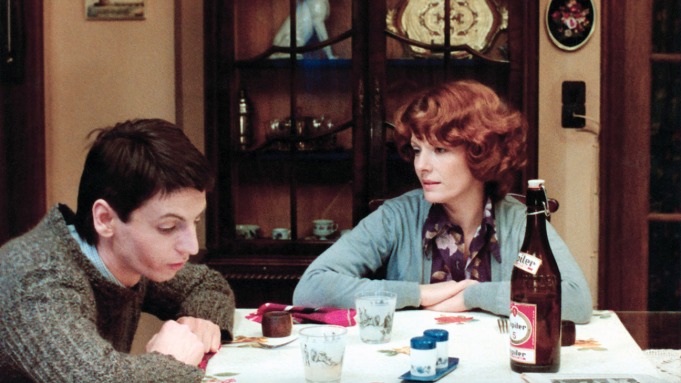
A scene from the French film Jeanne Dielman, voted best of all time at Sight & Sound magazine recently. It’s the first time the best-film honor has come to a female director, Chantal Ackerman.

Do you follow “best of” lists? I find them interesting, and I especially like seeing how judgments change over the years. Today’s story is about voting for the best film of all time. I’ve seen hardly anything on the list, but what caught my attention is that the film that has moved to the top was made by a woman. A first for the poll.

Alex Ritman writes at the Hollywood Reporter, “Almost 50 years after its release, Jeanne Dielman, 23 quai du Commerce, 1080 Bruxelles — Chantal Akerman’s groundbreaking 1975 drama following the meticulous daily routine of a middle-aged widow over the course of three days — has become the first film by a female director to top Sight & Sound magazine’s once-a-decade ‘Best Films of All Time’ poll in 70 years.

“More than 1,600 film critics, academics, distributors, writers, curators, archivists and programmers voted in the poll, which the BFI-backed [British Film Institute] publication has been running since 1952, with the results, announced Thursday, seeing Akerman’s feature — which was heralded by Le Monde in January 1976 as ‘the first masterpiece of the feminine in the history of the cinema’ — leapfrog from 36th position in 2022 to No. 1.

“The 2012 winner, Alfred Hitchcock’s Vertigo, now sits in second place, with Orson Welles’s Citizen Kane (which held the No. 1 spot for 50 years) placed third and Yasujirō Ozu’s Tokyo Story fourth. Three more films are new to the top 10, including Wong Kar Wai’s In The Mood for Love in fifth place (up from 24th in 2012), Claire Denis’ Beau travail at number seven (up from 78th) and David Lynch’s Mulholland Dr. in eighth place (up from 28th). Only four new films released since 2012 managed to break into the top 100 of the poll. …

“ ‘Jeanne Dielman challenged the status quo when it was released in 1975 and continues to do so today. It’s a landmark feminist film, and its position at the top of list is emblematic of better representation in the top 100 for women filmmakers,’ said Mike Williams, Sight and Sound editor. ‘While it’s great to see previous winners Vertigo and Citizen Kane complete the top three, Jeanne Dielman’s success reminds us that there is a world of under-seen and under-appreciated gems out there to be discovered, and that the importance of repertory cinemas and home entertainment distributors cannot be overestimated in their continued spotlighting of films that demand to be seen. What currently undervalued masterpieces might emerge in 10 years thanks to this tireless work?’

“Added BFI executive director of public programs and audiences Jason Wood: ‘As well as being a compelling list, one of the most important elements is that it shakes a fist at the established order. Canons should be challenged and interrogated and as part of the BFI’s remit to not only revisit film history but to also reframe it, it’s so satisfying to see a list that feels quite radical in its sense of diversity and inclusion.’

“See the top 20 greatest films of all time, according to Sight & Sound‘s 2022 poll, below

1       Jeanne Dielman, 23, quai du Commerce, 1080 Bruxelles (Chantal Akerman, 1975)

2       Vertigo (Alfred Hitchcock, 1959)

3       Citizen Kane (Orson Welles, 1941)

4       Tokyo Story (Ozu Yasujiro, 1953)

5       In the Mood for Love (Wong Kar Wai, 2001)

6       2001: A Space Odyssey (Stanley Kubrick, 1968)

7       Beau travail (Claire Denis, 1998)

8       Mulholland Dr. (David Lynch, 2001)

9       Man with a Movie Camera (Dziga Vertov,1929)

10     Singin’ in the Rain (Stanley Donen & Gene Kelly, 1951)

11     Sunrise: A Song of Two Humans (F.W. Murnau, 1927)

12     The Godfather (Francis Ford Coppola, 1972)

13     La Règle du jeu (Jean Renoir, 1939)

14     Cléo from 5 to 7 (Agnès Varda, 1962)

15     The Searchers (John Ford, 1956) 

16     Meshes of the Afternoon (Maya Deren & Alexander Hammid, 1943)

17     Close-Up (Abbas Kiarostami, 1989)

18     Persona (Ingmar Bergman, 1966)

19     Apocalypse Now (Francis Ford Coppola, 1979)

20     Seven Samurai (Akira Kurosawa, 1954) 

More at the Hollywood Reporter, here, and at the Boston Globe, here. I imagine that the reason several movies jumped higher up the list is that voters who had never heard of them found them and watched.

I am going to research a few and order them through our retro Netflix DVD service. Jeanne Dielman might be a bit dark for me. At least from what I’ve read about it. The selections I’ve already seen are the kinds I like: Vertigo, Citizen Kane, 2001. (How funny to think the the year 2001 is futuristic. Kubrick, you have no idea!)

Do you have any recommendations?

Read Full Post »

Photo: Pebbles.
India’s entry for the Oscars,
Pebbles, focuses on the inequalities that life inflicts on women in Tamil Nadu.

This year’s Oscars are scheduled March 27, and although I haven’t stayed up to watch the whole awards ceremony for years, I like reading about the winners later. I especially like getting ideas for foreign films my husband and I might eventually be able to order from our retro Netflix DVD service.

Hannah Ellis-Petersen, South Asia correspondent for the Guardian, describes one film that looks promising. The story of grinding poverty might be too painful for some potential viewers if they didn’t know that the director himself had lived that life and risen to be a filmmaker.

“As a child laborer working in the flower markets of Madurai, there was nothing more exciting for PS Vinothraj than when the film crews would descend. He would put down his sacks of petals and look up in awe at the camera operators who sat atop cranes to get dramatic sweeping shots. It was, to his nine-year-old mind, intoxicating. ‘I knew that’s what I wanted to do with my life,’ he said. …

“The odds were stacked heavily against him. Vinothraj was born into a poverty-stricken family of daily wage laborers in Tamil Nadu. He left school, aged nine, to support his family after his father died and by 14 was working in the sweatshops of Tiruppur.

“This month, his debut film Pebbles [Koozhangal] a Tamil-language movie made on a shoestring budget and set in the arid landscape where he grew up, was unanimously selected as India’s entry to the Oscars. In February this year, it had won the Tiger award for best film at the 50th International Film Festival Rotterdam. In a New Yorker review, Vinothraj was described as an ‘extraordinary observational filmmaker’ whose film presents ‘a gendered vision of rage.’

Pebbles is, as Vinothraj describes it, a ‘snapshot of a life.’ It depicts the journey of an abusive, alcoholic father and his son as they walk back home through the barren, overwhelmingly hot landscape of rural Tamil Nadu, after the father has dragged the boy out of school and taken him to a village where he wants to force his estranged wife to return home.

“It was inspired by true events; as Vinothraj says, ‘the story chose me.’ When his sister married a man from a neighboring village, the family were unable to provide a dowry. In a humiliating march, his sister was sent back to the family home by her new husband through the parched landscape. It was this walk of shame, that so many women are still forced to endure, that Vinothraj wanted to capture.

“ ‘But I wanted to make it so it was the husband who had to make the walk, not the woman,’ he said. ‘It was my small way of taking revenge for this humiliation of my sister.’

He also chose to portray the journey through the eye of a child, the son, to inject ‘hope and humanity’ into their journey.

“The film focuses on the small but devastating tragedies and inequalities that life in rural Tamil Nadu inflicts on women. … Women forced to get off buses in blazing heat when their babies, awoken by men aggressively coming to blows, need to be breast fed. Women forced to patiently scoop water from the ground and into jars as the merciless sun beats down.

“Tamil Nadu’s oppressive environment is omnipresent in Pebbles. ‘The landscape is the third main character in the film,’ Vinothraj said. ‘I wanted to explore it in detail, the role it plays in the plight of the people.’ For authenticity, he filmed during the hottest days of the year in May. Temperatures got so high during the 27-day shoot that cameras began to malfunction.

“Vinothraj’s determination to make films never wavered. While working in garment factories at 14, he enrolled into college between 6am and 10am before back-to-back shifts, realizing he would need education to go into cinema.

“Small things would bring glimmers of joy. In Pebbles a girl, whose family are depicted in such abject poverty that they hunt for rats to eat, is pictured momentarily euphoric as she collects helicopter seeds in her dress and then scatters them into the air. ‘This was how I used to feel when I was a child,’ said Vinothraj. ‘The conditions of my life were bad, but I could still find moments to be happy. I did not feel like I was suffering because I did not know anything else.’

“At 19, after his bosses tried to marry him off – a tactic used to keep child laborers working in factories once they grow up – he decided it was time to leave. He had heard that Chennai, the bustling main metropolis of Tamil Nadu, was where films were made and movie people mingled.

“ ‘I had no idea how I would survive; my only thought was that I had to pursue my passion for cinema,’ he said. On arriving in Chennai he slept in the streets until he convinced a DVD shop to hire him.

“ ‘In the DVD shop, I used to watch three films a day,’ he said. “English films, Korean films, Japanese films, Latin American films.’ … The DVD shop also gave Vinothraj access to film directors, who would borrow or buy films, often on his recommendation. After almost three years, he was hired as an assistant on a short film and began to work his way up. …

“The success of the film has left Vinothraj in a state of disbelief. He thought its only audience would be the villagers whose lives inspired the story.” More at the Guardian, here.

Click here to see 10 other foreign films submitted for this year. Several look like my cup of tea, maybe yours, too.

Read Full Post »

Photo: Cinetic.
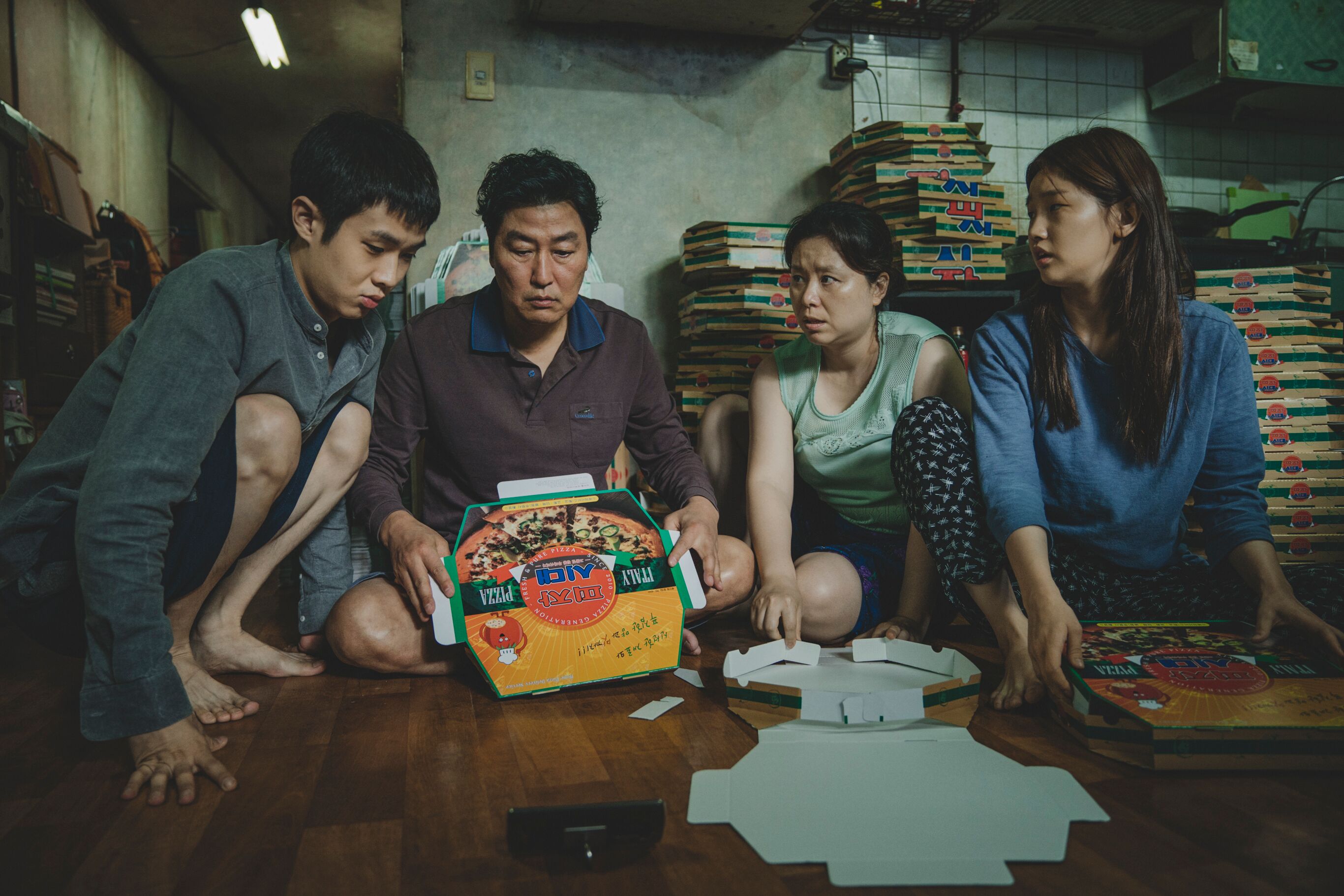
From the award-winning Korean film Parasite.

Movies can raise consciousness and lead to change, often positive change. Although the wonderful flic we watched last night, The Loins of Punjab, was mostly for laughs, I think some people would take away a heightened awareness of prejudice, and what it can be like to live in a society where too many people see a terrorist behind every brown skin.

Today’s post is about a hopeful side effect of the award-winning Korean movie Parasite, which led the government to look into the plethora of barely habitable basement apartments dividing the country’s haves and have-nots — and begin to make a plan.

As Monica Castillo wrote at Hyperallergic in February 2020, “Weeks after Bong Joon-ho’s historic win at the Oscars, his film Parasite is still making headlines. … Parasite may now pave the way for housing reform in South Korea.

“The country’s government announced it would launch an initiative to help families like the movie’s working-class Kims to improve housing conditions. The Korea Herald reports that the South Korean government, Korea Energy Foundation, and the Seoul Metropolitan Government will offer ‘3.2 million won per household to enhance heating systems, replace floors, and install air conditioners, dehumidifiers, ventilators, windows, and fire alarms’ to 1,500 families in semi-basement apartments who make less than 60 percent of the median income. …

“In Parasite, the Kims live in a cramped, dingy semi-basement apartment that becomes easily flooded when heavy rains fall. They envy the wealthier Park family that lives in an elevated area with a spacious modern mansion, and hatch a plan to get each member of the Kim family in the employment of the Parks. …

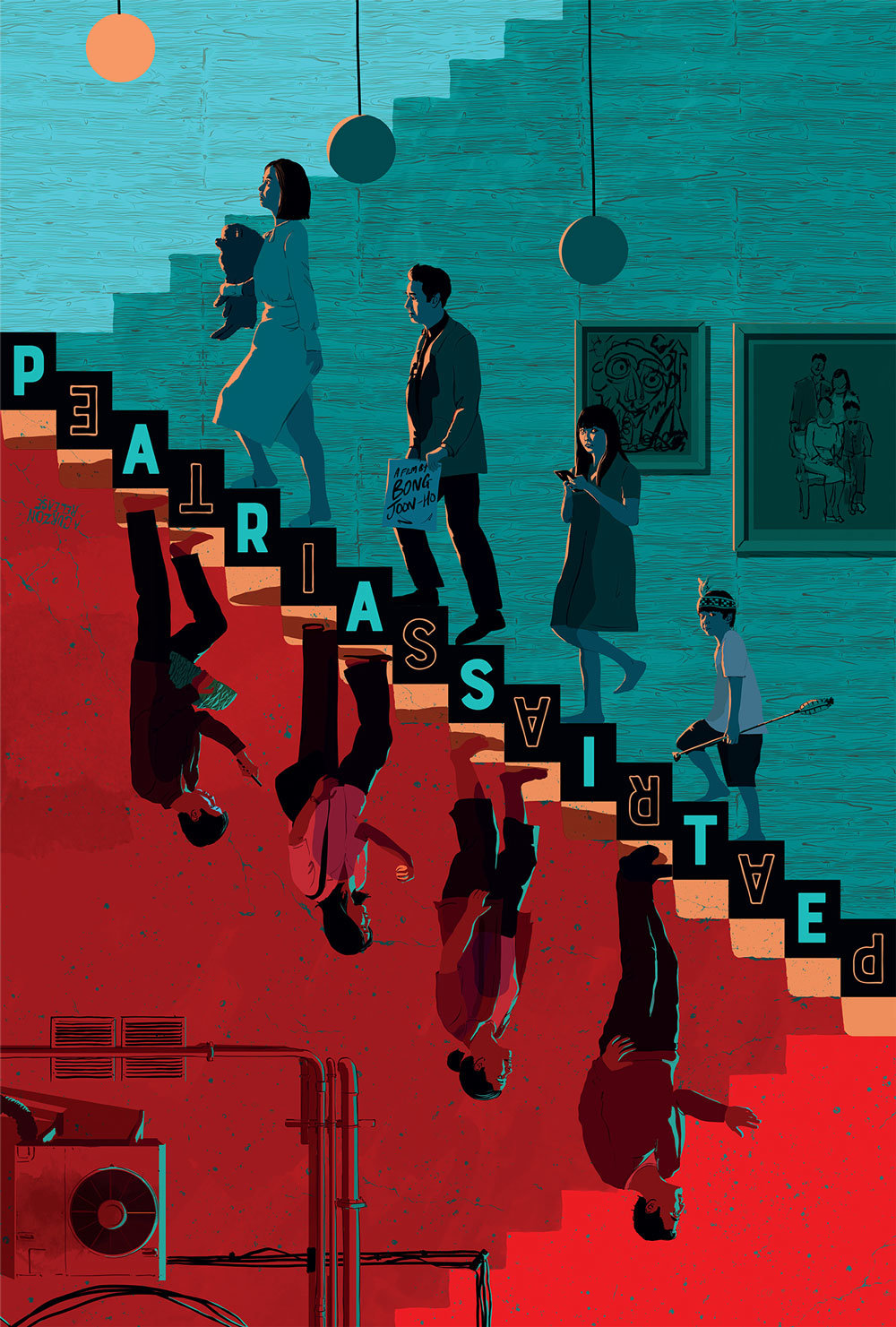
“The film’s clear class distinction between the haves and the have nots also inspired many designers. In a look at the fan art and advertising inspired by the movie, Mubi found several instances where artists visually interpreted the movie’s theme on class through metaphors. Parasite’s attention to architecture featured in a number of the pieces, as several artists incorporated both Park and Kim family homes into their designs. The works ranged from digital illustrations both intricate and deceptively simple to photographic composites reimagining the movie’s many twists and turns. 

“Even in the official movie poster, there are hints of a difference between the two families, as the post points out that the Kims have black censor bars over their eyes and the richer Parks have white censor bars. For the French release not long after its Cannes premiere, the Parasite poster featured the Kim family barefoot and the Parks in shoes, a nod to their well-heeled background.”

More at Hyperallergic, here.

At Mubu, you can check out posters the movie inspired and the emphasis on inequality. What an array! Adrian Curry wrote, “All great works of art inspire more great art and Parasite has been a gloriously fecund host for poster designers to feed off, inspiring ingenious commercial campaigns and fan art alike. The original Korean poster — the first glimpse any of us got of this soon-to-be sensation back [in April 2019] — was designed by Kim Sang-man, a film director (Midnight FM), art director (Joint Security Area), and composer. …

“Its placid yet ominous domestic scene, rendered undeniably creepy by the censor bars across the protagonists’ eyes … featured half the major players (not least that boxy, modernist home, the ultimate star of the film) and a number of significant objects (the teepee, that ornamental rock, those legs…) without giving much of the game away. One thing I didn’t register until quite recently is how the bars across the eyes are color-coded by family: black for the Kims, white for the Parks.”

I didn’t see Parasite. Did you? Did you think it made a case for affordable housing? A case against inequality?

Read Full Post »

Photo: Kino Lorber.
The film The Village Detective: A Song Cycle, directed by Bill Morrison, is a project that got started after an Icelandic fisherman pulled up an old Soviet movie from the depths.

Remember this post on repurposing 1980s photos of New Orleans street life damaged by Hurricane Katrina in 2005? Today’s story on waterlogged 35mm film found by a fisherman reminds me that creative people keep discovering ways of working with damaged art to convey deeper messages. It’s as if the lost island of Atlantis wants to break through to our modern world.

Dan Schindel reports at Hyperallergic, “In 2016, a fisherman dredged up a case off the coast of Iceland that contained four reels of decades-old 35mm film. It looked like the beginning of an inspirational story about a precious movie rediscovery. But, anti-climactically, he’d merely found pieces of the 1968 Soviet mystery-comedy Derevenskiy Detektiv (‘Village Detective’) — which was, as filmmaker and historian Bill Morrison puts it, ‘not lost, rare, or even, to my mind … particularly good.’

“But such an unusual event still deserved scrutiny. What circumstances led this particular film to this completely unexpected place? Morrison’s investigation resulted in his new film The Village Detective: A Song Cycle.

“Morrison constructs his films — such as Decasia (2002) and The Great Flood (2013) — from raw, unrestored fragments of celluloid. In 2016’s Dawson City: Frozen Time, he told the story of a much more exciting rediscovery, how hundreds of lost films were dug up from under a skating rink in the Yukon. He showcases the images of these movies with every scratch, fade, and blur included.

“Each film print records two stories: the one a crew conjured together however long ago, and the record of everything that’s happened to the strip since its creation. The vagaries of the projection, transportation, and preservation of physical film leave it vulnerable to damage. Many archival projects focus on the first story, but Morrison is interested in both. …

“Finding some reels of Village Detective may not in itself be remarkable, but this specific reel has its own unique story, and Morrison finds value in that. His interrogation of the water-warped images becomes a rumination on mortality.

Village Detective starred Mikhail Zharov. To several 20th-century generations of Russians, he was a vital figure, an acclaimed and popular actor who worked with many of the titans at the forefront of Soviet cinema development, including Sergei Eisenstein. … Morrison was told about the fisherman’s discovery by his friend Jóhann Jóhannsson. …

“Through images of Village Detective and Zharov’s other films, as well as pieces from contemporary Soviet cinema and modern-day interviews with historians and preservationists, Morrison reconstructs the actor’s life and times, tracing the path of his career.

“The discovery of his work entombed at the bottom of the sea precipitates the audience’s own rediscovery of him — through the use of his films, that rediscovery becomes something like a resurrection. He’s dead, he’s gone, and yet there he is again. He may be hard to discern through the haze of distorted colors or the flurry of scratches, but you can appreciate the way he acts. …

“The past is supposed to just be what we remember, and yet in the act of watching a film, we are in communion with it. From what could have merely been a curiosity, Morrison constructs a haunted, haunting meditation.”

Whenever I see an offbeat movie like this (the most recent being Agnes Varda’s The Gleaners and I), I think of my friend Penny, now gone. She used to make offbeat, artsy but messy Super-8 films back in the ’60s, and I helped. Even though we both worked in the mornings, Penny was a great one for dragging me out of my apathy to go to downtown Philadelphia for a Kenneth Anger flic or an Andy Warhol. Sure do miss her.

More at Hyperallergic, here.

Read Full Post »

p1022720-720x540-1

Photo:
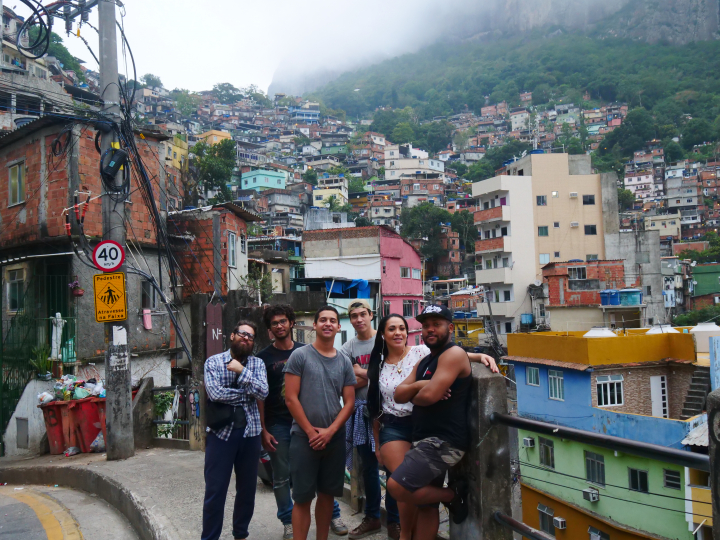
In a Brazilian favela, Rocywood actors pose with their screenwriter and their director.

The headlines from the slums of Brazil are hardly ever good. Between the gang violence and the police violence, there is frequent loss of life among innocent bystanders. So anytime I see something upbeat about these places — say, colorfully painted houses or musical instruments created from dump discards — I want to share the news.

This story is about the joy of making movies, even when the movies are about the harshness of life. It’s about the feeling of rising above it all.

Mariana Simões writes at Hyperallergic, ” Stacks of houses that showcase raw, exposed brick frame the rooftop view where I meet screenwriter Fabiana Escobar, or Bibi Danger, as she is known in Rio de Janeiro’s Rocinha, the largest favela in Brazil.

“With around 70,000 inhabitants, Rocinha is a vibrant community made up of low-income improvised homes built atop rolling hills that tower over Rio de Janeiro like a city within a city. Rocinha is also where, since 2015, Escobar and four other filmmakers have championed a budding film scene they call ‘Rocywood,’ combining Rocinha with Hollywood. Their Rocywood production company has one award-winning short under its belt and another short and two features in the making.

The films portray local realities, from the joys of growing up in a tight-knit neighborhood to the difficulties residents face living among drug traffickers and gun violence.

“ ‘When I was a kid, I stayed home to watch the Oscars on TV and I would marvel at every little detail. Hollywood creates that kind of magic that envelops us, even though it’s something that is so distant from our reality,’ Escobar says. …  ‘I grew up with that magic, but the industry doesn’t embrace Rocinha. We have to create our own magic. We are going to make it happen for ourselves.’

“The 38-year-old screenwriter used to own a salon and clothing store, but now rents out her shop while she dedicates her life to making Hollywood magic. But most of the people involved can’t afford to make movies full-time.

“ ‘The actors, the producers, the whole team has a second job. I am a manager at a clothing store, and I make films up here on the hill on the side,’ says Sergio Dias, Rocywood’s 31-year-old director. Dias was born and raised in Rocinha where he is known by his stage name, Sergio Mib. His one-bedroom apartment functions as a dressing room and houses Rocywood’s equipment and props, including three toy assault rifles that look impressively real.

“Rocywood’s productions cost $50 dollars (USD) on average. The filmmakers often take the budget out of their own pockets to cover transportation fees and snacks. With no dedicated financing, everyone in the community pitches in to make the films come to life, from lending filming equipment to styling hair and makeup for free at the local salon. Dias explains that Rocywood makes a conscious effort to include only people from favelas in its productions. The films, made for locals by locals, are screened on the streets of Rocinha using a projector and an improvised tarp as a screen, but are also available on YouTube for a worldwide audience to see. …

“I went in search of Rocinha’s low-budget Hollywood scene after meeting American filmmaker Alan Hofmanis by chance at a traditional Rio de Janeiro fast-food style chicken restaurant in the bustling tourist neighborhood of Copacabana. I struck up a conversation with him about his dessert and ended up learning about Wakaliwood, Uganda’s version of Hollywood, named after Wakaliga, the slum in Uganda’s capital of Kampala where the films are made.

“Eight years ago, after Hofmanis saw a trailer for a feature by Ugandan director Isaac Nabwana that mixed mafia gangs, kung fu, and gun fighting, he hopped on a plane to meet Nabwana. In 2013, Hofmanis sold everything he owned in New York and moved to Wakaliga, where he has been making movies with Nabwana ever since. Nabwana founded Uganda’s first action-film company, has produced about 45 films, and just had his feature Crazy World premiere at this year’s Toronto International Film Festival (TIFF).

“Fascinated by Nabwana and his ability to make kitschy action films with budgets around 65 dollars that still draw in millions of online viewers, Hofmanis searched the world for others like him. He found people in Ghana, India, Afghanistan, Peru, and even Siberia who are also making low-budget, Hollywood-inspired productions. He came to Brazil in the hopes of discovering the same scene in Rio de Janeiro. …

“The American filmmaker believes low-budget, Hollywood-inspired films are a growing phenomenon. … ‘They are taking something that is outside their reality and spinning it and making it their own,’ he says. ‘So maybe this [new movement] can be called the Micro Wave because it’s a New Wave movement, but it’s based on these micro-economies.’ …

“Escobar summarizes, ‘I decided our next feature will be a horror film to break free from that stigma that because I live in a favela, I can only make films about drug trafficking and violence. If we want to write about drug trafficking it will be a great film, but we can rock other narratives, too, and we want to break that barrier.’ ”

More at Hyperallergic, here.

Read Full Post »

01_yvesmarchandromain20meffre_repurposedtheaters_photovertical

Photo: Yves Marchand and Romain Meffre
Two French photographers spent years capturing the new uses of old movie theaters, like this one. Now a gym, the building was once famed as the Alhambra Theater of San Francisco.

Sometimes spectacular old buildings simply cannot be returned to their original purpose. Times change. But as I learned from pictures by two French photographers, many people value the old movie theaters and are giving them new life.

Michael Hardy writes at Wired, “Between the 1920s and the 1950s, Hollywood studios built thousands of ornate movie palaces in cities across the United States. Warner Bros., Paramount, RKO, MGM, and others competed to build the biggest and gaudiest cinematic cathedrals to showcase their big-budget blockbusters. In this vertically integrated era of filmmaking, when the major studios tightly controlled the production, distribution, and exhibition of movies, these palaces served as the showrooms in which they displayed their wares. Seating thousands of spectators, the theaters were decorated in a fanciful array of styles, including art deco, art nouveau, and ancient Egyptian.

“In 1948 the US Supreme Court found that such vertical integration violated the Sherman Antitrust Act and ordered the biggest movie studios to divest themselves of their theater chains. The decision spelled the end for the era of the movie palace, as the studios were forced to sell or close their theater holdings. Television and suburbanization — the grand old theaters were mostly located in downtown areas — provided the coup de grâce.

“One of the grandest of the old palaces was Detroit’s United Artists Theatre, a 2,000-seat, Spanish Gothic–style venue that showed movies from 1928 until the 1970s. French photographers Yves Marchand and Romain Meffre stumbled across the abandoned theater in 2005 while working on a series about the effects of deindustrialization on the city.

“Stunned by the building’s fading grandeur, Marchand and Meffre began traveling the country, seeking out other abandoned theaters to photograph.

‘The amount of fantasy and detail are amazing in some of the theaters,’ Meffre says. ‘I don’t think we have anything comparable in Europe except for our cathedrals.’ …

“After discovering some tastefully repurposed palaces, such as Brooklyn’s cavernous Paramount Theater—now used as a gymnasium by Long Island University—they expanded the scope of their project. Not all renovations were so sensitive. Marchand and Meffre shot palaces that have been transformed into grocery stores, office buildings, even school bus depots. …

“Because the palaces are so expensive to tear down, many have survived more or less intact, a process the photographer calls ‘preservation by neglect.’ ”

Funny. Here’s to life-saving neglect!

More at Wired, here.

Read Full Post »

Older Posts »