Feeds:
Posts
Comments

Posts Tagged ‘Nairobi’

Photo: Malin Fezehai for the Washington Post.
Steve Otieno (described below) rehearsing with the Ghetto Classics orchestra in Kenya.

Charitable work is complicated. It is not always possible to do the good for people that you intend. But if you are making a meaningful difference in some lives, that may be enough.

In Kenya, an orchestra called Ghetto Classics aims to help poor children achieve something fine and eventually move away from the dangers of their extreme poverty.

Katharine Houreld writes at the Washington Post about both the successes and failures of the orchestra.

“The violin’s quaver steadied and swelled through the gloomy concrete staircase, escaped through the wire mesh and soared over the packed-dirt playground before dissipating in the acrid smoke drifting in from the smoldering dump site next door.

“It was the last day of class before Ghetto Classics broke up for Christmas, and 14-year-old Steve Otieno was practicing his Christmas carols for his final performance of 2024. Undeterred by the demolition of his home last month, the floods that devastated his neighborhood in Nairobi this year, or the eye-watering stink of burning plastic all around him, he stroked the strings to coax forth each note of ‘Joy to the World.’

“ ‘Music makes me feel calm when I’m stressed,’ he said shyly. ‘Some people have drugs. For me, it is music.’

“Steve is one of thousands of children from the poorest neighborhoods of the Kenyan capital who have been introduced to classical music by Ghetto Classics. The organization was set up in 2008 by Elizabeth Njoroge, a classically trained singer who studied pharmacology at her parents’ urging but longed to return to music. A chance encounter with a priest trying to fund a basketball court at a Catholic school in the Nairobi slum of Korogocho inspired her to raise money for the first class of musicians there. …

“Now Ghetto Classics provides lessons to about 1,000 students, who feed three orchestras, a choir and a dance group. Njoroge raises funds to support its expanding programs.

“Ghetto Classics works in schools and community centers in Nairobi and Mombasa, but its headquarters is in the St. John compound in Korogocho, where a church, school and community all share space. A tarmacked basketball court and a dirt field for soccer are enclosed by a sagging chain-link fence and scraggly trees; on one side of the compound, the children have planted a garden to try to filter out the choking smoke.

“Ghetto Classics has performed for former president Barack Obama, first lady Jill Biden and Pope Francis. Alumni are studying in the United States, Britain and Poland.

They include one determined pianist who learned to play by watching videos and repeating the motions on a piece of cardboard on which he’d drawn keys.

“The lessons provide a refugee for students suffering from hunger, domestic violence and crime, said violin instructor David Otieno, who is not related to Steve. He joined the program a decade ago as a student; now he’s one of 45 graduates working as paid instructors.

“The tall, dreadlocked 29-year-old credits Ghetto Classics with saving him from the neighborhood gangs. He witnessed his first homicide when he was still in primary school, and as he grew up, the gangs sucked in friend after friend. His teachers became so worried he’d be killed, he said, that they collected money to move his mother and six siblings to a safer neighborhood where he could continue his music.

“Back then, he said, the group shared 10 violins among 30 students. Now he has his own instrument. Once shy and fearful, he has played in Poland, in the United States and at State House, the Kenyan president’s home in Nairobi.

“ ‘The violin gives you a voice,’ he said. ‘It makes you talk to people you’d never otherwise talk to.’ His students filed into the compound bumping fists.

“Thousands of kids enroll in Ghetto Classics, but most fall away. The discipline is demanding. … About a dozen young musicians who spoke to the Washington Post said their parents had never seen them perform. Some were single parents too busy working, some weren’t interested and some were actively opposed. …

“When opera singer David Mwenje started with Ghetto Classics, his father was skeptical, he said, but he came to see him perform and was won over — a bittersweet memory to which Mwenje clings now that his father has died.

“Mwenje sang for six years, including for Pope Francis at the Vatican, before turning professional in 2021. His first audition landed him the role of Okoth — a messenger who must tell a village medicine man that his daughter has taken up with foreign missionaries — in Nyanga: Runaway Grandmother with Baraka Opera Kenya at the Kenya National Theatre. It was the first ray of hope in years darkened by his father’s death and the covid pandemic that shuttered his school, he said.

“ ‘Through this opera, I could control all my pain,’ he said. ‘I also love to sing “Bring Him Home,” from Les Misérables, because the song reminds me of my dad and I feel like I’m pleading with God to bring him home.’ ”

More at the Post, here.
Read Full Post »

Photo: Edwin Ndeke/The Guardian.
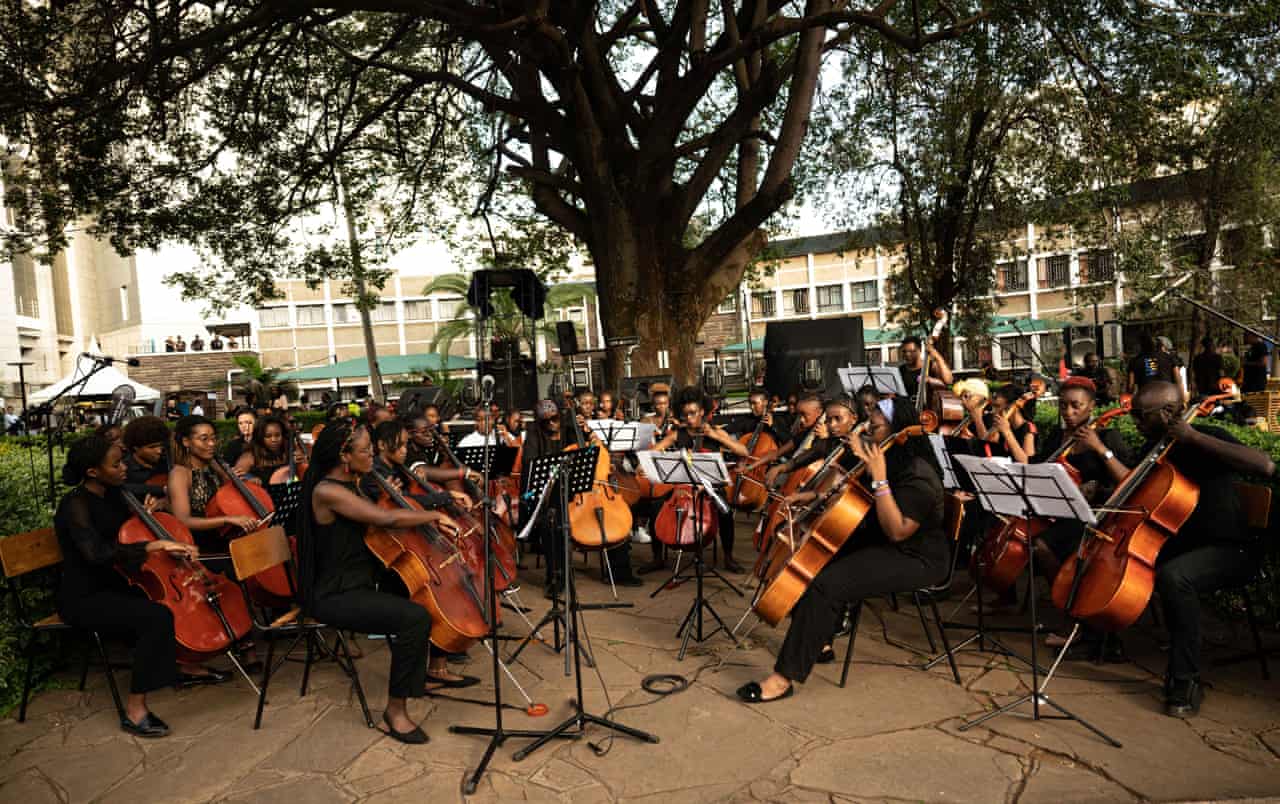
Kenyan classical musicians gave an outdoor performance in Nairobi recently. Cellist Yo-Yo Ma also performed that day. 

Do you know the cellist Yo-Yo Ma? He seems to be performing in a different country every day, and often he’s performing for charity. I follow him on Instagram, and I’m always amazed.

Caroline Kimeu wrote at the Guardian in June about Yo-Yo Ma’s recent visit to Kenya.

“Nairobi’s bustling Kenyatta market is an unlikely place to hear classical music. Yet playing today in front of stalls where butchers roast meat and hairdressers compete over heads to braid is a very surprising busker: the distinguished cellist Yo-Yo Ma. Playing ‘Over the Rainbow’ alongside Kenyan percussionist Kasiva Mutua, he matches his cello to her beats in a truly eclectic mix.

“Ma’s broad artistic sensibilities make weaving together the diverse musical traditions of drum and cello seem like a natural fit. ‘It was symbolic to introduce [classical] music to the crowd through something they know and understand,’ says Mutua. ‘Africans understand rhythm to their core.’ …

“Nairobi is Ma’s last stop of his Bach Project – a five-year, six-continent global tour. With its rising cultural and artistic scene, organizers say the city was near the top of the cellist’s list.

“The project marked Ma’s ambition to connect cultures and people across the world, performing Johann Sebastian Bach’s cello suites in 36 countries. …

“Bach’s cello suites were not well known by the time of the composer’s death in 1750. They began to resurface nearly a century later, and were brought to prominence in the 1930s when Pablo Casals, one of the world’s most highly regarded cellists, performed and recorded the neglected suites.

“Ma has recorded interpretations of the suites three times, with more than a decade between each.

“They are wrapped up with his life’s memories, he has said, citing his first encounter with Bach’s music when he was four: his father, Dr Hiao-Tsiun Ma, taught him the first suite in small, incremental steps. …

“ ‘For almost six decades, they have given me sustenance, comfort and joy during times of stress, celebration and loss,’ Ma wrote at the start of the Bach Project in 2018. ‘What power does this music possess that even today, after 300 years, it continues to help us navigate through troubled times?’

“Beyond busking, Ma takes to a more conventional stage with a concert at the Kenya national theatre. His audience now is a classical crowd – the [$145] auditorium tickets sold out in 24 hours – with prominent members including the arts minister, Ababu Namwamba, and the US ambassador, Meg Whitman. …

“Ma plays as though he is the only person in the room. Only the loud applause breaks through to him, earning his bow and embrace of the audience, arms flung wide. The solemn, lonely fifth cello suite – his penultimate performance – makes the auditorium fall silent.

“From a viewing room on the upper balcony, Brian Kivuti, a 34-year-old Kenyan jeweler, listens with closed eyes. ‘For me, it was a practice in presence,’ says Kivuti. ‘There are no lyrics telling you how to feel. It’s just the music and you, feeling your way through, so you pay more attention to how the notes make you feel. …

“ ‘When I started to listen with my body, I could feel notes of hope, the quiet of a Sunday morning, the dizziness of preparing for a party. The rise and fall of the notes allow you to tap into more than just everyday feelings.’

“At the theatre’s Wasanii restaurant, workers perched on rooftop balcony seats to watch a screening of the performance. For Margaret Wanjiru, a 22-year-old waitress, Ma’s music is a far cry from what she knows, such as her tribe’s Mugiithi. ‘It may not be the music I grew up with, but it slows you down, however much you’re busy, and allows you to get lost in your thoughts.’

“The Nairobi Orchestra, one of the oldest in Africa, performs ahead of Ma’s set, and its musicians are thrilled to have him in the auditorium. Violinist Bernadette Muthoni says: ‘For me, it was very huge to think that Ma was going to play just a few metres from where we were. He’s what a lot of us aspire to.’ …

“Ma is increasingly interested in using his work for social impact. He played outside the Russian Embassy in Washington DC last year to protest against its war in Ukraine, and dedicated his Songs of Comfort to providing solace for people during the difficult days of the pandemic.”

More at the Guardian, here.

Read Full Post »

Photo: Nick Migwi/ CNN.
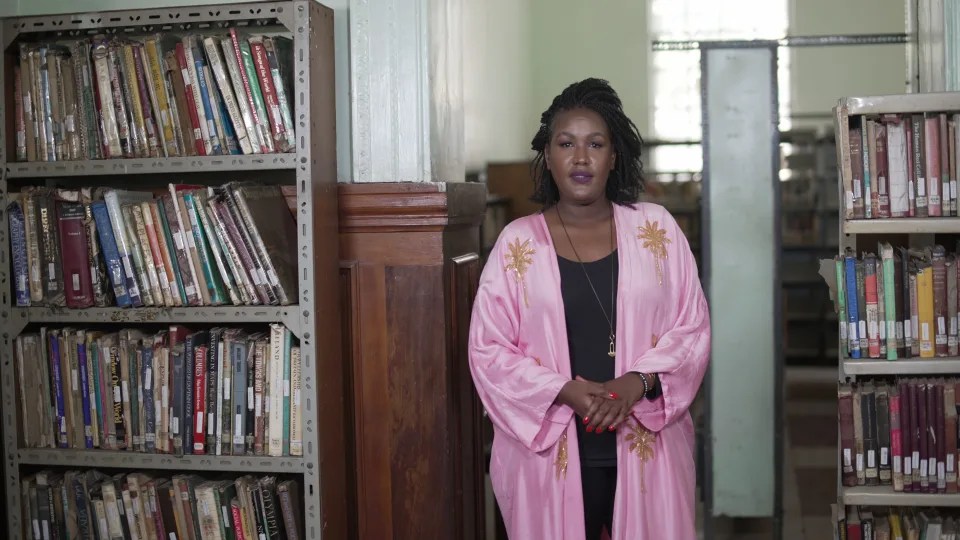
“I think that libraries are great equalizers,” says Book Bunk co-founder Angela Wachuka in Nairobi, Kenya.

Like many of you, I’m a big fan of reading books. In my family, I’ve always been known for gifts of books — books that I nearly always have read first so that I know they are right for the recipient. My aunt said she looked forward to the gifts no one else gave her on her birthday.

When I was a train commuter, I bought lightweight paperbacks to read while traveling, but after retirement, I became a devotee of the library, a place of magic, as blogger Laurie Graves knows more than most.

In recent years, Kenyan fans of libraries have been working to make them as accessible and lovely as possible.

Abdi Latif Dahir writes at the New York Times, “In 1931, the first library in Kenya’s capital, Nairobi, opened its doors — to white patrons only. Nearly a century later, Kenyans dressed in the slinky gowns, flapper headpieces and tweed suits of that era streamed into the now-dilapidated space in a celebration that was part fund-raiser for the remodel of the iconic building, part reclamation of the city’s public libraries as ‘palaces for the people.’

“ ‘Our public libraries can be glamorous spaces of storytelling,’ said Angela Wachuka, a Kenyan publisher. But, she added, ‘we are here to also reclaim history, to occupy its architecture and to subvert its intended use.’

“The restoration of the McMillan Memorial Library and others in the city was the brainchild of Wachuka and the novelist Wanjiru Koinange, who founded Book Bunk, a Kenyan nonprofit, in 2017 to restore and reclaim the city’s public libraries. The aim was to leave behind their excluding past and remake them into inclusive spaces. … Among their goals is to bring more books in African languages to the libraries, and incorporate services catering to those with visual, physical or reading disabilities. …

“As the guests streamed into the gala, in December, organizers urged them to think of themselves as ‘rebellious gate-crashers’ who, while dressed as those in the past, were about to embark on a radically different future in which libraries are an essential public good.

“Nairobi, a fast-growing city of over four million people, has very few bookstores or well-funded libraries. Book Bunk’s work comes amid heated conversations about urban design and about how corruption and colonial systems continue to shape the way public infrastructure and spaces are designed and who gets access to them.

“ ‘In the case of Nairobi, there’s almost an acceptance that certain social divisions should exist across social classes and different societal groups,’ said Constant Cap, an urban planner who has collaborated with Book Bunk in the past.

“Restoring public libraries, he said, could be an opportunity to break those barriers and bring together people from different socio-economic, ethnic, racial and religious backgrounds.

“For Wachuka and Koinange, the journey began a decade ago as they searched for a venue to host an event for the Kwani? [a literary magazine] literary festival. The two thought the McMillan library — built by Lady Lucy McMillan as a memorial to her American husband, Sir Northrup McMillan, and later bequeathed to the Nairobi City Council — would be an ideal venue given its centrality and connection to the city.

“But when they walked in, Wachuka said, they were surprised to see its crumbling state: Its interior neoclassical architecture was fading, its floors and walls were in ruinous condition and its collections were gathering dust.

“While they found another location for the event, the two immediately began researching the history and management structure of the McMillan library, and soon after, left their jobs to focus full time on its restoration.

“One of their earlier discoveries was that the McMillan library was the first of a series of other libraries built in the city. Only two were still open: the Makadara and Kaloleni libraries, in the city’s low-income eastern suburbs.

“After forming a partnership with the Nairobi city administration in 2018, Book Bunk first focused on restoring the two smaller libraries, prioritizing the needs of the communities there.

“The two branches have since reopened, with the Makadara library hosting storytelling sessions, film screenings, music performances and a literary festival. The Kaloleni branch is in a neighborhood built in the 1940s by Italian prisoners of war, and has become a hub for youngsters to do their homework and participate in workshops that help them, for example, learn how to make money using their creative talent.

“Joyce Nyairo, a Kenyan academic and cultural analyst, said that the restored libraries have the chance to be ‘great equalizers,’ particularly for people from disadvantaged backgrounds.”

More at the Times, here. I love the idea of asking Kenyans to envision themselves as “gate crashers” into spaces that should always have been theirs. Makes me think of One-Eyed Connelly, a famous gate crasher whose name my father borrowed for a pigeon that was always walking through our open doors.

Read Full Post »

I like this story about a couple of idealistic young men who have created fair-wage, environmentally sustainable textile jobs in the United States with the help of customers’ T-shirt collections. Their company, Project Repat, is “repatriating” some textile jobs lost overseas years ago.

From the website: “Project Repat story starts in Nairobi, Kenya, where Project Repat co-founder Ross Lohr was doing non-profit education work. After sitting in traffic for 2 hours, he discovered the cause of the jam: an overturned fruit and vegetable rickshaw pushed by a Kenyan man wearing a t-shirt that said ‘I Danced My Ass Off at Josh’s Bar Mitzvah.’

“Amazed by all the incredible t-shirts that get sold off and sent overseas by non-profit and for-profit companies in America, [Nathan Rothstein and I] began working with Kenyan artisans to design new products out of castaway t-shirts, including bags, scarves, and re-fabricated t-shirts. Those products were ‘repatriated’ (or returned to the country of origin) back to the United States and sold to raise money for non-profits working in East Africa.

“When trying to sell our upcycled products at markets in Boston, we quickly discovered the difference between a ‘good idea’ and a real business: while potential customers liked the idea of a repatriated upcycled t-shirt bag, they didn’t like it enough to actually buy it. What customers did ask for, time and time again, was an affordable t-shirt quilt.

“We had heard enough: instead of shipping goods all around the country, why not create fair wage jobs in the United States and create a product that has a lot of meaning for customers? As they say, the rest is history. Rather than ‘repatriating’ t-shirts back to the United States, Project Repat creates a high quality, affordable t-shirt quilt with minimal carbon impact.”

The factories are located in cities once-renowned for textiles: Fall River, Massachusetts (where “Precision Sportswear has been able to succeed by specializing in custom work and smaller production runs for made-in-USA. companies”), and Morgantown, North Carolina (where “each worker at Opportunity Threads is part of a collaborative working model, [and] each employee adds input to the production process and has the opportunity to earn an ownership stake in the company”).

I was not able to find on the website what happened to the artisans in Africa when the company’s focus changed. Ping @lunastellablog1 if you know.

On this Repat page, you tell the company what size quilt to make with your T-shirts, what size panels, and what color PolarTec backing you want.

Photo: Project Repat

Read Full Post »

In February, Treehugger posted an article on sustainable husbandry in Africa by Charlotte Kaiser, of the Nature Conservancy’s NatureVest arm.

“For thousands of years,” she writes, “the pastoralist communities of northern Kenya have herded their cattle alongside elephants and zebras, the grass of the rangelands shared between livestock and wildlife in relative balance. In recent decades, climate change, habitat loss, and human population growth have combined to erode that balance, leading to overgrazing and the degradation of the grasslands that both humans and wildlife need to survive.

“For over a decade, the Northern Rangelands Trust (NRT) has worked with the communities of Northern Kenya to develop community conservancies that support better management of cattle and grass. …

“A key tool in driving the better management of the rangelands is access to markets. … In 2008, NRT created the Livestock to Markets program (LTM), which brought the market to the Conservancies. In exchange for conservancies achieving specific targets in conservation, LTM buys cattle directly from the conservancies, purchasing several hundred head at a time from dozens of households. Providing access to markets allows pastoralists to better manage their herd sizes, since they know they can sell animals when they need to at a fair price. And LTM also encourages the herders to bank their cash, bringing mobile banking representatives to market days so herders can open bank accounts with the proceeds from the sale.

“Once the cattle are purchased, NRT treks the animals to Lewa Conservancy, a partner NGO. After six weeks of quarantine, the animals move to Ol Pejeta Conservancy, another partner, where they are fattened on grass for 15 months, improving the size and quality of the animals. Finally, the animals are [sold] into the Nairobi meat market. By capturing much of the full value of the supply chain, NRT can pay a levy on every animal they buy to the conservancies themselves. This levy funds conservancy investments in wildlife guards, ecotourism lodges, and community facilities like clinics and schools.” Check out the full article here, and the lovely pictures.

Photo: Ron Geatz
Livestock is the primary measure of wealth among herding communities of northern Kenya.

Read Full Post »

A new exhibit organized by the Cooper-Hewitt National Design Museum in New York demonstrates the power of design to make life better for disadvantaged people.

“This is a design show about remaking the world … And that’s thrilling,” writes Michael Kimmelman, “whether it’s happening in Cupertino, Calif., or Uganda, where H.I.V. infects hundreds of people a day, and the latest news cellphone-wise has been the design and distribution of a text-messaging system that spreads health care information.

“In Kibera, an area of Nairobi, Kenya, and one of the densest slums in Africa, the challenge was different. Traditional wood and charcoal fires cause rampant respiratory disease there. Refuse fills the streets. So a Nairobian architect designed a community cooker, fueled by refuse residents collect in return for time using the ovens.

“From cellphones and cookers to cities: in Thailand, a public program called Baan Mankong Community Upgrading has, for the last eight years, been improving conditions in hundreds of that country’s 5,500 slums, bringing residents together with government and nongovernment agencies to design safer, cleaner places to live.”

Read more in the NY Times.

You will also enjoy reading about slum (favela) painting in Brazil and what a new coat of paint can do for building residents’ skills while lifting their spirits.

Read Full Post »

Nicholas Kristof writes in the NY Times about a Kenyan called Jane, who was pushed out when her husband took a second wife and who found herself supporting her children through prostitution. That is, until she joined a remarkable nonprofit and made a better life for herself through sewing. She takes used wedding gowns and bridesmaid gowns and cuts them up to create several smaller dresses that she can sell.

Kristof writes that in 1999, Jane was fortunate to find “an antipoverty organization called Jamii Bora, which means ‘good families’ in Swahili. The group, founded by 50 street beggars with the help of a Swedish woman, Ingrid Munro, who still lives in Nairobi, became Kenya’s largest microfinance organization, with more than 300,000 members. But it also runs entrepreneurship training, a sobriety campaign to reduce alcoholism, and a housing program to help slum-dwellers move to the suburbs.” Jane became an entrepreneur, was able to get her children into good schools, and rejoiced to see them thriving.

But as Kristof explains, the lives of the working poor tend to remain one accident or illness away from upheaval. Jane’s daughter was hurt in a traffic accident and treatment for the injury sucked up all Jane’s savings, affecting her ability to pay for school.

Kristof likes to go beyond traditional reporting in his columns and give readers a way to help, so you might want to check his blog.

More on Jamii Bora:


Read Full Post »