Feeds:
Posts
Comments

Posts Tagged ‘native plants’

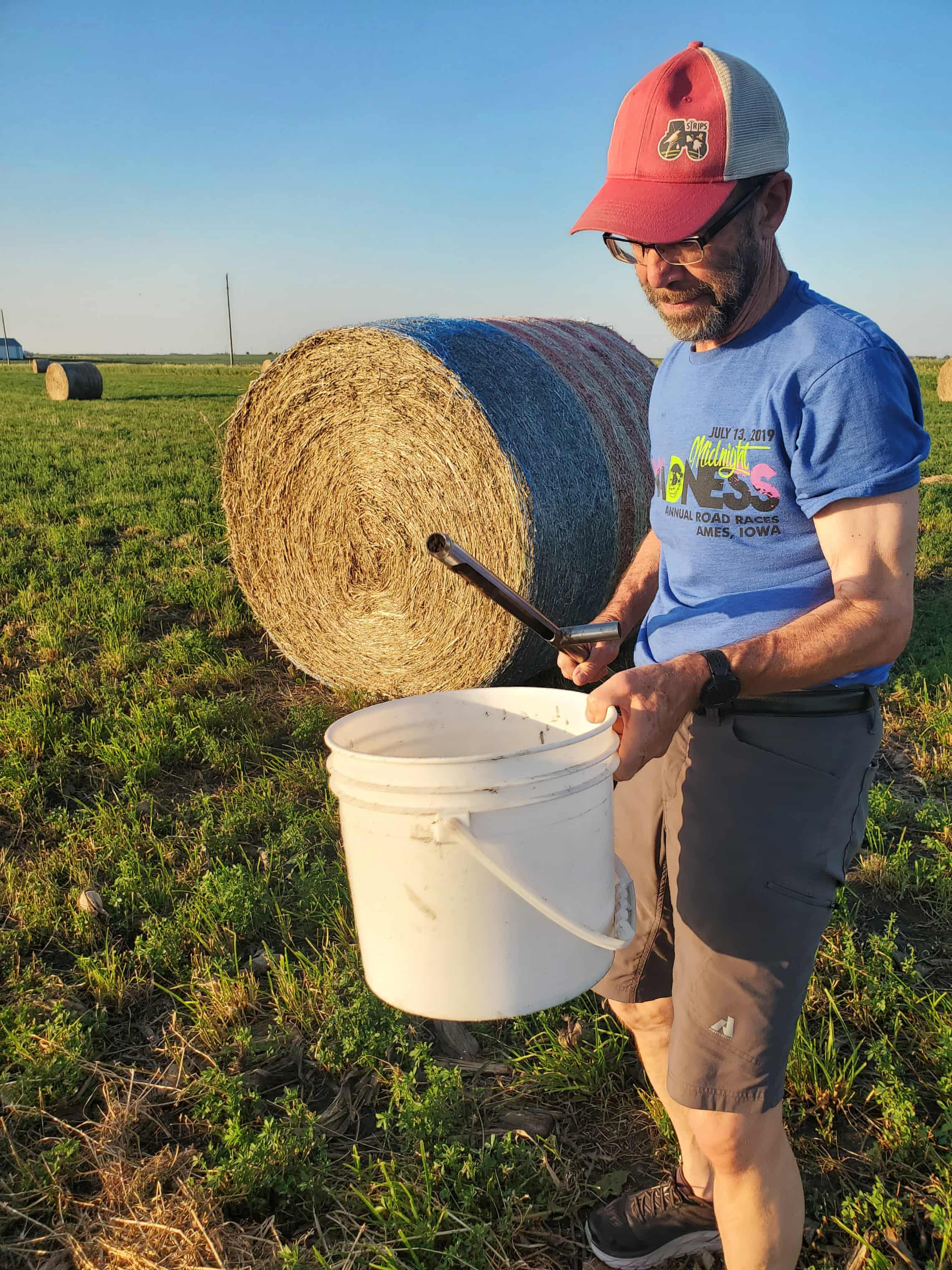
Photo: Lee Tesdell.
Behind farmer Lee Tesdell in the photo are rolled-up strips of prairie sod containing native plants that help improve his land’s resistance to climate change. 

There are so many things we have taken for granted in our natural world. Consider weeds. We might have noticed that various flying things liked their blossoms, but we didn’t like them.

That is, until we started noticing that we wouldn’t have much food if those flying things didn’t pollinate plants.

Now some farmers who used to kill weeds are bringing them back. As Rachel Cramer reports at the Guardian, strips of native plants (weeds) on as little as 10% of farmland can reduce soil erosion by up to 95%.

“Between two corn fields in central Iowa,” she writes, “Lee Tesdell walks through a corridor of native prairie grasses and wildflowers. Crickets trill as dickcissels, small brown birds with yellow chests, pop out of the dewy ground cover. …

“This is a prairie strip. Ranging from 10-40 metres (30-120ft) in width, these bands of native perennials are placed strategically in a row-crop field, often in areas with low yields and high runoff. Tesdell has three on his farm.

“He points out several native plants – big bluestem, wild quinine, milkweed, common evening primrose – that came from a 70-species seed mix he planted here six years ago. These prairie plants help improve the soil while also protecting his more fertile fields from bursts of heavy rain and severe storms, which are becoming more frequent.

“ ‘To a conventional farmer, this looks like a weed patch with a few pretty flowers in it, and I admit it looks odd in the corn and soy landscape in central Iowa,’ … he said. ‘I’m trying to be more climate-change resilient on my farm.’ …

“Prairie strips also help reduce nutrient pollution, store excess carbon underground and provide critical habitat for pollinators and grassland birds. Thanks to federal funding through the USDA’s conservation reserve program, they’ve taken off in recent years.

“But the idea started two decades ago with Iowa State University researchers and Neal Smith National Wildlife Refuge managers. Lisa Schulte Moore, a landscape ecologist and co-director of the Bioeconomy Institute at Iowa State University, who was integral to the research, knows that large patches of restored and reconstructed prairie are vital, especially for wildlife, but she argues that integrating small amounts of native habitat back into the two dominant ecosystems – corn and soya beans – can make a big difference. …

“In north-central Missouri, farmer Doug Doughty has been adding and expanding conservation practices, like no-till, for decades. He also has a few hundred acres of prairie enrolled in the USDA’s conservation reserve program. This past winter, he added prairie strips, as part of a plan to tackle nutrient pollution. High levels of nitrates and phosphorus can wreak havoc on aquatic habitats and the economies that depend on them. There are also health risks for people. Nitrates in drinking water have been associated with methaemoglobinaemia or ‘blue baby syndrome,’ and cancer. …

“During an outreach event in the Iowa Great Lakes region, Matt Helmers uses a rainfall simulator to demonstrate runoff and erosion with different conservation practices. He’s one of the prairie strips researchers and director of the Iowa Nutrient Research Center at Iowa State University. …

“During a big rain storm, each prairie strip in a field acts like a ‘mini speed-bump,’ said Helmers. A thick wall of stems and leaves slows down surface water, which reduces soil erosion and gives the ground more time to soak up water. Below ground, long roots anchor layers of soil while absorbing excess water, along with nitrates and phosphorus.

“Farmer Eric Hoien says he first heard about the conservation practice a decade ago, right around the time he was becoming more concerned about water issues in Iowa. But the final push to add 24 acres of prairie strips came from something Hoien saw in an plane above the Gulf of Mexico.

“ ‘I looked down and for what was probably 20 minutes, it was just like the biggest brown mud puddle I’d ever seen. And so I knew that, that stuff they say about the dead zone, from 30,000 ft, was real,’ Hoien said. …

“Hoien says prairie strips offer other benefits close to home. Neighbors often tell him they appreciate the wildflowers and hearing the ‘cackle’ of pheasants. He also enjoys hunting in the prairie strips and spotting insects he’s never seen before.

“The strips are hugely beneficial for pollinator populations, which have been dropping around the world. Researchers point to a combination of habitat loss, pesticide exposure, parasites and diseases, along with warmer temperatures and more severe weather events due to climate change.

“ ‘If we can help them have a place to live and something to eat, they can be better equipped to cope with those kinds of stress that they’re inevitably going to encounter in their environments,’ says Amy Toth, who is also part of the prairie strips research team and an entomology professor at Iowa State University. Research shows both the diversity of pollinator species and overall numbers are higher in prairie strips compared to field edges without native plants.

“And strips of native plants aren’t just good for pollinators. Researchers, including Schulte Moore, found a nearly threefold higher density of grassland birds on fields with prairie strips. She says that grassland birds have declined more than any other avian group in North America since 1970. …

“Schulte Moore says a group of forward-thinking, innovative farmers and partnerships with non-profits, foundations, universities and agencies in the midwest have helped prairie strips gain traction, but then a ‘monumental shift’ happened with the 2018 Farm Act, when prairie strips became an official practice in the federal conservation reserve program.” More here.

Pray that these federal conservation programs are not already slashed.

And for more on the prairie’s vast potential, read about Buffalo Commons, a movement launched by my husband’s classmate and his wife in the 1980s, here.
Read Full Post »

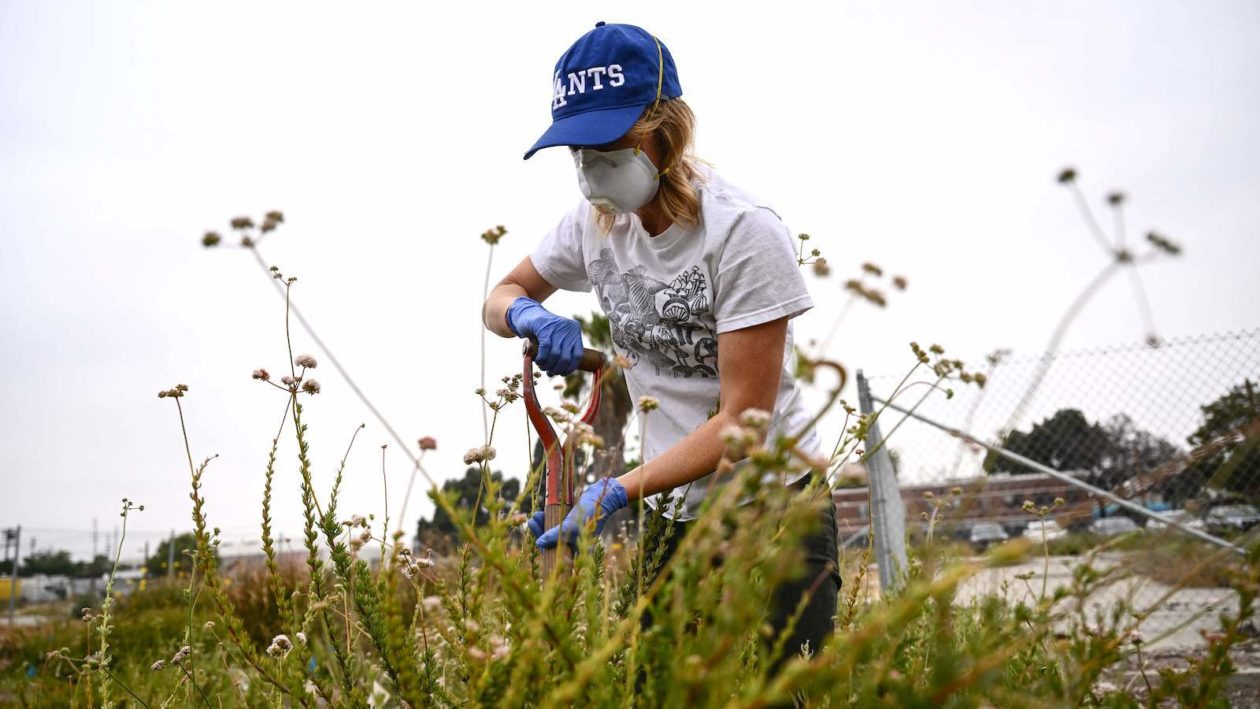
Photo:  Patrick T. Fallon/AFP via Getty Images.
Researcher Danielle Stevenson digs up California buckwheat grown at a brownfield site in Los Angeles.

Given the mess we humans make of the environment, I have to be grateful that we can learn ways to clean things up. And to be fair, we don’t always realize we’re making a mess until it’s too late.

Richard Schiffman at Yale Environment 360, explains one new technique for cleaning things up: harnessing the power of fungus.

“The United States is dotted with up to a million brownfields — industrial and commercial properties polluted with hazardous substances. These sites are disproportionally concentrated near low-income communities and communities of color, according to the Environmental Protection Agency, and researchers predict that heavy rains and flooding due to climate change are likely to both spread and increase exposure to these contaminants.

“For more than 15 years, Danielle Stevenson, who holds a PhD in environmental toxicology from the University of California, Riverside, has been pioneering a nature-based technique for restoring contaminated land, using fungi and native plants to break down toxins like petroleum, plastics, and pesticides into less toxic chemicals.

“The usual way of dealing with tainted soil is to dig it up and cart it off to distant landfills. But that method is expensive and simply moves the problem somewhere else, Stevenson says in an interview with Yale Environment 360, ‘typically to another state with less restrictive dumping laws.’

“In a recent pilot project funded by the city of Los Angeles, Stevenson, 37, working with a team of UC Riverside students and other volunteers, significantly reduced petrochemical pollutants and heavy metals at an abandoned railyard and other industrial sites in Los Angeles. While her research is still in its early stages, Stevenson says she believes her bioremediation methods can be scaled up to clean polluted landscapes worldwide.

Yale Environment 360: I understand that you grew up on the shores of Lake Erie in a highly polluted area.

Danielle Stevenson: The Cuyahoga River, near Lake Erie, used to catch on fire from oil spills. There’s a huge amount of industrial agricultural runoff that leads to toxic algae blooms. The second-largest floating plastic island of the Great Lakes is in Lake Erie.

“But I was surprised to see abandoned oil refineries and factories with trees, plants, and mushrooms growing. I mean, they’ve found fungi growing in Chernobyl in a melted down nuclear reactor. I’ve been on sites that look so desolate and bleak, where the air smells like diesel. It looks like nothing could possibly live there. But when we sample the soil, we always find life, and we especially find fungi that are really resilient and have found a way to live in those conditions and get some sort of food from the pollution.

e360: So you became interested in fungi, eventually founding your own mycoremediation company, D.I.Y. Fungi. What are fungi?

Stevenson: They are their own kingdom of life. They are not bacteria, not a type of plant or animal. Some fungi form mushrooms [as their fruiting bodies], like the ones we like to eat. Other fungi do not form mushrooms but create these beautiful dynamic networks throughout forests and grasslands that connect to the roots of plants. Fungi are largely overlooked, but it is a really important kingdom without which we wouldn’t have soil or the carbon cycle or so many other really important functions in our ecosystems.

e360: How do fungi help restore contaminated soil?

Stevenson: Decomposer fungi can degrade petrochemicals the same way they would break down a dead tree. And in doing so, they reduce the toxicity of these petrochemicals and create soil that no longer has these contaminants or has much reduced concentrations of it. They can also eat plastic and other things made out of oil, like agrochemicals. …

e360: You worked at industrial sites in Los Angeles that were highly contaminated with heavy metals: How did the fungus help there?

Stevenson: Unfortunately, most metals don’t break down because they’re not carbon-based. In nature, it’s actually plants that pull metals out of soil. And so there are fungi, they’re called arbuscular mycorrhizal fungi, that can help plants do that better. And so on Taylor Yard [the Los Angeles railyard] and other sites, I’ve worked with a combination of decomposer fungi, arbuscular mycorrhizal fungi, and plants that we previously found to be able to pull metals like lead and arsenic out of the soil into their aboveground parts. These plants can then be removed from the site without having to remove all of that contaminated soil.

e360: How did the sites look different after the work that you did on them?

Stevenson: They became basically beautiful meadows of native plants that were flowering, and now there are bees and birds and all sorts of life coming through. We had a very high success rate. In three months we saw a more than 50 percent reduction in all [petrochemical] pollutants. And then by the 12-month period, they were pretty much not detectable.”

The rest of this article — on reusing some metals, on working with tribes — is fascinating. Read at e360, here. No paywall.

Read Full Post »

Photo: Aram Boghosian for The Boston Globe
Jean Devine (left) and Jayden Pineda, 7, make a meadow at the Waltham Y.

I’m excited that today the Boston Globe caught up with my friend Jean’s terrific biodiversity-education outreach. Readers may recall that I blogged here and here about how she and Barbara Passero got started on “meadowscaping” — hoping to ween homeowners from using pesticides and herbicides that harm the environment and contribute to global warming.

Debora Almeida reports on the educators’ latest work with kids: “Swimming, crafting, and playing games are staples of day camp, but kids at the Waltham YMCA are doing something new this summer.

“They’re learning how to plant and cultivate a meadow — and why they should.

“ ‘We just want to save the world, that’s all,’ said Barbara Passero, cofounder of Meadowscaping for Biodiversity, an outdoor environmental education program for students of all ages, which has partnered with the Y for the project.

“Over the course of the summer, Passero and program leader Jean Devine are teaching children the fundamentals of meadow upkeep and the importance of planting exclusively native plants. They are the best hosts for pollinators, such as bees, butterflies, and moths. In turn, the insects attract other wildlife such as birds and rabbits, building biodiversity.

“While some people’s first instinct would be to spray pesticides to protect their hard work from leaf-munching insects, Passero knows that birds will take care of the insects on their own. She also refuses to use any toxic substances around the children, who truly get their hands dirty digging in the meadow. Seth Lucas, program administrator at the Waltham Y, said kids love the activity. …

“The meadow started as a patch of weedy grass, but is in the process of becoming a 10-by-60-foot flourishing garden. Passero and Devine are setting the meadow up for success with native plants that come back year after year. The plants are self-sustaining and spread on their own.”

Such a happy story! Do read the whole thing here.

Read Full Post »