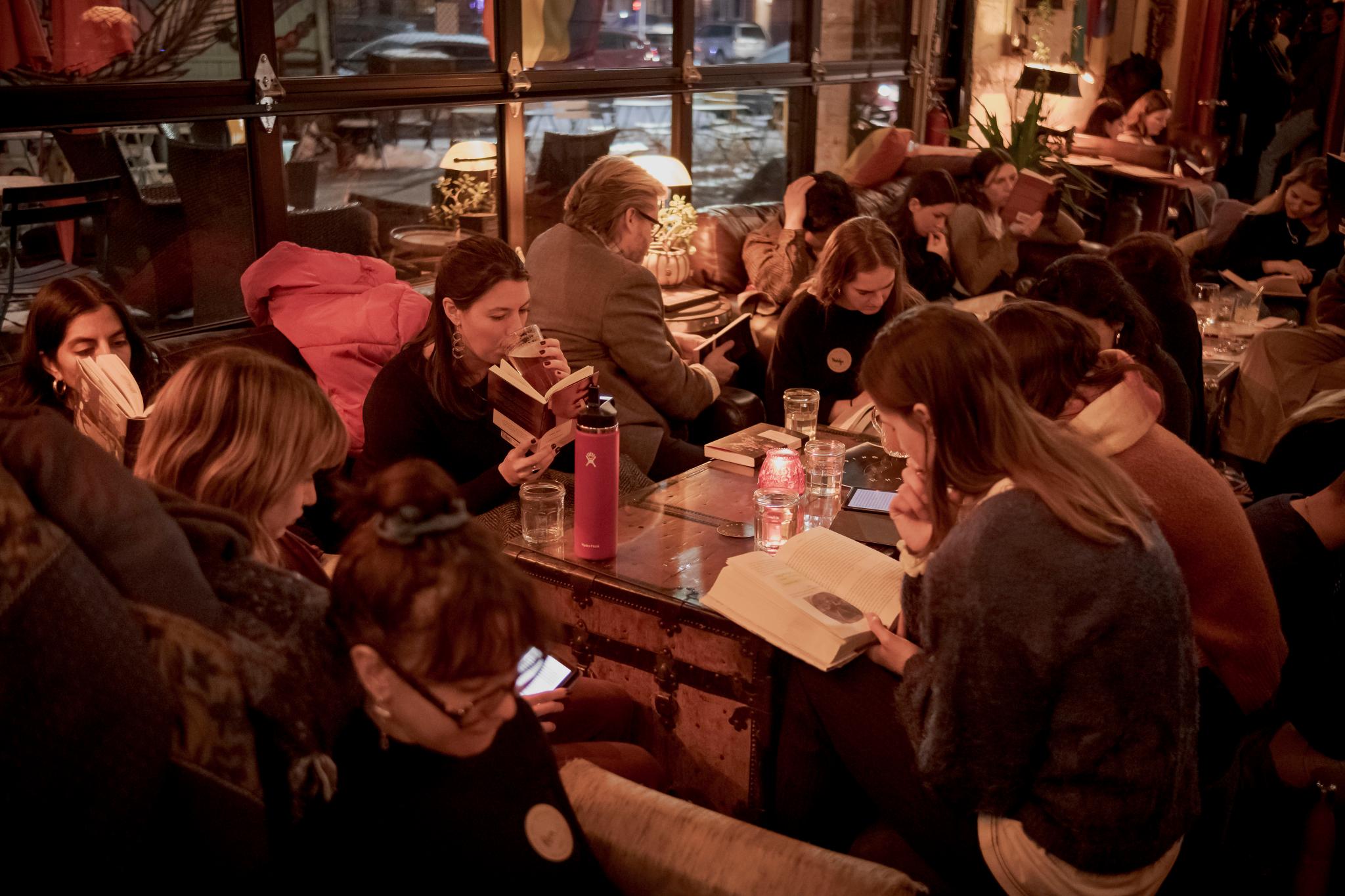
Photo: Stefano Giovannini for N.Y.Post.
A reading party in New York. No phones.
I often wonder why anyone agrees to get notifications on their mobile phones. To me, it feels like some sort of conspiracy to keep us all from ever finishing a thought. That’s why I love hearing about people who have said “enough already” to cellphones, at least for a fewer hours a day.
Today’s story is from the Netherlands, and Orla Barry covers it at the radio show The World.
“Saliha Gündüz, a PhD student from Turkey, has just handed over her smartphone to one of the founders of The Offline Club in Amsterdam, who places it carefully in a ‘phone hotel’ — essentially a locker with dividers that holds up to 60 phones.
“Gündüz said she doesn’t feel apprehensive yet — and she settled down to a cup of herbal tea at the New Yoga School cafe in the center of Amsterdam.
“ ‘The withdrawal symptoms will kick in later,’ she said. ‘But maybe a withdrawal is what’s needed if I’m going to cure myself of my addiction.’ …
“Gündüz is among 20 people of all ages and nationalities who turned up at The Offline Club on a wet Friday evening in May to see if they could wean themselves off of their addiction.
“The club’s founders — Ilya Kneppelhout, Valentijn Klok and Jordy van Bennekom — started the venture in 2022 with a plan to host offline weekend getaways. Kneppelhout said, at the time, each of the co-founders felt their phones had been dominating their lives.
“Earlier that year, he took a short trip to the north of the Netherlands on his own with ‘some books, a journal and myself.’ No phone. He said something shifted over those four days.
“ ‘I felt so much creativity and, at the same time, a sense of peace.’
“Van Bennekom did the same and loved it. They began organizing weekend getaways with groups in a house in the countryside. Everyone was required to hand over their phones upon arrival. The three-day events were a hit. But Kneppelhout said that not everyone can afford to pay a few hundred dollars for the experience. So, the idea of The Offline Club was born.
“Each attendee at the club pays around $8 at the door. The events and venues differ each time. At the New Yoga School in Amsterdam, van Bennekom lays out the rules for the evening.
“First, there’s 45 minutes of quiet time, then a 30-minute break to chat, then a further 30 minutes of time to yourself. Most people bring books to read. Soft music plays in the background as van Bennekom lays out coloring books and markers for anyone who wants to draw or doodle.
“On that rainy Friday, three men from Puglia in Italy were huddled in one corner drinking tea. Two of them were visiting their friend Pietro Maggi who lives in Amsterdam. Maggi, who works for electric carmaker Tesla, said the evening was his idea and that he persuaded his two visitors to join him. …
“[Damiano Caforio admits] ‘I keep looking at the news constantly, checking to see what’s going on in the world, or, more specifically, with my job.’ He works at the Italian Chamber of Commerce.
“ ‘I need to know what’s going on, I feel I need to control the environment. … Actually, I desperately need this experience tonight,’ he laughed. …
“Leah Davies from Wales said she spotted a post about The Offline Club on Instagram.
“ ‘I saw people reading books and knitting and playing piano,’ she said. ‘And I just loved the idea of being able to go somewhere where you’re not checking your phone all night.’ …
“Davies said she would like to see phones restricted at other events too, like concerts and nightclubs, ‘so people can just dance or talk like you did in the ‘90s.’
“Phone-free music events are already happening elsewhere in the Netherlands. In Tilburg, a city in the south of the country, another group, Off the Radar, organizes music gigs where attendees are expected to hand in their devices at the door.
“There isn’t anything quintessentially Dutch about the desire to have smartphone-free events, said Ilya Kneppelhout, co-founder of The Offline Club. But work-life balance is an important aspect of life in the Netherlands. …
“A study by the Organization for Economic Cooperation and Development (OECD) found only 0.3% of employees in the Netherlands work very long hours in paid work, the lowest rate in the OECD, where the average is 10%. In January, smartphones were banned in secondary schools across the country under government guidelines.
“A similar ban is set to be introduced in Dutch primary schools in the 2024-25 school year. A study last month by Radboud University in the Netherlands found that students were generally positive about the change, saying breaks were more enjoyable and there was less bullying during school hours.”
More at The World, here. No firewall. See my earlier post on the new book-reading parties, here.

 Suzanne's Mom's Blog