Feeds:
Posts
Comments

Posts Tagged ‘novel’

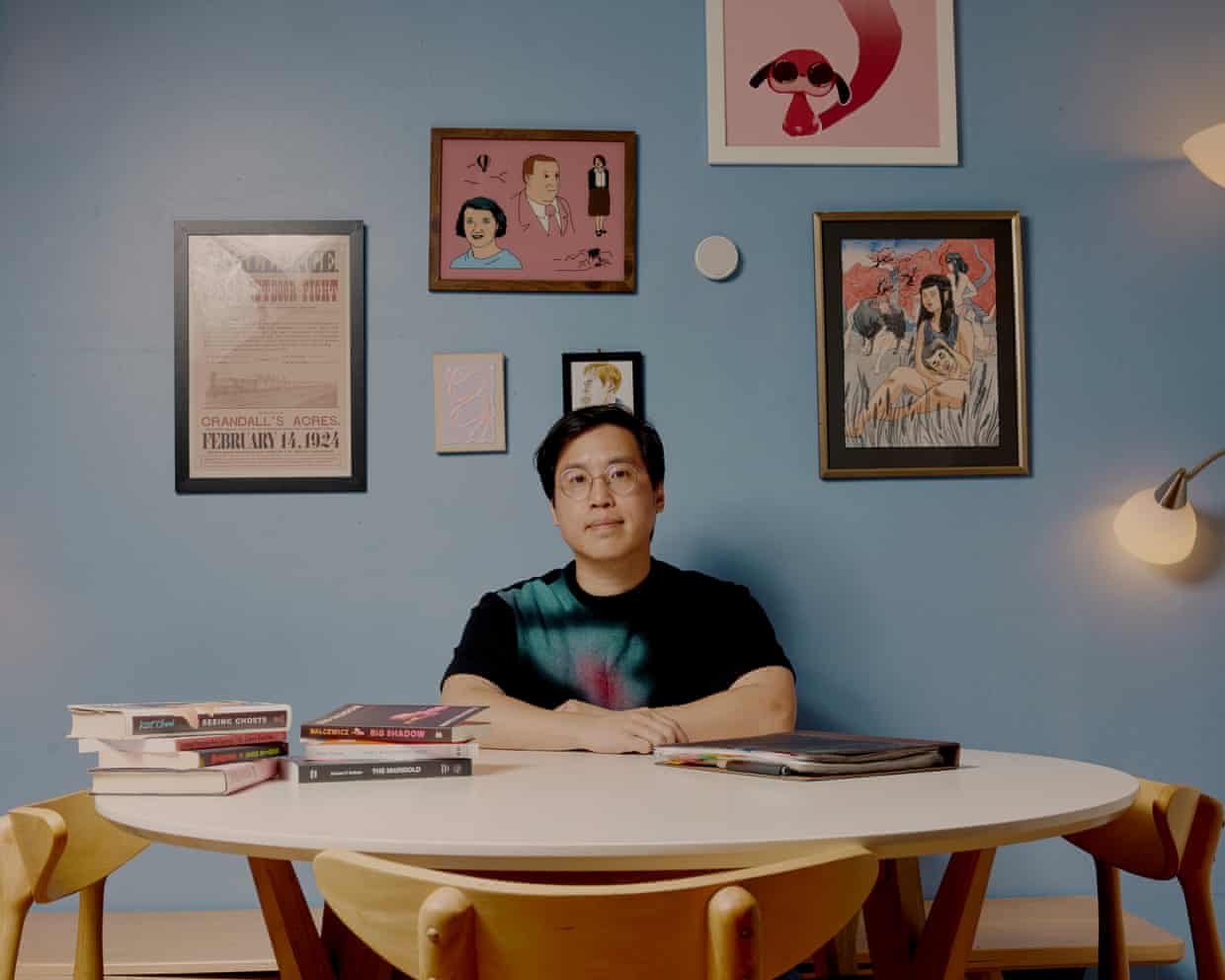
Photo: Vincent Tullo/The Guardian.
Tony Tulathimutte won the Whiting award for his first novel, Private Citizens. To support his writing, he gives workshops that have launched other writers.

The other day I heard a watercolor artist talk about having an MBA and an investment career before switching to art. Several people in her audience noted that most painters don’t have such a good foundation for income and often support themselves with more menial jobs.

A recent interview in the Guardian shows a Brooklyn novelist finding a still different way to support his art.

Isabel Slone writes, “The list of past guest speakers at Crit, the writing workshop that author Tony Tulathimutte runs out of his Brooklyn apartment, reads like a veritable who’s who of 21st-century literary greats. … And while Tulathimutte describes himself as ‘literally just some guy’ on his website, he’s won an O Henry award, and former students like Beth Morgan and Rax King have gone on to earn lucrative book deals and win highly prestigious prizes.

“Tulathimutte, 39, founded Crit in 2017 after winning the Whiting award for his first novel, Private Citizens. While he had previously taught courses at Sarah Lawrence College and the University of Massachusetts, and led workshops for indie companies like Sackett Street Writers, these gigs came and went.

“Running his own school seemed like a more sustainable way to make a living while maintaining his career as an author (Tulathimutte announced the sale of his second novel, Rejection, earlier this year). According to the US Bureau of Labor Statistics, writers and authors earn on average $69,510 a year, while an alarming Authors Guild survey showed that its members drew a median income of $6,080 in 2017, down 42% from 2009. …

“Crit accepts nine students per session. They meet twice a week (Wednesdays and Fridays) over the course of two months. Spots cost $800, netting Tulathimutte approximately $30,000 per year. He supplements his income by accepting freelance writing assignments and visiting-faculty positions. He is currently a thesis adviser at Brooklyn College.

“In the six years since Crit’s inception, Tulathimutte has managed to build not just a successful side hustle, but a thriving community of writers. He hosts book swaps, parties, even a dedicated Slack channel where alumni can chitchat, form casual writing groups and perhaps land a connection to the agent or editor who will launch their career.

Guardian: What was the impetus for founding Crit?
“Tulathimutte: I just thought I could design the class I would have wanted to take. Most MFA programs function more like book clubs or discussion groups, where people are reading your work and giving feedback. I try to do formal pedagogy in the class, so I came up with 16 lectures breaking down different aspects of craft and process, such as ‘What is plot? or ‘What is dialogue?’ Students find the career-oriented class especially of interest because [practical matters] very often get neglected in the academy. It’s the last class of the course and it goes on indefinitely. My record is 11 hours and 45 minutes.

Why is it important for you to teach practical skills like money management?
“Most working writers I know slap together a bunch of different sources of income. On the side, I take visiting faculty gigs, pitch articles, freelance as a novel editor and writing consultant, and shoot author photos. Plus, there’s the very occasional windfall from book-related things like speaking engagements and selling foreign rights or film and TV options.

“I teach students how to cobble together different income streams to create something workable. Usually I talk about whatever grants, fellowships, residencies, contests, funded MFAs and other things I think are worth applying for, but I’ve also talked about Roth IRAs, eligible tax deductions from writing income, speakers bureaus, negotiating freelance rates, loan forgiveness programs and so on.

“Does it feel harder to make a living as a writer now than it did in the past?
“It’s definitely harder now, with so many media companies and publication venues folding and ever fewer places to publish book-related content. …

“Crit students have landed 12 book deals to date. What about your classes gives them a competitive edge?
“I think that a lot of my students would have succeeded just fine eventually. I could point to some writers and say, ‘I introduced them to their agent,’ to others, ‘I made X and Y notes on their manuscript,’ but who knows if that increased or decreased their selling prospects. …

How have you managed to get the word out?
“In the beginning, my only marketing strategy was to ask a couple of my more famous friends, like Jenny Zhang [and] Carmen Maria Machado, to retweet me. The slight bump in visibility was enough to get a handful of people signing up for the first few classes. After the first year, the balance shifted to 50/50 Twitter and word of mouth. Now it’s almost entirely word of mouth.

“How do you manage to convince people like Jonathan Franzen to visit your class?
“I email them. … Jonathan Franzen was a massive get, obviously. He asked me to moderate one of his book launch events for Crossroads in 2021 and after the event I asked if he’d like to guest and he said yes. I just figure there’s no harm in asking.”

More at the Guardian, here. No firewall. Can’t agree it’s harder now. Read New Grub Street.

Read Full Post »

Photo: Library of Congress
Walt Whitman holding a butterfly.

I love reading about the early writings of famous authors. For example, the Brontë children worked on stories about a kingdom they invented called Angria and another kingdom called Gondal, in which the hero was based on the Duke of Wellington.

Sometimes authors do not want anyone to know about their unpolished work, though. Jane Austen convinced her sister to burn letters and other writings after her death. And Walt Whitman wrote an anonymous potboiler that was kept under wraps until a grad student with a knack for finding lost work discovered it last summer.

Rachel Leah writes at Salon, “A new Walt Whitman novel is now available for purchase, 125 years after the author’s death. Previously, the text had only been published anonymously in a six-part series in a New York City newspaper in 1852.

“But last summer the novel was rediscovered by a graduate student deep within the Library of Congress. This is the second Whitman novel that the literary scholar Zachary Turpin has unearthed. …

“Turpin previously uncovered a lengthy newspaper series on fitness and healthy living that Whitman had published under a pseudonym in 1858, CBS reported.

“The novel titled ‘The Life and Adventures of Jack Engle’ was published online on Feb. 20 in the Walt Whitman Quarterly Review, and soon will be in book form, courtesy of the University of Iowa Press. …

“Perhaps most remarkable is the novel’s relevant subject matter.

“According to Whitman expert David S. Reynolds, ‘This is Whitman’s take on the city mystery novel, a popular genre of the day that pitted the “upper 10 thousand” — what we would call the 1 percent — against the lower million,’ he told The New York Times.” Hmmm.

More at Salon, here, and at the Times, here.

I’m always sorry — not only for the sake of researchers, but for those of us who like literary biographies — that early writings are lost. And now that no one uses a typewriter or writes by hand anymore, we are also losing the thought process that was once revealed in cross-outs and scribbled corrections. We have yet to plumb the full cost of that loss.

Read Full Post »

No, I’m not thinking of the 19th century, of George Eliot (Mary Ann Evans), Currer Bell (Charlotte Brontë), or George Sand (Amantine-Lucile-Aurore Dupin). Masculine names are taken more seriously than feminine ones nowadays, too.

Here is a woman who put it to the test.

Catherine Nichols writes at the Jezebel blog, “The plan made me feel dishonest and creepy, so it took me a long time to send my novel out under a man’s name. But each time I read a study about unconscious bias, I got a little closer to trying it.

“I set up a new e-mail address under a name—let’s say it was George [Suzanne’s Mom asks, ‘What is it about the name George?’] Leyer, though it wasn’t—and left it empty. Weeks went by without word from the agents who had my work. I read another study about how people rate job applicants they believe are female and how much better they like those they believe are male. …

“So, on a dim Saturday morning, I copy-pasted my cover letter and the opening pages of my novel from my regular e-mail into George’s account. I put in the address of one of the agents I’d intended to query under my own name. I didn’t expect to hear back for a few weeks, if at all. It would only be a few queries and then I’d close out my experiment. I began preparing another query, checking the submission requirements on the agency web site. When I clicked back, there was already a new message, the first one in the empty inbox. Mr. Leyer. Delighted. Excited. Please send the manuscript.

“Almost all publishers only accept submissions through agents, so they are essential gatekeepers for anyone trying to sell a book in the traditional market rather than self-publishing. …

“I sent the six queries I had planned to send that day. Within 24 hours George had five responses — three manuscript requests and two warm rejections praising his exciting project. For contrast, under my own name, the same letter and pages sent 50 times had netted me a total of two manuscript requests. …

“I wanted to know more of how the Georges of the world live, so I sent more. Total data: George sent out 50 queries, and had his manuscript requested 17 times.

He is eight and a half times better than me at writing the same book.

“Fully a third of the agents who saw his query wanted to see more, where my numbers never did shift from one in 25. …

“Most of the agents only heard from one or the other of us, but I did overlap a little. One who sent me a form rejection as Catherine not only wanted to read George’s book, but instead of rejecting it asked if he could send it along to a more senior agent. Even George’s rejections were polite and warm on a level that would have meant everything to me, except that they weren’t to the real me. George’s work was ‘clever,’ it’s ‘well-constructed’ and ‘exciting.’ No one mentioned his sentences being lyrical or whether his main characters were feisty. …

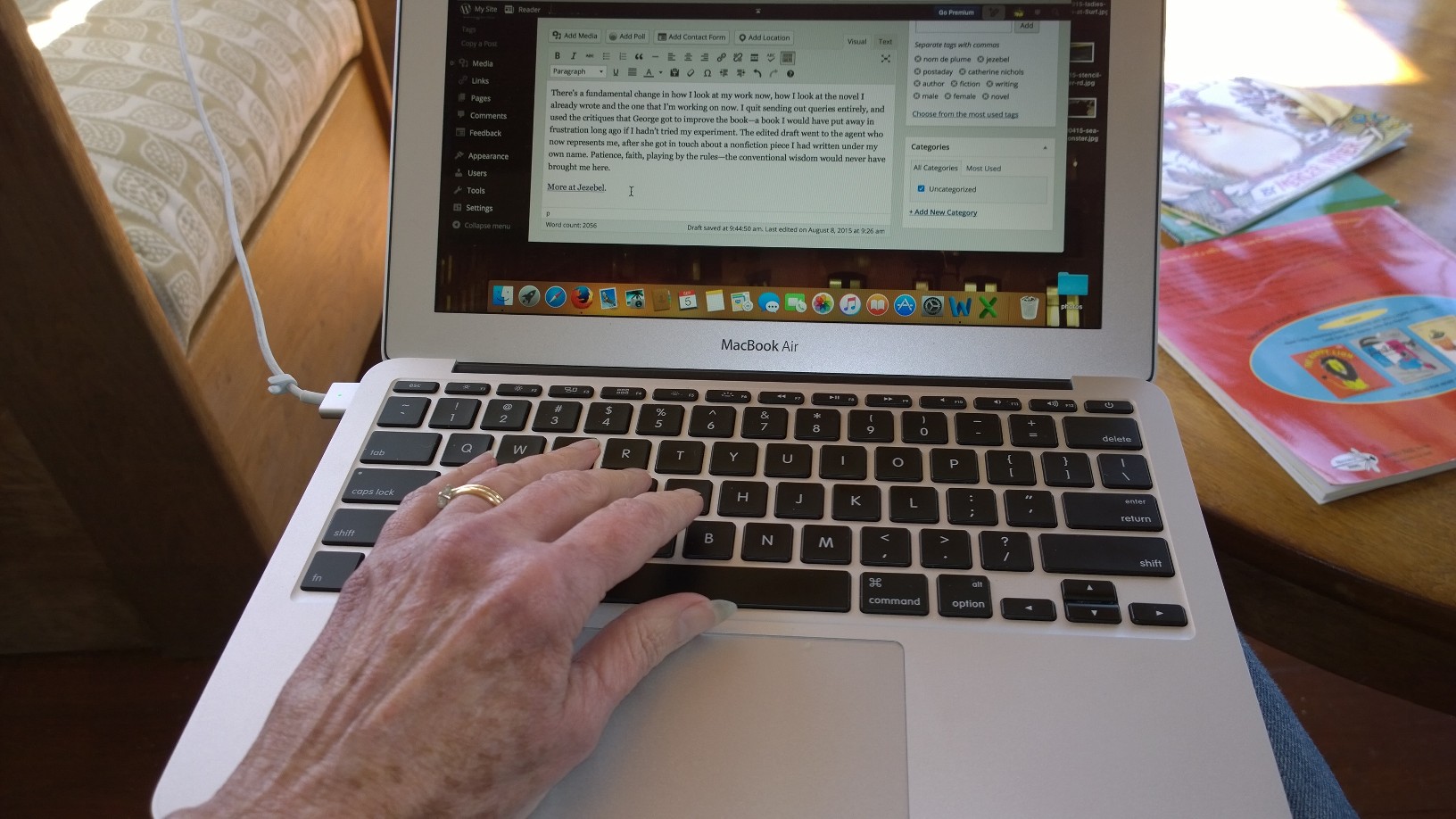
“I quit sending out queries entirely, and used the critiques that George got to improve the book — a book I would have put away in frustration long ago if I hadn’t tried my experiment. The edited draft went to the agent who now represents me, after she got in touch about a nonfiction piece I had written under my own name. Patience, faith, playing by the rules—the conventional wisdom would never have brought me here.” More at Jezebel.

Whew. Now I’m wondering if the fantastic (male) nonfiction writer ML Elrick got some rejection letters because recipients thought he was a female masquerading as a male.  Like JK Rowling. Who now writes mysteries as Robert Galbraith.

090515-typing

Read Full Post »

My friend Ronnie is a former broadcaster, a poet, and a food maven, who lived in France for years and later wrote a book called Eat Smart in France. Recently Ronnie interviewed the mystery writer Cara Black for a blog called My French Life. Black writes about Paris. Her latest novel is Murder in Pigalle.

Ronnie asks, “What drew you to this part of town?

Black: “There are two worlds in Pigalle. The world of the day with families and people who work in the shops, and the world of the night, where people work in the clubs. …

“I really like Pigalle. I discovered so much I didn’t know. [But] I get intrigued by different districts, their flavor and feeling. If I ever figure them out, I’ll probably stop writing about them.” More of the interview here, including a observations on the German occupation of Paris during WW II.

For a wonderful, unusual book with the occupation of Paris as a setting, I recommend Léon and Louise. It’s an odd love story taking place over many decades in France, written by a Swiss and translated into English. I haven’t read many books by Cara Black, but if you like novels that teach you something about a different part of the world in a rather fanciful way, I recommend Léon and Louise, by Alex Capus.

Photo of Ronnie Hess

Read Full Post »

Did you read Jack Kerouac’s On the Road? I was really into Kerouac for a while after being startled that Dharma Bums, read by Allen Ginsberg on an audiotape, sounded so jolly. I thought Kerouac was supposed to be gloomy. After hearing that tape, I went straight to the wonderful 1994 Kerouac biography by Gerald Nicosia, Memory Babe.

Andy Cush, of Animal New York, recently posted driving directions for On the Road using Google Maps.

“In case you want to replicate everyone’s favorite overrated Beat Generation novel,” he says, “this is On the Road for 17,527 Milesan ebook that catalogs every twist and turn in Sal Paradise’s epic cross-country journey as a set of Google Maps directions. The exact and approximate spots Kerouac traveled and described are taken from the book and parsed by Google Direction Service API. The chapters match those of the original book,’ writes the creator, [German college student] Gregor Weichbrodt.

“It’s 45 pages long of pure, unadulterated driving directions — ‘Passing through District of Columbia. Entering Maryland. Take the 2nd left onto US-1Alt N/Bladensburg Rd,’ goes one particularly stirring passage — and if you’re interested, you can get a paperback edition here.” More.

I am not sure I agree that the book is overrated, but I must say I loved the Nicosia description even more.

Neal Cassady and Jack Kerouac

Read Full Post »

Francesca has published Pen Pal, an e-book for middle grades through adults. $3.99. (Paperback available by January 1.)

I can’t recommend the book highly enough. It’s the story of two unlikely pen pals who turn out to have a lot in common and, though living a world apart, actually end up helping each other in times of crisis.

Em is a girl in a marginalized community on the southern U.S. coast (think “Beasts of the Southern Wild”) who puts a message in a bottle. The message is ultimately received by Kaya, a young woman in a place that is an amalgam of Asian countries where minorities have struggled to preserve their language and culture. Kaya is a political prisoner because of her advocacy.

It’s an amazingly enjoyable and compelling story, not as didactic as I may have made it sound. Francesca even went to tutor English in East Timor last summer, capping off several years of research about various locales in Asia and on the Gulf Coast.

Here is the message in the bottle starts it all off:

“Dear Person Who Finds My Message,

“I live in a place called Mermaid’s Hands. All our houses here rest on the mud when the tide is out, but when it comes in, they rise right up and float.

“They’re all roped together, so we don’t lose anyone. I like Mermaid’s Hands, but sometimes I wish I could unrope our house and see where it might float to. But I would get in trouble if I did that, so instead I’m sticking this message in a bottle. If you find it, please write back to me at this address. Tell me what the world is like where you are.

“Yours truly,

“Em”

Francesca says, “The ebook of Pen Pal is out in the world at three out of the four locations it’ll be available at–Amazon, Barnes & Noble, and Kobo.”

If you like the book, enjoy its special website, here. And spread the word.

Read Full Post »

My husband and I like Colin Cotterill’s quirky mystery books about Dr. Siri Palboun of Laos. The series starts with The Coroner’s Lunch, in case you are interested.

Cotterill has been involved in several worthy causes in Laos, including one addressing the abysmal lack of children’s books in the country. You can read how he got started on his quest for children’s books, here. That work is now handled by Sasha Alyson at Big Brother Mouse, who writes:

“Do you remember the excitement of rushing home to read a book that you hoped would never end? Many Lao children have no such memories, because they’ve never seen a book that was fun or exciting to read. Some have shared textbooks; others have never seen a book at all. We sometimes have to explain how books work: ‘Look, if you turn the page, there’s more!’ ”

Big Brother Mouse is a “Lao-based, Lao-owned project.” More.

Cotterill also works with http://www.copelaos.org to help victims of land mines left over from the CIA’s “secret war.”

And, pointing out that more than 75 percent of children in the far north of Laos have no schools, Cotterill funds efforts to get hill tribe students into teachers colleges. More.

Art: Colin Cotterill at http://www.colincotterill.com

Read Full Post »