Feeds:
Posts
Comments

Posts Tagged ‘nurse’

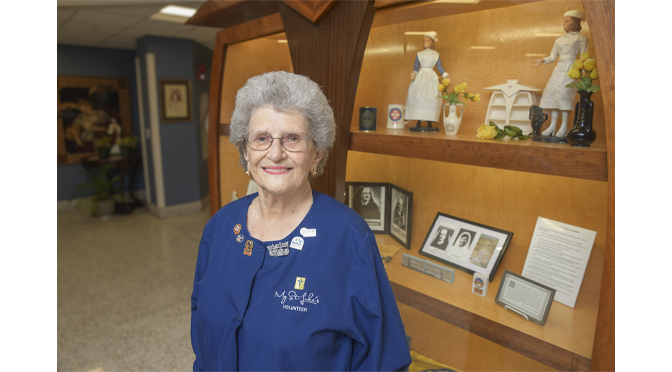
Photo: The Valley Ledger.
Grace Carr became a nurse cadet in 1944. She is still active as a volunteer at St. Luke’s Sacred Heart Campus in Allentown, Pa.

Nancy L and I, both living in retirement communities, have been fascinated to see how differently we ourselves — and the people around us — age. It’s like we’re making a study of our cohort.

Nancy tells me with a certain awe about an active woman over 100 that she’s met where there are people in their 70s who can barely function. What makes the difference? she wonders. We ponder together whether it’s all genetics, something about the life they’ve lived, a combination of those elements, or what.

From the Washington Post comes a story about an elderly WW II-era nurse called Grace Carr who adds to the wonderment.

Cathy Free writes, “Grace Carr was 17 when she left her family home in the coal town of Freeland, Pa., to pursue a dream she’d had since she was 5 years old.

“ ‘Ever since I can remember, I wanted to be a nurse and work in a hospital,’ said Carr, who as a child spent hours wrapping her dolls in bandages and taking their temperatures. …

“Carr, now 97, is still at it, working exactly where she started: St. Luke’s Sacred Heart Campus in Allentown, Pa., about 60 miles from where she grew up.

“Although she retired from her nursing job at age 62, Carr continued as a volunteer at the hospital, and she now shows up every Wednesday to escort patients to their tests, deliver flowers to rooms and take specimens to the lab.

“ ‘From the time she shows up in the morning until she leaves in the afternoon, Grace always has the same happy smile,’ said Beth Fogel, the hospital’s volunteer engagement specialist, who has known Carr for 20 years.

“ ‘She never shows any weariness and always has the same pep in her step,’ she said. ‘Everyone loves talking to her.’

“Carr has logged more than 6,000 hours as a volunteer, taking only a few months off at the height of the coronavirus pandemic. ‘I love people, and my health is good, so I’m happy to do what I can,’ she said. …

“Carr, formerly known as Grace Malloy, started training to become a nurse at Sacred Heart Hospital during World War II in 1944.

“ ‘When I went to nursing school at the hospital, we all lived on-site in a home for nurses,’ she said. ‘We had classes for most of the day, then we’d go onto the floors and learn about all the usual things nurses did, like making beds, taking temperatures and helping to keep the patients comfortable.’ In her first year as a trainee, she was paid $15 a month.

“The U.S. Army paid for her training on the condition that she serve in the U.S. Cadet Nurse Corps and work in a public hospital like Sacred Heart after graduation, she said. The nurse cadet program ensured that U.S. hospitals didn’t experience nursing shortages during the war. …

“Carr said the Army gave her two cadet uniforms — one for summer and one for winter — and she’d often wear them when she took the train home to visit her parents. …

“When Carr’s boyfriend, Edward Carr, came home from serving in the military, they were married in 1947 — the same year she graduated from nursing school.

“Carr was then hired to work the night shift at Sacred Heart, which she did for more than 20 years while raising four daughters and a son. She laughs when people ask her whether she slept during those years.

“ ‘I’d take little naps,’ Carr said. ‘Then when my husband came home, I’d let him take over until it was time for my hospital shift to start at 11 p.m. I look back on it now and I think, “How in the world did I do that?” … I always felt thankful to be doing something I loved.’

“Carr passed her work ethic along to two younger sisters who followed her into nursing. Her daughter Grace Loring also worked at the same hospital. …

“Loring, now retired after 35 years as a pediatric nurse, picks up Carr at her home in Allentown every Wednesday and drives her to and from the hospital. She said she often wonders how her mother managed it all while she was growing up.

“ ‘I also worked nights when I became a nurse, but I was single, and I could just go to bed,’ she said. ‘My mom was there for us after school, she handled the housework and the gardening, and she made matching Easter outfits for us every Easter.’ …

“ ‘When I was a student nurse, I was working in the maternity nursery and had to take this adorable baby boy to his mother,’ Carr said. ‘That little boy later married my oldest daughter, Janet, and he’s now 78. …

” ‘I’ve been given a lot by the hospital,’ Carr said. ‘So as long as I’m healthy and able, I’m going to keep coming back.’ ”

More at the Post, here, and at the Valley Ledger, here.

Read Full Post »

Nurse in Ukraine

Photo: Scott Peterson/Getty Images/The Christian Science Monitor.
Ukrainian senior nurse Oksana Sokhan waits to treat wounded soldiers near the southern war front in Zaporizhzhia district, Ukraine, in February.

You don’t need to save the whole world. Just do something where you are. That is a bit of wisdom I heard on the radio last week from a woman who had served as a judge in Massachusetts. In her youth, she had fought apartheid in her home country when the battle seemed hopeless. But as we know, many hands together made a difference in South Africa.

Scott Peterson writes at the Christian Science Monitor about a nurse in Ukraine who is also making a difference.

“From all her years of caring for wounded soldiers, the Ukrainian nurse recounts one transcendent moment of comfort she provided early in this war that she says she’ll never forget. …

“Not long after Russia’s February 2022 invasion of Ukraine, Oksana Sokhan found herself in an evacuation minibus, wedged between two stricken soldiers in the dark, as the vehicle tried to safely get away from the front line.

“The wounded men were agitated and anxious, disoriented and determined to get up and move. Ms. Sokhan had no sedatives – but she had within her the key to calming them. She began singing Ukrainian lullabies to the wounded fighters, and stroking them as a mother would. Their anxiety eased. If she stopped the soothing singing for a moment, she saw their anxiety surge again.

“ ‘I was surprised myself that it worked – surely it worked on a subconscious level for both of them. … I didn’t know what else to do; we didn’t have any medicine.’ …

“Ms. Sokhan may be just one senior nurse, but she is emblematic of the legions of Ukrainian military medics devoted to preserving the lives of the country’s outnumbered forces. …

“Ukraine’s liberation of Kherson in September 2022, for example, and the monthslong grinding fight for Bakhmut late last year pushed Ms. Sokhan and her colleagues to the limit. During both campaigns, the medical teams regularly saw 100 casualties come through their doors daily. …

“ ‘Everyone here, we all live for one day. If we survive today, it’s good,’ she says. ‘I’ve learned not to not build plans.’ …

“Ms. Sokhan never expected to be a front-line nurse in Russia’s war, either. … She was a decade ago at the opposite end of the country, in the far west, taking care of people at a sprawling resort.

“When Russian troops invaded Ukrainian Crimea in 2014, she recounts, her daughter and son-in-law, who were on the peninsula to ‘live close to the sea,’ called her in alarm. They told her the Russians had issued an ultimatum: Take Russian passports and denounce Ukraine, or leave. … They moved back to their hometown of Lysychansk, but within a month, Russian and pro-Russian proxies were there, too, seizing control. The family had to walk more than 4 miles, with a 4-year-old and all the belongings they could carry, before fleeing west.

“ ‘I got very angry,’ recalls Ms. Sokhan. ‘I quit that job and went to the military office to sign up for the army.’ …

“Ms. Sokhan focuses on doing what she can to contribute to the well-being of Ukraine’s wounded soldiers.

“ ‘We want to save everyone,’ she says. … ‘What’s uplifting and inspiring are our guys, people who come here wounded, who are cold and hungry and dirty,’ says Ms. Sokhan. ‘But all they say is, “Doc, quickly get me fixed up; I’ve got to get back to my guys.” ‘ “

More at the Monitor, here.

Read Full Post »

Photo: Elayna Yussen — Bloomberg/Getty Images.
It’s not just hospitals that have critically low staffing levels. Our aging population is retiring, and most industries are hurting for labor. We need more immigrants.

Happy Fourth!

We think of ourselves as a nation of immigrants, but only for the past. We have turned against immigration at a time we badly need more applicants for every kind of job. The effects of labor shortages can be dangerous if we are talking about hospitals or aviation, for example. But it’s bad all over. I’ve read that even the military is having trouble finding recruits.

Today’s article is about nurses, but you can substitute almost any job category and think about whether better immigration policies, with a good route to citizenship, would help.

Alex M. Azar and Kathleen Sebelius wrote in Time magazine’s Ideas section, “The United States is about to learn the hard way what happens when an entire generation of nurses retires without enough new clinicians to fill their shoes at the bedside.

“As a result, hospitals in the same country that performed the first successful kidney transplant and pioneered anesthesia and heart rhythm restoration will have no choice but to ration care.

“That’s the only way to describe what happened to an Alabama man who was turned away from 43 different hospitals across three different states before ultimately dying of a cardiac emergency 200 miles from home because no nearby system had an available intensive care bed it could staff. …

“And it’s what happened to expecting mothers in Idaho earlier this year when the only hospital in the 8,000-person city of Emmett said it had become ‘unsustainably expensive to recruit and retain a full team of high-quality, broad-spectrum nurses to work.’ That followed an earlier decision by an upstate New York facility to pause its maternity services after struggling to recruit enough replacements to offset staff resignations and retirements. …

“A nurse old enough to retire today has only known the U.S. health care system in a nursing shortage, but they’ll tell you it’s never been more challenging. It’s a crisis in five parts, including increased demand for care by an aging population and workforce, restraints that hinder nurses from practicing at the top of their licenses, lingering burnout from the pandemic, an inability to educate enough new nurses, and a recently throttled pipeline of qualified international talent.

To fill the gap in care left by retirements and burnout, federal economists calculate that the U.S. health care system will need to add at least 200,000 new nurses every year through 2026.

Nursing schools reject tens of thousands of applicants every school year. It’s not because these would-be nurses failed to meet admission criteria — it’s largely because the schools don’t have enough nurse educators to train them. As limited instruction capacity squeezes the number of new matriculating nurses, hospitals have increasingly relied on foreign-educated nurses, who’ve grown to represent roughly 15% of the U.S. nursing workforce.

Employment-based health care immigration is a complex labyrinth of rules and regulations that doesn’t make it easy or fast for an international nurse to emigrate and begin treating American patients. Under current law, international nurses compete for the same limited number of employment-based green cards within an enormous pool of applicants that include IT workers, lawyers, engineers, and architects. Unlike those other workers, nurses do not qualify for temporary visas. So, while many computer engineers from other countries apply for green cards after moving to the U.S. and working under an H1-B visa, nurses must complete the immigration process entirely overseas.

“Under the best conditions, that’s a multi-year process in which the nurse has passed English language and licensure exams, established a sterling overseas clinical record, and secured a job offer that has been demonstrated not to harm U.S. workers. Now, that timeline will grow significantly, thanks to a recent visa freeze instituted by the U.S. State Department.

“The State Department tightly monitors the number of employment-based green cards issued against the remaining number for the fiscal year, which is set by Congress and has been untouched since 1990. Post-pandemic resurgent demand for this category recently forced State to issue a notice of visa retrogression, an immigration term of art that refers to eligibility backdating when demand exceeds equilibrium. As a result, any nurse who became eligible for their green card after June 1, 2022 — which amounts to thousands of nurses who have been winding through the system for upwards of two years — is ineligible to enter the country until the backlog has cleared. In practical terms, American hospitals won’t be get the nurses they’ve been counting on any time soon.

“Despite the urgency to get more nurses to the bedside, the State Department and the White House have zero discretion. The responsibility falls to Congress, which reserves the authority to issue visas and allocate them for specific immigrant preference categories. Each year, processing issues and other inefficiencies across various government agencies involved result in thousands of issued visas going unused. Health care advocates have begun pressing Congress to recapture some of these allocated-but-untouched green cards for the express use of immigrant nurses. There’s precedent: Congress did just that in 2000 and 2005.

“More recently, one bipartisan proposal introduced last Congress, the Healthcare Workforce Resilience Act, would have set aside tens of thousands of these mothballing visas for nurses and doctors. But it didn’t pass, and a new version has yet to be reintroduced. According to the nonpartisan Congressional Research Service, there are roughly 220,000 employment-based visas that were available for recapture as of 2021. …

“The nursing shortage isn’t a red-vs-blue, rural-vs-urban issue. It’s not about the southern U.S. border or the gridlock that defines D.C. It’s about a pregnant mother getting the care she and her baby deserve. It’s about the heart attack patient not being turned away because the emergency room doesn’t have the nurses to treat him. This is a whole-of-America crisis and we need a whole-of-government response, including a sensible loosening of licensing requirements, prioritize positive patient outcomes by modernizing the responsibilities and standards of nursing, supporting expanded educational opportunities, and enabling lawful employment-based immigration.”

More at Time, here.

Read Full Post »

5881
Photo: Sarah Johnson/
The Guardian 
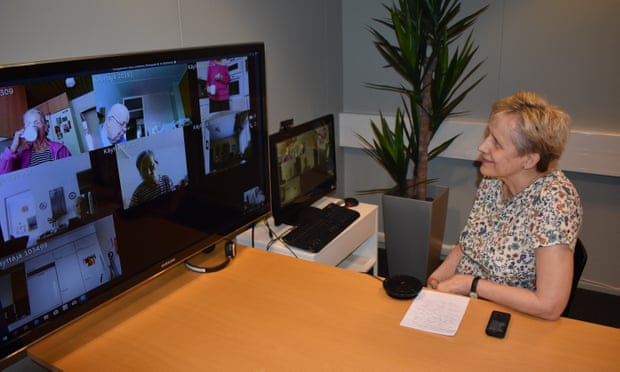
A remote nurse oversees a virtual lunch for older people in Helsinki. “The client feels like they are a part of a bigger thing. It’s also guaranteed that they eat properly,” she says.

Because my sister’s brain cancer is so troubling and her needs for care are growing so fast, I have started to give more serious thought to my own future and the more-common problems of ageing. I may never bite the bullet about a retirement community, but I plan to look into what they offer just in case.

Meanwhile Finland, which seems to be on the cutting edge of everything from preschool to end-of-life care, has set an example of keeping people in their homes longer using technology, as costs for in-person services increase.

Sarah Johnson writes at the Guardian, “It’s 11.30 am on a midweek June morning in Helsinki, Finland. Duvi Leineberg, a remote care nurse, is doing the lunch rounds. But instead of jumping in a car and visiting each person one by one, she is sitting in an office looking at a large computer screen where she can see into seven people’s homes. Most are sitting at a table preparing to tuck into some food.

“This is a virtual lunch group, set up to make sure older people receiving home care services in the city eat regularly and at the right time. Leineberg runs the session. She starts by checking everyone has their food and that it is warmed up. Some have soup, others have pre-prepared meals that have been delivered by home care services. People also sip coffee.

“One screen shows an empty backdrop and she calls the home to check her client is all right. He walks past the screen but says he isn’t hungry and doesn’t want to eat right now. Leineberg then asks everyone if they have any plans for the afternoon. A few reply that they will go out for a walk.

“A former hospital nurse, Leineberg sees the value of such groups. ‘Firstly, the client feels like they are a part of a bigger thing. It’s also guaranteed that they eat properly. If I spot anything that seems out of the ordinary, I can call the home care nurses who will pay them a visit if necessary.’

“Her clients are also fans of the lunch group. Riitta Koskinen, 80, says through a translator: ‘I’m old and living alone and it’s nice to have the company. We eat at the same time – food tastes better when you’re with others – and I’ve really enjoyed it. It makes me eat and it’s good to see other people.’

“Finland has a rapidly ageing population and recruitment problems in health and care. By 2070, one in three Finns is expected to be over 65. At the same time there has been a huge decline in the birth rate and the number of Finns of working age is expected to fall by around 200,000 by 2050. As a result, the demand for and cost of care services are growing while tax revenues are decreasing. …

“The virtual lunch group is one aspect of Helsinki’s remote care – where clients have a tablet that links up with remote care nurses in a service centre. Remote care appointments are set up to check on clients throughout the day and to make sure they take the relevant medication. There are 800 home care clients, and nurses carry out 24,000 remote care visits a month. By the end of 2019, the service hopes to cater for 1,100 clients. …

Over the course of one shift, a remote care nurse can carry out over 50 visits – which works out almost 90% cheaper than if they had knocked on each of their client’s doors.

“Little wonder that the city’s service centre is hoping to start a remote dinner group soon as well as other sessions. They already take clients virtually to concerts and shows. Hanna Hämäläinen, who works as a planner at the service, remembers when she took 64 clients virtually to a carol concert. A screen was placed on the front row and the priest greeted them while they watched at home on their tablets. She remembers: ‘The funny thing is that even if some had memory problems, they knew all the lyrics. That is the power of music and made me see that if there’s a concert, we should be there.’ …

“Roope Leppänen, medical director of Espoo hospital, … maintains that remote care will never fully replace physical care but that, with advancing technology and future generations that are used to digital life, it will become more and more important. But he doesn’t expect it to totally replace physical care services. ‘People will need physical visits as well. It’s my belief that [remote care] can’t completely replace that, but tech will make [things] even easier in 10 years time.’

“Both the staff and patients I meet seem to like it. Tiina Kosonen, a remote care nurse, says she is able to build close relationships with her clients. ‘I like it and the patients get a lot from it. It’s really intensive this contact. We look into each other’s eyes and talk together face to face.’ ”

More at the Guardian, here.

Read Full Post »

Some initiatives that are costly up front have benefits that far outweigh those costs but don’t show up for years. Even then, people may disagree about what caused the outcomes.

One such initiative sends nurses to new mothers who are young, poor and often friendless to help ensure that their babies get a leg up in life.

At the Washington Post

“A high school senior learns that she’s pregnant — and she’s terrified. But a registered nurse comes to visit her in her home for about an hour each week during pregnancy, and every other week after birth, until the baby turns 2. The nurse advises her what to eat and not to smoke; looks around the house to advise her of any safety concerns; encourages her to read and talk to her baby; and counsels her on nutrition for herself and her baby.

“This kind of support, with trained nurses coaching low-income, first-time mothers, is among the most effective interventions ever studied. Researchers have accumulated decades of evidence from randomized controlled trials — the gold standard in social science research — following participants for up to 15 years. They have consistently found that nurse coaches reduce pregnancy complications, pre-term births, infant deaths, child abuse and injury, violent crimes and substance abuse. What’s more, nurse coaches improve language development, and over the long term, cognitive and educational outcomes.

“Nurse coaching is a vital tool that addresses both the liberal concern about income inequality and the conservative concern about inequality of opportunity. …

“Still, nurse coaching reaches only 2 to 3 percent of eligible families. Which raises the question: if it’s so successful — and people on both sides of the aisle support it — why can’t it be scaled to reach every eligible family?”

There are two stumbling blocks according to the reporters: First, funding must be cobbled together from numerous unpredictable sources; second, the costs are up front, whereas the benefits to government and society appear over time.

“If nurse coaching were fully scaled to reach every eligible family, the costs to state and federal governments would outweigh the savings for the first five years. But then the savings would start to outweigh the costs. Over 10 years, the net savings would be $2.4 billion for state governments and $816 million for the federal government.”

So the question becomes: do we have the patience? More here.

A similar initiative that Suzanne started supporting when she lived in San Francisco focuses on homeless mothers. Read about the great results of the Homeless Prenatal Program here.

Photo: iStock
When nurses coach low-income moms, their babies benefit.

Read Full Post »

Some years ago, the John Adams family biographer Paul Nagel introduced me to physician/poet Norbert Hirschhorn. Paul told me that Bert was on the team that helped save thousands of lives in Third World countries simply by distributing water to which sugar and electrolytes had been added. (A National Institutes of Health paper references Bert’s 1973 research on “oral glucose electrolyte solution for all children with acute gastroenteritis” here.)

A special NY Times science supplement on Sept. 27, 2011, “Small Fixes,” reminded me of Bert and the notion that small innovations can have a huge impact.

Among the great stories in the supplement. is this one about Thailand’s success fighting cervical cancer with vinegar.

It turns out that precancerous spots on the cervix turn white when brushed with vinegar. “They can then be immediately frozen off with a metal probe cooled by a tank of carbon dioxide, available from any Coca-Cola bottling plant.” The complete procedure, which can be handled by a nurse in one visit, has been used widely in Thailand, where there are a lot of nurses in rural areas.

In Brighton, Massachusetts, Harvard’s George Whitesides founded Diagnositcs for All to commercialize his inventions, including a tiny piece of paper that substitutes for a traditional blood test for liver damage. Costing less than a penny, “it requires a single drop of blood, takes 15 minutes and can be read by an untrained eye: If a round spot the size of a sesame seed on the paper changes to pink from purple, the patient is probably in danger.” Read the Times article.

Amy Smith at MIT is another one who thinks big by thinking small. Read about her Charcoal Project, which saves trees in poor countries by using vegetable waste to make briquettes for fuel.

Read Full Post »

Pippa Jack at the Block Island Times reports today on a Rhode Island humanities grant for post-production work on a local film. The film is called “Island Nurse” and is about island treasure Mary Donnelly.

“The filmmaker, Sue Hagedorn, who is also a nurse practitioner, retired nursing professor and summer resident of the island, shot the intimate footage over the past two years, following Donnelly as she made house calls, visited with family, did non-profit work and remembered the past. Next she will film other people, collecting stories about the frail-looking but dynamic woman who has tended to the sick here for two generations.” Read more here.

Read Full Post »