Feeds:
Posts
Comments

Posts Tagged ‘octopus’

Photo: Shimabuku.
Unlike animals that spend their days eating, sleeping or mating, octopuses “have time to wander — time for hobbies,” says Shimabuku, who makes art for sea creatures to enjoy. 

There’s an artist in Japan who makes art for marine animals just to see how they react. The responses of octopuses seem to be the most gratifying to him. The whole time I was reading this story, I was wondering why I had never heard the naturalist Sy Montgomery, author of The Soul of an Octopus, talk about this on Boston Public Radio in one of her her weekly visits. I must have missed that day.

“When the Japanese artist Shimabuku was 31 years old,” writes Francesca Perry at CNN, “he took an octopus on a tour of Tokyo. After catching it from the sea with the help of a local fisherman in Akashi, a coastal city over 3 hours away from the Japanese capital by train, he transported the live creature in a temperature-controlled tank of seawater to show it the sights of Tokyo before returning it safely to its home the same day.

“ ‘I thought it would be nice,’ the artist, now 56, said about the experience, over a video call from his home in Naha, Japan. …

‘I wanted to take an octopus on a trip, but not to be eaten.’

“Documenting it on video, Shimabuku took the octopus to see the Tokyo Tower, before visiting the Tsukiji fish market, where the animal ‘reacted very strongly’ to seeing other octopuses on sale, the artist said. …

“The interspecies day trip, resulting in the 2000 video work ‘Then, I Decided to Give a Tour of Tokyo to the Octopus from Akashi,’ kickstarted a series of projects Shimabuku has undertaken over the decades that engage with octopuses in playful, inquisitive ways. A portion of this work is currently on show in the UK, in two exhibitions that explore humanity’s relationship with nature and animal life: ‘More than Human‘ at the Design Museum in London (through October 5) and ‘Sea Inside‘ at the Sainsbury Centre in Norwich (through October 26).

“Fascinated by what the sea creatures might think, feel, or like, Shimabuku has documented their reactions to various experiences, from the city tour of Tokyo to being given specially crafted artworks. ‘They have a curiosity,’ he said. …

“When he lived in the Japanese city of Kobe, Shimabuku would go on fishing trips with local fisherman, taking the opportunity to learn about octopuses. ‘Traditionally we catch octopuses in empty ceramic pots — that’s my hometown custom,’ he said. Fishermen would throw hundreds of pots into the sea, wait two days, then retrieve them — finding octopuses inside. ‘Octopuses like narrow spaces so they just come into it,’ explained Shimabuku.

“When he saw the animals within the pots, he discovered they were ‘carrying things’: shells, stones, even bits of broken beer bottles. He began to save the small objects the octopuses had gathered. …

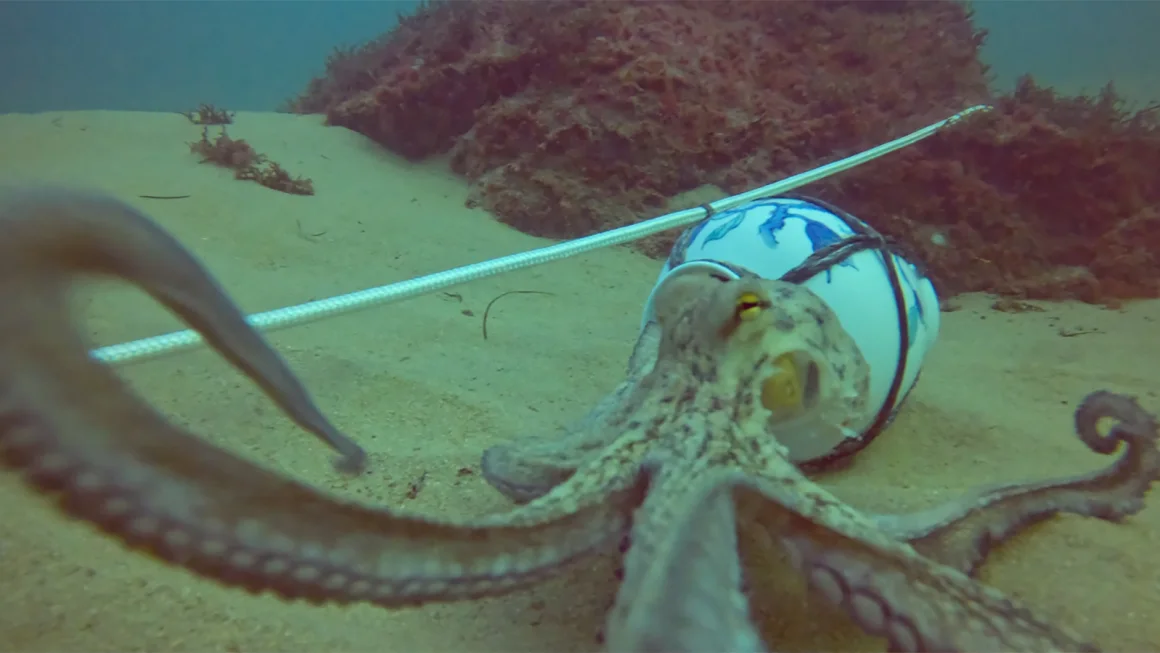
“Shimabuku started to think, ‘maybe I can make sculptures for them.’ … In his 2010 work ‘Sculpture for Octopuses: Exploring for Their Favorite Colors,’ Shimabuku crafted a selection of small glass balls and vessels, in various colors. At first, he went out in a fishing boat and threw the sculptures in the sea, ‘like a present to the octopuses.’ But then he wanted to see how the animals were reacting to the objects.

“Collaborating with the now-closed Suma Aqualife Park in Kobe, he repeated the effort in a large water tank, where he could film the reaction of octopuses.

“ ‘They played with them, and sometimes they carried them,’ said Shimabuku. … ‘They keep touching, touching.’ The resulting film, and photographs, show the octopuses wrapping their tentacles around some of the glass objects, grabbing and rolling them across the sand, and even holding them in their suckers as they move across the side of the tank.

“In 2024, Shimabuku had a landmark solo show at Centro Botín in Santander, Spain. Specially for the exhibition, he collected an assortment of glass and ceramic pots to offer to local octopuses. Some of the vessels were made by the artist and others were from ‘second-hand shops and eBay.’ …

“Although octopuses are colorblind, Shimabuku wanted to see through these projects whether they were attracted to objects of certain colors. ‘What I heard from fishermen is that octopuses like red,’ he said. ‘Long ago in Kobe, I found an octopus in a red pot, so I believe they like red.’ Perhaps more so than the hue, Shimabuku is convinced that octopuses are drawn to very ‘smooth, shiny’ glass objects. He doesn’t have evidence to back this up, [he’s just] a man entranced by eight-legged mollusks is dedicating his time to engaging with them through art.”

More at CNN, here.

Read Full Post »

Photo: Eduardo Sampaio and Simon Gingins.
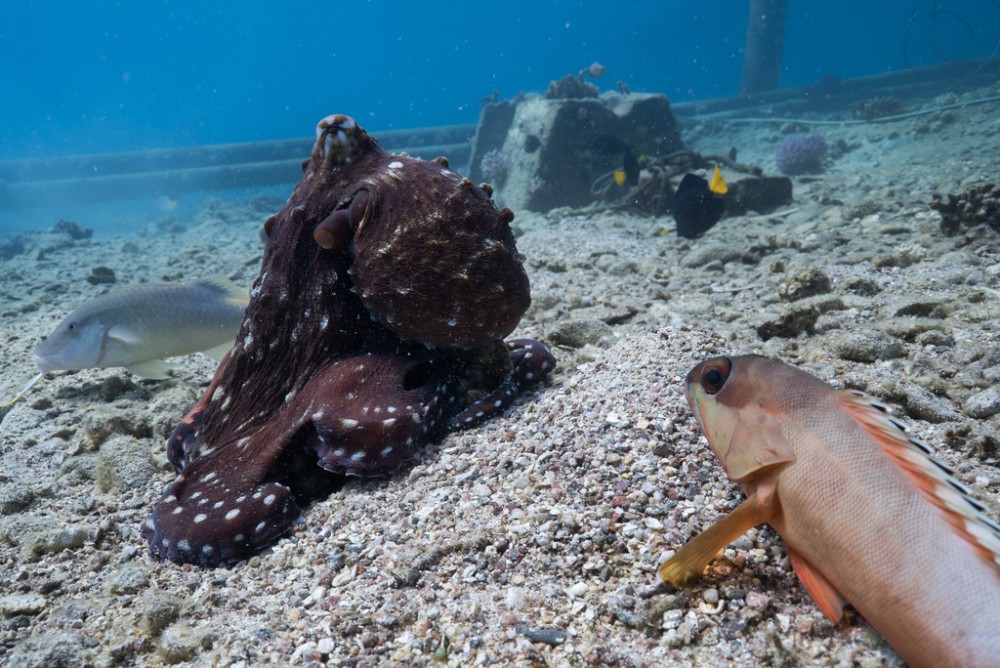
An Octopus cyanea, center, hunts with a blacktip grouper on one side and a blue goatfish on the other.

There are trends, I think, in which animals are popular and get the most news coverage. Lately, octopuses seem to be “in.” That is probably because the people who know them best, like naturalist Sy Montgomery, have demonstrated how intelligent octopuses are.

Now we learn that some octopuses hunt with partners from other species and may make the group decisions.

Evan Bush writes at NBC News, “A new study shows that some members of the species Octopus cyanea maraud around the seafloor in hunting groups with fish, which sometimes include several fish species at once.

“The research, published in the journal [Nature], even suggests that the famously intelligent animals organized the hunting groups’ decisions, including what they should prey upon.

“What’s more, the researchers witnessed the cephalopod species — often called the big blue or day octopus — punching companion fish, apparently to keep them on task and contributing to the collective effort.

“Octopuses have often been thought to avoid other members of their species and prowl solo using camouflage. But the study [is] an indication that at least one octopus species has characteristics and markers of intelligence that scientists once considered common only in vertebrates. …

“Said Eduardo Sampaio, a postdoctoral researcher at the Max Planck Institute of Animal Behavior and the lead author of the research, ‘We are very similar to these animals.’ …

“To understand the inner details of octopus lives, researchers dived for about a month at a reef off the coast of Eilat, Israel, and tracked 13 octopuses for a total of 120 hours using several cameras. The team followed the octopuses for 13 hunts, during which they observed groups of between two and 10 fish working with each octopus.

“These hunting groups typically included several species of reef fish, such as grouper and goatfish. The octopuses did not appear to lead the groups, but they did punch at fish to enforce social order — most often at blacktip groupers.

“ ‘The ones that get more punched are the main exploiters of the group. These are the ambush predators, the ones that don’t move, don’t look for prey,’ Sampaio said. …

“ ‘If the group is very still and everyone is around the octopus, it starts punching, but if the group is moving along the habitat, this means that they’re looking for prey, so the octopus is happy. It doesn’t punch anyone, Sampaio said.

“The researchers think fish benefit from such hunting groups because an octopus can reach into crevices where prey hides and root out lunch. The octopus benefits, they believe, because it can simply follow the fish to food, rather than perform what the researchers call speculative hunting. …

“After shooting their video, the researchers fed all of their hunting scenes into software that creates a three-dimensional representation, then used another program to track each animal and log its position in relation to others. The data allowed the researcher to measure how close the creatures remained to one another and which creatures anchored or pulled the group in one direction or another.

“The data showed that a particular fish species, the blue goatfish, would roam off and lead the hunting groups in that direction, but the group of fish would linger if the octopus didn’t immediately follow.

“The goatfish ‘are the ones exploring the environment and finding prey,’ Sampaio explained. ‘The octopus is the decider of the group.’

“The researchers did not see evidence that the creatures shared prey. All the species involved are generalists that eat crustaceans, fish and mollusks, but whoever was able to catch the prey got a meal. Questions remain, however, including whether certain octopuses recognize or prefer to hunt with a favorite fish companion. … It’s also not clear if this social hunting behavior is something octopuses learn or if it’s innate.

“ ‘In my intuition, I think it’s something they learn, because the smaller octopuses seem to have a higher difficulty to collaborate with fish than the large ones,’ Sampaio said.

“Jonathan Birch, a professor of philosophy at the London School of Economics who studies animal sentience but was not involved in the new research, said he … appreciated that the study’s observations were made outside a laboratory setting, where a lot of animal cognition research takes place. Octopuses can be difficult to study outside their natural setting. …

“ ‘Octopuses were seen as a problem case because they are intelligent and yet solitary, it was assumed, so researchers puzzled for a long time about what’s going on there,’ Birch said. ‘[This study shows that] For at least one species of octopus, there is quite a rich social life.’ “

More at NBC, here. No paywall.

Read Full Post »

Photo: MBARI.
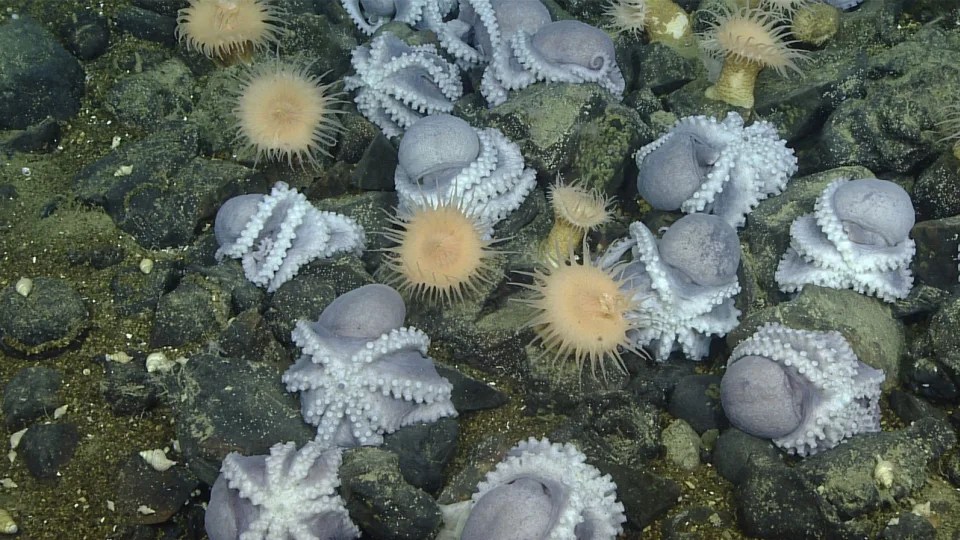
Researchers nicknamed the Muusoctopus robustus species the pearl octopus because of the way they look while upside down protecting their eggs. In 2018, a team of scientists found thousands of M. robustus at the base of the Davidson Seamount, about 80 miles southwest of Monterey, California.

Some people may recall Ringo Starr singing “Octopus’s Garden” on “Abbey Road,” but who knew there was really such a thing as an octopus garden? Kasha Patel describes one at the Washington Post.

“About 80 miles from the coast of central California, thousands of octopuses gather on rocks two miles below the surface of the ocean. This location, dubbed ‘octopus garden,’ is the largest known aggregation of these mollusks in the world. … Scientists have been puzzled why so many octopuses plant themselves in these abysmal, colder waters — until now.

“After three years of monitoring the area, researchers found the site is a popular mating and nesting ground for pearl octopuses, where hot springs help embryos develop twice as fast as expected at this depth. The faster development increases a hatchling’s likelihood of survival through the brooding period, according to a study released [in August] in the journal Science Advances. …

“ ‘We’re supposed to be managing these areas and protecting them for future generations, and we didn’t even know that this habitat was down there [and] what kind of impact it was having,’ said Andrew DeVogelaere, research ecologist and study co-author. …

“The discovery of the octopus garden back in 2018 was lucky, said DeVogelaere, who runs the research program for NOAA’s Monterey Bay National Marine Sanctuary. For more than two decades, researchers have been studying an extinct underwater volcano called the Davidson Seamount. The seamount, located southwest of Monterey, Calif., is one of the largest seamounts in the world and known for its beautiful deep sea corals. It is also one of the most well-studied seamounts in the world, so when DeVogelaere wanted to explore it further, others were skeptical he would find anything new.

“ ‘We said, “Don’t waste your time going there,” ‘ said Jim Barry, senior scientist at the Monterey Bay Aquarium Research Institute and lead author of the new study. ‘ “We’ve been all over it.” ‘ …

“Nevertheless, Barry and his colleagues said there is an unexplored area on the foothills of the seamount that could be interesting to investigate. The researchers then sent a ship to study the area.

“DeVogelaere, who was following along on a video feed, said it was at first pretty dull, just a lot of mud. Then suddenly, they spotted a hoard of balls, like opalescent pearls, on the seafloor.

“They had found the ‘octopus garden,’ home to at least 6,000 nesting, Muusoctopus robustus. … The researchers estimate there could be 20,000 in this nursery.

“For three years, the team monitored the population through cameras and dives with remotely operated vehicles, measuring water temperature and oxygen. They found only adult males and female octopus, developing eggs, and hatchlings at the location, indicating the site was used exclusively for mating and nesting.

“They also noticed shimmering water, which was indicative of a thermal spring — something ‘totally new in this area,’ Barry said. He explained the shimmering water appears when warm water (such as from a thermal spring) and cool waters mix. Water temperature from these thermal springs can reach nearly 51 degrees Fahrenheit, while ambient water temperature is around 35 degrees. …

Typically at near-freezing temperatures in the deep ocean, researchers expected pearl octopus eggs at least five years to hatch. These hatched in just two years.

“ ‘As you get into colder waters, whether it’s polar waters or deeper waters, colder water slows down metabolism, slows down metabolic rates, slows down growth and embryonic development rates,’ Barry said. ‘We think that the warm water is providing some sort of reproductive benefit for them.’ …

“The team thinks the octopus garden is just one of many deep sea octopus environments out there. Just five miles away from the garden, researchers found another octopus nursery near thermal springs. In June, another group of researchers discovered a nursery near thermal springs in Costa Rica.

“[Beth Orcutt, vice president for research at the Bigelow Laboratory for Ocean Sciences in Maine] helped lead the Costa Rica expedition. [She] said both of these discoveries show that these small outcrops of rock on the seafloor, which are often passed over for study to focus on larger seamounts, can be incredibly rich and productive sites of life.

“ ‘I don’t think it’s a one-off curiosity,’ DeVogelaere said. ‘Most of the deep sea hasn’t been looked at.’ ”

More at the Post, here. For a version of the story with no firewall, see CNN, here.

Read Full Post »

An Octopus Tantrum

Photo: John Turnbull via Flicker via the Smithsonian.
Female octopuses are far more likely than males to ‘throw’ objects at others.

Have you ever read a book by the popular naturalist Sy Montgomery? She loves every kind of creature (except the Bobbitt worm) and can write and talk engagingly about them all. She’s a regular visitor to the radio show Boston Public Radio (BPR). I hear her Wednesdays as I go to visit the Rhode Island grandchildren, and she loads me up with implausible but true animal stories to share.

Recently, Montgomery talked with BPR hosts Jim and Margery about octopuses throwing things to defend their space. Later, I read about this mostly female behavior at the Washington Post.

Jennifer Hassan wrote, “It looks like a scene from a tense thriller movie — a dark octopus rises from its lair on the ocean floor, sneaking up toward another octopus that lurks, barely visible, nearby among a blanket of shells and algae.

“The second octopus shrinks away, while the first attacks by raising its arms and shooting a cloud of debris through the water toward it. … While octopuses have long been known to thrash around underwater, researchers now believe they have video evidence that shows the creatures can not only throw objects — an uncommon behavior in animals — but may also be capable of deliberately targeting each other. Perhaps out of rage, perhaps to protect their eggs — or possibly because they are seeking the octopus equivalent of personal space.

“Researchers from the University of Sydney described several incidents of octopuses throwing debris during social interactions, including attempted sexual exchanges, which they said provided evidence that octopuses were targeting each other on purpose.

“They had analyzed more than 20 hours of footage from Jervis Bay, off the south coast of New South Wales, Australia, from 2015 and 2016, observing 10 octopuses from the octopus tetricus species — also known as gloomy octopuses or the common Sydney octopus. Their findings published [in November] in the peer-reviewed PLoS One journal.

“In one clip, a female octopus threw 17 objects in 60 minutes — hitting other octopuses nine times.

On another occasion, a single female threw material 10 times, with half of those attempts successfully hitting a male in an adjacent den who had been attempting to mate with her. …

” ‘We can’t be sure, but we think some hits are probably intentional,’ Australian researcher and professor Peter Godfrey-Smith told the Washington Post, adding that they found the wild octopuses used a ‘jet-propelled throw’ to project material through the water — essentially, by releasing the debris from their arms while also creating a powerful jet from the siphon located under their arm web.

“Researchers say the frequent octopus throws ‘appear to be mildly aggressive’ and that this apparent targeting of members of the same species ‘is a rare form of nonhuman projectile use,’ which has only been documented among a handful of social mammals.

“ ‘We doubt if it’s playful,’ Godfrey-Smith said of the behavior caught on camera. ‘I think a lot of it is probably about the octopus equivalent of “personal space.” ‘ …

“The report acknowledges that it is difficult to prove the gesture is targeted, as ‘showing intention in a behavior is difficult in non-human animals.’

“ ‘Some throws hit other octopuses, but is this deliberate? We certainly don’t think it’s 100 percent clear, or close to that. But I do think it is more likely than not,’ Godfrey-Smith said.

“Nonetheless, the study adds, the throws are significant even if there is no deliberate targeting — because ‘they do have social effects in interactions between individuals’ studied at the sites.

“Octopuses hit during such throws ‘often altered’ their behavior in response — many ‘octopuses in the line of fire ducked, raised arms in the direction of the thrower, or paused, halted or redirected their movements,’ researchers said.

“Researchers say they hope to do further research and plan more recordings, though they have faced challenges in recent years due to the coronavirus pandemic and storms and flooding in Australia.”

More at the Post, here.

Read Full Post »

Photo: Dorothea Oldani via Unsplash.
Divers get to see wonders the rest of us only dream about.

I’m always intrigued by all the different kinds of work that exist. Today we learn about the work of a diver who is also a successful author.

From the environmental radio show Living on Earth: “Underwater explorer Craig Foster dives nearly every day in the near-shore waters of South Africa, and it’s here that he befriended an octopus, a relationship captured in the 2020 Academy Award-winning documentary My Octopus Teacher. His 2021 book Underwater Wild: My Octopus Teacher’s Extraordinary World brings the kelp forest to life with stunning photographs and gripping prose. Craig Foster joined Host Steve Curwood for a recent Living on Earth Book Club event to discuss the power of connecting with wild nature. …

“STEVE CURWOOD: Oceans cover about 70 percent of our planet and hold 95 percent of our biosphere, that is, places where life can thrive. … Befriending and learning from creatures with gills and without back bones is an unusual pastime for humans, unless you are Craig Foster. Diving virtually every day for years into the near shore waters of South Africa with just a mask, snorkel and flippers, Craig eventually became friends with an octopus and told the story in his 2020 academy award winning documentary, My Octopus Teacher. …

“With friend and diving partner Ross Frylinck, he wrote the 2021 book, Underwater Wild: My Octopus Teacher’s Extraordinary World. [It] tells the stories of the kelp forest with stunning photographs and gripping prose. Craig joined me from Cape Town for a recent Living on Earth Book Club event. I started by asking him to describe where he dives in this underwater world just offshore.

“CRAIG FOSTER: The Great African Sea Forest stretches from right up Namibia all along the West Coast of South Africa, and then turns around the point and goes a few hundred kilometers up the East Coast. It’s about 1,400 kilometers in length. And the actual kelp itself grows to up to 15 meters, or 45 feet, in length. … There are an enormous number of animals in the kelp [and] a great biodiversity of animals living around the forest itself. …

“CURWOOD: One of the most remarkable moments in [My Octopus Teacher] is when she actually extends her arm, a tentacle, and touches your hand. Why do you suppose a wild animal would make contact with a human in this way? …

“FOSTER: In the case of octopus, or cephalopods, they have a natural curiosity. So their whole lives are balanced between this fear and curiosity. And they’re almost like a cat — you know how curious cats are, they just can’t help themselves. …

“CURWOOD: You introduce us to another cephalopod in the kelp forest there: the cuttlefish. And you were lucky enough to witness an incredible display of how cuttlefish have mastered the art of mimicry. …

“FOSTER: I remember very clearly the first day that I saw a tuberculate cuttlefish. This is a small species of cuttlefish that only occurs in South Africa. And they are such masters of camouflage that [when] I looked at this creature, I had no idea what it was. I thought maybe it’s a strange piece of algae. … And it was mimicking the algae. And this animal then changed into a cuttlefish and jetted off and left a puff of ink in front of my face. [This] animal is even better at camouflage than an octopus, if you can imagine that. It’s very small, very vulnerable, soft bodied. So it’s got this incredible way of pretending to be a hard-shelled whelk.

It changes its whole body shape, and it points its arms, and it changes its color, and even tiny details of these little polychaete worms that grow on the backs of the whelk shells, it even mimics those.

“So it fools predators into thinking it’s a hard shell. It even then sometimes pretends to be a hermit crab living in that hard shell, and drags itself along slowly, when it can actually swim, you know, relatively fast. And then if it has to swim, it can actually mimic a fish called a klipvis that lives in this environment. So this animal is truly the master of mimicry and camouflage, it’s quite incredible. …

“CURWOOD: [Living on Earth listener] Nathalie Arias, who’s in the eighth grade asks, ‘How have you used what you’ve learned from the octopus and the experience in your personal life? …

“FOSTER: When you start having relationships with wild animals, and a lot of wild animals, it takes a lot of pressure, strangely enough, off your human relationships. You know, we rely very heavily on human relationships for our well being. But as you start having the relationships with these wild animals, and spending time with them, and I like sometimes spending time alone with them, you kind of feel that — it’s a wonderful feeling — the pressure off the human relationships. … It’s improved, I think, my human relationships.

“CURWOOD: So to what extent does the ocean heal you? I mean, you and your co-author Ross mention in this volume that you’ve been recovering from emotionally traumatic experiences you, you’ve had; you talk about divorce, Ross mentions a sad, difficult relationship with his father. So how has the ocean healed you?

“FOSTER: I think in actually in a number of ways. As I say, the daily immersion, almost anybody can be in a, not a very good mood, or quite tired, lethargic. And I promise you, I’ll take you into that water, 20 minutes later, you’re going to feel completely different. It almost works for everybody. And that’s because there is actually a big brain chemistry shift and a physiological shift, and that can last for many hours of the day. And then of course, having a relationship with wild animals changes one dramatically. You feel connected to your environment, you know their behaviors, you have a sense of place, you don’t feel so separate a lot of the time, you know, so separate; you feel like you are connected to an environment. And that, psychologically, is very empowering.”

Read about Foster encountering a Great White Shark, an amazing clawless otter, and other wonders at Living on Earth, here. Nice pictures. No firewall.

Photo: Craig Foster and Ross Frylinck.
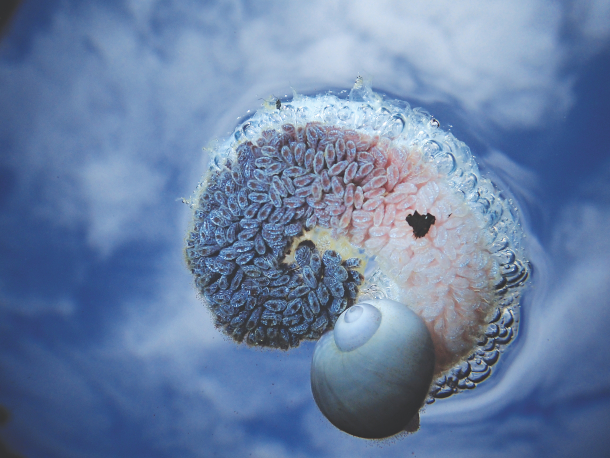
This image of a global bubble-raft shell was taken from below, looking up to the surface. This animal creates a stiff raft out of a stream of bubbles so it can float. They lay their eggs on the raft, too, and that’s what’s visible here: the darker eggs were laid first and have developed more than the newly laid pink ones.

Read Full Post »

Photo: Phil Torres, Dr. Geoff Wheat
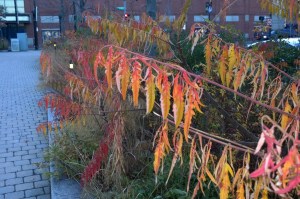
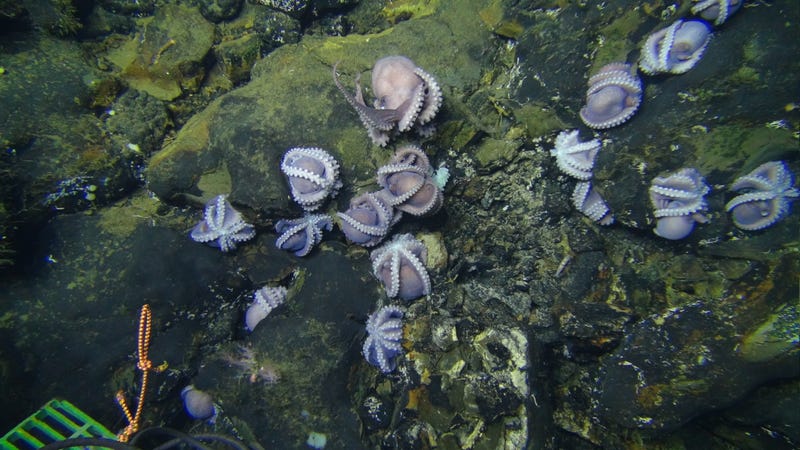
Seventeen octopods huddled on the Dorado Outcrop, two miles underwater near Costa Rica. Most are in a brooding (in the sense of baby-launching) posture.

Not sure where I picked up this octopus story, maybe from twitter. But who knows? Sometimes I learn facts about sea creatures from the Octonauts-loving grandchildren. (I’m grateful that cartoons these days have educational content. The cartoons I watched as a child were often no more than a bunch of mice running around and squeaking.)

Maddie Stone reports at Earther, “Scientists have made a truly bizarre discovery on an expanse of cooled lava 150 miles west of Costa Rica and nearly two miles underwater. There, they laid eyes on more than a hundred female octopuses, tending to eggs that didn’t seem to be growing in water that seemed too warm for their liking.

“Deep sea octopuses are a rare sight, and it’s even rarer to catch them in the act of brooding. So when Janet Voight, a deep sea biologist at the Field Museum of Natural History, examined footage collected at the Dorado Outcrop during a 2013-14 study of warm hydrothermal fluids seeping out of cracks in the rocks, it was nothing short of shocking to discover an enormous camp of tentacled, seemingly-expectant moms. …

“It’s [puzzling], because deep sea octopuses tend to thrive in near freezing temperatures. Warm water speeds up their metabolism, causing them to use up too much oxygen. And indeed, when lead study author Anne Hartwell examined the octopods’ breathing patterns in hundreds of hours of video footage collected by an ROV and a crewed underwater vehicle, she learned that those in or near hydrothermal fluids were breathing faster, suggesting oxygen stress.

“Moreover, none of the nearly 200 eggs the researchers examined appeared to be developing at all. …

“The researchers go on to speculate that females are drawn to the area because of the lack of sediment, which makes it easier to anchor their eggs, blissfully unaware of their new home’s thermostat problem.

“As the authors explain, hydrothermal fluid discharges can ramp up quickly at any given site, and once a female chooses a place to brood, she’s stuck with it — stressful environment or not. …

“Nicole Morgan, a deep sea biologist at Florida State University who also wasn’t involved, told Earther in a Twitter DM that while the water is warm, it’s ‘not outside known ranges for the octopus genus.’ The oxygen levels are also low but not lethal, she said, suggesting ‘the authors are probably right that this is sub-par brooding habitat.’

“ ‘I think they have captured a snapshot of what evolution looks like in real life — they are brooding in an area that is stressful but available and not immediately lethal,’ Morgan continued. ‘More likely than not this subpopulation will die out because of the high egg fatality, but if some eggs do survive, that could be a start to speciation.’ ”

More here.

Read Full Post »

These photos are from my rambles in downtown Boston, which I will be leaving at the end of the year for a new commute to Providence.

The first picture shows strange reflections on an iconic piece of local architecture. Then we have musicians in South Station, an octopus sculpture at the convention center, a lovely floral display by the landscape genius where I currently work, fall color in the Greenway, and more color along Fort Point Channel in front of the Children’s Museum.

What a neighborhood!

120715-Fed

120115-South-Station-musicians


121015-Boston-convention-center-art

120315-lobby-flowers


120715-fall-color-in-Greenway

121115-childrens-museum-colors

Read Full Post »

I was charmed by Sy Montgomery’s recent article in the Boston Globe on the intelligence of octopi (she says “octopuses”).

The author of The Soul of an Octopus: A Surprising Exploration into the Wonder of Consciousness, Montgomery describes getting to know a clever and apparently affectionate octopus called Octavia.

“Everyone wanted to pet Octavia,” she writes. “And no wonder. She was beautiful, graceful, and affectionate. The fact that she was boneless, slimy, and living in painfully cold, 47-degree water deterred none of us.

“What thrilled us — me, New England Aquarium volunteer Wilson Menashi, and four visitors from the environmental radio show Living on Earth was the surprising fact that Octavia, who clearly wanted to be petted, was a giant Pacific octopus.

“When her keeper, Bill Murphy, opened the top of her exhibit, Octavia recognized Menashi and me immediately; we’d been working with her for several weeks. Turning red with excitement, she flowed over toward us from the far side of her tank. When we put our hands in the water, her arms rose to meet ours, embracing us with dozens of her strong, sensitive, white suckers. Occasionally Wilson handed her a fish from the plastic bucket perched on the edge of her tank. …

“Then, as Menashi reached for another capelin to feed her, we realized the bucket of fish was gone. While no fewer than six people were watching, and three of us had our arms in her tank, Octavia had stolen the bucket right out from under us.

“ ‘Octopuses are phenomenally smart,’ Menashi says. And he should know: He has worked with them for 20 years, and is expert in keeping these intelligent invertebrates occupied. Otherwise, they become bored. Aquariums design elaborate escape-proof lids for their octopus tanks, and still they are often thwarted. Octopuses not infrequently slip out of their exhibits and turn up in other tanks to eat the inhabitants.

“Many aquariums give their octopuses Legos to dismantle, jars with lids to unscrew, and Mr. Potato Head to play with. Menashi, a retired inventor, designed a series of nesting Plexiglas cubes, each with a different lock, which Boston’s octopuses quickly learned to open to get at a tasty crab inside. And just this spring, New Zealand Sea Life aquarists teamed up with Sony engineers to teach a female octopus named Rambo to press the red shutter button on a waterproof camera to take photos of visitors, which the aquarium sells for $2 each to benefit its conservation programs. Rambo learned in three attempts.”

What a different perspective on the scary beast in the film 20,000 Leagues Under the Sea, which I saw as a child.

I’d love to copy the whole intriguing article, but I’m afraid that would not be “fair use.” So read it all here.

Photo: Tia Strombeck
Sy Montgomery pets Octavia, an octopus at the New England Aquarium in Boston.

Read Full Post »

Have you ever taken out-of-town guests to see the glass flowers at Harvard? They are among the area’s must-see attractions.

The Czech father-son team Leopold and Rudolf Blaschka created the flowers in the 19th century, when they also made glass replicas of sea creatures.

Now scientists are comparing the duo’s marine life to what exists today. Have the creatures evolved? Are some extinct?

“I’ve been a marine biologist my entire professional life,” write C. Drew Harvell in the Science section of the NY Times, “spending more than 25 years researching the health of corals and sustainability of reefs. I’m captivated by the magic of sessile [attached by the base]  invertebrates like corals, sponges and sea squirts — creatures vital to the ecosystem yet too often overlooked in favor of more visible animals like sharks and whales.

“The filmmaker David O. Brown and I want to change that. To make a documentary, Fragile Legacy, we are on a quest to lure these elusive and delicate invertebrates in front of the camera lens.

“Our inspiration springs from an unlikely source: a collection of 570 superbly wrought, anatomically perfect glass sculptures of marine creatures from the 19th century.

“These delicate folds and strands of glass make up the Blaschka collection of glass invertebrates at Cornell, of which I am the curator — enchanting and impossibly rare jellyfishes of the open ocean; more common but equally beautiful octopus, squid, anemones and nudibranchs from British tide pools and Mediterranean shores.

“They are the work of an extraordinary father-and-son team, Leopold and Rudolf Blaschka.”

The rest of the story is worth your time. Check it out.

Photo: Kent Loeffler
A glass sculpture of Facelina drummondii, a sea slug in Cornell’s Blaschka collection.

Read Full Post »