Feeds:
Posts
Comments

Posts Tagged ‘oregon’

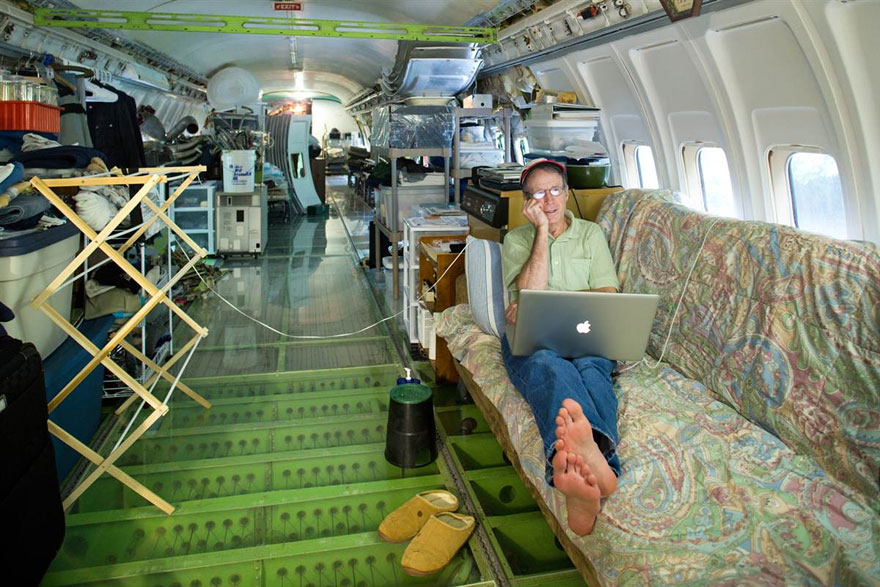
Being reminded recently that Bored Panda was a good place to look for cool stuff, I read about a guy who makes his home in an airplane.

“Bruce Campbell is an inventive engineer who bought a retired Boeing 727 aircraft fuselage and upcycled it into an unusual and innovative home. The huge 3-engine commercial airliner is propped up on concrete pillars in a suburban wooded area outside of Portland, Oregon, and has its own driveway.

“The aircraft features a makeshift shower, but he is still working to install a working lavatory and to restore some of the plane’s original interior elements, like seating and lights. Campbell lives in this plane 6 months every year, and spends the other part of the year in Japan, where he is also looking to buy and similarly re-use a retired Boeing 747 fuselage.”

More here. Lots of pictures.

Photo: John Brecher
Says plane denizen Bruce Campbell, “Shredding a beautiful and scintillating jetliner is a tragedy in waste, and a profound failure of human imagination.

Read Full Post »

Kai sent a link to a story about a guy who has his mother living in a tiny house in his backyard.

I had to laugh. The house is about the size of my garage, and as much fun as it would be to live in a child’s playhouse, I can’t imagine what a born pack rat would do with all her clutter. (Not to mention, how many grown children want a parent living in the backyard?)

Sandy Keenan reports in the NY Times, “In most cities, adding a second house to a single-family lot would be illegal or would set off an epic battle with the neighbors that could drag on for years. But not in Portland, Ore.

“There, this kind of housing — referred to officially as ‘accessory dwelling units,’ but better known as granny flats, garage apartments or alley houses — is being welcomed and even encouraged, thanks to friendly zoning laws. And additional living spaces are springing up everywhere, providing affordable housing without changing the feeling or texture of established neighborhoods the way high-rise developments can. …

“Eric Engstrom, a principal city planner, has seen these small structures become increasingly popular during his 16 years working for the city. And as he put it, ‘Given the low vacancy rate, when they’re done, you can rent them out in about an hour.’ Which means that adding an accessory dwelling unit, or A.D.U., increases the value of a piece of property. …

“It was in 2010 when the biggest changes took place. That was when the city relaxed the limitations on size and began offering the equivalent of a cash incentive by waiving the hefty fees usually levied on new development. Other cities in the Northwest have been moving in this direction, but Portland is the first to offer a significant financial benefit and one of the few that does not require owners to live on the site, provide additional off-street parking or secure the approval of their neighbors.” More.

I know of at least one resort community that allows accessory apartments for family members. It’s a good idea, but there’s always the worry that in the season, some folks will just rent them out to tourists and still need a place to stay.

Photo: Laure Joliet for The New York Times
A 480-square-foot garage, now a home: one of many small dwellings encouraged by the city of Portland, Ore.

Read Full Post »
Got this from SmallerCitiesUnite! on twitter.

Rachel Walker writes at PeopleForBikes.org, “How do you get more people on bikes? Go to where they are, open up a ‘shop,’ teach them to build and maintain a bike. Help them earn a bike. Repeat.

“This is the philosophy behind the myriad of community bike shops sprouting up in inner-city neighborhoods throughout the country. Non-profit organizations that cater to the underserved aim to destigmatize and popularize cycling among communities that have probably not heard of Strava or clipless pedals. In these neighborhoods, bicycle lanes, racks, and, most importantly, riders, are noticeably absent.

“And that, according to the forces behind community bike shops, must change—for multiple reasons.

“ ‘For our core constituents, getting a bike and learning how to maintain it is about economic mobility,’ says Ryan Schutz, executive director of Denver’s Bike Depot. ‘Owning a bike lets them travel farther to find work and spend their money on food, instead of on gas or bus fares.’

“Like the majority of community bike shops, Bike Depot puts bikes into the hands of people who otherwise couldn’t afford them or may not choose to buy them. The organization accomplishes this through earn-a-bike programs and by selling low-cost refurbished bikes. They also teach members bike safety and maintenance skills.” More here.

Sounds like a variation on Bike Not Bombs, which started in the Greater Boston area several decades ago, refurbishing donated bicycles and sending them to poor countries.

Here’s what Bikes Not Bombs says on the website: “Bikes Not Bombs uses the bicycle as a vehicle for social change. We reclaim thousands of bicycles each year. We create local and global programs that provide skill development, jobs, and sustainable transportation. Our programs mobilize youth and adults to be leaders in community transformation.”

All good stuff.

Photo: People For Bikes
The Community Cycling Center in Portland, Oregon, offers bike camps to local kids.

Read Full Post »

Eben Horton, a glassblower with a studio in Wakefield, Rhode Island, loved hearing how glassblowers in Lincoln City, Oregon, had hidden special creations on a local beach for a community treasure hunt.

Inspired to do something similar, he settled on the idea of glass floats, the kind traditionally used on fishing nets.

The Block Island Tourism Council helped Horton launch the Glass Float Project. The council’s site has details.

“WHEN: The hunt begins June 2nd, 2012, and continues indefinitely. It only ends when all the floats have been found!

“WHAT: 200 Glass Floats (glass orbs about the size of a grapefruit) will be hidden on Block Island. Floats will be dated, numbered and stamped with the shape of Block Island. All floats are clear glass except for 12 (because it is 2012), which are special colored orbs. One super special float is made entirely out of gold leaf.

“WHERE: 100 floats on beaches and 100 floats on Greenway trails. Floats will be hidden above the high tide mark but NEVER in the dunes or up the bluffs.”

Understandably, they don’t want people walking on the dunes, which protect the island in storms.

Check the council website for the bio on the artist, too: “Eben creates custom one of a kind pieces on an individual basis out of his studio that he calls ‘The Glass Station’- a converted 1920’s gas station.” More.

Read Full Post »

« Newer Posts