Feeds:
Posts
Comments

Posts Tagged ‘origins’

Photo: Albert Ting/Renwick Gallery of the Smithsonian American Art Museum.
This cow was made out of about 700 pounds of butter and was on display at the Smithsonian’s Renwick Gallery in Washington, D.C. for a year. It was created by Sarah Pratt, the official butter sculptor of the Iowa State Fair.

When we lived in Minneapolis, one of the must-see events of any year was the state fair. We loved checking out the crazy foods on offer. Deep-fried jelly beans, Anyone? Watermelon tacos? We loved the sculpture of Princess Kay of the Milky Way, created out of butter, the seed art, and the livestock exhibits.

For state fairs, you can’t beat Minnesota.

Ayana Archie has wrote at National Public Radio [NPR] about the origins of these partly playful, partly serious annual celebrations.

“There’s something for everyone at a state fair — petting zoos, live music, fried foods. For many states in the U.S., summer to fall is the season for the annual state fair. The country’s first state fair dates to the 19th century, when locals would showcase livestock, crafts and agriculture.

“State fairs of today share the same elements, but have evolved into something like pop-up theme parks. They remain a favorite American pastime, contributing $30 billion to the U.S. economy each year, said David Grindle, CEO of the International Association of Fairs & Expositions. …

“State fairs began as agricultural competitions, which the British brought with them as they colonized North America, said Nick Pirro, who the New York State Fair has deemed its unofficial resident historian. … They served as spaces where farmers could show off their livestock and inform the public. …

“Once the colonies began developing governments and counties, county fairs took off. … In 1841, the state fair was born. The first one was held in Syracuse, N.Y. There were plowing competitions and animal exhibits. …

“Now, fair contestants show off all kinds of things — flowers, outfits and cakes … but agriculture is still everywhere at fairs.

” ‘The driving force is agriculture,’ Pirro said.

“Crafts have an early presence at state fairs, too. But back then, displays and demonstrations were a matter of function. They were useful for determining things like the types of wool a sheep might produce, or showing off the latest manufacturing or blacksmith techniques, said Mary Savig, the curator-in-charge of the Smithsonian’s Renwick Gallery, an arm of the American Art Museum in Washington, D.C. …

“In the 19th century, Victorian hair wreaths (made from human hair) were all the rage throughout the country, said Savig. She traveled to various state fairs to curate the Renwick exhibit. She said more recently, ‘diamond’ art has become popular, in which people make portraits, or recreate famous artworks out of crystals.

And as a tongue-in-cheek homage to fair food, some crafters have begun constructing quilts-on-a-stick at the Minnesota State Fair, for example.

“They’re mini quilts about the size of a sheet of printer paper that artists poke skewers through. ‘It’s a pretty small project and it’s very accessible to people, especially new quilters,’ Savig said.

“In Mississippi, the Choctaw Indian Princess is crowned each year at the Choctaw Indian Fair, in which the contestants often make their own garments with elaborate beading and embroidery work. In Minnesota, there are contests for rosemaling, a Norwegian folk art, which is characterized by intricate patterns of flowers and swirls. …

” ‘On artists, [fairs] have had historically, a really important impact, just as far as validating an artist’s skills, also giving them a platform to show their work and be recognized,’ Savig said.”

More at NPR, here. Official butter sculptor of a state fair? Don’t you love the kinds of jobs that exist in our nutty, fascinating world?
Read Full Post »

cbvcc2xvxyi6te4xe3dlbwvsqi

Photo: Julia Cumes for the Boston Globe
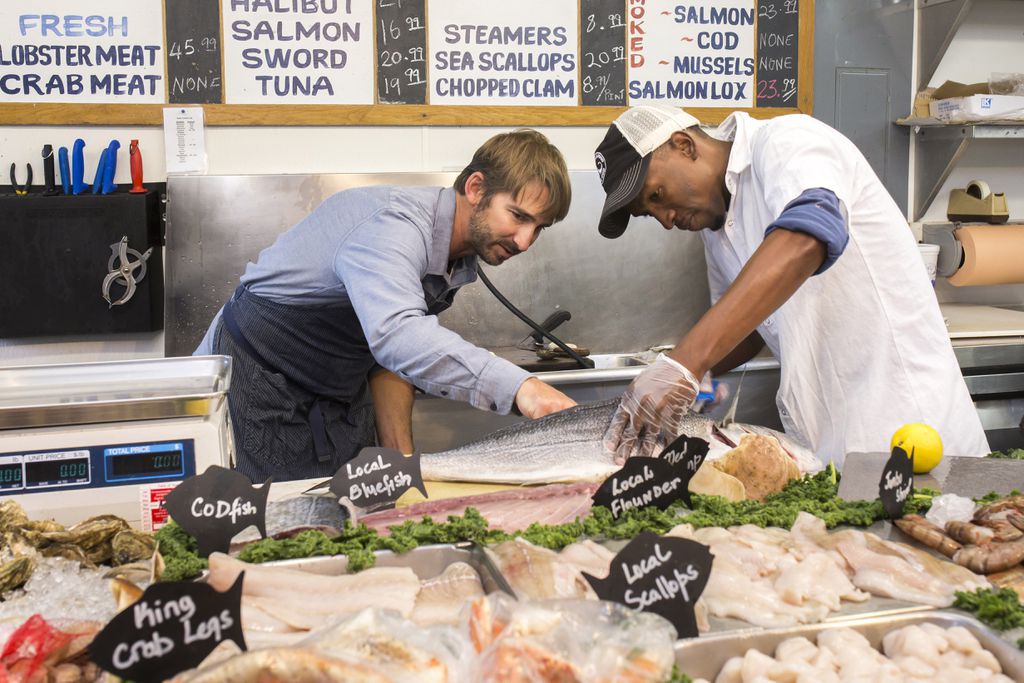
Mac Hay (left) and Robert Campbell at Mac’s Seafood Market in Wellfleet, Mass. Fish markets are the final link in a blockchain initiative to inform consumers about the food they buy.

Last summer I met a woman running a thriving experimental community garden on an old tennis court in the New York City projects. She told me that she got into growing produce because she found herself overthinking every decision in the grocery store: was that lettuce really organic; were the lettuce pickers paid a living wage; how much fossil fuel was burned transporting the produce to New York?

She may be an extreme example, but I’m hearing that many consumers want to know more about the origins of what they’re eating. They are much less passive about food.

Hiawatha Bray reported at the Boston Globe in October, “A Massachusetts fishing company will soon be able to show diners at a restaurant chain in California exactly where and when the seafood on their plates was harvested, in some cases even showing video of scallops being hauled out of the sea.

“ ‘They can watch it as we catch it,’ said Dan Eilertsen, owner of Nordic Inc., which operates six scallop boats based in New Bedford. ‘The whole story about the product you’re eating will be right in front of you.’

“Nordic Inc. and its distributor, Raw Seafoods Inc. of Fall River, are deploying Food Trust, a system from IBM Corp. that captures detailed information about food production from harvest to table. Now the companies are about to share this information with the consumers who feast on their products — and scallops are just the start.

Food Trust essentially creates a digital tag for each step of the food production process, the data forming a complete biography of every bite we eat, down to each ingredient in a package of processed food. …

It’s already started at French grocery chain Carrefour, which operates stores throughout Europe, China, Africa, and South America. Carrefour customers can use a phone app to find detailed information about two dozen items, including chicken, eggs, oranges, pork, and cheese; Carrefour plans to add about 100 more items by the end of 2019.

“In the United States, early Food Trust adopters are mostly using it internally, to track inventory and monitor freshness. Giant US grocery chains such as Walmart, Kroger, and Albertsons have signed on, as have a number of food suppliers such as Swiss-based Nestle, pork producer Smithfield Foods, and distributor Golden State Foods.

“An IBM spokesperson said that Nordic and Raw Seafoods will be among the first US users of Food Trust to deliver food data to consumers. The experiment begins in November, at TAPS Fish House & Brewery, a four-restaurant chain based in Brea, Calif. A special barcode will appear on the menu next to the restaurant’s scallop dishes. Tom Hope, TAPS director of food and beverage, said customers who scan the code with a smartphone will see the day and date of the scallop harvest. …

“It’s all made possible by blockchain, the technology that underlies digital currencies such as Bitcoin. A blockchain is an immense string of data, each digital tag along the food chain, as it were, adding to the string. The information is stored in an encrypted database that is dispersed across hundreds or thousands of computers. A blockchain can be easily updated with new data, and because it’s encrypted and widely distributed, it’s virtually tamperproof.

“Fishing on the open sea is hard, dangerous work, with little time to punch data into computers. Food Trust makes it easy. The name of the person on watch — the captain or the mate — is punched in once, at the start of each shift. After that, the fishermen just start bagging and tagging.

“Every time a bag hits the scales, a computer records the date and time of the catch, the boat’s latitude and longitude, and of course the weight — generally around 50 pounds each bag. There’s no need for a worker to enter data by hand; it’s all collected automatically from the boat’s GPS system, which acts as clock and calendar as well as a navigator. All this information is uploaded to the blockchain via satellite radio. A fisherman slaps a label onto each bag, with a barcode that links it to the recorded data.”

For a lot more detail, please read the Globe article, here. And start asking questions where you buy food.

Read Full Post »