Feeds:
Posts
Comments

Posts Tagged ‘palestine’

Photo: It’s Time.
Jewish Israeli singer Achinoam Nini and Palestinian Israeli singer Mira Awad take the stage at the People’s Peace Summit in Jerusalem, May 9, 2025.

You wouldn’t know it from the headlines, but in Israel there are actually quite a few Jewish and Palestinian individuals who refuse to give up on peaceful coexistence.

Dina Kraft reports at the Christian Science Monitor, “For Israelis and Palestinians, May 28 marked 600 days of the most devastating period either side has known since Israel’s foundation. And yet amid it all, there are people trying to build bridges from one side to the other, attempting – together – to create a different reality.

“Some of them gathered recently for a well-attended two-day People’s Peace Summit in Jerusalem, forged by a coalition of Jewish and Palestinian peace-building and coexistence organizations. They sought to demonstrate that a peace movement is a viable and growing notion, and that joint Jewish-Palestinian activism is withstanding the raging war and shattered trust.

“ ‘The way to peace will not be short, but it is better than endless war,’ Sally Abed, a Palestinian citizen of Israel, called out from the Jerusalem stage to an auditorium packed with over 3,000 people. She is a leader of Standing Together, a fast-growing group uniting Jewish and Palestinian Israeli citizens.

“One outspoken Israeli peace activist is Maoz Inon, whose parents were burned to death in their home near Gaza in Hamas’ Oct. 7, 2023, attack that sparked the war. He and his siblings responded with a vow to seek peace, not revenge.

“ ‘Yes, we are devastated from the horrors that are happening in Gaza and the West Bank, and we acknowledge the ongoing trauma both peoples are enduring,’ he says in an interview. ‘But we know the only way to end the bloodshed and the cycle of violence, revenge, and hate is shaping and creating a new reality. We are learning from spiritual and faith leaders, security leaders, and from other conflict areas that were resolved.’

“In the aftermath of Oct. 7, Mr. Inon paired with a fellow entrepreneur, Aziz Abu-Sarah, a Palestinian from East Jerusalem whose older brother died soon after being imprisoned and beaten in the first intifada. Together they have been advocating reconciliation, equality, and justice.

“They say they can see their growing impact in their growing list of invitations to speak, not only at peace-related events but also in public schools, at universities, and at conferences. Their joint TED Talk has gone viral, and their work caught the attention of the late Pope Francis, leading to a Vatican meeting.

“It can be difficult for Israelis and Palestinians to work together openly. Activists are called naive at best, traitors at worst. But, Mr. Abu-Sarah argues, ‘We are offering the only viable answer to the current reality. As Maoz told me after his parents were killed, “Right now, we are in the desert – no food, no water. We’re lost. And when you’re lost in the desert, you call out for water.”

” ‘We are calling out for peace. … In times like these, we must work with Israelis who oppose the bombardment of Gaza and genuinely support peace. [But] bridge-building must be rooted in clear principles: equality, justice, recognition, healing, and safety for all. It’s not just about dialogue. It must lead to real action and tangible change. We do have strong, principled allies on the Israeli side. … They need us, and we need them, because without each other, we’re weaker – and the killing won’t stop.’

“[Standing Together] sees the recent surge in activism as the sign of an awakening among Israeli Jews who view the war as endangering Palestinian civilians alongside Hamas-held Israeli hostages and soldiers. …

“Illustrating both the challenge and the potential for peace activists, throngs of ultranationalist young Israelis swept through Jerusalem’s Old City on May 26, shouting hateful slogans in a sometimes-violent march marking the day in 1967 when Israel captured East Jerusalem.

“Volunteers from Standing Together and the Free Jerusalem collective, a group of predominantly Jewish Jerusalem residents that works with Palestinians in the city, acted as a ‘humanitarian guard’ to prevent violence. In a scene captured on video, a Jewish Israeli volunteer can be seen rushing into a crowd of far-right marchers surrounding a Palestinian man. …

“ ‘We always have something we can do and a way we can do it,’ wrote Rula Daoud, co-director of Standing Together, herself a Palestinian citizen of Israel.

“Mohammad Darawshe, director of strategy at Givat Haviva, Israel’s oldest and largest organization working for a shared Jewish-Arab society, says bridge-building is challenging for Palestinian Israelis. They face systemic discrimination and are often seen as a fifth column in Israel, he says, and while they have an ethnic and cultural affinity for West Bank and Gaza Palestinians, they have limited political influence.

“ ‘As peacemakers they have a very underutilized role. But if empowered by Israel and by Palestinians on the other side, then they could play a significant role in peacemaking thanks to our bilingualism and dual identity,’ he says. …

“Mika Almog, creative director of the It’s Time movement that organized the peace summit, says that it is hard to counter the general Israeli mindset that there are no Palestinian partners for peace, especially in the wake of the Oct. 7 atrocities. …

“She says Israelis have been told that the conflict could be contained through periodic wars, but not resolved. ‘We have been taught that this is a reasonable price,’ she says. ‘In order for Israelis to be able to sustain and build faith [in the prospects for peace] we need to see Palestinian partners within Israel but also partners in Gaza and the West Bank.’

“At the summit, a view of life in Gaza came in the form of a brief video of a Palestinian woman walking through the rubble. She details the difficulties of her life: living in a tent, subsisting on limited food and water.

“ ‘We are living a tragedy,’ she says. ‘Most people in Gaza are against extremism and terrorism. We want peace.’ ”

More at the Monitor, here. No firewall. Subscription prices are reasonable.
Read Full Post »

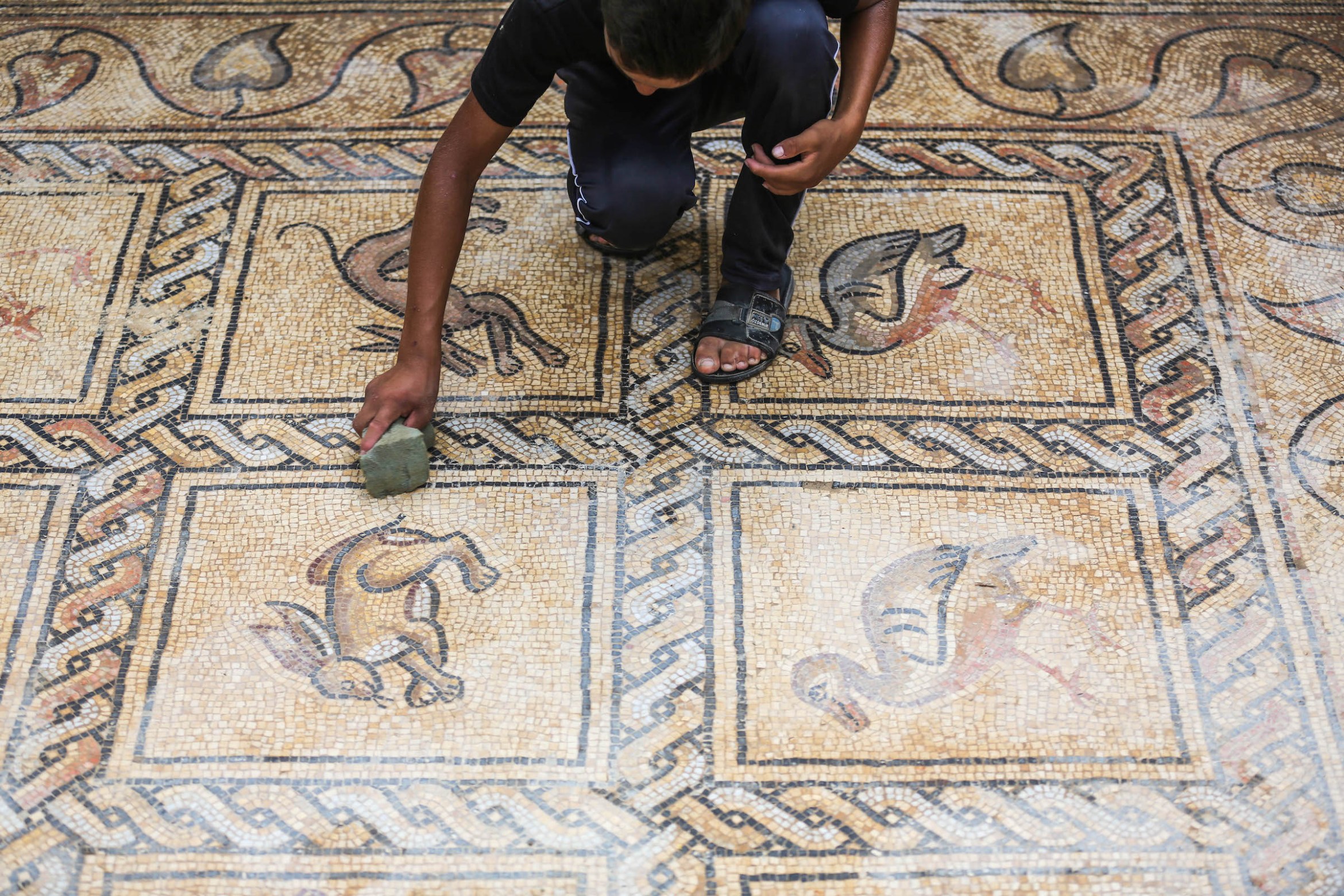
Photo: Ahmed Zakot.
A Palestinian farmer unearthed a Byzantine floor mosaic beneath his olive grove.

We keep learning that beautiful discoveries can still be made, even in mundane settings. Perhaps you have discovered yellowed letters your parents wrote to each other when courting. Perhaps there was an antique bottle inside a wall when you renovated.

Such items can be exciting, but it’s hard to beat the discovery a farmer in today’s stumbled upon.

Elaine Velie reports at Hyperallergic, “Salman al-Nabahin, a farmer from Gaza’s Bureij refugee camp, was trying to plant new olive trees in his orchard but something underneath the soil was standing in his way. He investigated for three months, digging out the soil with his son until they unearthed a stunningly well-preserved Byzantine floor mosaic.

“Al-Nabahin told Reuters that he searched the internet to asses the mosaic’s origins. An archaeologist from the French Biblical and Archaeological School of Jerusalem, René Elter, later confirmed the work as a Byzantine mosaic, placing the mosaic between the fifth and seventh centuries CE. …

“ ‘Never have mosaic floors of this finesse, this precision in the graphics and richness of the colors been discovered in the Gaza Strip,’ Elter [told the Associated Press], adding that more research is needed to determine the work’s intended function.

“The Palestinian Ministry of Culture stated that investigation into the mosaic was still in its early stages and a team of national experts would partner with experts at the French Biblical and Archaeological School of Jerusalem to research the work.

“Gaza is situated on a thriving ancient trade route, and dozens of important archaeological discoveries have been uncovered there in the last few years. The recently revealed mosaic, however, sits less than a mile away from the Gaza-Israel barrier, which Elten said puts the discovery in ‘grave danger.’ …

“ ‘I see it as a treasure, dearer than a treasure,’ al-Nabahin told Reuters. ‘It isn’t personal, it belongs to every Palestinian.’ “

Sarah Kuta at the Smithsonian adds, “Now, archaeologists with the Palestinian Ministry of Tourism and Antiquities and the French Archaeology School are hard at work studying the flooring to learn more about its ‘secrets and civilization values,’ says the ministry in a press statement.

“The mosaic features 17 iconographies of birds and other animals depicted in bright colors. Archaeologists … don’t know whether the mosaic had religious or secular origins.

“The farmer has been covering the unearthed areas of the mosaic floor with tin sheets to protect them; so far, he’s dug up three separate sections, the widest measuring 6 feet by 9 feet, according to Fares Akram of the Associated Press. In total, the land covering the entire mosaic is about 5,400 square feet, and the mosaic itself measures about 250 square feet. Some parts of the mosaic appear to be damaged, likely from the roots of an old olive tree.

“ ‘These are the most beautiful mosaic floors discovered in Gaza, both in terms of the quality of the graphic representation and the complexity of the geometry,’ [Elter] tells the AP. …

“The Bureij refugee camp [is] located about half a mile from the border with Israel. Archaeologists and other experts are concerned about the mosaic’s future because of the ongoing Israeli-Palestinian conflict, as well as looting and a lack of funding for historical preservation.

“ ‘It is a spectacular find, especially as our knowledge of archaeology is sadly so spotty given circumstances there,’ Asa Eger, an archaeologist at the University of North Carolina at Greensboro, tells the Art Newspaper’s Hadani Ditmars. ‘Gaza was very important during the period of this mosaic and known for its burgeoning wine production exported across the Mediterranean.’ “

You’ll love the photos at Hyperallergic, here, and at Smithsonian, here. No firewalls.

Read Full Post »

I was so happy to get this hopeful update on Kids4Peace Boston today.

“For a while last summer, as violence escalated in Israel/Palestine, the possibility of Israeli, Palestinian and US youth coming together for a Kids4Peace camp seemed pretty unlikely.

“But despite countless barriers and uncertainties, all 25 young leaders — Muslims, Christians and Jews from Jerusalem, the West Bank, and Boston — did make it to be together on that beautiful mountaintop in New Hampshire. …

“Being in the presence of one another and listening, really listening, to each other’s stories is the crucial first step in the Kids4Peace experience.

” ‘I came to Kids4Peace to try and understand the different viewpoints that each kid has. Some people don’t understand that someone with a different opinion than you can be right without making you wrong.’
~Participant from Boston

“In the midst of violence, in the midst of despair, there are people who turn towards each other rather than away. This summer 25 peace leaders and their families proved that they are the kind of people who choose to turn towards. These young leaders walked away from camp feeling empowered by and connected to others who believe, as they do, that together peace is possible.

” ‘To be a peacemaker is to hold our hands together, and to help each other not killing each other, to treat each other as humans.’ 
~Participant from Jerusalem”

Read Full Post »

Margarida Santos Lopes has a hopeful story at the Christian Science Monitor about an Israeli rabbi and a Palestinain who are friends.

“Shaul David Judelman is an Israeli rabbi who moved from Seattle to Bat Ayin, a religious community in the occupied West Bank.

“Ziad Abed Sabateen is a Palestinian farmer who endured imprisonment during the first intifada against the Israelis more than 20 years ago and whose family was dispossessed of most of its land to accommodate Jewish settlers.

“The two men are good neighbors, friends, and business partners – not enemies.

“Mr. Judelman and Mr. Sabateen are committed to ‘peaceful coexistence’ between Israelis and Palestinians, whether they live together in one state or two separate states.

“The majority of those in both their camps may find it hard to understand the two men’s close relationship. But neither side repudiates them as traitors or collaborators. …

“On a mountaintop with a view of the Mediterranean Sea … Judelman and Sabateen plan to create the Heavens Field Farm, which will put ’emphasis on belonging to the land, not ownership of it,’ according to their joint manifesto.

“Their idea is to run an organic farm that will sell vegetables in local markets, support families in need, and attract volunteers and tourists. Among their partners are a joint Israeli Palestinian journal, called Maktub, and other nonpolitical groups such as Eretz Shalom (Land of Peace).”

Read more to understand how each came to their worldview through different paths.

Photo: Udi Goren
Shaul David Judelman (l.) and Ziad Abed Sabateen, in Bethlehem. They want to create an organic farm in the West Bank as a project for peace.

Read Full Post »

A musician and his scholar wife have created an unusual show based on their visits to Israel and Palestine and on the music and sounds they absorbed there.

Joel Brown writes in the Boston Globe: “Performer Yuri Lane grew up the son of artists in San Francisco’s then-gritty Haight-Ashbury neighborhood, which he found to be good preparation for traveling the West Bank as a Jew.

“ ‘I learned a lot about tolerance, and seeing people for who they are, not judging them,’ he says. ‘Also, some street smarts.’

“Lane began visiting Israel and the West Bank in the late 1990s, following his girlfriend, now wife, Rachel Havrelock, a religion scholar who studied on both sides of the Green Line that marks Israel’s pre-1967 borders.”

Together they have created “From Tel Aviv to Ramallah: A Beatbox Journey,” which they call a “hip-hop travelogue.”

Lane tells the Globe his travels “just kind of opened me up, just being Jewish in Israel . . . and also traveling across the Green Line and seeing a lot of similarities between Tel Aviv and Ramallah. … The night life and the jazz cafes and places where people can smoke water pipes and hang out, listening to the sounds of music, from sped-up Bedouin music to hip-hop. I really just tried to be a sponge.” More from the Globe.

By the way, you can hear Yuri’s harmonica beatboxing on YouTube. (Had to look up beatboxing: “a form of vocal percussion primarily involving the art of producing drum beats, rhythm, and musical sounds using one’s mouth, lips, tongue, and voice.”)

Photograph: The Boston Globe


Read Full Post »