Feeds:
Posts
Comments

Posts Tagged ‘Paraguay’

Photo: Steven Wright/Unsplash.

Anyone can post on Wikipedia. I even tried it once myself. But volunteer editors are always checking that you obey the rules. My post on the neglected artist Lucille Corcos was removed because at that time, citations from online links were not allowed.

Today’s story shows what can happen if your Wikipedia entries are mainly another no-no: self-promotion. There’s a lot of self-promotion on Wikipedia, but this guy was especially sneaky.

Nate Anderson writes at Ars Technica, “Quick — what are the top entries in the category ‘Wikipedia articles written in the greatest number of languages‘?

“The answer is countries. Turkey tops the list with Wikipedia entries in 332 different languages, while the US is second with 327 and Japan is third with 324. Other common words make their appearance as one looks down the list. ‘Dog’ (275 languages) tops ‘cat’ (273). Jesus (274) beats ‘Adolf Hitler’ (242). …

“A couple months back, something would have been different. Turkey, the US, and Japan were still in the same order near the top of the leaderboard, but the number one slot was occupied by an unlikely contender: David Woodard, who had Wikipedia entries in 335 different languages. …

“Woodard is a composer who infamously wrote a ‘prequiem’ — that is, a ‘pre requiem’ — in 2001 for Oklahoma City bomber Timothy McVeigh, who had murdered 168 people with a truck bomb. The piece was to be performed at a church near McVeigh’s execution site in Terre Haute, Indiana, then recorded and played on the radio so that McVeigh would have a chance to hear it.

“According to the LA Times, which spoke to the composer, ‘Woodard’s hope in performing the 12-minute piece, he said, is to “cause the soul of Timothy McVeigh to go to heaven.” ‘ …

“Woodard also had a scheme to help save Nueva Germania, an 1880s colony in Paraguay that was designed to let German culture flourish away from the influence of European Jews. … ‘As an artist who is fed up with much of the pretentious nonsense that has come to define Western culture,’ Woodard told SF Gate, ‘I am drawn to the idea of an Aryan vacuum in the middle of the jungle.’

“So what was a guy like this doing with articles in 335 different languages? Inquiring minds want to know, which is why people have posted questions to sites like Reddit over the last year asking about the Woodard situation. …

“A Wikipedia editor who goes by ‘Grnrchst’ recently decided to find out, diving deep into the articles about Woodard and into any edits that placed his name in other articles. The results of this lengthy and tedious investigation were written up in the August 9 edition of the Signpost, a volunteer-run online newspaper about Wikipedia.

“Grnrchst’s conclusion was direct: ‘I discovered what I think might have been the single largest self-promotion operation in Wikipedia’s history, spanning over a decade and covering as many as 200 accounts and even more proxy IP addresses.’

“A network of accounts with an unusual interest in Woodard was identified, and its activities over the last decade were mapped. Starting in 2015, these accounts inserted Woodard’s name ‘into no fewer than 93 articles (including “Pliers,” “Brown pelican,” and “Bundesautobahn”), often referencing self-published sources by Woodard himself.’ And that was just in the English version of Wikipedia.

“From 2017 to 2019, the accounts ‘created articles about David Woodard in at least 92 different languages, creating a new article every six days on average .… They started off with Latin-script European languages, but quickly branched out into other families and scripts from all corners of the globe, even writing articles in constructed languages; they also went from writing full-length article translations, to low-effort stub articles, which would go on to make up the vast majority of all translations (easily 90 percent or more).’ …

“After a reduction in activity, things ramped up again in 2021, as IP addresses from around the world started creating Woodard references and articles once more. For instance, ‘addresses from Canada, Germany, Indonesia, the UK and other places added some trivia about Woodard to all 15 Wikipedia articles about the calea ternifolia.’

“Then things got ‘more sophisticated.’ From December 2021 through June 2025, 183 articles were created about Woodard, each in a different language’s Wikipedia and each by a unique account. These accounts followed a pattern of behavior: They were ‘created, often with a fairly generic name, and made a user page with a single image on it. They then made dozens of minor edits to unrelated articles, before creating an article about David Woodard, then making a dozen or so more minor edits before disappearing off the platform.’

“Grnrchst believes that all the activity was meant to ‘create as many articles about Woodard as possible, and to spread photos of and information on Woodard to as many articles as possible, while hiding that activity as much as possible. … I came to believe that David Woodard himself, or someone close to him, had been operating this network of accounts and IP addresses for the purposes of cynical self-promotion.’

“After the Grnrchst report, Wikipedia’s global stewards removed 235 articles on Woodard from Wikipedia instances with few users or administrators. Larger Wikipedias were free to make their own community decisions, and they removed another 80 articles and banned numerous accounts. …

“In the end, just 20 articles about Woodard remain, such as this one in English, which does not mention the controversy.”

More here.
Read Full Post »

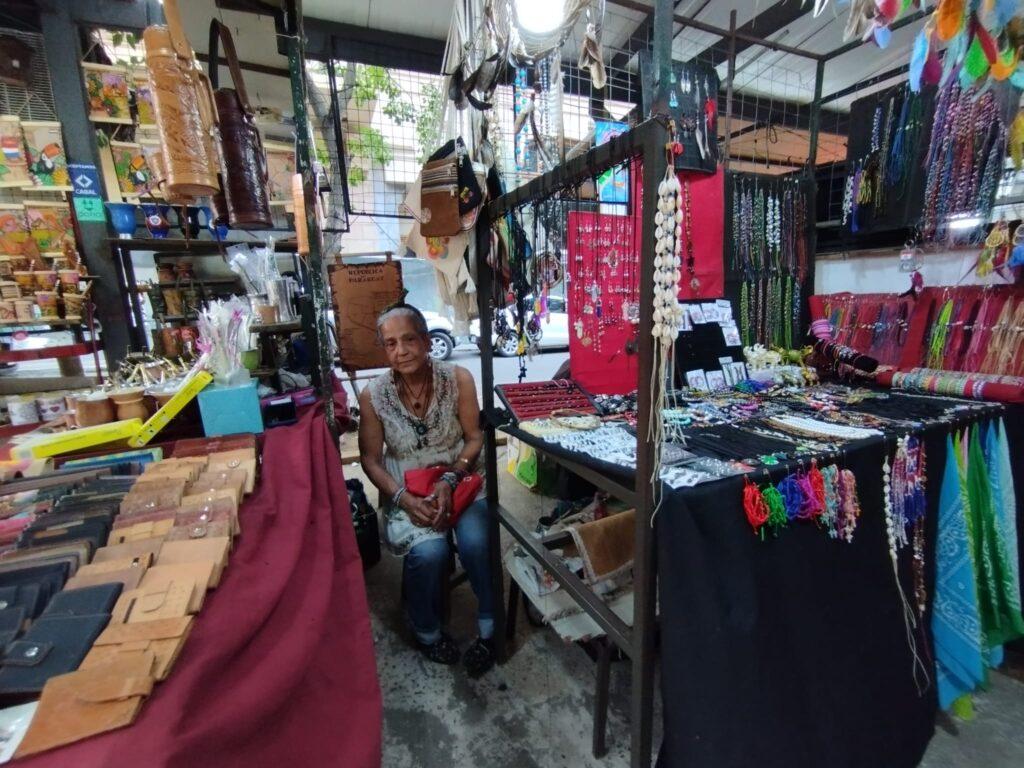
Photo: Michael Fox/The World.
Rita Álvarez has been selling handicrafts and homemade jewelry on the streets of Asunción, Paraguay, for more than 40 years. She said that most of her customers in the city speak a combination of Guaraní with Spanish.

Most of our stories on indigenous languages are about struggles in the face of looming extinction.

It’s different for an indigenous language called Guaraní in Paraguay. Michael Fox reports on the phenomenon at Public Radio International’s The World.

Tomas Zayas, who lives in the Paraguayan countryside, spoke only the Indigenous Guaraní language until he was 22 years old. 

“Later, he started to speak Spanish to be better prepared as a community leader. But Guaraní has remained his main language.

“ ‘For me, Guaraní is identity,’ said Zayas, a longtime campesino leader with the Alto Parana Small Farmers Association. ‘It’s happiness. It’s beauty. Because a joke in Spanish isn’t funny at all.’ 

“The Guaraní language, along with its many dialects, comes from the Indigenous Guaraní people who have lived in this region since long before the Spanish conquest. 

“Today, nearly 300,000 Indigenous Guaraní still live in Paraguay, Brazil, Bolivia and Argentina. In some of these countries, their language has influenced Portuguese and Spanish. 

“But in Paraguay, Guaraní is spoken as an official language alongside Spanish. Most Paraguayans speak Guaraní or a mixture of Spanish and Guaraní as their first language, whether they are of Indigenous descent or not. 

“Although there are several theories about how Paraguayans have been able to preserve their Indigenous language, one that stands out focuses on the Triple Alliance War of the 1860s.

“Most of Paraguay’s male population was killed after Brazil, Argentina and Uruguay invaded the country. ‘As a question of survival, the women who were left would only speak Guaraní,’ Zayas said. ‘They passed it on to their children.’ …

“Under the dictatorship of Alfredo Stroessner, which lasted from the 1950s until the late 1980s, Guaraní was banned in Paraguay. It has also been stigmatized as a language of the poor.

“But many Paraguayans say that Guaraní is a language of metaphor and beauty.

“Rita Álvarez has been selling handicrafts and homemade jewelry on the streets of Asunción, Paraguay’s capital, for more than 40 years. ‘For me, it’s the sweetest language,’ she said. ‘Because you can say with one word in Guaraní what you would need 10 to say in Spanish.’

“She said that most of her customers in the city speak a combination of Guaraní with Spanish, or jopara, which means ‘mixture’ in Guaraní. …

“Blanca Estela González is a retired elementary schoolteacher who now teaches Guaraní at IDIPAR Language School in Asunción.

“Gonzalez said that foreigners often pick up Guaraní rather quickly, because, unlike Spanish, there are only three types of verb conjugations: past, present and future. And Gonzalez said the language has received a boost in recent decades.

“ ‘Now, it’s an official language,’ she said. ‘And half of the lessons at the public schools are taught in Guaraní.’ ” More at The World, here.

Happy New Year to all blog friends, whatever language you speak. Any plans for celebrating?

Read Full Post »

09landfill1-jumbo

Photo: Landfill Harmonic
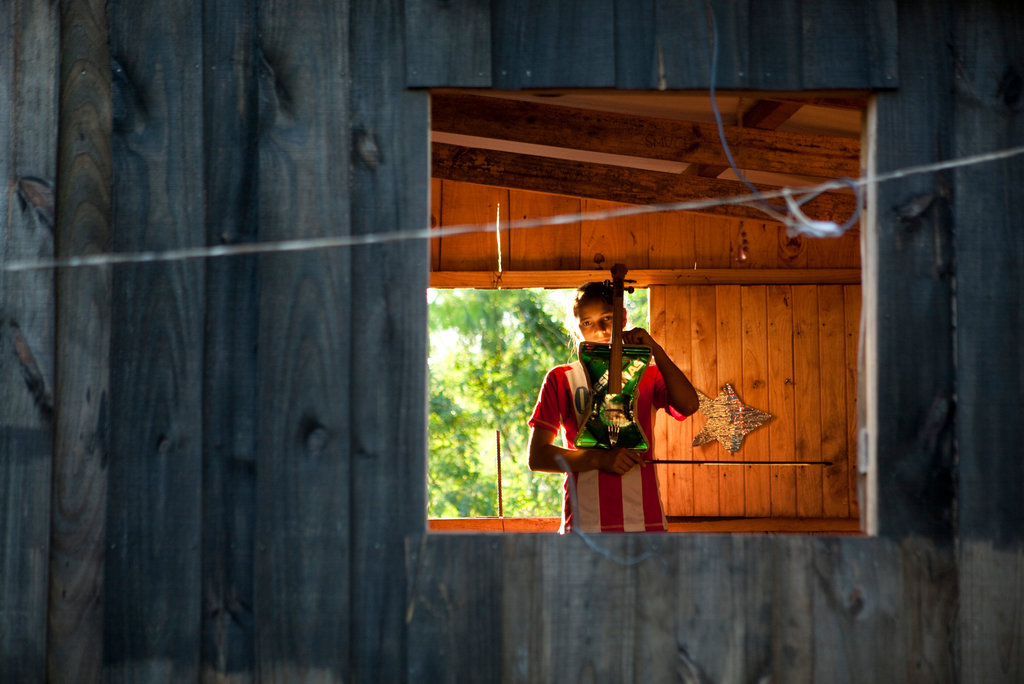
Tania Vera Hertz showing off her recycled violin in a documentary about poor kids in Paraguay.

Today’s story is about people in Paraguay who built instruments out of recycled materials and taught the children of impoverished landfill scavengers to play. That is the nugget, and a lovely nugget it is. But as I learned at Wikipedia, fame brought conflict among the adults involved. You can read about both aspects of the story below and see what you think.

Ken Jaworowski writes at the New York Times about the documentary Landfill Harmonic, which “starts in Cateura, Paraguay, an impoverished town outside Asunción, the country’s capital. There, at an enormous landfill, thousands of slum-dwellers support their families by sifting through trash to find things to sell.

“Favio Chávez, an environmental engineer, came to the area to help with a recycling program. That failed, but he stayed to teach music to children. Instruments were so scarce that Mr. Chávez, with help from a resident, Nicolás Gómez, created them from materials found in the garbage heaps. Those include violins made with metal cans, a cello built from an oil container and a drumhead fashioned from discarded X-ray film.

“Mr. Chávez and his students formed the Recycled Orchestra of Cateura and gained fame once video of their playing these scrappy instruments went online. Soon, children who’d never left their town were traveling the world to perform.

“It’s an inspiring tale — if it were fiction you’d dismiss it as unbelievable — and Brad Allgood and Graham Townsley, the directors (Juliana Penaranda-Loftus is listed as co-director), capture some endearing moments. …

“The children of Landfill Harmonic are wonderful to watch. A section in which David Ellefson, bassist for the metal band Megadeth, comes to visit them is downright adorable. (The orchestra later performs with the group at a concert, and it’s excellent.) Here and elsewhere we see barriers disappear — those between genres, cultures and languages become meaningless. For everyone involved, there’s nothing but joyous music.” More at at the Times, here.

Wikipedia adds history and describes an ongoing controversy about who started what when.

“The orchestra originated in the ‘Sonidos de la Tierra (Sounds of the Earth) program (created and directed since 2002 by Luis Szarán) and Procicla a recycling project of the Alter Vida NGO. Szarán founded the Sonidos de Cateura (Sounds of Cateura) music school on July 7, 2006, and its first workshop, sponsored by the geAm NGO to build recycled instruments, was held on May 24, 2007, luthier Carlos Uliambre. …

“The music school began with the recyclers’ children after Szarán donated ten guitars bought with proceeds from a tribute he received at Salemma Mall. A group of children between 8 and 12 years old from the Sounds of Cateura school was presented at the regional seminary of Youth Orchestras of Sounds of the Earth in Acahay [in 2006]. …

“The first group of Sounds of the Earth musicians with recycled instruments made their debut at the former Sheldonian Theater in Oxford, England as part of the Skoll Foundation’s World Forum of Social Entrepreneurs on March 26, 2008. …

“In October 2011, Sounds of the Earth announced on its Facebook page that Orchestra of Recycled Instruments coordinator Favio Chávez had left the program. Chávez announced the formation of the Recycled, with Sounds of the Earth musicians from Carapeguá and Cateura playing recycled instruments, two months later.” Lawsuits were in their future.

Wikipedia may have more information than you want about the ins and outs, but if you are interested. click here.

Read Full Post »