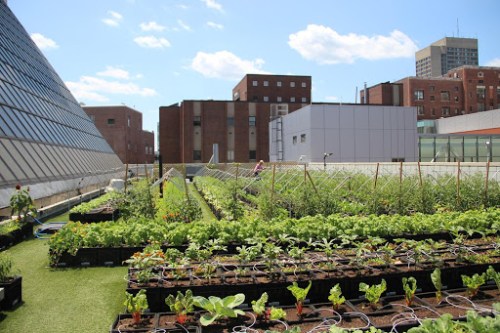
Photo: Matthew Morris
Boston Medical Center’s rooftop farm, spanning 2,658 square feet, is part of a mission to keep patients, especially low-income patients, healthy.
For many years, visionary physicians and staff at Boston Medical Center (BMC) have been taking a holistic approach to caring for patients — more often than not, desperately poor patients. If a child had asthma from conditions in a suboptimal apartment, BMC enlisted pro bono lawyers to get the landlord to meet legal obligations. If new Americans needed help understanding the forms they were supposed to fill out, BMC rounded up translators and guides. It didn’t have to be medical forms: people could get help with any kind of form.
The story below shows BMC’s ongoing efforts to ensure patients living in food deserts get decent nourishment. Doctors started writing prescriptions for farmers markets. Now they’re supporting a move to grow healthful food on the hospital’s roof.
Lindsay Campbell has the story at Modern Farmer.
“Carrie Golden believes the only reason she’s diabetes free is that she has access to fresh, locally grown food.
“A few years after the Boston resident was diagnosed with prediabetes, she was referred to Boston Medical Center’s Preventative Food Pantry as someone who was food insecure. The food pantry is a free food resource for low-income patients.
“ ‘You become diabetic because when you don’t have good food to eat, you eat whatever you can to survive,’ Golden says. …
“Three years ago, the hospital launched a rooftop farm to grow fresh produce for the pantry. The farm has produced 6,000 pounds of food a year, with 3,500 pounds slated for the pantry. The rest of its produce goes to the hospital’s cafeteria, patients, a teaching kitchen and an in-house portable farmers market. … The facility’s 2,658-square-foot garden houses more than 25 crops, organically grown in a milk crate system.
“ ‘Food is medicine. That’s why we’re doing what we’re doing,’ says David Maffeo, the hospital’s senior director of support services. ‘Most urban environments are food deserts. It’s hard to get locally grown food and I think it’s something that we owe to our patients and our community.’
“Lindsay Allen, a farmer who has been managing the rooftop oasis since its inception, says her farm’s produce is being used for preventative care as well as in reactive care. … What people put in their bodies has a direct link to their health she says, adding that hospitals have a responsibility to give their patients better food. …
“In addition to running the farm, Allen teaches a number of farming workshops to educate patients, employees and their families on how to grow their own food. The hospital’s teaching kitchen employs a number of food technicians and dieticians who offer their expertise to patients on how they can make meals with the local produce they’re given.
“This is part of the medical center’s objective to not only give patients good food, but also provide them the tools to lead a healthy life. Golden, who has used the pantry for the last three years, says the experience has changed the way she looks at food.
“ ‘I’ve gone many days with nothing to eat, so I know what that feels like when you get something like the food pantry that gives you what you need to stay healthy,’ she says. ‘I appreciate all the people that put their heart into working in the garden. If only they knew how we really need them.’ ” Perhaps they do.
More at Modern Farmer.

 Suzanne's Mom's Blog