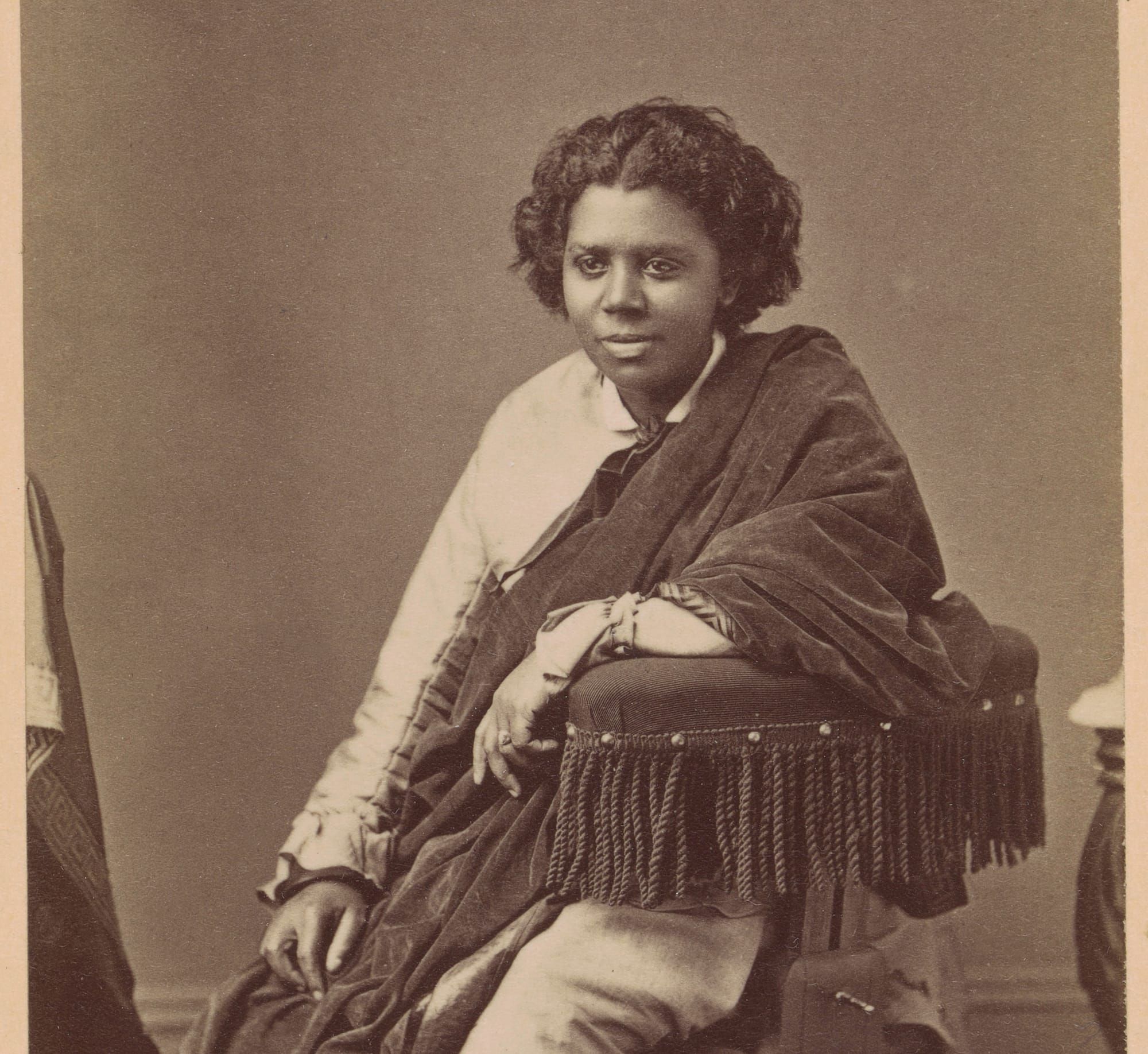
Photo: Henry Rocher/Harvard Art Museums Fogg Museum.
“Edmonia Lewis 1845-1907” (circa 1870).
Having just learned of an order to post signs outside the Smithsonian saying that the history inside is false, I’m sharing — in the interest of holding on to history based on facts — the kind of information you can still find at the Smithsonian.
Sháńdíín Brown has an article at Hyperallergic about black indigenous sculptor Edmonia Lewis and the exhibit about her in Massachusetts.
” ‘Sometimes the times were dark and the outlook was lonesome, but where there is a will, there is a way,’ the Black and Indigenous sculptor Edmonia Lewis once said. The quotation, now printed and spotlit on a dark blue wall in the exhibition ‘Edmonia Lewis: Said in Stone,’ continues, ‘That is what I tell my people whenever I meet them, that they must not be discouraged, but work ahead until the world is bound to respect them for what they have accomplished.’
“Lewis — who was born in Greenbush, New York, in 1844 and died in London in 1907 — is paid such respect in her first major retrospective at the Peabody Essex Museum [Salem, Massachusetts] held over a century after the artist’s death.
“Co-organized by the Peabody Essex Museum and the Georgia Museum of Art, the extensively researched exhibition tells an expansive narrative of the artist’s sculpture practice and legacy, displaying 30 of Lewis’s Neoclassical white marble sculptures alongside a plethora of archival materials and works by other artists.
“One of the strongest elements of ‘Edmonia Lewis: Said in Stone’ is that the curatorial framework allows for Lewis to be understood simultaneously as a Black and Indigenous artist without conflating the two identities. Indeed, each quite literally occupies its own space in the exhibition: Four thematic rooms — ‘Antislavery and Emancipation,’ ‘Indigenous Artistic Worlds, ‘the Studios of Rome,’ and ‘Religion, Mythology, Transcendence’ — are in conversation with one another and designated by different colors of wall paint. Through collaboration with Black and Native scholars, the groundbreaking exhibition is the first of its kind to present Lewis’s work in dialogue with both of her ancestries. …
“In 1865, Lewis moved from Boston to Rome — a premier hub for American Neoclassical sculptors from the late 1820s to the mid-1870s — and worked there as a sculptor until the early 1890s, when she moved to London. The exhibition informs visitors that within a few years of her arrival in Italy, Lewis was the first woman artist of Black and Indigenous descent to achieve widespread international acclaim. ”I was practically driven to Rome,’ Lewis explained, because ‘the land of liberty had no room for a colored sculptor.’ …
“While abroad, Lewis’s practice did not shy away from activism; her work commented on current American political events. The first carved marble sculpture by Lewis that exhibition-goers encounter is ‘Forever Free’ (1867), in which a man stands upright and looks up with his fist in the air. Broken shackles hang from his arm as a woman kneels beside him with clasped hands, also looking upward. ‘Forever Free’ was the first sculpture by a Black American artist to celebrate Emancipation.
“Made in Rome, the composition borrows visual elements from ancient Greco-Roman marble statuary. Throughout her work, Lewis used the language of Neoclassical sculpture to spread her message while also borrowing imagery from her own time. For example, the exhibition links the kneeling woman in ‘Forever Free’ to a similar image printed on the copper token ‘Am I Not a Woman & A Sister,‘ produced by the American Anti-Slavery Society, and a 1863 newspaper printing of the Emancipation Proclamation.
“Displayed alongside 18th-century, 19th-century, and contemporary Haudenosaunee and Anishinaabe art, ‘Hiawatha’s Marriage’ (modeled 1866, carved 1870) is displayed in another room. In response to Henry Wadsworth Longfellow’s popular poem of 1855, ‘The Song of Hiawatha,’ Lewis carved the union of Dakota woman Minnehaha and Ojibwe warrior Hiawatha. …
“The exhibition closes by demonstrating Lewis’s legacy in a powerful work by Gisela Torres, a London-based interdisciplinary artist of Afro-Cuban descent who feels a deep ‘psychic connection’ with the sculptor. In a video work titled ‘Reverie and Slumber’ (2020), Torres dreams of Lewis. Video footage of Rome is projected on plaster casts of Torres’s head, overlaid with audio of the artist singing Peggy Lee’s 1969 song ‘Is That All There Is?’ and whispering names of other Black women sculptors. … ‘Reverie and Slumber’ is from Torres’s ongoing reclamation series Looking for Edmonia (Self-Portrait) (2018–present), which began after she read an article about the discovery of Lewis’s unmarked grave in a London cemetery where she regularly walked.
” ‘Edmonia Lewis: Said in Stone’ [contributes] not just in its carefully curated presentation of her artworks, but also in its critical research on the artist and her life, demonstrating how her legacy was carried forward by the Black community. It is deeply moving. I imagine that, as the exhibition travels to two other museums, it will reach other contemporary artists who, like Torres, follow in Lewis’s footsteps. “
More at Hyperallergic, here.