Feeds:
Posts
Comments

Posts Tagged ‘peace’

Photo: It’s Time.
Jewish Israeli singer Achinoam Nini and Palestinian Israeli singer Mira Awad take the stage at the People’s Peace Summit in Jerusalem, May 9, 2025.

You wouldn’t know it from the headlines, but in Israel there are actually quite a few Jewish and Palestinian individuals who refuse to give up on peaceful coexistence.

Dina Kraft reports at the Christian Science Monitor, “For Israelis and Palestinians, May 28 marked 600 days of the most devastating period either side has known since Israel’s foundation. And yet amid it all, there are people trying to build bridges from one side to the other, attempting – together – to create a different reality.

“Some of them gathered recently for a well-attended two-day People’s Peace Summit in Jerusalem, forged by a coalition of Jewish and Palestinian peace-building and coexistence organizations. They sought to demonstrate that a peace movement is a viable and growing notion, and that joint Jewish-Palestinian activism is withstanding the raging war and shattered trust.

“ ‘The way to peace will not be short, but it is better than endless war,’ Sally Abed, a Palestinian citizen of Israel, called out from the Jerusalem stage to an auditorium packed with over 3,000 people. She is a leader of Standing Together, a fast-growing group uniting Jewish and Palestinian Israeli citizens.

“One outspoken Israeli peace activist is Maoz Inon, whose parents were burned to death in their home near Gaza in Hamas’ Oct. 7, 2023, attack that sparked the war. He and his siblings responded with a vow to seek peace, not revenge.

“ ‘Yes, we are devastated from the horrors that are happening in Gaza and the West Bank, and we acknowledge the ongoing trauma both peoples are enduring,’ he says in an interview. ‘But we know the only way to end the bloodshed and the cycle of violence, revenge, and hate is shaping and creating a new reality. We are learning from spiritual and faith leaders, security leaders, and from other conflict areas that were resolved.’

“In the aftermath of Oct. 7, Mr. Inon paired with a fellow entrepreneur, Aziz Abu-Sarah, a Palestinian from East Jerusalem whose older brother died soon after being imprisoned and beaten in the first intifada. Together they have been advocating reconciliation, equality, and justice.

“They say they can see their growing impact in their growing list of invitations to speak, not only at peace-related events but also in public schools, at universities, and at conferences. Their joint TED Talk has gone viral, and their work caught the attention of the late Pope Francis, leading to a Vatican meeting.

“It can be difficult for Israelis and Palestinians to work together openly. Activists are called naive at best, traitors at worst. But, Mr. Abu-Sarah argues, ‘We are offering the only viable answer to the current reality. As Maoz told me after his parents were killed, “Right now, we are in the desert – no food, no water. We’re lost. And when you’re lost in the desert, you call out for water.”

” ‘We are calling out for peace. … In times like these, we must work with Israelis who oppose the bombardment of Gaza and genuinely support peace. [But] bridge-building must be rooted in clear principles: equality, justice, recognition, healing, and safety for all. It’s not just about dialogue. It must lead to real action and tangible change. We do have strong, principled allies on the Israeli side. … They need us, and we need them, because without each other, we’re weaker – and the killing won’t stop.’

“[Standing Together] sees the recent surge in activism as the sign of an awakening among Israeli Jews who view the war as endangering Palestinian civilians alongside Hamas-held Israeli hostages and soldiers. …

“Illustrating both the challenge and the potential for peace activists, throngs of ultranationalist young Israelis swept through Jerusalem’s Old City on May 26, shouting hateful slogans in a sometimes-violent march marking the day in 1967 when Israel captured East Jerusalem.

“Volunteers from Standing Together and the Free Jerusalem collective, a group of predominantly Jewish Jerusalem residents that works with Palestinians in the city, acted as a ‘humanitarian guard’ to prevent violence. In a scene captured on video, a Jewish Israeli volunteer can be seen rushing into a crowd of far-right marchers surrounding a Palestinian man. …

“ ‘We always have something we can do and a way we can do it,’ wrote Rula Daoud, co-director of Standing Together, herself a Palestinian citizen of Israel.

“Mohammad Darawshe, director of strategy at Givat Haviva, Israel’s oldest and largest organization working for a shared Jewish-Arab society, says bridge-building is challenging for Palestinian Israelis. They face systemic discrimination and are often seen as a fifth column in Israel, he says, and while they have an ethnic and cultural affinity for West Bank and Gaza Palestinians, they have limited political influence.

“ ‘As peacemakers they have a very underutilized role. But if empowered by Israel and by Palestinians on the other side, then they could play a significant role in peacemaking thanks to our bilingualism and dual identity,’ he says. …

“Mika Almog, creative director of the It’s Time movement that organized the peace summit, says that it is hard to counter the general Israeli mindset that there are no Palestinian partners for peace, especially in the wake of the Oct. 7 atrocities. …

“She says Israelis have been told that the conflict could be contained through periodic wars, but not resolved. ‘We have been taught that this is a reasonable price,’ she says. ‘In order for Israelis to be able to sustain and build faith [in the prospects for peace] we need to see Palestinian partners within Israel but also partners in Gaza and the West Bank.’

“At the summit, a view of life in Gaza came in the form of a brief video of a Palestinian woman walking through the rubble. She details the difficulties of her life: living in a tent, subsisting on limited food and water.

“ ‘We are living a tragedy,’ she says. ‘Most people in Gaza are against extremism and terrorism. We want peace.’ ”

More at the Monitor, here. No firewall. Subscription prices are reasonable.

Read Full Post »

Photo: Nathaniel Bivan.
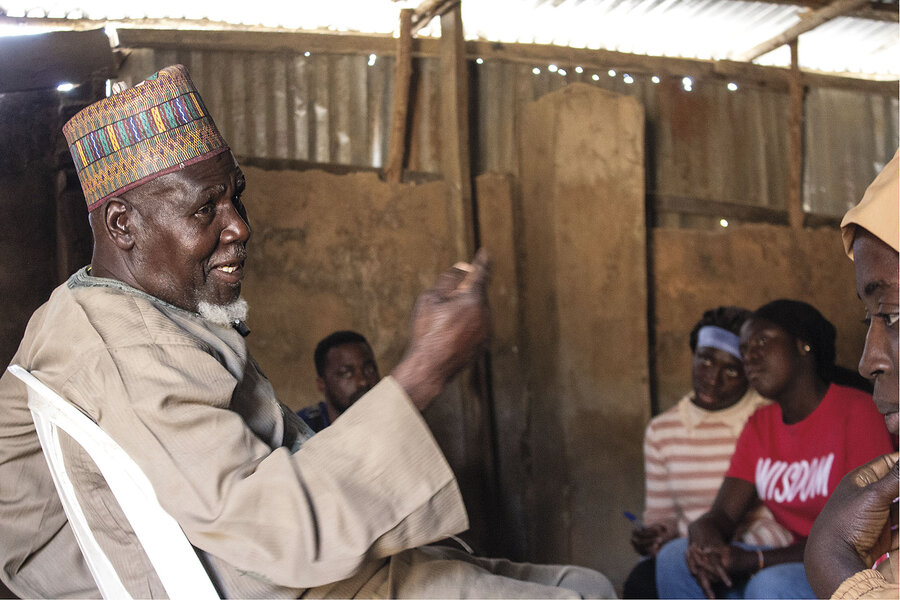
Ahmed Haruna speaks during a storytelling session in Nigeria.

I know I pick sides when I read about wars. It’s pretty clear that Russia invaded an independent neighbor when it launched attacks on Ukraine, for example. I have to remind myself that civilians on all sides suffer. And then for years after — sometimes generations after — bitterness festers. Not a good thing.

So I was interested to read how some Nigerians are working to ease longlasting enmity. Whatever works, I’d say.

Nathaniel Bivan writes at the Christian Science Monitor, “Seven years ago, when Dalyop Timothy Toma was 15, an angry mob came in the night to torch his family’s home in Kyeng village. Everyone but his grandfather fled outside into the bushes to safety. 

“ ‘He couldn’t run because he was disabled,’ recalls Mr. Toma, his face contorting in grief at the memory of his grandfather’s killing. Then he adds matter-of-factly, ‘We were planning revenge.’

“Mr. Toma and his family, who are Christians from the Berom ethnic group, blamed Muslims, mainly from the Fulani group, for the attack. Sectarian tensions run high in Kyeng and other communities in Nigeria’s Plateau state. Disputes often involve politics or land and sometimes erupt into violence.

“But in 2022, a youth leader from Kyeng invited Mr. Toma to do something extraordinary: Recount his painful story aloud to a large room full of people from different ethnic groups that he distrusted. That gathering, organized by a nongovernmental organization called Youth Initiative Against Violence and Human Rights Abuse (Yiavha), changed Mr. Toma’s attitude toward those he thought were his enemies.

‘Telling my story helped me heal gradually,’ says Mr. Toma, explaining that he no longer thirsts for vengeance.

“Yiavha has made him a peace ambassador, tasked with spreading his story of grace and forgiveness at intergenerational storytelling sessions in his community and in others.

“Plateau state, in central Nigeria, is home to some 4 million people. Jacob Choji Pwakim, a longtime peace-building activist in Jos, the state’s capital, founded Yiavha to change the narrative in communities that have been riven by ethno-religious attacks.

“The origins of the violence in Plateau state can be traced to a tumultuous week in Jos in early September 2001. More than 1,000 people were killed and tens of thousands displaced amid a long-running struggle for political and economic power among the area’s different ethnic groups. Disputes also flared between settlers and people indigenous to Jos. 

“Yiavha has held at least 66 storytelling sessions across the state. Elders have given accounts of bygone times when residents from various ethnic groups lived in harmony, even sharing gifts during religious celebrations for Eid and Christmas. Meanwhile, young people have recounted why they destroyed farms or livestock belonging to members of a different faith or tribe.

” ‘This was what inspired me to set up Yiavha in 2014, with the objective of creating a platform where young people across the divide can talk about their experiences without judgment,’ Mr. Pwakim says. 

“So far, Yiavha has worked with up to 3,300 young people, including more than 300 who have been trained as peace ambassadors who might eventually organize storytelling sessions in their communities. Other young people become agents of change after attending the sessions, organizing interfaith meals, youth soccer competitions, and trash cleanups. …

“One sunny afternoon in February, a group of young people is assembled at a soccer viewing center in Kambel, a community in the Anglo-Jos settlement within Jos. Ahmed Haruna is at the front of the room telling stories to the rapt audience, which includes residents of both Kambel and Channel Seven, another community in Anglo-Jos.

“ ‘Growing up, we didn’t even know the difference, who was Muslim or Christian among us,’ Mr. Haruna says. Over the years, residents have lived in segregated areas, with Christians mainly in Kambel and Muslims mainly in Channel Seven. But the storytelling sessions are gradually bringing them together to interact once again. 

“After Mr. Haruna finishes sharing stories about the settlements’ tranquil past, peace ambassador Joshua Tsok opens the floor for questions. …

“Training for peace ambassadors is extensive. In 2023, for example, peace ambassadors gathered in Barkin Ladi, another community in Plateau state known for violent sectarian conflict. A training facilitator, Hussaini Umaru, who is an associate professor in the department of theater and film arts at the University of Jos, says he divided the young people into groups and asked them to narrate and dramatize personal experiences of conflict, and then discuss the episodes. 

“It is not easy for ambassadors to trust their trainers. Umar Farouk Musa, a development consultant who facilitated a training session last August, explains that this is typically the first hurdle. ‘Some thought we were there to introduce an agenda or to spy. But we built their confidence,’ he says. 

“The government’s Plateau Peace Building Agency is a key partner with Yiavha. Kenneth Dakop, a team lead for the agency, says that Yiavha’s initiatives have helped transform young people who previously were drivers of violence in their communities. ‘Most of them are either unemployed or into substance and drug abuse,’ he says. 

“Yiavha’s ambassadors have seen transformations in themselves. ‘I want to become a professional teacher,’ Mr. Toma says. 

“This year, Yiavha paired Mr. Toma with a Fulani boy and assigned each of them to plant a pear tree in the other’s village to signify a commitment to peace.”

More at the Monitor, here.

Read Full Post »

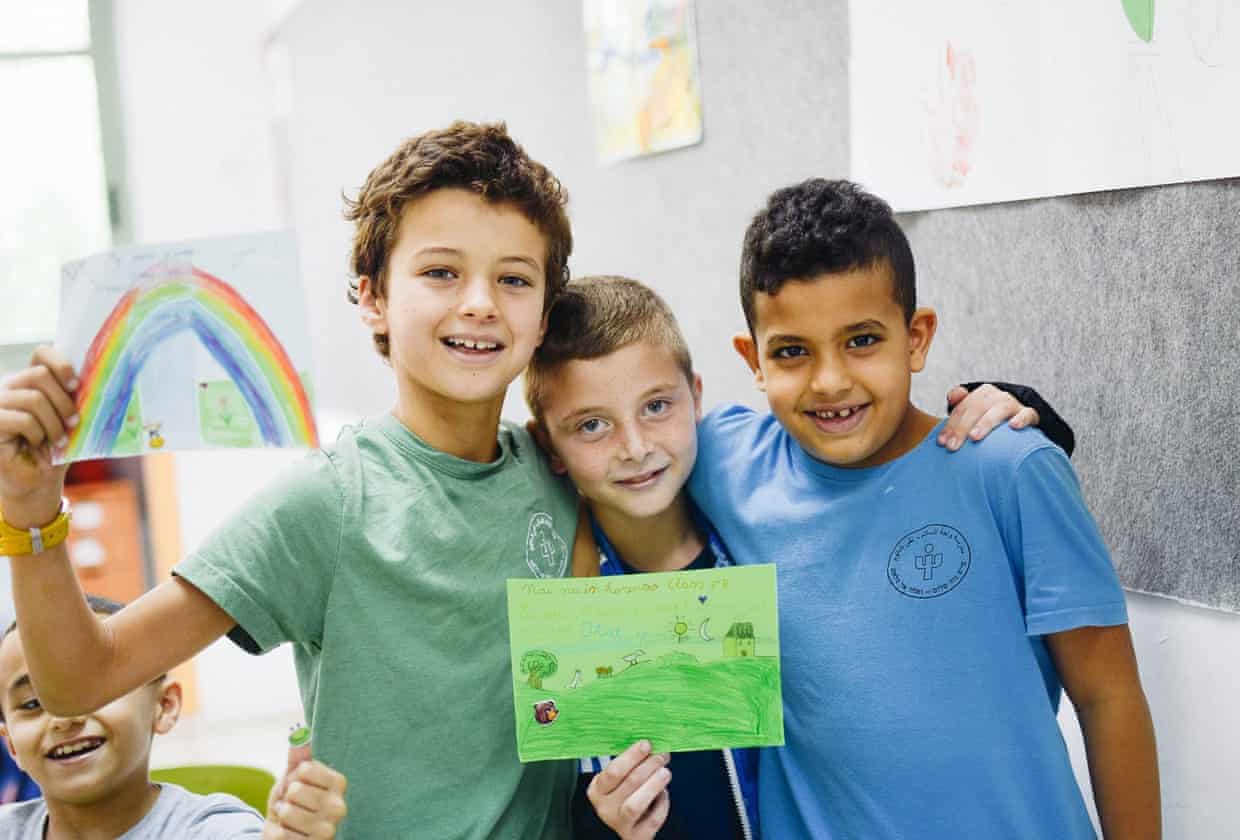
A classroom in the village of Wahat al-Salam/Neve Shalom, an Israeli village where Jews and Palestinians live together to promote peace.

Here’s an impossibly hopeful story that is in danger because its approach to peace is not the same as the government’s.

Chris Osuh reported at the Guardian in May, “An Israeli village where Jews and Palestinians live together to promote peace is in danger of losing vital overseas funding following Israeli government proposals to impose an 80% tax on foreign donations, residents have warned.

“Leading figures from the unique community – Wahat Salam/Neve Shalom, which translates as ‘Oasis of Peace’ – flew to the UK [in May] in a visit hosted by the Co-operative Group, which is calling for the UK government to support peace-building cooperatives worldwide with foreign and development policy.

“Samah Salaime, an Israeli Palestinian, and Nir Sharon, an Israeli Jew, co-direct the village’s educational institutions, which include the School for Peace for activists and a primary school where 250 Jewish and Palestinian children learn each other’s histories, in Arabic and Hebrew.

“The co-directors addressed a parliamentary round table, attended by Labour and Co-operative MPs and non-governmental organizations (NGOs) … in a visit coinciding with the 77th anniversary of the Nakba, when more than 700,000 Palestinians were dispossessed. On Saturday, the pair addressed the Co-operative Group’s annual general meeting in Manchester.

“Before the meeting, Salaime told the Guardian of the threat posed by a bill being debated in Israel’s Knesset. If it became law, it would decimate the finances of NGOs in Israel that receive funding from foreign states. …

“ ‘The biggest supporters for Wahat Salam come from the UK, from the Co-op, our friends in Switzerland, in Sweden, in the US. We don’t have any local Israeli support for our project … financially and ideologically, they are against us.’ …

“Conceived by Bruno Hussar, a Jewish Catholic priest, the village started with a handful of residents in 1978, in ‘no man’s land’ between Jerusalem and Tel Aviv.

“It now has 300 residents, half Israeli Palestinians and half Israeli Jews, including academics and tech professionals, with a waiting list of about 200 families.

There is no synagogue or mosque: instead, residents pray or meditate in a dome called the Court of Silence.


“Surrounded by olive trees, communal life in the village revolves around committee meetings where the co-operative’s decisions are voted on, shared meals, the swimming pool and the Garden of Rescuers, which commemorates heroes of global catastrophes. There is a guesthouse in the village, and children from surrounding areas are bussed in to attend the school.

“Salaime said: ‘We were attacked by settlers three times. … We have all kinds of unfortunate incidents, and we survive. … We break the rules, we break the stereotype, the brainwashing of the Israeli mainstream that peace isn’t possible,’ Salaime said. ‘We have to win this and offer a different agenda.’ “

More at the Guardian, here. France’s Le Monde has more here.

Read Full Post »

Photo: Clay Banks/Unsplash.
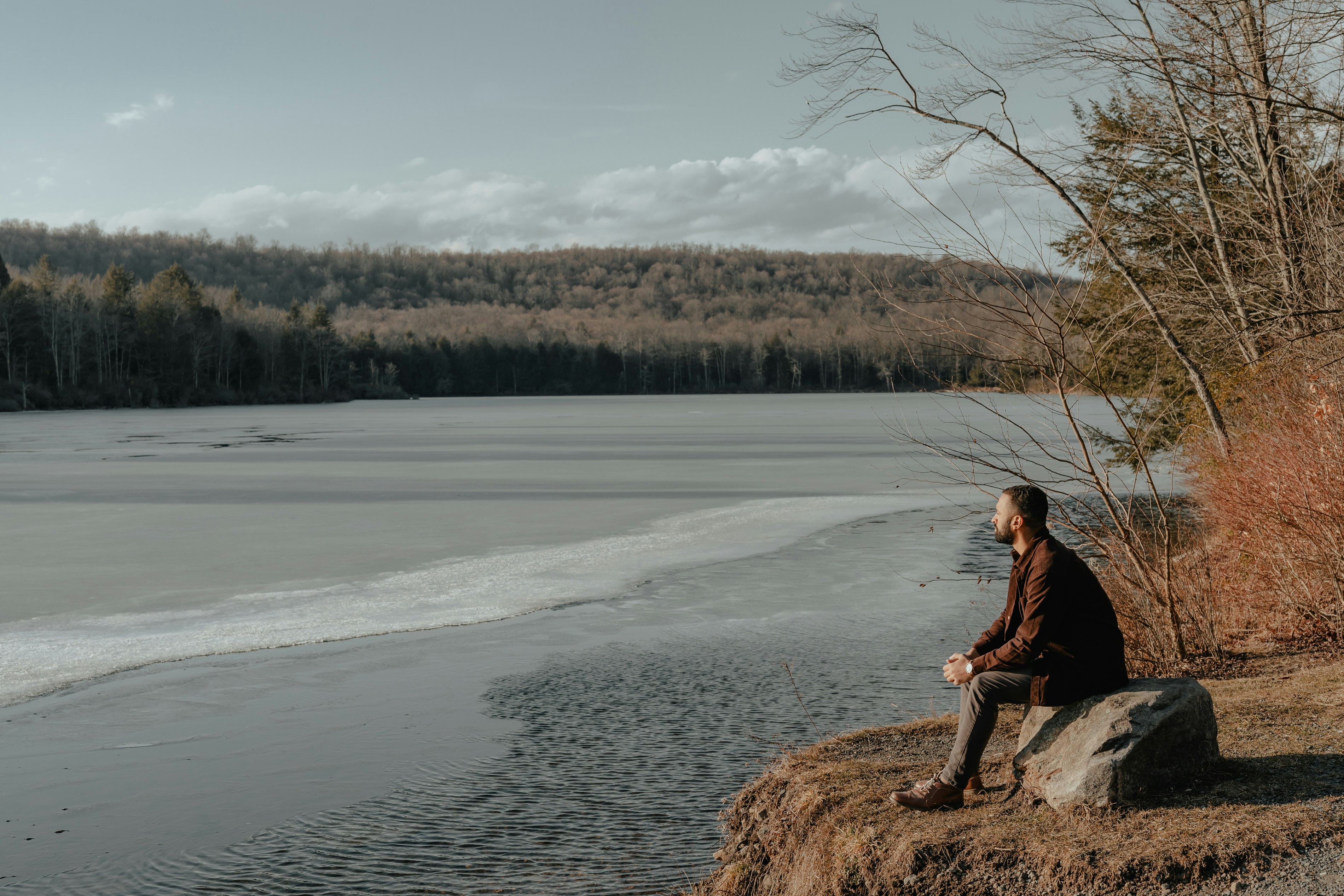
It’s important to know when to be active and when to just do nothing.

I’m worried about the election. I just made more donations to the get-out-the-vote groups I trust. It’s important to do more than worry. It’s important to do something.

But there are also times when it’s important to stop tying yourself up in knots and just do nothing. Maybe not for a solid year as described in today’s article, but when you need renewal.

Holly Williams writes at the BBC about the “slow-living” movement.

“How does the idea of doing nothing for a year sound? No work, no emails, no career progression, no striving or achieving or being productive. For many of us, such a thought might once have brought its own anxiety attack – surely, work is status, earning money is achievement, and being busy is a brag? But these days, a year of nothing is more likely to sound dreamy, even aspirational – there has been, as they say, a vibe shift.

“Millennials are embracing the concept of #SlowLiving – the hashtag has been used more than six million times on Instagram (despite posting on Insta being fairly antithetical to its principles of a mindful, sustainable lifestyle, with much reduced screen-time). Gen Z, meanwhile, have pioneered quiet quitting and ‘lazy girl jobs,’ where one does the minimum at work to preserve your energy for the more meaningful parts of your life. …

“This is something Emma Gannon knows all about: the prolific author, podcaster, and Substack entrepreneur published A Year of Nothing – her account of taking an entire 12 months off – earlier this year. It quickly sold out when published earlier this summer, and has proved so popular it will now be reprinted and available to buy in November. 

“Not that it was, initially, a lifestyle choice: Gannon suffered such extremely bad burnout, she had no choice but to stop working. Her account of her year of rest and recuperation is now published in two small, sweetly readable volumes by The Pound Project, charting her journey back to health via gentle activities such as journaling, watching children’s TV, birdwatching, and the inevitable cold-water swimming. …

“Having been fully on-board with the girl-boss culture of the 2010s, Gannon had already stepped away from that with her last book, The Success Myth: Letting Go of Having It All, which explored how relentlessly striving for success rarely brings true happiness. But it was experiencing complete burnout that forced her to really confront the importance of rest.

” ‘Looking back, there were lots of red flags – feeling very confused, pulsating headaches, not being able to focus on things in the room, quite scary stuff. But I over-rode it, [thinking]: “I’m busy, I’ve got to crack on,” ‘ she recalls. Suddenly, in 2022, her body went into a forced shut-down mode. ‘Couldn’t look at a phone, couldn’t look at a screen, couldn’t walk down a street without feeling fragile. …

” ‘Many people with chronic burnout have to get to that point before they’ll take time off [work], because we’re so conditioned in this society to push through at all costs.

” ‘But we were designed to have naps, and [walks in] the park. To go for a swim, and look at the sky. That stuff’s really important,’ Gannon insists. And she’s determined to carry the lessons from her burnout, and her recovery, into a slower, more spacious life. …

“Jenny Odell’s How to Do Nothing: Resisting the Attention Economy became a sensation in 2019, linking our frazzled brains to how profit-hungry technology and social media use up our attention and distract us. She advocated re-wiring our awareness to the natural world around us, and to our own interiority.

“Odell is also part of a wave of writers encouraging active resistance to the relentless ‘goal-oriented’ expectation that, ‘in a world where our value is determined by our productivity,’ every hour and minute of our time should be put to good use – if not at work, then in self-improvement. Resisting the pressure to always be optimizing can also be found in Oliver Burkeman’s surprisingly comforting 2021 book Four Thousand Weeks – which reminds us that life is brief, and we will never get everything on our to-do list done. Rather than seeking to be ever-more efficient, he argues that we should focus on what really matters … and live more fully in the present. 

“And it seems the idea of doing nothing is catching on: you may have noticed the recent proliferation of titles about niksen, the Dutch term for ‘doing nothing, intentionally.’ Olga Mecking’s book Niksen clearly chimed with readers when published in the pandemic, and has been followed by a wealth of others, many in the Little Book of Hygge mold. …

“Even the word ‘rest’ itself has become something of a buzz term. Published in 2022, Pause, Rest, Be by yoga teacher Octavia Raheem helps readers going through big changes or periods of uncertainty to slow down and turn inwards. Rather than using yoga to sweat your way to Instagrammable tight abs, she emphasizes what the practice can tell us about self-knowledge, peace and stillness.

The Art of Rest by Claudia Hammond also has a practical bent: its chapters lay out the 10 most relaxing activities identified in global research, as well as arguing for the importance of intentional winding down – whether that be taking a bath or reading a book or spending time in nature. ‘Rest is not a luxury,’ Hammond writes, but ‘a necessity.’ Meanwhile Katherine May’s book Wintering has the subtitle The Power of Rest and Retreat in Difficult Times, and forms a lyrical account of the author learning to accept the seasonality of life: that there are fallow periods when, rather than pushing on through, we need to step back and nurture ourselves.”

Lots more at the BBC, here. No firewall.

Read Full Post »

Photo: FeelBeit.
FeelBeit is a cultural center for Israelis and Palestinians on the border of East and West Jerusalem.

Today’s story, published at Public Radio International’s The World on April 12, 2024, is one of those beauties one hopes is still true two months later. It’s about a group of Jewish and Palestinian artists who have provided a safe space for different cultures to be together in Jerusalem. It’s called FeelBeit.

Host Marco Werman reported, “For years, isolated pockets of quiet resistance in Jerusalem have tried to bring together people from both sides of the conflict, but the Oct. 7 attacks seem to have put a lot of that resistance on indefinite hold.

“But since then, one place is trying again to establish common ground between Israelis and Palestinians: FeelBeit, an event space and bar in Jerusalem.

“Located on the seam line between east and west Jerusalem, FeelBeit is an Israeli-Palestinian arts house and incubator, according to one of its managers, Karen Brunwasser. Each Wednesday night, the venue gives audiences a few hours of escape from the latest news engulfing the lives of Israelis and Palestinians.

“The venue intentionally sits on the line that divides Arab East Jerusalem and Israeli West Jerusalem. In both Arabic and Hebrew, bayt or beit means ‘home,’ so ‘FeelBeit’ literally means ‘feel at home.’ …

“ ‘This is our sort of sacred refuge,’ Brunwasser said.

“FeelBeit is an offshoot of Jerusalem Season of Culture, another organization that runs a summer festival in the city. The festival calls itself a laboratory for connection between people of different backgrounds, but it has struggled in the past against deeply entrenched opinions about the conflict.

“But Brunwasser and [Riman Barakat, a fellow manager] felt like they had a responsibility to continue hosting events amid the increased tension after Oct. 7.

“ ‘We understood how scared people are because we, ourselves, were afraid in the beginning,’ Brunwasser said. … ‘We understood that people were terrified to talk.’

That’s where they got the idea to call this evening of the arts ‘No Words,’ a stealth tool to bring people together.

“There have been eight or nine ‘No Words’ shows since the Israel-Hamas war began.

“According to Barakat, the audience every week is a mix of Israelis, Palestinians and people from other international backgrounds. And every show features Israeli and Palestinian artists alongside one another on stage. In fact, Barakat said it has actually been easier to coordinate joint performances with Israeli and Palestinian artists since the war began.

“ ‘And that’s something that has blown our mind,’ she said. …

“Zudhi Naguib is another FeelBeit member who started working on communications for the group about five years ago. He said he felt instantly at ease, partly because of the violence experienced growing up as a Palestinian in Jerusalem.

“He described the nature of this violence: ‘Eh, getting attacked by extremist Jewish Israelis, by being attacked by extremist Palestinians. Like I was attacked from both sides.’ Naguib said FeelBeit gave him a home.

“ ‘It actually shows me that Jerusalem is really much bigger than what I thought before. It shows me that there’s space for everyone. It was the trust that we succeeded to build with the people who come to FeelBeit, it really was what rescued us after the seventh of October,’ he said.

“After Oct. 7, Naguib felt too scared to leave his house. He didn’t speak to anyone for five days. It was the FeelBeit community that finally helped him. Naguib drove to the home of his boss at FeelBeit, who wanted him to join her at a kibbutz — an Israeli commune — where the parents of their mutual friend Oz had been killed in the attacks. … Naguib recounted Oz’s response to his condolences: ‘It’s not my sorry, it’s ours.’

“ ‘And he told me, “I don’t want anyone to use my mom and dad’s blood for revenge,” ‘ Naguib added.”

More at The World, here. No firewall. Donations encouraged.

Read Full Post »

Photo: Atdhe Mulla.
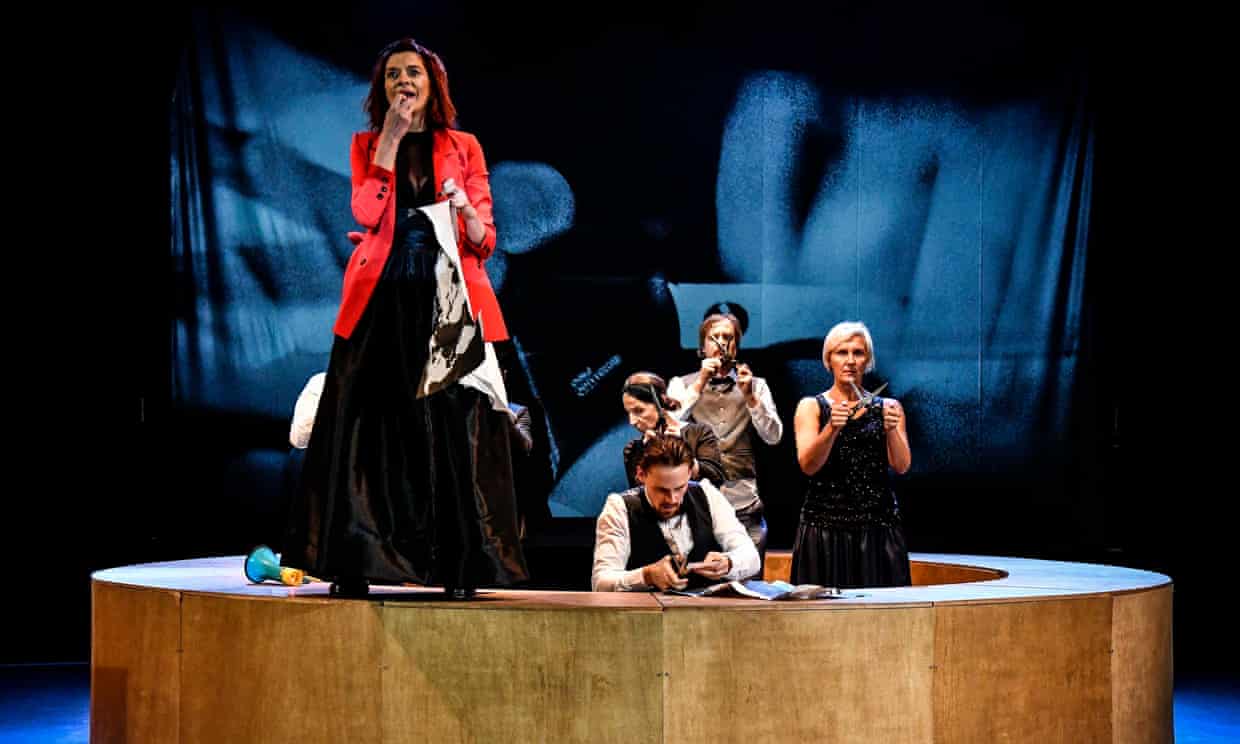
The play Negotiating Peace had its premiere at Pristina’s Oda theatre in October, before going on tour. 

Wars eventually end, but the peace that follows is often uneasy. Art can bring some laughs into people’s lives and add to the accumulation of small things that make a more lasting difference.

Philip Oltermann writes at the Guardian, “When political leaders present war as the only solution, it is up to artists to remind people that finding peace is still possible. That is the starting point for a Kosovo-based theatre company, Qendra Multimedia. …

“The lesson it draws, and the genre it chooses to present its findings, is unexpected: the Kosovan playwright Jeton Neziraj’s Negotiating Peace shows the diplomacy of peace as a farce, albeit a necessary one.

“Dramatizing roundtable talks between the fictional warring countries of Banovia and Unmikistan, the play is a frenzied comedy in which vain generals can only be lured to the negotiating table by promises of Hollywood films celebrating their actions. Opposing parties get drunk while negotiating demilitarized zones, mix up drafts of ceasefire agreements and sign on the wrong dotted line. Maps of disputed territories are partitioned with paper scissors until holy lands turn into showers of confetti. …

“ ‘When you talk about serious things, you must not talk about it in a serious way,’ said Orest Pastukh, a Ukrainian actor who is one of five members of Qendra’s multinational cast with first-hand experience of their country going to war. ‘If we would speak seriously about war and peace, everybody would go mad.’

“The play … is loosely based on the Dayton accords that in 1995 brought a halt to the three-and-a-half-year Bosnian war, the deadliest chapter in the breakup of Yugoslavia. At its premiere at Pristina’s Oda theatre last week, it also mixed in elements of the peace settlement that four years later ended the war in Kosovo. …

“To end that conflict between Serbs and Kosovo-Albanians in the breakaway province, Nato acted more swiftly and aggressively than it had done in the Bosnian war. In downtown Pristina, gratitude for the US’s assertive leadership in the peace talks is still palpable. There is a statue of a waving Bill Clinton, a bust of Madeleine Albright and a street named after Richard Holbrooke. …

“It may seem surprising, therefore, that in Negotiating Peace, moral certitudes come wrapped in sarcasm and not in pathos. The Holbrooke-type character, Joe Robertson, played by Harald Thompson Rosenstrøm, a Norwegian, is not just a ‘beast of peace’ but also ‘a schizophrenic, a brutal Mazarin.’ …

“ ‘When I read Holbrooke’s memoir To End a War, I realized that the negotiating table was also a kind of stage,’ Neziraj said on the eve of his play’s premiere. ‘And a dramatic stage on which actors were acting quite bizarrely,’ involving negotiators staging walkouts and new political borders ‘being drawn on napkins.’

“He said studying the Dayton agreement, as well as the Oslo accords signed between Israel and Palestine in 1993, had robbed him of the illusion that peace talks were structured conversations led by experts in their fields. ‘They are the fruit of the wills of individuals at a certain moment,’ Neziraj said. …

” ‘War doesn’t end when you lay down your arms,’ Neziraj said. ‘We in Kosovo live in an interim state, which is not war but neither a fully fledged peace.’ …

“Neziraj is aware of his own cynicism, and Negotiating Peace eventually manages to snap out of it. Towards the end of the play, the summit looks like a failure: faith in the UN is shot to shreds, there are calls for a second conference organized by the EU.

The chief negotiator appeals to the audience for advice to break the deadlock.

“As the play tours around the Balkans, the company intends to invite different real-life witnesses on to the stage. In Pristina the job fell to Aida Cerkez, a veteran Associated Press correspondent who covered the siege of Sarajevo from the Bosnian capital. Her 10-minute monologue changes the mood of the play.

“ ‘The only precondition for peace is to get everybody around the same table,’ she said after the curtain call. ‘And to get everybody around the same table, you have to militarily weaken the dominant side. As long as one side can think it can win, there’s no reason to sit down at the negotiating table. In Bosnia, that condition was met by Nato bombing. …

” ‘Peace is not the absence of armed conflict,’ she said. ‘In Bosnia we are living the absence of armed conflict, not peace. But that’s not nothing. It’s a lot.’ “

More at the Guardian, here. No paywall.

Read Full Post »

Photo: WCIA [Welsh Centre for International Affairs].
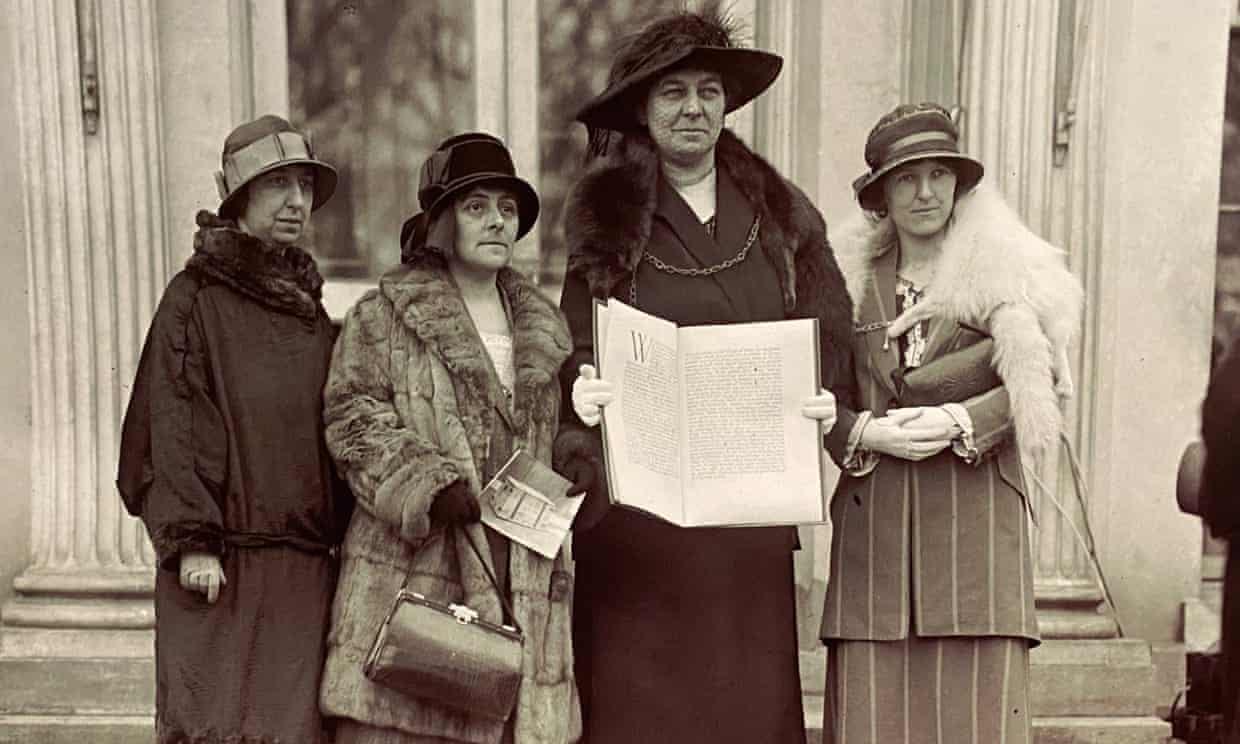
Annie Hughes-Griffiths holds the women’s peace appeal outside the White House in 1924 after a meeting with President Coolidge, with (from left) Gladys Thomas, Mary Ellis and Elined Prys. 

There are so many great initiatives by women that take years to get broad recognition because, at the time, they weren’t highly valued. That’s why I love sharing them now.

Steven Morris covered today’s example for the Guardian.

“There were tears of joy, speeches of hope and sighs of relief that all had gone smoothly after an extraordinary century-old document – reputedly seven miles long – completed its transatlantic trip back to Wales.

“The peace petition, signed by almost three-quarters of all Welsh women in the 1920s but forgotten until the last few years, arrived at the National Library of Wales [in April] after being gifted to the country by the National Museum of American History in Washington.

“Over the coming weeks and months, the reams of sheets will be taken carefully out of the hefty oak chest where they are stored, then digitized at the library in Aberystwyth, before a crowd-sourcing exercise takes place to transcribe all 390,296 signatures and addresses.

Prof Mererid Hopwood, the chair of the Peace Petition Partnership, said she was so excited she could hardly breathe and, though it was an overcast day in Wales, quoted the Welsh phrase mae’r haul yn gwenu – the sun smiles.

” ‘Actually, I think the sun’s practically chuckling with joy in Aberystwyth today. We are so very delighted,’ she said.

“In 1923, galvanized by the horrors of the first world war, a group of Welsh women decided to organize a campaign for world peace.

“During a Welsh League of Nations Union (WLNU) conference at Aberystwyth University, they agreed that the best way would be to appeal to the women of the US to work with them for a world without war. Two paid officers and 400 local organizers set about collecting names from every community in Wales.

“In 1924 the Welsh delegation, led by Annie Hughes-Griffiths, the chair of the WLNU, crossed the Atlantic with the petition and worked with American women such as the women’s rights campaigner Carrie Chapman Catt to disseminate their message.

“They received an enthusiastic welcome and travelled through the US addressing audiences. The US press claimed that if the signature sheets were laid end to end they would go on for 7 miles.

“However, over the years the petition was forgotten, until a mysterious plaque mentioning it was uncovered at the time of the centenary of the first world war in Cardiff’s Temple of Peace.

“ ‘It was a lost story, a hidden story,’ said Hopwood, a poet and the chair of Welsh and Celtic studies at Aberystwyth University. She said the idea of returning the petition to Wales was both to remind people of its amazing story and to inspire people today to campaign for peace.

“Hopwood pointed out that Wales has a history of its citizens working for peace, including … the women who marched from Wales to Greenham Common in Berkshire in 1981 to protest against nuclear weapons. …

“The Welsh deputy minister for arts and sport, Dawn Bowden, said it was an inspiring document: ‘I hope that the return of the petition to Wales will inspire and motivate a new generation of advocates for peace.’

“Dafydd Tudur, the head of digital services at the National Library of Wales, called it an ‘historic’ day.

“He said he hoped a pilot of the crowd-sourcing exercise would take place in the autumn, before fully beginning next year. An exhibition will be organized to present the chest and petition at three locations – Aberystwyth, St Fagans in south Wales, and Wrexham in the north.

“Tudur studied modern Welsh history but had not heard of the petition until the plaque was found. ‘It was forgotten. People are amazed when they hear about it,’ he said.” More at the Guardian, here. No firewall.

For more on the peace agenda, click here on an article co-authored by my friend Ann Tickner. The article examines “feminism in international relations from the emergence of women’s peace pragmatism during WW I to the development of the United Nations (UN) Women, Peace, and Security (WPS) agenda a century later. … We show how the principles articulated by women peace activists at the 1915 Hague Conference represent distinct contributions to the discipline.”

Read Full Post »

“I Heard the Bells on Christmas Day” is song that really makes you think. Not the usual jolly fare, it speaks solemnly about how humanity has fallen short of the universal ideals the holiday is supposed to represent. Do we make peace our priority?

I myself stand accused of not focusing enough on ending war, given that I want to see Ukrainians triumph over the Russian invasion last February. It’s complicated. Of course I wish the heroic people fighting back didn’t have to die, but I have to respect why they are fighting.

The hymn is also hopeful because it reminds us that there are others who feel as we do and long for peace everywhere.

The carol was written by Henry Wadsworth Longfellow on Dec. 25, 1863, in response to the near fatal wound his son, Charles Appleton Wadsworth, received at the Mine Run campaign in Virginia during the Civil War. Now, that’s a heartbreaking war!

Blogger Will McMillan of “A Musical Life on Planet Earth” has a lovely rendition of the carol that you can listen to here. And today I would like to share this version from the group Casting Crowns.

Read Full Post »

Photo: Paul Stremple.
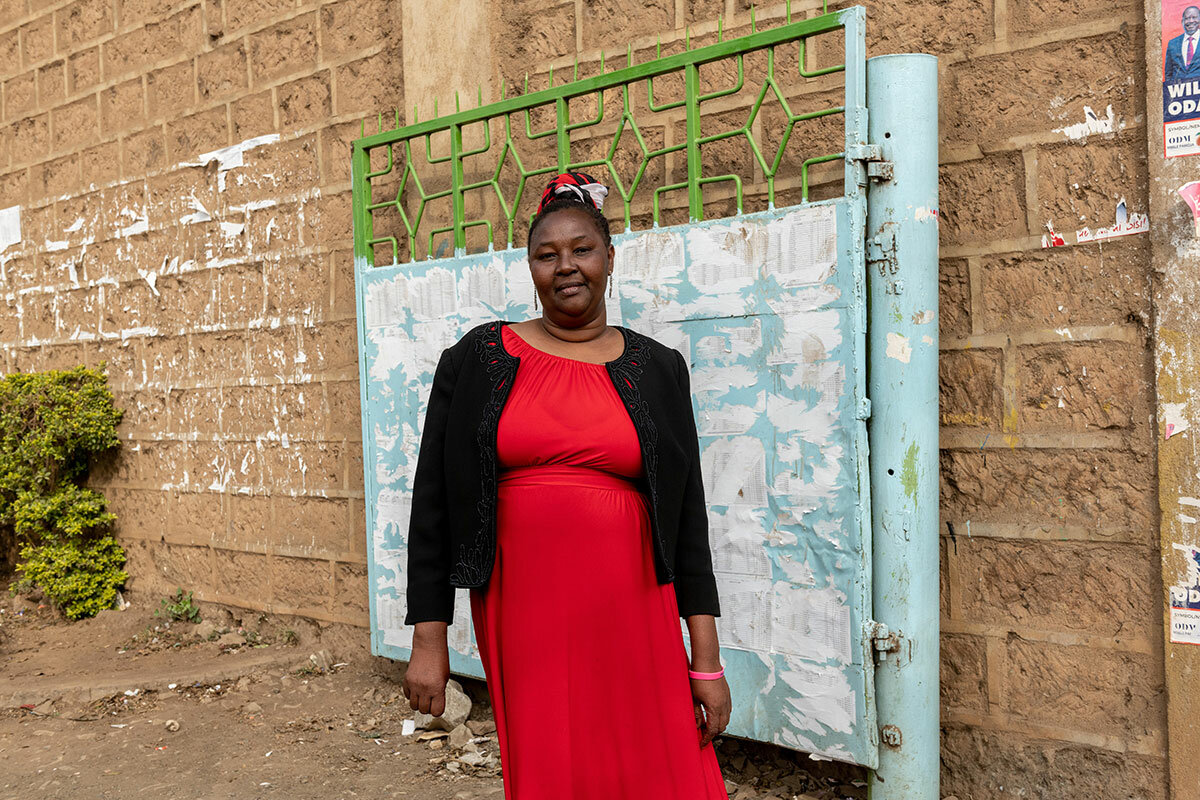
Beatrice Karore, a community leader involved in peace building during Kenya’s elections, stands outside a local vocational college in Mathare that served as a polling station.

Blessed are the peacemakers.

Often they are women. We know that not all women are peacemakers, but many are. They see where differences of opinion can get out of hand and take action.

Today’s article is about peacemakers in Kenya trying to change the pattern of violent election periods. The story was written before the country’s Supreme Court made its decision on the recount. If you can’t stand suspense, skip to the end.

Mukelwa Hlatshwayo writes at the Christian Science Monitor, “The Kenyan presidential elections are over, but peace campaigner Beatrice Karore’s work is not done.

“One recent cloudy morning in Nairobi, the founder of Wanawake Mashinani – Swahili for Grassroots Women – walks to her office in Mathare, one of the most densely populated slum areas in the Kenyan capital. 

“Sliding a heavy-duty padlock off a thick metal door, Ms. Karore and her team file into the tiny room that serves as their headquarters, and sit on blue plastic chairs. Over loud music blaring from a nearby shop, Ms. Karore begins with a prayer for a good ‘walk for the peace’ ahead.

“Ms. Karore is one of dozens of grassroots peace activists across the country who sprang into action in the months leading up to Kenya’s Aug. 9 presidential elections. Now, as the country waits for a final verdict on disputed results, that work has become increasingly important.

“The Supreme Court is due to hand down a judgment on Sept. 5, after opposition candidate Raila Odinga challenged official results that showed him losing to William Ruto by a margin of 200,000 votes. A former prime minister, Mr. Odinga has blamed five previous presidential election losses on rigging – claims that have sparked deadly riots in the past. 

“For now, an uneasy calm is holding. But some campaigners fear the Supreme Court verdict could yet unleash the violence that followed disputed polls in 2007, when more than 1,200 people were killed, and again in 2017, when more than 100 people died. 

“As her team walk out of their modest office into narrow passageways crammed with shacks, Ms. Karore says she knows the current lull is far from guaranteed. ‘We [are still] doing peace campaigns to empower the community,’ she says.

‘We realized that when there is no peace, everyone loses.’ …

“Some analysts believe that the relatively peaceful election campaign, in which the main candidates ran on social and economic issues, rather than demanding voters’ ethnic loyalty, points to a maturing democracy. 

“Widely touted reforms to the electoral process, including the effective registration of voters in the diaspora, may have given more Kenyans a sense of greater transparency. And battered by two years of COVID-19 lockdowns and rising costs of living, most Kenyans would prefer to accept the Supreme Court verdict than go to an election rerun, analysts say. …

“The manner in which Kenyans navigate the decision by the court will set a precedent for future disputes across Africa. … Even if the fragile peace holds, electoral watchers caution it will take more than one election cycle to show Kenya has left violence in the past. …

“For the past two presidential elections, Ms. Karore’s team has organized the kind of ‘holistic’ monitoring that Kenya’s human rights commission says will transform how communities like Mathare – which typically bear the brunt of any unrest – participate in the post-electoral process. Wanawake Mashinani has held several community meetings at which faith-based leaders have encouraged people to remain calm. It’s given safety tips to residents on election day. 

“And in a neighborhood that’s neglected by officials, where violence, drug abuse, and crime are prevalent, perhaps the group’s most important work is also the simplest: It checks in on residents and listens without judgment. 

“On this August morning ‘peace walk,’ Ms. Karore stops first to talk to a group of women selling hair-care products outside a corrugated iron-roof shack. Speaking in Swahili, she asks them how they are and how things have been since the elections. The discussion is light and jovial; the women laugh at a joke about a fake flour scandal doing the rounds in Mathare. 

“One vendor, a young woman called Kim, says that things have been quiet and business has been slower. She tells the group they are glad major protests didn’t break out after the results were announced, because that would have meant they would have lost everything. 

“ ‘Anything small can trigger violence on the streets,’ Ms. Karore says. ‘Many people leave their homes and go to rural areas at this time, or where people of their same tribe live.’

“Research has shown that when marginalized communities feel that their favorite candidate loses an election due to irregularities, they are more likely to resort to violence. Human rights organizations say the unrest often breaks out along ethnic and identity lines. …

“As Ms. Karore and her team walk deeper into the township, checking in on neighbors and store owners, they are greeted by passersby who recognize them from previous door-to-door visits.

“Buoyed by the work of peace campaigners across Kenya as a whole, the political atmosphere has been significantly calmer than in two previous elections. A range of activists, from artists to religious leaders, have been galvanized into action in recent months. A campaign by artists in Kibera, Kenya’s largest township, displays works that celebrate the country’s ethnic diversity. Another group of activists organized a ‘peace caravan’ across the country, carrying messages urging voters to remain calm during the heated polls.

“Still, violence and intimidation persist. … In Mathare, Reagan Victor Ondigo says he barely escaped with his life when a mob of men tried to burn down his home as he and his family slept. … He blames politicians for whipping up ethnic grievances, but he’s cautiously hopeful that those perceptions are slowly changing.

“ ‘I hope that my daughter will know that freedom is there,’ he says.”

Looks like Kenya’s Supreme Court decision was accepted by both sides. More at the Monitor, here.

Read Full Post »

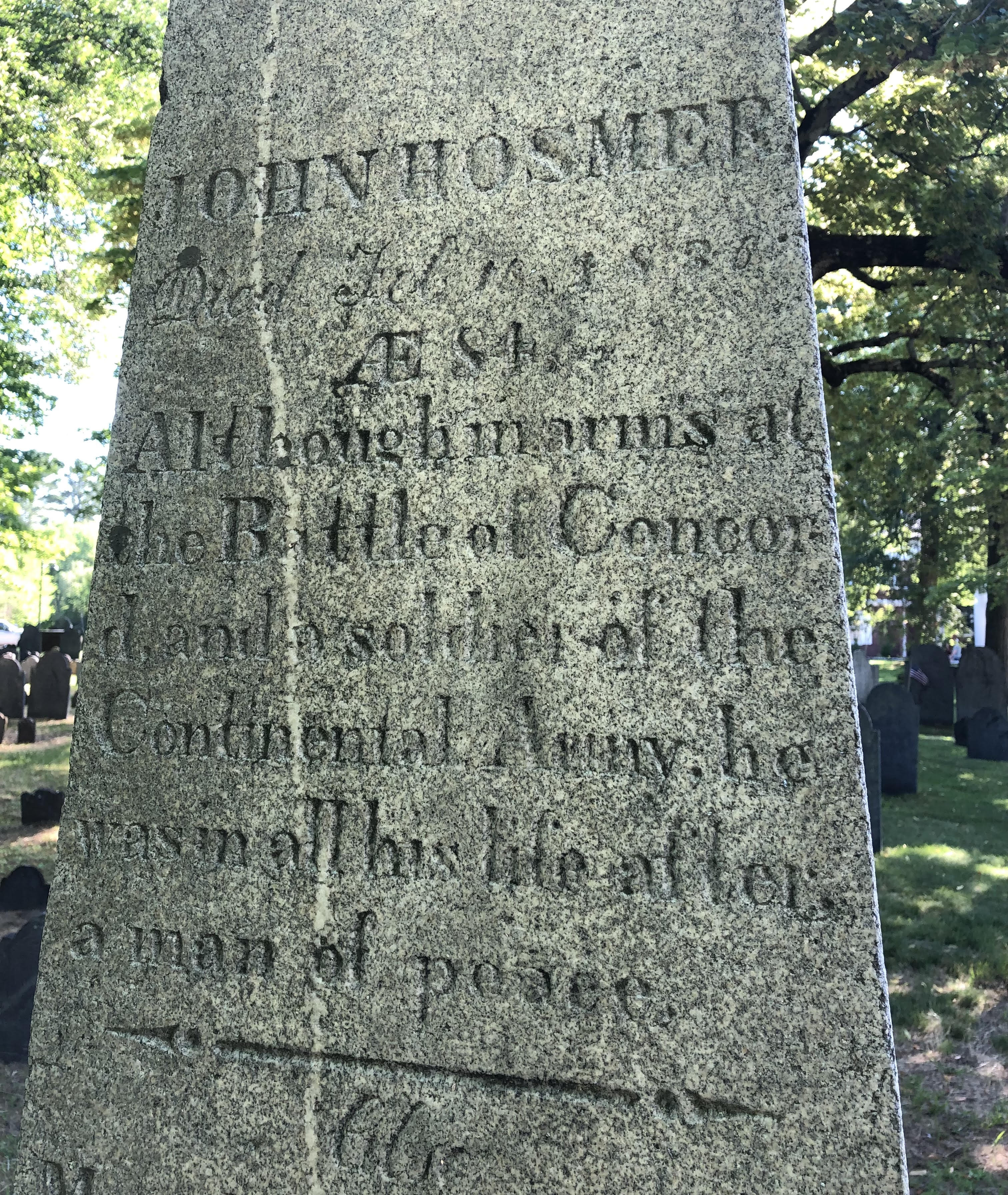
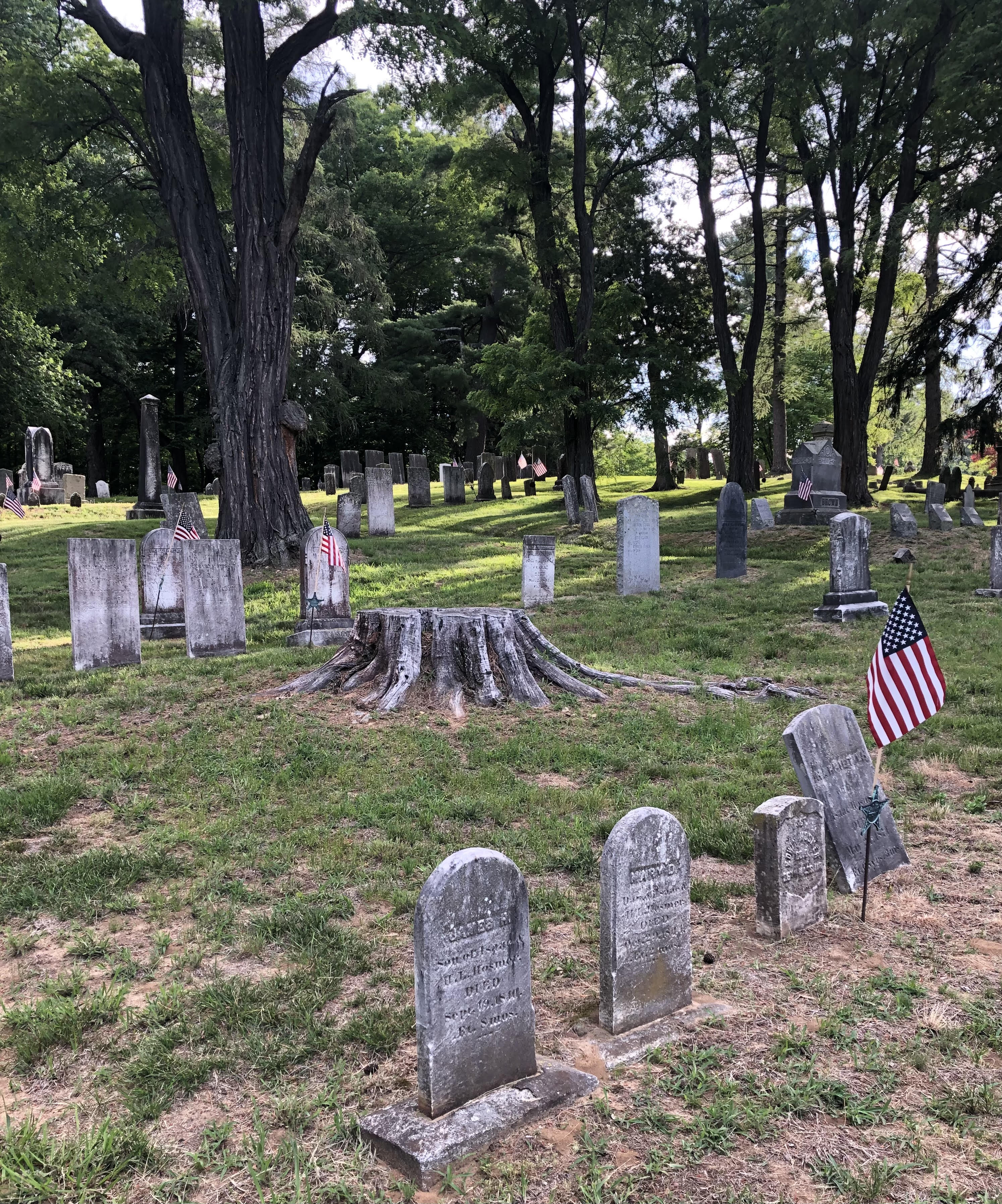
The photos are from two local cemeteries. The first honors John Hosmer, who fought in the Continental Army and “was in all his life after a man of peace.” In the second, you see how the living put flags on the graves of veterans who have died.

In one of the ESL (English as a Second Language) classes where I volunteer, the teacher introduces a citizenship factoid every week as some students plan to take the test to become US citizens. Citizens or not, we all learn something from the test questions.

That made me think that for Veterans Day this year, I should look up the history. The commemoration started after World War I, when many soldiers came home relieved to be alive, only to die of a pandemic not unlike the one that you and I know too well.

The day was originally named for the cease-fire that ended hostilities in the “Great War” but became “Veterans Day” in 1954, when a WW II general who had become president renamed it

Here’s what the US Department of Veterans Affairs has to say.

“World War I – known at the time as ‘The Great War’ — officially ended when the Treaty of Versailles was signed on June 28, 1919, in the Palace of Versailles outside the town of Versailles, France. However, fighting ceased seven months earlier when an armistice, or temporary cessation of hostilities, between the Allied nations and Germany went into effect on the eleventh hour of the eleventh day of the eleventh month. For that reason, November 11, 1918, is generally regarded as the end of ‘the war to end all wars.’

“In November 1919, President Wilson proclaimed November 11 as the first commemoration of Armistice Day with the following words: ‘To us in America, the reflections of Armistice Day will be filled with solemn pride in the heroism of those who died in the country’s service and with gratitude for the victory, both because of the thing from which it has freed us and because of the opportunity it has given America to show her sympathy with peace and justice in the councils of the nations…’

“The original concept for the celebration was for a day observed with parades and public meetings and a brief suspension of business beginning at 11:00 a.m. … In 1954, after World War II had required the greatest mobilization of soldiers, sailors, Marines and airmen in the Nation’s history; after American forces had fought aggression in Korea, the 83rd Congress, at the urging of the veterans service organizations, amended the Act of 1938 by striking out the word ‘Armistice’ and inserting in its place the word ‘Veterans.’ With the approval of this legislation (Public Law 380) on June 1, 1954, November 11th became a day to honor American veterans of all wars.”

I had forgotten why there’s a moment of silence at 11 a.m. on Veterans Day. Good to know. More here.

Read Full Post »

This weekend, I’m thinking about people who served our country in the military. And especially about the sacrifices of those who came back from combat with physical and emotional injuries — and how little the country does for them or their families after their service.

And I can’t help thinking at the same time how much I wish humanity had evolved to the point of solving conflicts in some other way than combat.

When I was a teen, I was friendly with the family of Charles Lawrence, who was head of the US branch of the Fellowship of Reconciliation, and I learned this Ed McCurdy peace song from them. I still sing it.

Last night I had the strangest dream
I never dreamed before.
I dreamed the world had all agreed
To put an end to war.
I dreamed I saw a mighty room
And the room was filled with men.
And the paper they were signing said
They’d never fight again.
And when the papers all were signed
And a million copies made,
They all joined hands end bowed their heads
And a grateful prayer was prayed.
And the people in the streets below
Were dancing round and round,
And the swords and guns and uniforms
Were scattered on the ground.
Last night I had the strangest dream
I never dreamed before.
I dreamed the world had all agreed
To put an end to war.

(Lyrics © T.R.O. Inc.) There are several versions on YouTube. I kind of liked this creaky one by Johnny Cash.

Read Full Post »

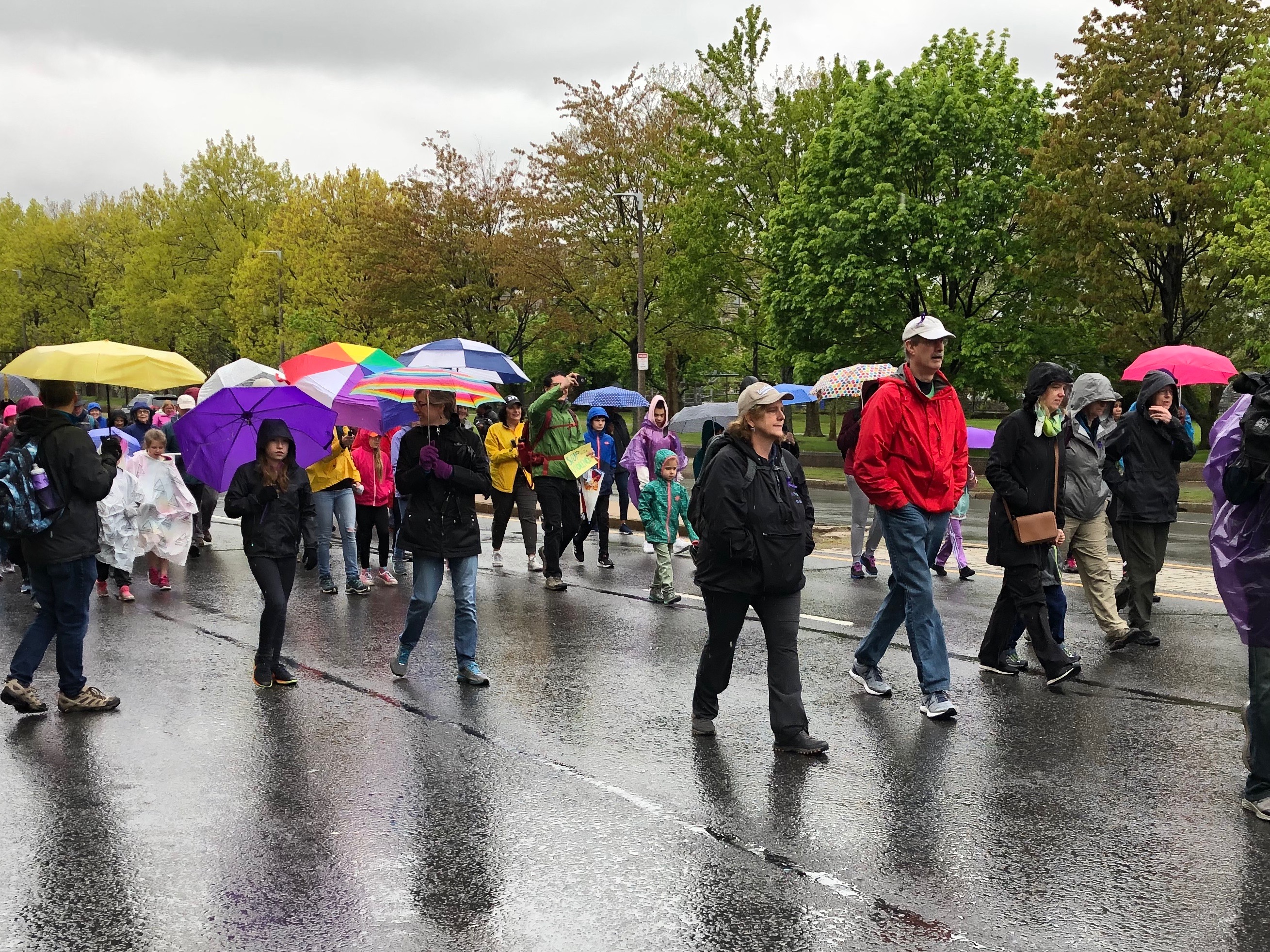
The Louis D. Brown Peace Walk in Boston has been supporting survivors of violent crime for a quarter century.

The nonprofit’s concern is for the people who are left behind after a violent death — the mothers, the fathers, the children, the siblings, the classmates, the communities. Sometimes the ongoing needs of these survivors get lost. In Boston, some of the bereaved families have banded together to help others heal. They have taken the lead in standing against violence and have invited residents of the Greater Boston area to join them. Nonprofit groups, churches, mosques, synagogues, and individuals arrive from the suburbs in droves.

Here are a few photos from this year’s walk, which is always held on Mother’s Day.

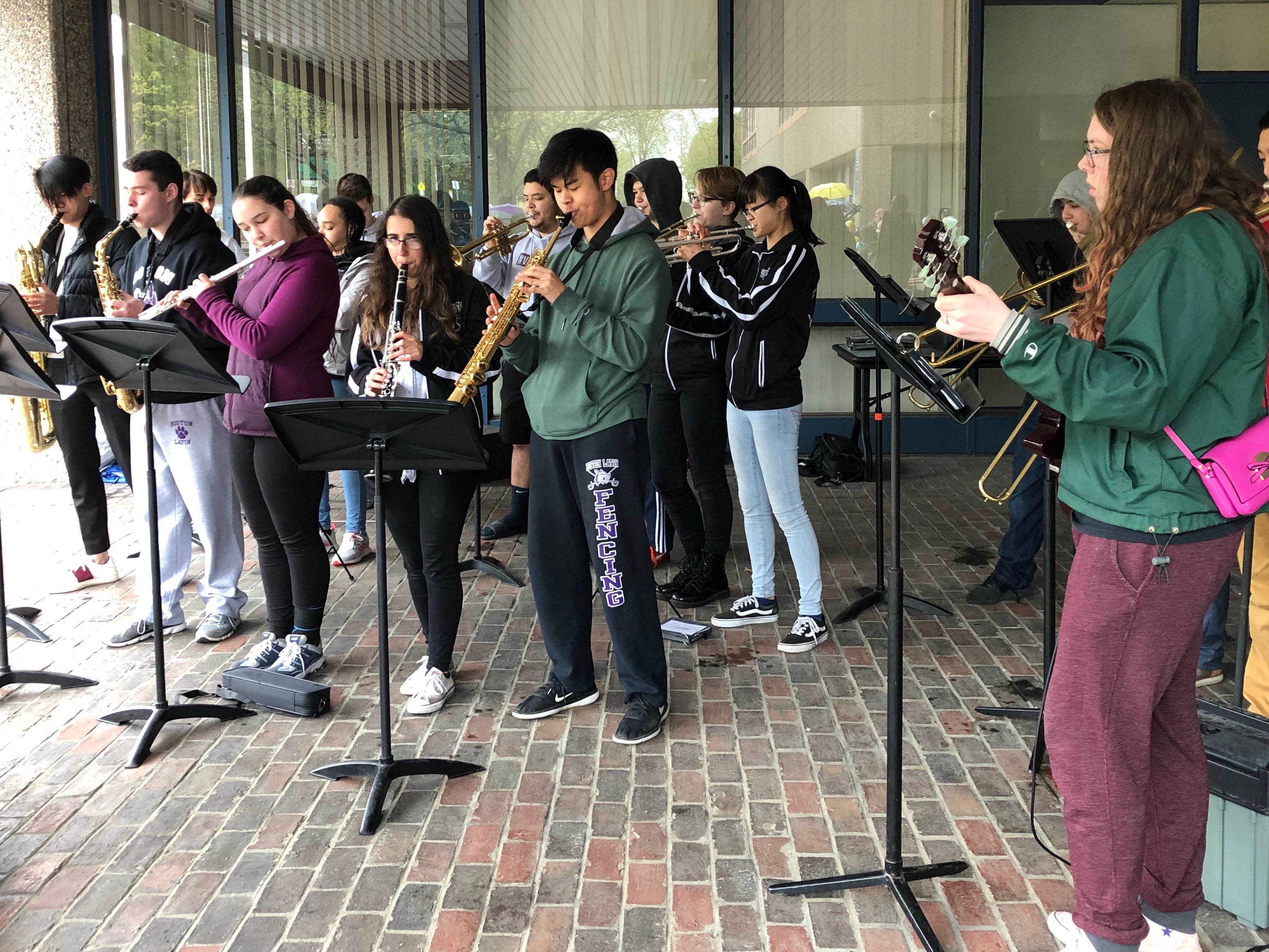
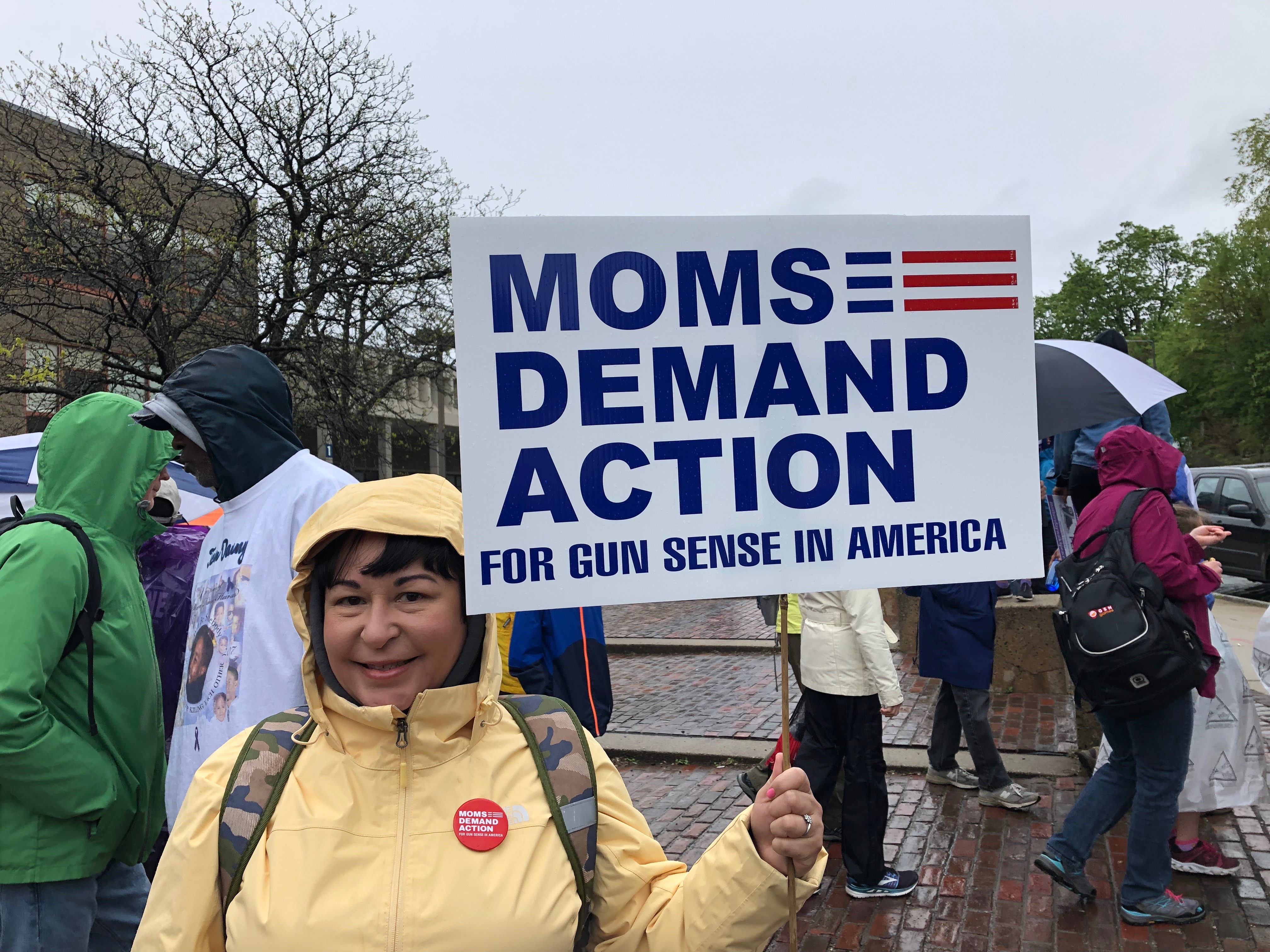
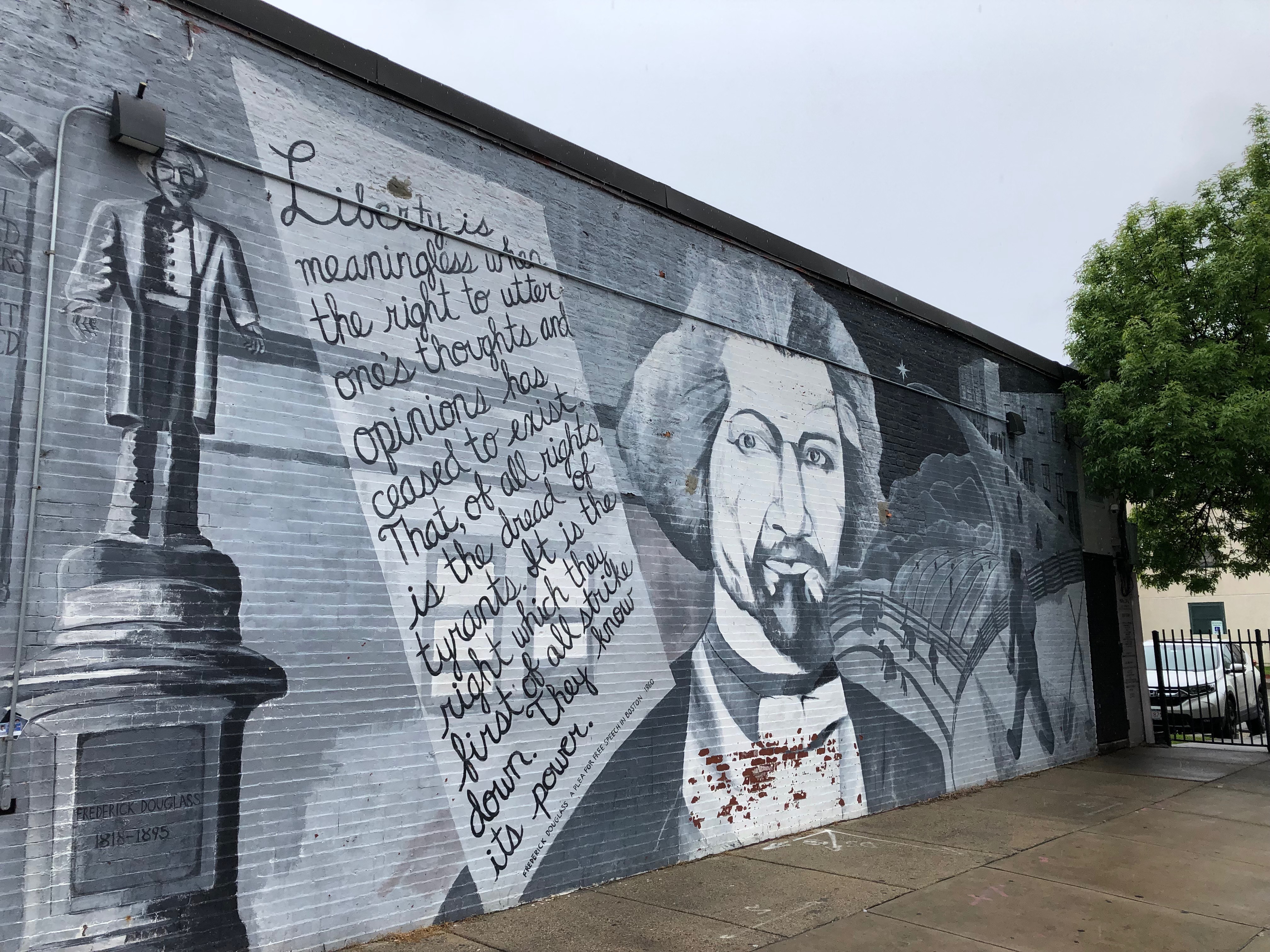
I loved the band that played outside Madison Park High School, where our group joined the walk. Some people carried signs. Lots of people chanted peace slogans. We passed by a mural of the great Frederick Douglass in Roxbury.

If one or two people were to walk down Tremont Street on a rainy Sunday morning, no one would notice. When many hundreds do, it’s an event.

But other than raise funds for the Louis D. Brown Peace Institute outreach, which is valuable, does this help prevent violence? There are still homicides in Boston. But the huge gathering seems to generate an indefinable energy and awareness that sometimes leads individuals to wage peace in their own ways throughout the year.

051219-good-band-at-Peace-March-Boston

051219-good-idea-US-Dept-of-Peace

051219-Peace-Marcher-Boston

051219-Frederick-Douglass-mural-Roxbury-MA

051219-1-and-2-and-50-make-a-million


Read Full Post »

Photo: AFP/Sebastien Rieussec
A dancing contest in Mali challenges entrants to excel in traditional dances not their own. Here is a contestant in the “Faso Don,” performing during the filming of the show in the Malian capital, Bamako.

In Mali, an African country still suffering from the effects of French colonialism, ethnic groups have often had trouble getting along, and extremists have moved into vulnerable areas. (See my blog post about a secret operation to save ancient manuscripts from the radicals’ destructive rampage.)

But better days are ahead, especially if more people act on their ideas to promote peace and coexistence.

Sebastien Rieussec wrote recently for Agence France-Presse [APF] about one such person.

“All 3,000 seats in the cavernous Palace of Culture in Bamako had been snapped up, and the mood was at fever pitch as the TV dance competition reached its climax. The three finalists took to the floor one by one, dancing alongside a celebrity — a format familiar to viewers of talent shows around the world.

“But here’s the difference: the three hopefuls each had to perform a traditional dance from a region of Mali that was not their own. …

“In the landlocked Sahel state of Mali, the show has been a raging success. And it has bred a desperately-needed sense of unity in a country burdened by jihadist violence and ethnic tensions.

“The competition is the brainchild of dancer and choreographer Sekou Keita. Just six years ago, he was wondering how he could reverse the decline of traditional dance in Mali, a country whose music is now achieving global fame.

” ‘Our dances are so varied, we have a number of ethnic groups — we’re very lucky to have such cultural wealth,’ he told AFP. … ‘But [dancers] don’t know the traditional dances of their own country.’

“From this came his idea for a program that explored ancient cultural roots and built bridges across ethnic divides — ‘Faso Don,’ or ‘Dances of the Country’ in the Bambara language.

“Over six weeks, TV audiences shared the fate of eight young men and women from different regions, who shared a house Big Brother-style in Bamako, the capital.

“Each week they performed before an audience and the TV cameras, their numbers progressively falling as a competitor was eliminated by a vote by the public and the jury. … The final took place last weekend before an audience exhilarated by the ground-breaking, cross-cultural performances.

“Dressed in traditional costumes, the finalists performed one dance from their region and one from another region, accompanied by Malian stars such as musician Bassekou Kouyate and singers Habib Koite and Oumou Sangare. …

“The winner was Rokia Diallo, a woman from the Fulani pastoral community in Sikasso, southern Mali. Dressed in a flowing gown and a veil, she interpreted the takamba, a sinuous, sensuous dance from the Songhai group in the far north of the country.

” ‘It’s the first time I’ve seen something like this,’ said hip-hop dancer Oumar Tamboura, who had come to support a relative who was also one of the finalists. ‘Until now, people weren’t interested in folk dance, tradition and costumes.’

“Faso Don has not just revived interest in generations-old regional dances in Mali. It has also reinforced mutual respect in a country whose reputation for hospitality is tragically being supplanted by one for violence.”

Read more of this hopeful initiative here. It’s another example of one solitary individual having an idea and making a big difference.

Read Full Post »

Photos: Beit HaGefen Arab-Jewish Cultural Center
People dance in the streets of the mostly Arab neighborhood of Wadi Nisnas in Haifa, Israel, for the 25th Holiday of Holidays festival, which celebrates religious diversity.

Most days, I find news about Israel completely depressing. Then along comes a story about an annual three-religion celebration there, and I’m reminded that not everyone associated with the 70-year-old nation and its neighbors is keen on in endless war.

Dina Kraft writes at the Christian Science Monitor. “In the port city of Haifa, two young art curators, one Jewish and one a Palestinian citizen of Israel, are dealing with something decidedly less fraught [than the daily news]: They are planning the logistics of an art installation that will include 88 pounds of white pepper, za’atar, sumac, and ginger.

“The piece is an exploration of what notions of ‘home’ mean, a loaded concept in a land claimed by two peoples. It is planned as a centerpiece of a new art exhibition for the Holiday of Holidays, the only event of its kind in Israel and a rare celebration of religious and cultural diversity in the fractious Middle East. The festival honors Christmas, Hanukkah, and Muslim traditions over three weekends in December in a gathering that is part block party, part intercultural artistic extravaganza. …

“Every year there is a different theme and this one is ‘the third dimension,’ an invitation to look at what happens when different cultures and identities influence each other to create something new – a hybrid space – as Yael Messer describes it. Ms. Messer is curator of the art gallery run by the Beit HaGefen Arab-Jewish Cultural Center. Messer, who is Jewish, is going over plans with Haneen Abed, her deputy, a Palestinian Israeli, in their shared office. The staff of the center is made up of both Arab and Jewish citizens of Israel.

“The story of the Holiday of Holidays is also the story of Haifa, Israel’s third-largest city. Haifa likes to bill itself – though not without criticism – as the country’s capital of coexistence, a place where Jewish and Arab residents live more integrated lives.

“Across the country, most Jews and Arabs live separately even in so-called mixed towns and cities, such as Haifa, where the two groups usually inhabit different neighborhoods. Social interaction is especially rare.

“But the festival brings together people from both sides of the demographic divide to dance to music performed on outdoor stages, on streets festooned with holiday lights. Arabs and Jews together follow the path of food and literary tours through the alleyways and streets of the mostly Arab neighborhood of Wadi Nisnas, eating local offerings like hummus and baklava at food stalls and attending concerts of liturgical music at churches. The massive undertaking is organized by Beit HaGefen and funded by the city of Haifa.

“Upstairs from Messer and Ms. Abed, their colleague Hila Goshen, the cultural director of Beit HaGefen, has her laptop open to a color-coded schedule of the festival’s events.

“ ‘It seems like every year there is some war, or military operation, or suicide bombing that happens [during the planning season] and we ask, “What are we doing, bringing people together to hear music and hear each other?” ‘ says Ms. Goshen. ‘And then the festival happens and this place looks like the most normal place on earth. The magic happens.’ …

“She says the example of the gathering, brief as it is, shows this concept of shared society, a place where Arabs and Jews can live together and lead equal lives.

“ ‘I know all our issues are not being solved in this festival,’ she says. ‘But even having this kind of exposure to thinking a little bit differently is a seed we have to plant.’

“Some critics believe this is gauzy naiveté. They argue that people really come to the festival for the food, not the message of unity. But [Asaf Ron, the director of Beit HaGefen,] disagrees.

“ ‘I don’t think people come for the hummus or the knafeh,’ he says. ‘I think they come for the hope.’ ”

More at the Christian Science Monitor, here. Check out past posts about the three religions interacting as the Daughters of Abraham, here, and in the pliable time of youth, here.

And for extra inspiration, click here to learn about the Parents Circle Family Forum, a beacon of light in Israel that brings together the bereaved on both sides of the conflict who understand that ending it can only come from the ground up.

Read Full Post »

Photo: Hartford Courant
Former US Marine Roman Baca
develops ballets that help veterans heal and help audiences gain empathy. For his Fulbright Fellowship, he’s creating a new version of Igor Stravinsky’s
Rite of Spring tied to WW I.

Not long ago, Suzanne’s friend Liz found a piece of antique weaponry and asked instagram friends how it might be used in an art project or something else positive.

I said to “beat it into plowshares.”

In their own way of beating weapons into plowshares, war veterans may continue to serve the country after their time in the military. They may run for Congress like Seth Moulton of Massachusetts or establish a nonprofit like Soldier On, which treats veterans suffering from addictions.

And then there’s the Marine who became a choreographer to tell stories that enlighten and heal.

Candice Thompson writes at Dance Magazine, “When Roman Baca returned home from active duty in Iraq in 2007, he found himself having a tough time transitioning to civilian life.

” ‘I remember a couple of instances where I was mean and angry and depressed,’ says Baca. [His wife] suggested Baca return to his roots in dance. ‘She asked me, “If you could do anything in the world, what would you do?” ‘…

“Baca had to broker his transition back into dance. Earlier, he had trained at The Nutmeg Ballet Conservatory in Connecticut and spent a few years as a freelance dancer before feeling compelled, like his grandfather had, to serve his country. ‘I walked into the recruiter’s office and said, “I want to help people who can’t help themselves.” ‘ Baca reveled in the rigor of the Marine Corps, which seemed like a perfect analog to classical ballet. …

“Baca served as a machine gunner and fire team leader [in Fallujah]. And while his job was one of looking for insurgents and intelligence, Baca also ended up doing humanitarian work, bringing water and school supplies to those in need. The transition from violence to aid helped him meet his original desire to defend the vulnerable.

“In 2008 … he reached out to his mentor Sharon Dante from The Nutmeg Ballet Conservatory. He had dabbled in choreography before joining the Marines and had begun to write while overseas. Dante suggested [that he] focus his writing and choreography on his experiences in Iraq. The exploration led Baca to form Exit12 Dance Company, a small troupe with a goal of inspiring conversations about the lasting effects of violence and conflict. …

“When a theater in the UK reached out to him in 2016 about creating a new Rite of Spring — one that would explore the connections between the creation of this famous ballet and the outbreak of World War I, in commemoration of the war’s centennial, as well as touch on today’s veterans and current events — he knew immediately it was a project for [him].

” ‘One percent of our population serves in the military, and an even smaller number serves in war,’ explains Baca of one of the central questions motivating this new commission. ‘How do we take all of this remote and little understood experience and inspire the audience to positive action?’ ”

More at Dance Magazine, here.

Read Full Post »

Older Posts »