Feeds:
Posts
Comments

Posts Tagged ‘performance’

Photo: Robert Ormerod for the New York Times.
Graham Maxwell performing “The Flying Bubble Show” during the Edinburgh Festival Fringe.

Nowadays, hearing or reading about something cool is generally good enough for me. As interested as I might be in a foreign country or a new play or a natural wonder, I don’t often think, “I wish I had been there.”

But today’s story on bubble art is different. I would have loved to see these performances and be in the midst of audience reactions. They took place at the Edinburgh Festival Fringe in August.

Alex Marshall wrote at the New York Times, “In McEwan Hall last week, the atmosphere was riotous. For about an hour, some 400 adults and children were gasping, screaming and laughing as Louis Pearl, the Amazing Bubble Man, encased girls and boys in huge soapy globules, made bubbles levitate and wobble, filled many of the fragile spheres with smoke, and karate-chopped others in half.

“For the show’s finale, Pearl, 68, grabbed a long plastic stick with a ring on one end, dipped it into a vat of soapy formula and waved it above his head so that thousands of bubbles drifted over the audience. Children throughout the theater leaped out of their seats to pop them. …

“This year, four bubbleologists, as they like to be called, have shows on the Fringe. … Ray Bubbles has a show for disabled children and an ‘Ultimate Bubble Show‘; an act called the Highland Joker has the simply titled ‘Bubble Show‘; and Maxwell the Bubbleologist has a ‘Flying Bubble Show,’ largely performed midair.

“After his gig last Monday, Pearl posed for photos with fans and sold bubble-making kits outside the venue. ‘Bubbles are like dreams,’ he said later in an interview: ‘When you blow one, you go out of normal reality and this magical thing captures your attention until — boom! — it pops.’ …

“Born in San Francisco, Pearl said his bubble fixation began in the 1970s at Dartmouth College in New Hampshire when a roommate showed him a bubble pipe and they tried out some tricks like filling the bubbles with marijuana smoke.

“While working odd jobs after college, Pearl sold toy bubble pipes on the streets of San Francisco, and sometimes sold pot, too. His life changed in 1983 when he saw Tom Noddy, a bubble artist who once appeared on The Tonight Show, perform at the Exploratorium, a San Francisco science museum. Noddy’s tricks included creating a cube-shaped bubble, making smoke spin tornado-like inside a bubble, and blowing piled-up bubbles to form the shape of a goblet.

“Pearl said he spent ‘hours and hours’ replicating Noddy’s tricks and developing his own. During that time, Pearl recalled, he also had to work out the ideal mixture for bubble blowing. (His current recipe, he said onstage, calls for dish soap, water — and lube to make the bubbles stretchy.)

“At this year’s Fringe, Pearl is performing versions of some of Noddy’s best stunts. ‘In the bubble community, if you present tricks in a new way, it’s cool, Pearl said. ‘If you steal, it’s not. …

“When Pearl first took his ‘Amazing Bubble Man’ act to the Fringe, in 2007, he played a 100-seat venue. Now, he’s in an over-1,000-capacity hall, although he said a full house could be disastrous, in part because the heat generated by larger crowds creates air currents that make it harder to control the bubbles. …

“Yet Pearl is up against an even bigger challenge this year. For the first time, the most hyped bubble act at the festival isn’t his, but ‘The Flying Bubble Show,’ in which Maxwell the Bubbleologist blows hundreds of the iridescent orbs while flying on a harness around a circus tent.

“The spectacle’s performer, Graham Maxwell, 32, said in an interview that he had been putting on traditional bubble shows around the world for about a decade when, in 2024, he had ‘a vision’: He pictured himself suspended midair while using tai chi movements to make bubbles levitate, bulge and spin. That inspired him to train in a circus tent in Goa, India, where he learned how to use a wired harness. …

” ‘There’s a whole, deep world to bubbles, he said: Seeing one pop could prompt adults to recall their youth or dwell on their mortality, he said. How bubbles form and move can be used to understand fundamental scientific properties, he added, and for him, the act of blowing bubbles can induce a meditative state. …

“Last week, Maxwell performed his flying show to an audience of about 500. … As graceful classical music played, Maxwell — wearing a top hat and billowing velvet shirt — swooped overhead as the audience sat around a circular stage. Trailing behind him were elongated bubbles that he created by blowing through his soapy fingers or using ropes he had dipped in bubble-making fluid. During the hourlong show, he juggled bubbles midair, tried to create ‘the biggest bubble ever’ and performed his bubble-levitating trick.

“ ‘Bubbles, it’s such a lovely word,’ he said at one point. ‘You can’t ever say it without smiling.’ “

More at the Times, here. Amazing pictures!
Read Full Post »

Photo: South China Morning Post composite/Zhihu.
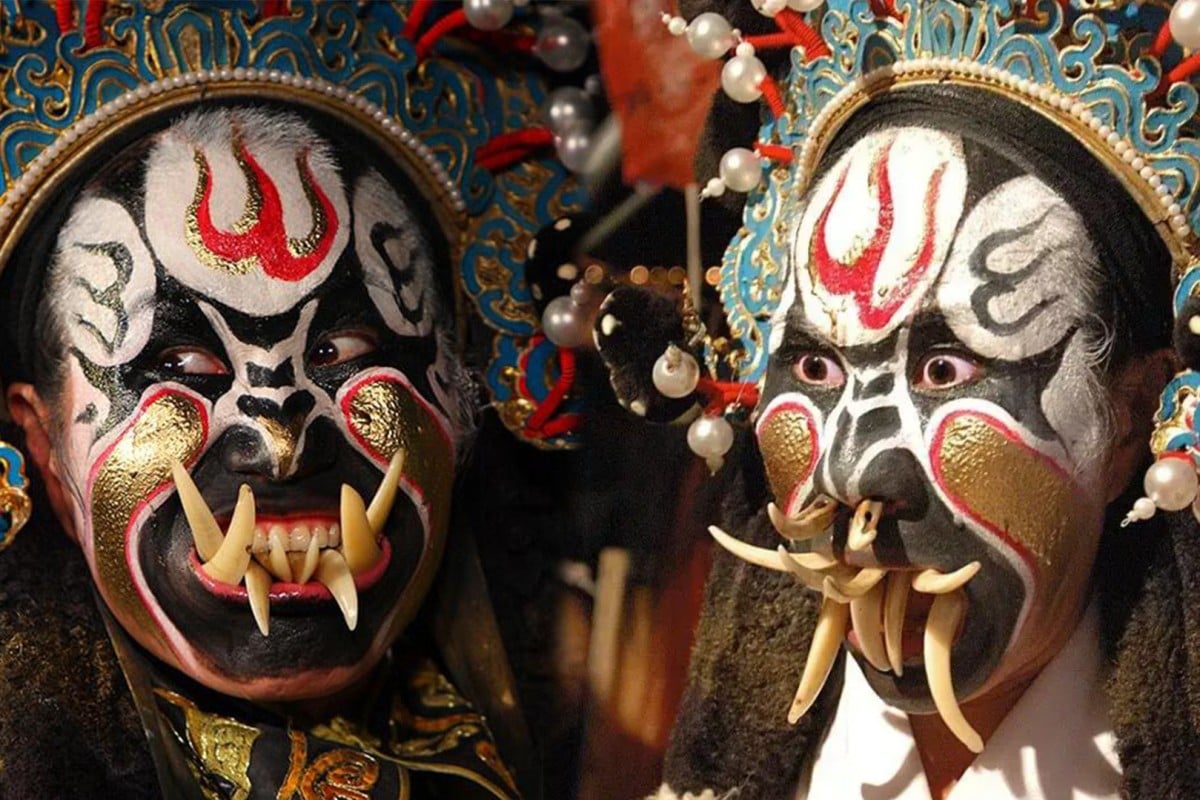
“Teeth Playing” is one of China’s most terrifying, and difficult, forms of folk art. Performers manipulate up to 10 wild boar tusks at a time with their mouths. 

At Halloween in the US, children often think it’s fun to be vampires and go trick-or-treating with scary wax fangs in their mouths. But the fake dentures soon come out and go in a pocket because they are so uncomfortable.

In China, there’s a performance art that involves singing with actual boar tusks in the performer’s mouth. Talk about uncomfortable! At the South China Morning Post, you can see a photo of the damage that tusks are causing a young performer.

Zoey Zhang reports on the strange art of “teeth playing.”

“A performer with a fierce makeup conceals the tusks of several wild boars in their mouth, flipping them up and down with their tongue and teeth. Throughout this process, they need to sing, read and dance.

“It could well be the most terrifying, and most difficult, folk art in China. It is called shua ya, which literally means ‘teeth playing.’

“Shua ya is a stunt used in traditional Chinese opera designed to portray the dark, dangerous and complex psychology of villainous characters.

“The tusks of male wild boars that it uses are polished and disinfected and usually reach the length of an adult index finger.

Performers need to manipulate four to 10 tusks in their mouths, using their lips, teeth, and breath to make them move, conveying the emotions of characters.

“Lowering the tusks indicates relaxation and satisfaction, while shaking them vigorously indicates anger. …

“Shua ya has a history spanning over 400 years and is a distinctive feature of opera performances in Ninghai, a county located in Zhejiang province in eastern China.

“The most classic shua ya performance is Jinlian Slays Jiaolong. Jiaolong, or the Chinese water dragon, diverges from the auspicious portrayal of Chinese dragons, causing chaos and bringing misfortune to people. Artists portraying Jiaolong need to master shua ya to perform the part of a villain.

“The stunt is recognized by the government as an intangible piece of cultural heritage. Due to the arduous training process, the art form is on the brink of extinction. Its exponents must keep sharp tusks in their mouths at all times, except when eating or sleeping, until they can speak clearly. It typically takes over a decade of practice to fully master.

“Xue Qiaoping, 41, from Zhejiang province, is a sixth-generation inheritor of China’s shua ya art and one of its few female performers.

“She told China Central Television: ‘When training with eight tusks in my mouth because they are very hard, my entire gums were worn out. I couldn’t eat or drink for a week, only relying on intravenous drips for nutrition.’

“When she reached 10 tusks, Xue needed to use both hands to open her mouth wide enough to fit in all the teeth. Her mouth cracks after each performance.

“Meanwhile, Li Yi, 19, from Henan province in central China, is a shua ya artist with 1.4 million followers on Douyin. He has been practicing this stunt for eight years.

“ ‘My mouth has torn and ulcerated more than 70 times, my jaw muscles enlarged, my teeth were ground down and my appearance changed dramatically,’ Li said. ‘But I am willing to devote my youth entirely to traditional culture.’ “

More at South China Morning Post, here. No paywall.

Read Full Post »

Photo: Toronto Star.
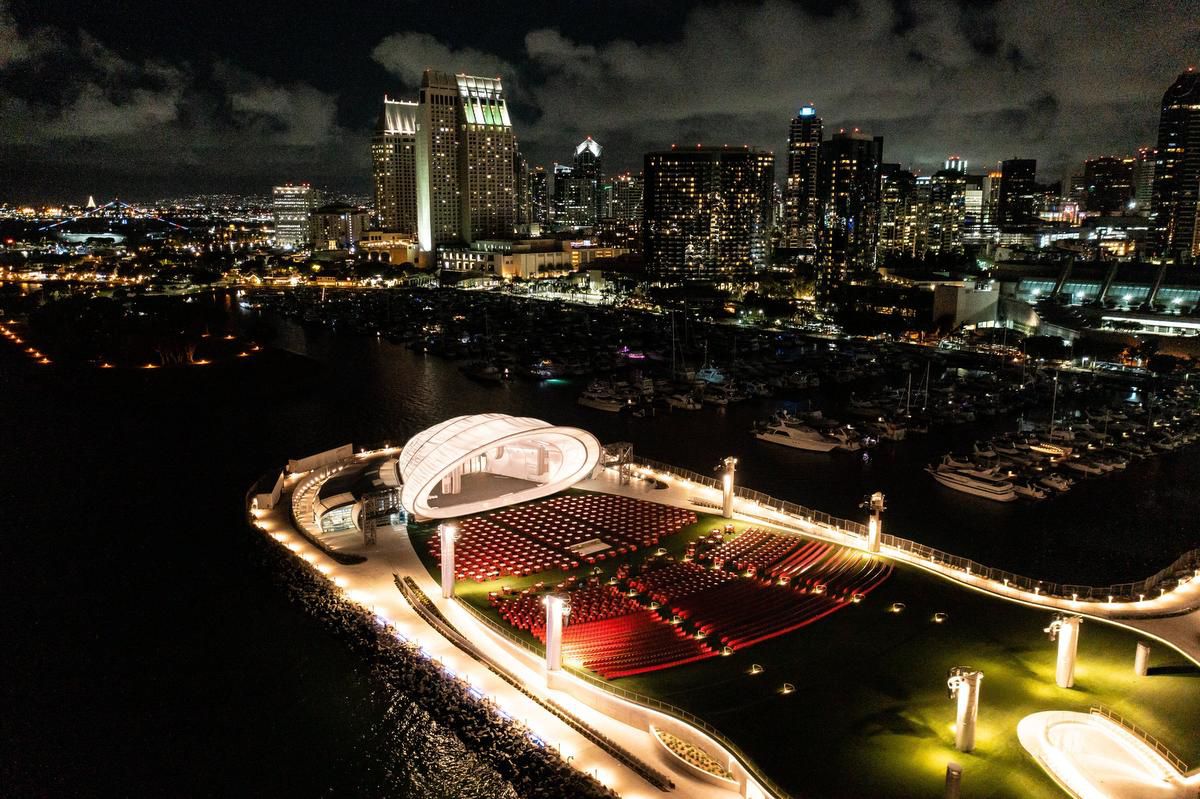
The San Diego Symphony’s waterfront venue, the Rady Shell.

The pandemic made us take a close look at the possibilities of moving the performing arts outdoors. Maybe outdoor performance is a good idea even without a pandemic.

William Littler writes at the Toronto Star, “Yes, San Diego is an outdoors city, blessed with an enviable oceanside location and a climate worthy of a snowbird’s dreams. No wonder the local symphony orchestra wants to come out and play.

“It has an even better reason now, thanks to last month’s opening of Rady Shell in Jacobs Park, a downtown al fresco setting for up to 10,000 people, picturesquely surrounded on three sides by water.

“The setting is nature’s gift, slightly reminiscent of the days when the Toronto Symphony Orchestra had a popular series at Ontario Place. And I say slightly because Ontario Place offered the orchestra a shared residence in a multi-purpose facility, whereas Rady Shell was developed specifically as a home for the San Diego Symphony.

“Described as the only permanent waterfront performance space on the West Coast, the handsome shell stretches forward as if to embrace the audience, with a series of speakers lined up on each side of the upward sweeping, (imitation) grass-covered audience area.

“At an afternoon rehearsal I took the opportunity to walk around and sample the sound from different standpoints and was not surprised to find the best sound — which was surprisingly good — closer to the front, where most of it came directly from the stage. …

“The arrival of COVID-19 has led orchestras to seek ways to enhance their outdoor profiles.

“The Montreal Symphony Orchestra has taken to its city’s parks. The Boston Symphony Orchestra heads for Western Massachusetts and Tanglewood. The Los Angeles Philharmonic has Hollywood Bowl.

“Though never an ideal solution, Ontario Place gave the Toronto Symphony an opportunity to broaden its audience and lengthen its season.

“Rady Shell demonstrates what more can be achieved through years of careful planning. A community effort, because it is part of a park, 85 per cent open to the public, people have routine access to the site.

“According to CEO Martha Gilmer, the orchestra plans to present about 110 events there per year, including the first part of its fall season, thanks to San Diego’s friendly climate. …

“The Southwest is clearly America’s fastest growth area; witness the fact that Phoenix, Arizona, recently passed Philadelphia to become the country’s fifth largest city. A can-do attitude helps explain how the new facility was built almost entirely without government support.

“The architects clearly wanted to design a people place, even providing a 12-foot-wide walkaround with benches just outside the porous perimeter fence for those who would like to hear, if not actually see the concert, without buying tickets. During the opening concert I even saw passing sailboats pause to share the experience.

“Of course I am describing a special place, not the kind of home most orchestras could hope to build in their neighbourhood. But the need is the same, to reach out to more people in a friendly environment.

“The San Diego Symphony has obviously understood this: the opening event at Rady Shell was a full-scale symphony concert, conducted by its popular music director, Rafael Payare, who will add the Montreal Symphony Orchestra to his schedule in 2022, but the second event was a Broadway program presided over by a different maestro, and the third was a concert by Gladys Knight.

“Three substantially different audiences attended these concerts, testimony to the orchestra’s wish to open its doors wide. It is a strategy for survival for symphony orchestras in Canada as well as the United States.

“In the program handed out for the opening concerts, Payare declared unequivocally: ‘From the moment I first stood on the stage of what would become Rady Shell at Jacobs Park, I knew that it was going to be an incredibly powerful acoustic for the orchestra.’ ” More at the Toronto Star, here.

In related news, there’s an interesting New York Times article about an outdoor theater space that was launched by black-listed artists in the McCarthy era and got a new lease on life during the pandemic.

Read Full Post »

The Royal Frog Ballet recently staged an outdoor event to welcome fall, but according to the lead players, it wasn’t so much a performance for strangers as a gift to new friends. The effect was surreal and entertaining.

Amelia Mason reports at WBUR, “A masked woman in an apron and kerchief jumps up on a picnic table and addresses a crowd.

“ ‘I’m your grandmother, and I’m here to help you throughout this show …  The first thing to know is that when I ring this bell it means we’re all going to move to the next thing and you’re going to have to follow my directions, OK?’

“It is the opening night of the Royal Frog Ballet’s ninth-annual ‘Surrealist Cabaret.’ Our guide — Shea Witzo, in the role of the Granny — gives us some more instructions: Watch out for holes. Stick close together. But first — wait. We pause for a moment, unsure of where to look.

“Then, 6-year-old Aiden Bairstow catches sight of something.

“ ‘Oh, I know what’s happening,’ he says. ‘I see it right behind you.’ We turn to see a band — fiddle, accordion and drums — approaching from across the field.

“The farm, it turns out, has many secrets in store. No matter where we look, something strange and surprising is bound to appear: a tall, swaying monster on stilts, for instance, or the pair of scientists who inform us that we are part of their experiment. At one point, our guide delights us with a salty parody of Bruce Springsteen’s ‘Dancing in the Dark.’ The pieces are linked loosely around a theme. …

“ ‘A lot of us are trying to make work that is like a gift, rather than a performance for [the audience],’ says Sophie Wood, one of the founders of the ‘Surrealist Cabaret.’ The project started in 2007, when Wood and a group of artist friends decided to perform some of their works-in-progress at a farm in Amherst. They mounted the production in a big barn and served the audience dinner. …

“The collective goes by the name the Royal Frog Ballet, and it has mounted weird and whimsical performances every year since its founding. … This fall, the theme is ‘hope and joy.’ …

“ ‘It feels like an old tradition,’ says Leah Sakala. … ‘It feels like we’re partaking in something, the kind of art that’s been made for a very long time, but at the same time it manages to be very relevant.’ ”

More here.

Photo: Sarah Ledbetter for WBUR
A performance of the “Surrealist Cabaret” in Essex, Mass., in October.

Read Full Post »

Early last month, an unusual tribute took place at Waterloo Station, London. How I would have liked to be there and see return to life the soldiers who died in the devastating Battle of the Somme in World War I!

Charlotte Higgins at the Guardian describes what the event was like.

There “were about 20 young men, immediately conspicuous because they were dressed in the dull-green uniforms of the first world war. They were just there: not speaking, not even moving very much. Waiting, expressionless, for who knows what.

“A small crowd gathered, taking photographs. A woman caught the eye of one of the men. She tried to speak to him. Without speaking or dropping his gaze, he pulled a small card out of his pocket and handed it to her.


‘Lance Corporal John Arthur Green,’ it read. ‘1st/9th Battalion, London Regiment (Queen Victoria’s Rifles). Died at the Somme on 1 July 1916. Aged 24 years.’

“There were similar scenes across the UK. … They gathered on the steps of the Gallery of Modern Art in Glasgow. They smoked roll-ups outside Bristol Temple Meads and marched, metal-tipped boots ringing, through Manchester Piccadilly. They stood in clumps by the entrance to Queen’s University, Belfast, and sat on the market cross in Lerwick, Shetland. …

“The event, which unfolded without advance publicity, can now be revealed as a work by Jeremy Deller, the Turner prize-winning artist …

“The participants were a volunteer army of non-professional performers, including social workers, farmers, security guards, farmers, shop assistants, students, labourers, flight attendants and schoolboys. All were sworn to secrecy, and rehearsals took place across the country over the past months. Deller worked with Rufus Norris, the artistic director of the National Theatre in London, and theatres throughout the UK to train the volunteer army.” More.

Photo: Alicia Canter for the Guardian
Soldiers at Waterloo station, London. Each represents a real person who died in the Battle of the Somme.

Read Full Post »

On the other hand, your living room could be a perfectly good performance venue. In fact, the Guardian calls your living room the “hottest new arts venue.”

The newspaper’s Darryn King writes, “On a recent Friday night in Manhattan, around 20 people and one terrier gathered in the living room of an Upper East Side apartment to listen to a string quartet perform Beethoven, Ravel and Tchaikovsky.

“The guests sampled cheese and wine – several had brought bottles to share – and asked strangers: ‘Is this your first time?’ …

“There are similar events to this performance, organised by Boston-based chamber music concert community Groupmuse, happening in New York, San Francisco and four other cities every week: intimate shows taking place in living rooms of all shapes, sizes and levels of cleanliness, a paradoxically homely and exciting alternative to traditional theatres, concert venues and comedy clubs.

“And it isn’t limited to classical music. Thanks to a range of organisations putting on events in the home, there’s a good chance that, if you were so inclined, you could enjoy standup comedy, live theatre and rock gigs in the comfort of someone else’s residence tonight. Welcome to the latest and greatest nontraditional venue invigorating the city’s live performance scene: the humble living room.

“A lot of folks seek out live music to feel like they are actively contributing to and sharing in something larger than themselves – not just standing by, observing the experience,” says Groupmuse founder Sam Bodkin. “Living rooms are just the best way to do that.”…

“The New Place Players, a troupe of Shakespearean performers-for-hire, have also been busy immersing audiences. The group has staged their productions of Twelfth Night and A Midsummer Night’s Dream in homes all over the city, while also putting on regular supper-and-show performances in the sumptuous living room of the historic Casa Duse residence in Park Slope, Brooklyn.

“The productions are a harmonious blend of music, lighting, theatre, food and drink, amounting to a communal atmosphere that harks back to the experience of catching a theatre performance in Elizabethan times.” More here.

Photo: Groupmuse
A Groupmuse gig.

Read Full Post »

One thinks of Iran as repressive, and having watched the doomed 2009 revolution unfold on twitter, I believe it is. But Iranian theater people seem to be managing to squeeze in some fun.

I blogged before about the Tehran production in a taxi, here. Now Studio 360 has a story on what might be called extreme improvisation. I take that back. There’s a script. But the actor doesn’t get to see it in advance.

“Actors face stage fright all the time,” says Studio 360, a radio show. “But consider this scenario: you show up to perform a one-person show, and you’ve never seen the script. You don’t know what it’s about because you promised not to do any research. It’s your first performance, and the only one you’ll ever have. The theater’s artistic director hands you a fat manila envelope with a script. And go.

“Also, the audience will decide whether you drink a glass of water that appears to have been poisoned.

“This is the premise of White Rabbit, Red Rabbit, by Iranian playwright Nassim Soleimanpour. ‘I did not know what was in front of me inside that envelope,’ says actor Gwydion Suilebhan. ‘What if this script is going to require that I disrobe? Or insult my mother? Or be rude or self-debasing?’ …

“Soleimanpour pulls his strings from afar, because — although the play has been performed in Toronto, Berlin, San Francisco, Brisbane, Edinburgh, London, and now Washington, DC — he really is in a cage. He doesn’t have a passport and can’t leave Iran, so he has never seen his play performed. ‘Nassim has given up the kind of control that is customary for playwrights,’ says Suilebhan, of working with actors and directors to realize the play. ‘At the same time, because he has put all of these restrictions on how it is to be performed, he has seized certain kinds of control that playwrights normally do not have. So he is literally embodying the ideas of control and submission and manipulation that he’s baked into his script.’ ” More.

Photo of Iranian playwright Nassim Soleimanpour found at the HuffingtonPost

Read Full Post »