Feeds:
Posts
Comments

Posts Tagged ‘philippines’

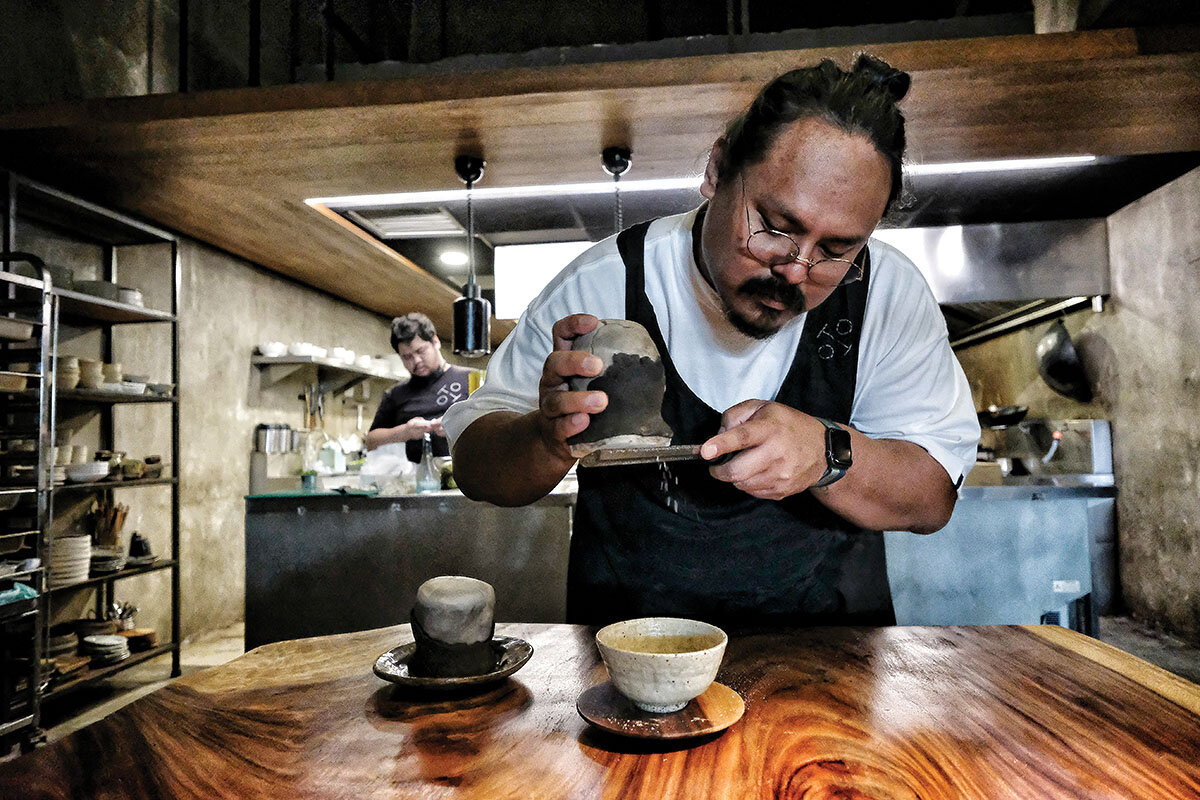
Photo: Oscar Espinosa.
“Jordy Navarra, chef at Toyo Eatery in Manila, Philippines, delicately grates a bit of ‘asin tibuok salt on top of flan de leche ice cream, one of his restaurant’s signature desserts,” reports the Monitor.

When Fuji Xerox brought the Kinoshita family over to Rochester years ago, I spent a lot of time with Yuriko. She had lots of questions about the US but spoke great English and soon was advising other Fuji Xeros families, even making a guide book for the women.

One day Yuriko asked me why Morton Salt said “with iodine” on the label. I told her Americans didn’t get enough of that essential ingredient in their typical diets. But it got me interested in salt.

Oscar Espinosa and Laura Fornell have a report at the Christian Science Monitor on a particularly unusual salt.

“Smoke escapes from a hut in front of the mangroves of Alburquerque, on the Philippine island of Bohol. The pleasant smell of wood, coconut, and salt burning over a slow fire signals that the making of artisanal salt has begun. 

“The process, which had been passed down for generations, results in a product known as asin tibuok. It’s an oval piece of salt compacted into a clay mold that has been partially broken by the intense heat of the fire. Asin tibuok is only produced in this small coastal town of about 11,000 inhabitants. 

“ ‘For the next few days, we’ll be taking turns so that we can watch the fire 24 hours a day,’ says Nestor Manongas, who keeps his eyes on the pile of smoldering wood in the center of the hut. ‘We will have to be pouring seawater [in] to prevent the flame from igniting so that the coconut shells are slowly consumed,’ he says. ‘We can’t get distracted because the process could be ruined.’

“This controlled combustion will result in gasang, a highly salt-concentrated ash, which is then placed in a funnel-shaped tank made of bamboo, where the salt is filtered out of the ash by pouring in more seawater. The resulting brine, called tasik, will be used to cook the asin tibuok pieces.

“Mr. Manongas is one of the last remaining makers of this salt. But thanks to the determination of his family, this old trade, which had fallen into oblivion, has been revived.

“ ‘Against all odds, we kept going because we were determined to give it a new life,’ says Crisologo Manongas, Nestor’s brother. He recalls how, little by little, asin tibuok became known, with university students making it the subject of their research, chefs from Manila discovering it, documentaries being made, and in 2017 a Filipino American entrepreneur based in California deciding to import the product to the United States.” Fascinating pictures at the Monitor, here. No paywall.

For more on the production of salt, particularly the production of sea salt, I turned to Malden Salt, here. Of course, it’s self-promoting, but I think you may learn a few things, as I did. Those of you who are cooking bloggers might be especially interested.

The website says, “Salt production is one of the oldest practices dating as far back to 6,000 BC. Used for various trading and religious offerings, empires such as the ancient Romans actually used salt as a means of commerce, with Rome deriving the word ‘salary’ from salt. … Not only does it enhance flavors within dishes and allows you to season to perfection, it is an element in which the human body can’t live without – sodium. …

“Sea salt is made by seawater from the ocean entering into shallow ground or a ‘salt works’ (man-made salt water pools) where by time the sun will begin to evaporate the water, leaving behind sea salt crystals – this is called solar evaporation.

“Now this is is the easiest and preferred method for warmer climates with a low rainfall and high evaporation rate. But what about the other climates like the UK that aren’t graced with regular hot weather? This is where countries like ourselves get creative with sea salt production.

“[It’s] a naturally occurring element, containing less iodine than table salt and obtains traces of minerals/nutrients including magnesium and potassium. …

“Although it’s safe to say Maldon is sea salt’s biggest fan – there are other salts. Table salt [is] mined from natural salt deposits (older bodies of seawater which have dried long ago) the salt is then processed and manufactured into smaller crystals. Unlike sea salt, which is produced through natural methods, table salt production involves chemicals after being mined. It’s purified and striped of minerals and infused with anti-caking substances.

“Mineral salt [is] similar to table salt, but this type of salt is specifically mined from areas such as Pakistan, near the Himalayas. Did you know it’s colors are influenced from the additional minerals, such as calcium, potassium, and magnesium. You may know this as ‘Rock Salt.’ Here at Maldon we stock Tidman’s Natural Rock Salt. [Unlike] other salts, Tidman’s is also additive free. …

“Since 1882, our world-famous salt flakes have been made with the same traditional artisan methods from the coastal town of Maldon, Essex. Our salt works are run by the fourth generation Osborne family, currently in the hands of Steve Osborn, following his father’s footsteps Clive, grandfather Cyril and great grandfather James.

“Seawater from the the Blackwater Estuary in Maldon is carefully harvested on the spring tide, where there is an appreciated art to the temperature and timing, which is a family secret. Master of salt makers have been hand harvesting the naturally formed pyramid-shaped crystals that have since became Maldon’s signature.

“Maldon Salt is created through an evaporation process. Brine is evaporated in our salt pans over flames to form the unique salt crystals. [Our] salt makers use the same time-honored techniques with skilled hands poised over every batch. You can find out more where Maldon Sea Salt comes from by heading over to our YouTube channel.” Read more here.

Read Full Post »

Sometimes I get blog ideas from Facebook, which is one reason I can’t see myself pulling out despite all the irrelevant, unwanted clutter there.

Former colleague Scott G. recently posted a curious item on Facebook about turning pineapple waste into leather — real leather, not “fruit leather.” It’s much better for the environment than animal-based leathers and more appealing to sustainability-conscious consumers than petroleum-based ones.

Adele Peters at FastCoexist says that Carmen Hijosa got the idea for a new, sustainable industry on a visit to the Philippines years ago. But first she needed a PhD.

“When leather expert Carmen Hijosa visited the Philippines to consult with the leather industry there, she discovered two big problems: The leather was poor quality, and producing it was bad both for the local environment and the people involved.

“But as she traveled around the country, she had an epiphany. The Philippines grows a lot of pineapples — and ends up with a lot of wasted pineapple leaves. The leaves, she realized, had certain features that might make it possible to turn them into a plant-based leather alternative. …

“She also looked at other local plants, such as banana fibers and sisal. But only pineapple fibers were strong and flexible enough to handle the manufacturing process she had in mind.

“Hijosa left her work in the traditional leather industry and spent the next seven years at the Royal College of Art in London, developing the material into a patented product while she earned a PhD. Now running a startup — at age 63 — she’s ramping up manufacturing of her pineapple-based leather, called Piñatex. …

“Her startup, Ananas Anam, has built its production from 500 meters to 2,000 meters, and [by August], she expects the next batch to be around 8,000 meters. But as the company’s capacity grows, demand is already outpacing supply. Companies like Puma and Camper have made prototypes with the material, and others are already using it.”

What an impressive woman! More here.

Photo: FastCoexist
Because pineapple leaves would normally be wasted, turning them into leather, is an extra source of income for farmers.

Read Full Post »

Recently, Simone Orendain wrote a story for the Christian Science Monitor‘s “People Making a Difference” series on a Philippine man who helps kids.

“For the past 30 years [Harnin] Manalaysay has been a father figure and mentor to hundreds of youths in Cavite City, just south of Manila. … Half the young people he has helped were out of school and on the streets – neglected, abused, or abandoned. The other half were in school but on the verge of slipping into gang life …

“A majority of the young people [he has helped] have gone on to become professionals in fields such as finance, education, marketing, and psychology, Manalaysay says.

“Some have become rock stars of the philanthropic world. Kesz Váldez, his 16-year-old adopted son, won the 2012 International Children’s Peace Prize – the children’s equivalent of the Nobel Peace Prize – for starting, at the age of 7, a foundation to help street children live with dignity and understand their rights.”

Manalaysay began his good works at 17, when, having run away from a violent father and some risky behaviors of his own, he found religion and “came across some kids in ragged clothes outside his new church making a lot of noise as they gambled with the loose change they had just begged for. He felt bold enough to scold them for making a ruckus.

“He asked if they were in school. They said no, so he started giving them basic lessons in reading and ABCs. The number of students grew, and he decided to tap some high school teachers, who recommended student volunteers. But he found that even those kids came from unstable families and needed help, too, including lessons in self-esteem and self-respect. Club 8586 was born. …

“Manalaysay credits his mother with this philosophy.

His earliest memories were of her selling home-cooked snacks that she would then give away to the poor once she earned enough to pay for the family’s needs.

That lesson in selflessness and love has stuck with him, and he has tried to pass it along to all of the kids whose lives he has touched.”

More here.

Photo: Simone Orendain
Harnin Manalaysay founded an outreach organization that helps street children in Cavite City, Philippines.


Read Full Post »

Fellow parishioner Phil Villers has a strong social-justice side, having volunteered for years with Amnesty International and similar organizations. He also runs businesses. Bella English recently wrote about his latest venture for the Boston Globe, describing how the for-profit company benefits low-income people around the world. 

Writes English, “Phil Villers has founded several high-tech companies, but the one he oversees now offers something much more basic: a way to alleviate hunger in developing countries. GrainPro, Inc., which Villers runs out of Concord, makes airtight, impermeable bags of polyvinylchloride, similar to the material used by the Israeli Army to protect its tanks in the desert heat.

“The bags are critical because about one-fourth of grain products grown in developing countries or shipped to them — rice, peanuts, maize, seeds, beans — are lost to insects or rodents, or rot in cloth or jute storage bags.

“GrainPro’s ‘cocoons’ are made of the same material as the company’s bags, and … can reduce grain losses from 25 percent to less than 1 percent, Villers says. [The] company concentrates on hot and humid countries in Africa, Asia, and Latin America. …

“ ‘We eliminate the need for pesticides, and we can protect food supplies against all kinds of calamities such as typhoons and earthquakes,’ Villers says.

“During Typhoon Haiyan, which recently devastated the Philippines, the rice, cocoa, and seeds stored inside the cocoons were protected. In fact, GrainPro’s products are all made at a factory on the former US Naval Base at Subic Bay, 75 miles from Manila.” More.

One thing I would’ve like English to ask him about is how the plastic gets recycled. Too often one public good seems in conflict with another public good. More than likely, Villers has a plan for recycling.

Photo: Essdras M Suarez/ Globe Staff
“We eliminate the need for pesticides, and we can protect food supplies against all kinds of calamities such as typhoons and earthquakes,” said Phil Villers, on his “ultra-hermetic” grain bags and storage “cocoons.”

Read Full Post »

This extra post is just to give you suggestions for where you can send donations. Send love through your thoughts. Send donations to Doctors without Borders or one of these other relief organizations, here. You can specify which disaster you want your aid to go to. I personally do unspecified in case other disasters follow and the money is needed for them.

Thank you, Asakiyume, for the list.

Photo: NBCNews

Read Full Post »

Pamela Boykoff at CNN has a nice story about a ballet school in the Philippines and the hope it offers children from very poor families.

“Jessa Balote is 14-years-old and training to be a professional ballerina in Manila,” writes Boykoff.

“It is a task that takes enormous amounts of dedication for even the most determined of young women, but Balote’s challenge is nothing compared to life outside the dance studio where she has to support her entire family.

” ‘I’m the only one they expect to bring the family out of poverty,’ she says.

“Balote is one of 54 students enrolled in ‘Project Ballet Futures,’ a program run by Ballet Manila to provide free ballet training to children from some of the city’s most deprived neighborhoods.

“Balote lives in Tondo, a slum built next to a major waste dump in Manila. Her parents make what little money they have by selling trash. If Balote was not involved in the dance program, she says she wouldn’t be able to eat everyday.

” ‘They want to earn money to be able to survive,’ says Lisa Macuja-Elizalde, founder of the program and the Philippines’ first prima ballerina. She believes in her students, personally paying for their lessons and uniforms.

“Macuja-Elizalde’s goal is to help these children become professional members of the company with incomes to match. They are among her most focused students, she says, not afraid to work hard and to push themselves and their bodies.”

Read more.

Photograph: CNN

Read Full Post »