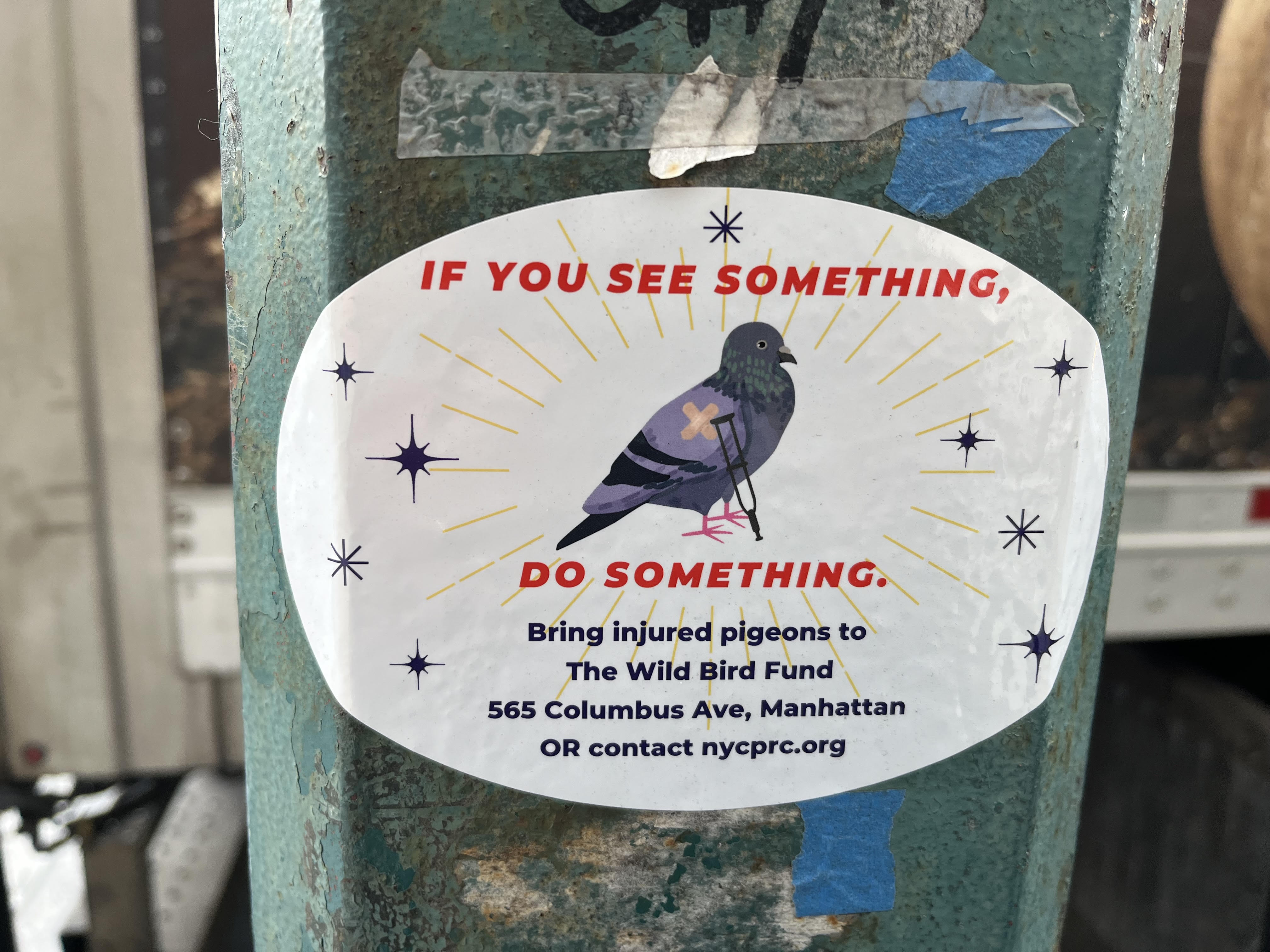
Photos: John and Suzanne’s Mom. Only in New York will you find people who care what happens to pigeons.
I was in crazy and wonderful New York for a few days. The occasion was the memorial for my friend Manny Kirchheimer, who was, as A.O. Scott of the New York Times once said, “an indispensable New York filmmaker, a noticer and a listener without peer.”
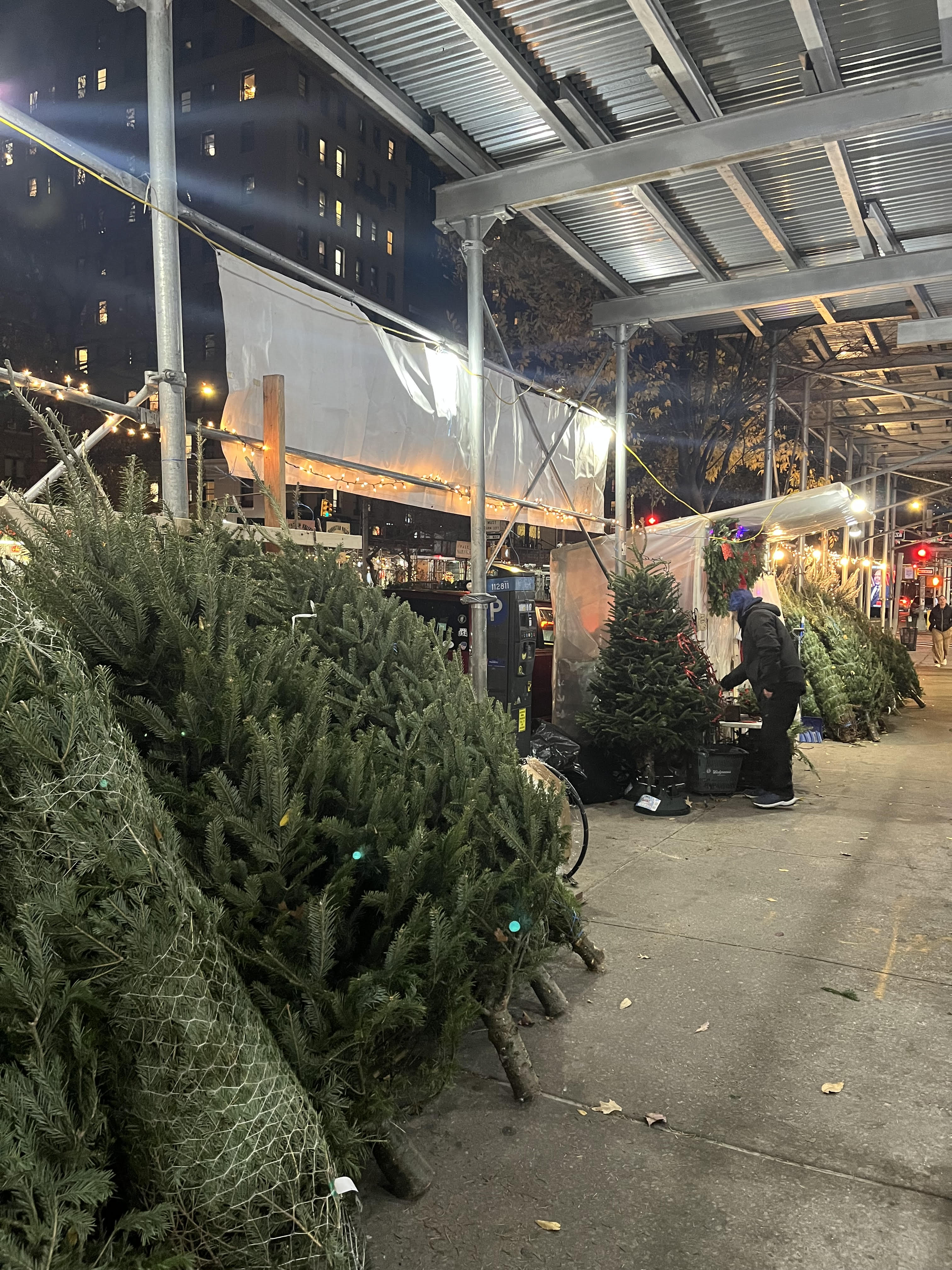
I walked around a lot and took pictures. And since I was in the city, I went to see “Egon Schiele: Living Landscapes” at the Neue Galerie, which was great. I do think New York museums have an awful lot of rules and waiting lines, but if you expect that, it’s easier to accept.
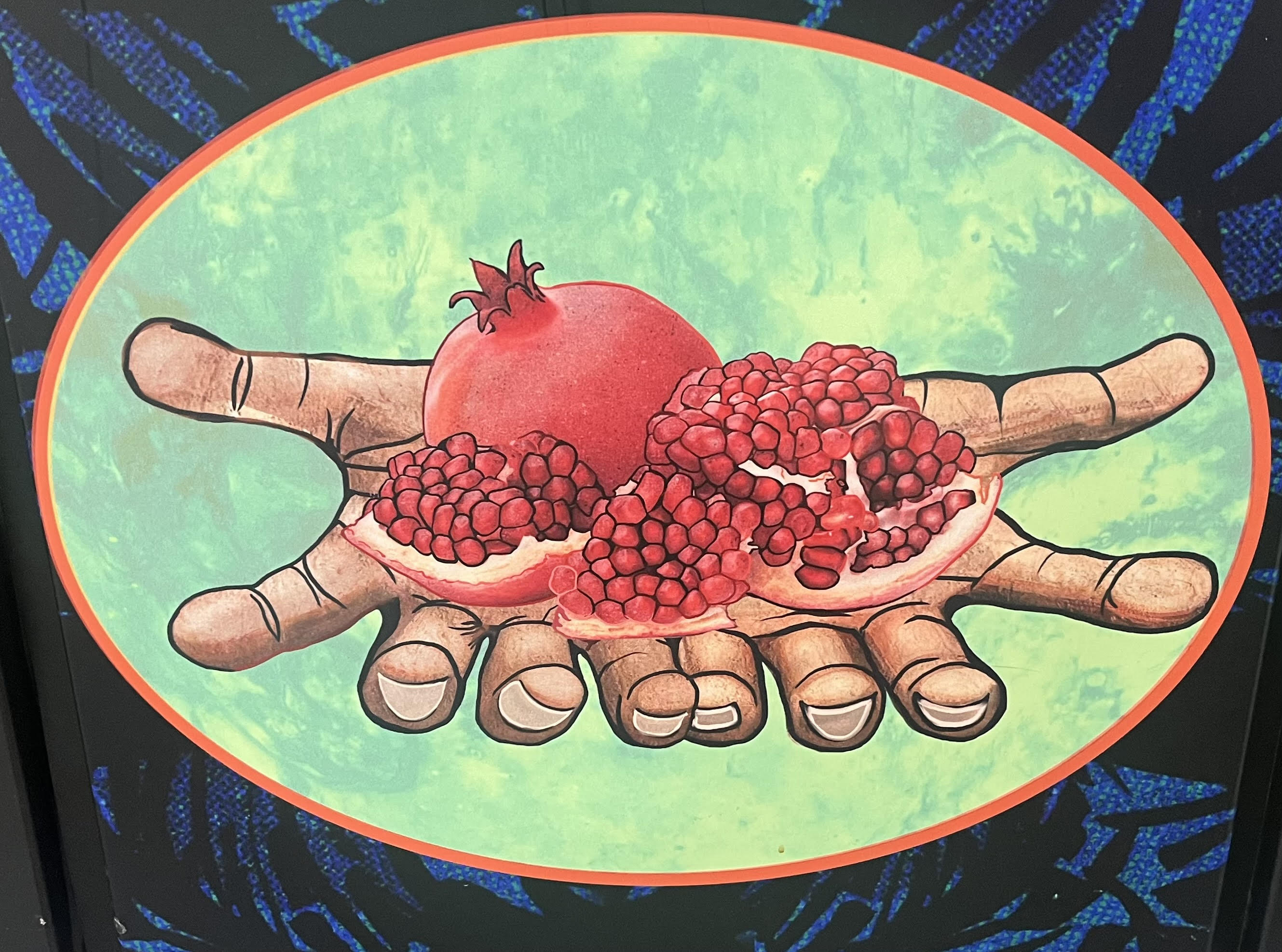
Among sights that caught my eye were giant murals by Chitra Ganesh in Penn Station (see Art at Amtrak). The hands offering pomegranates were on a pillar.
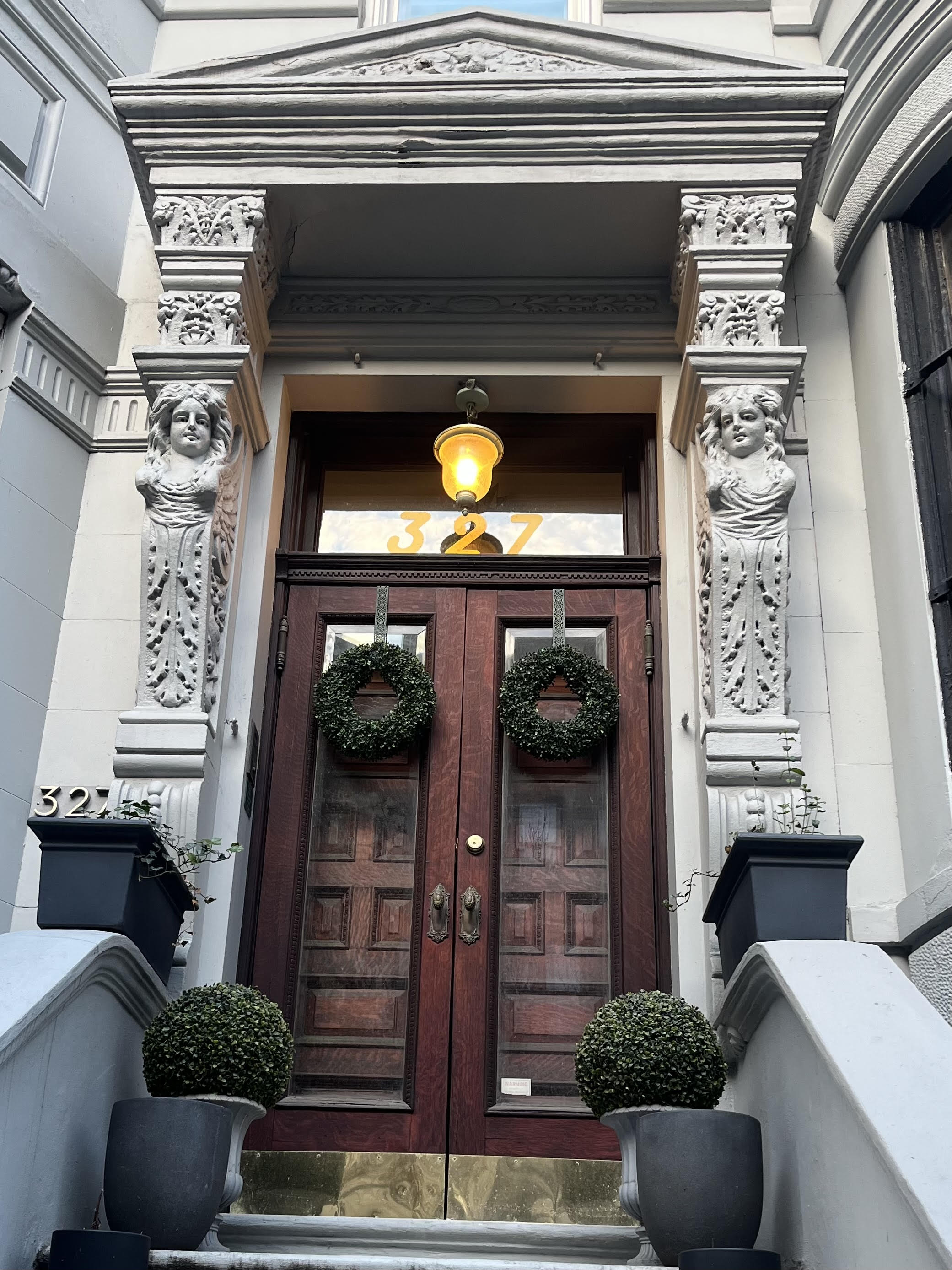
Although I can never compete with blogger Sherry’s Thursday Doors, which she gathers on a continent that really knows doors, I shot a New York one for her.
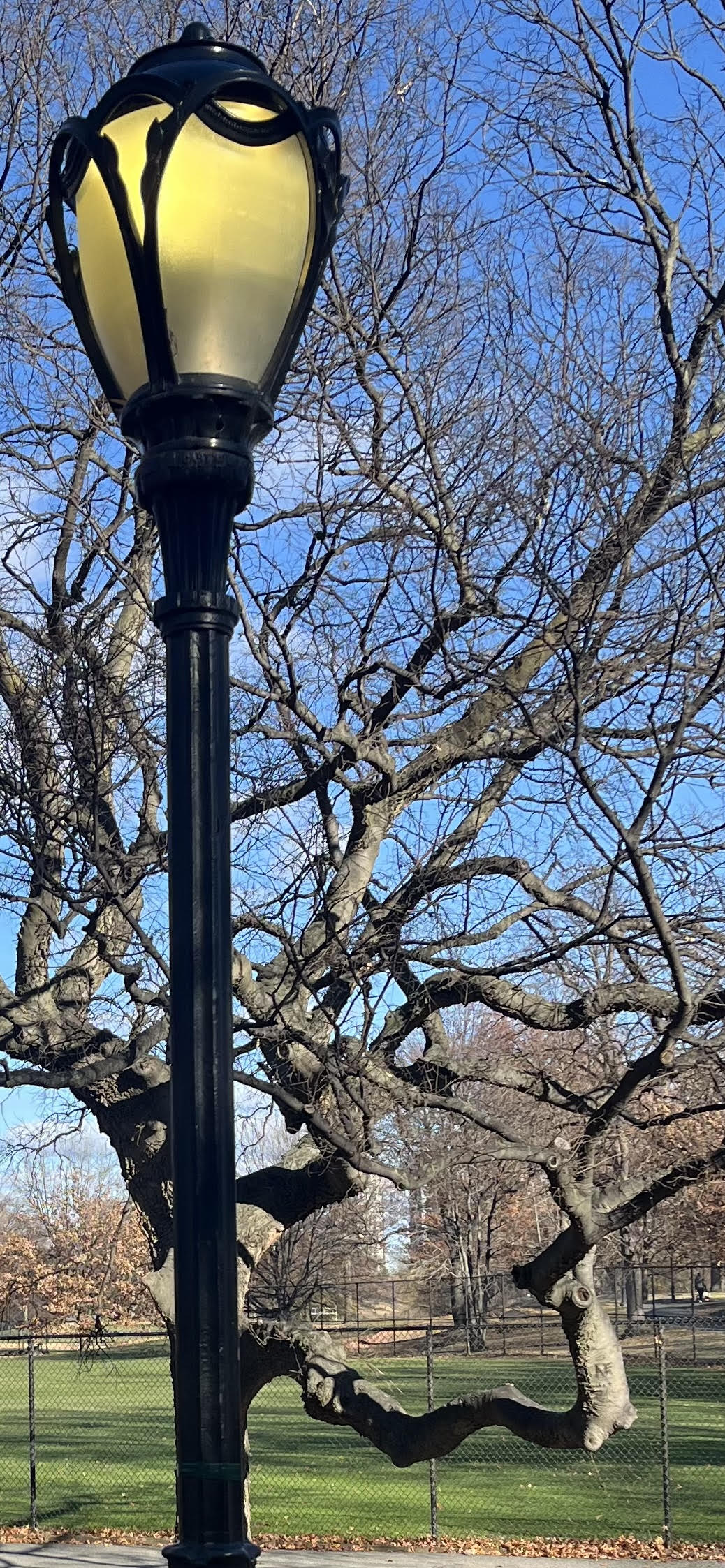
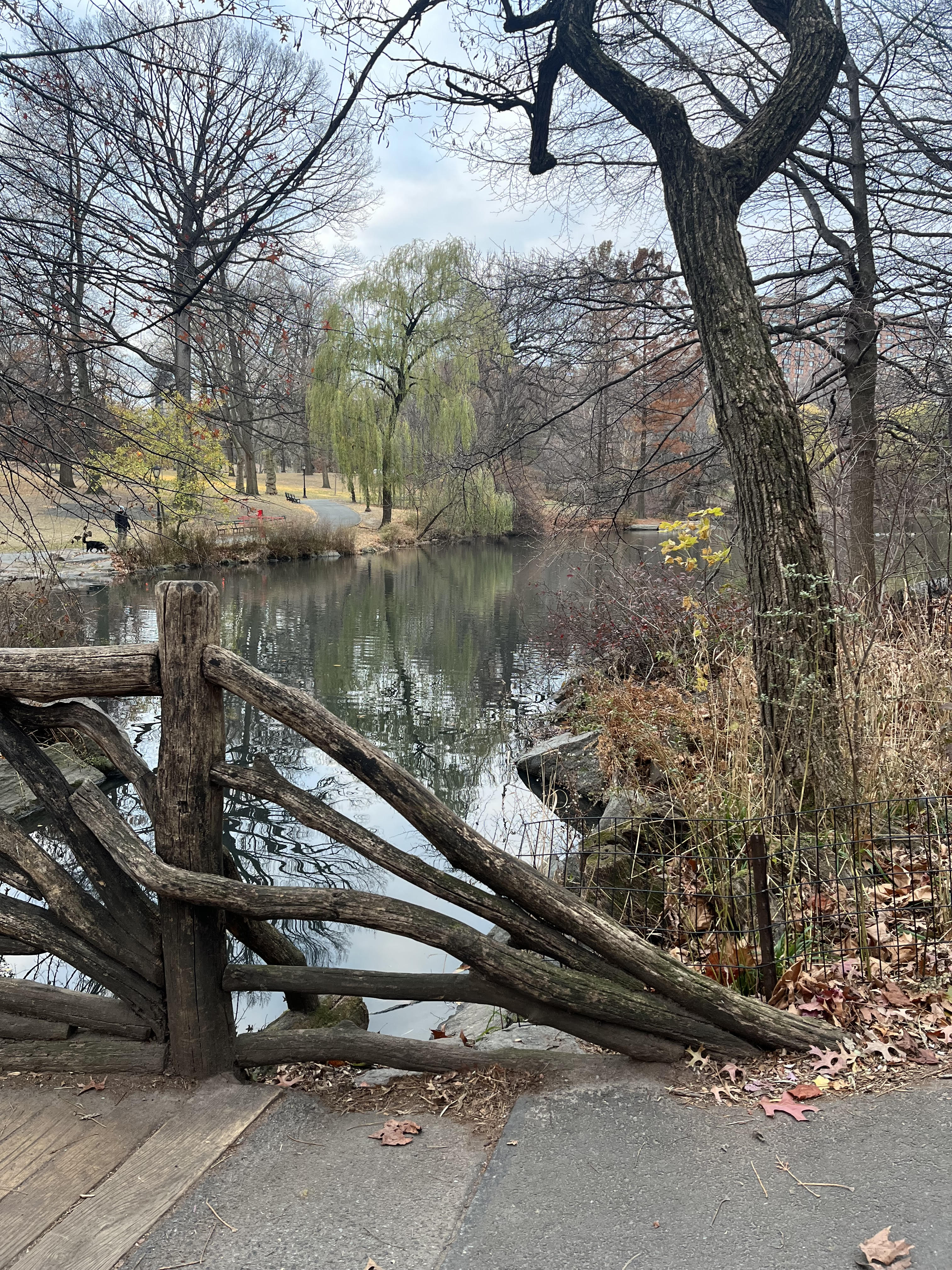
The two shots of Central Park are similar to ones I’ve taken before and shared, but every time I see that fantasy bridge or the Narnia lamp posts, I see them anew.
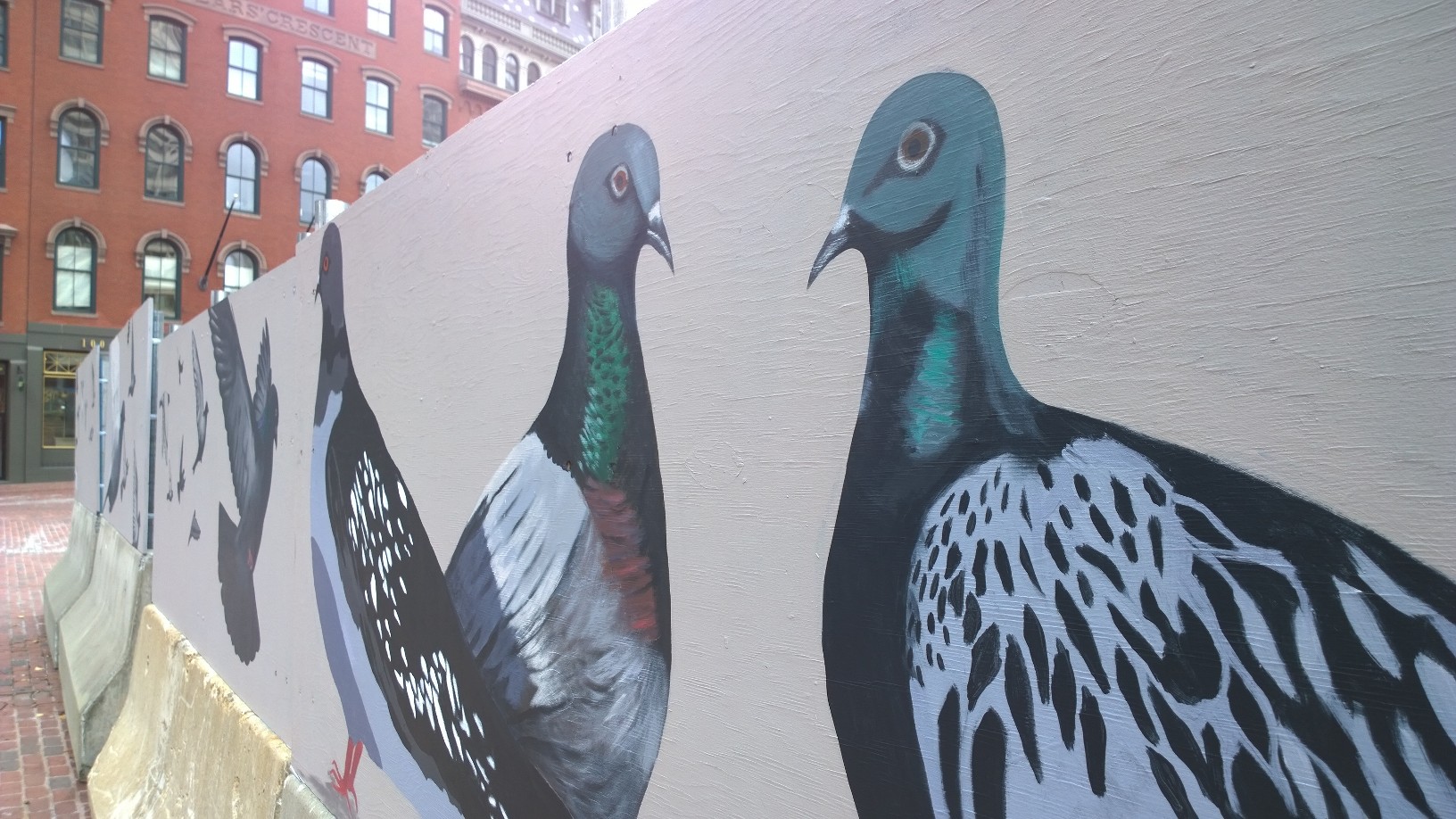
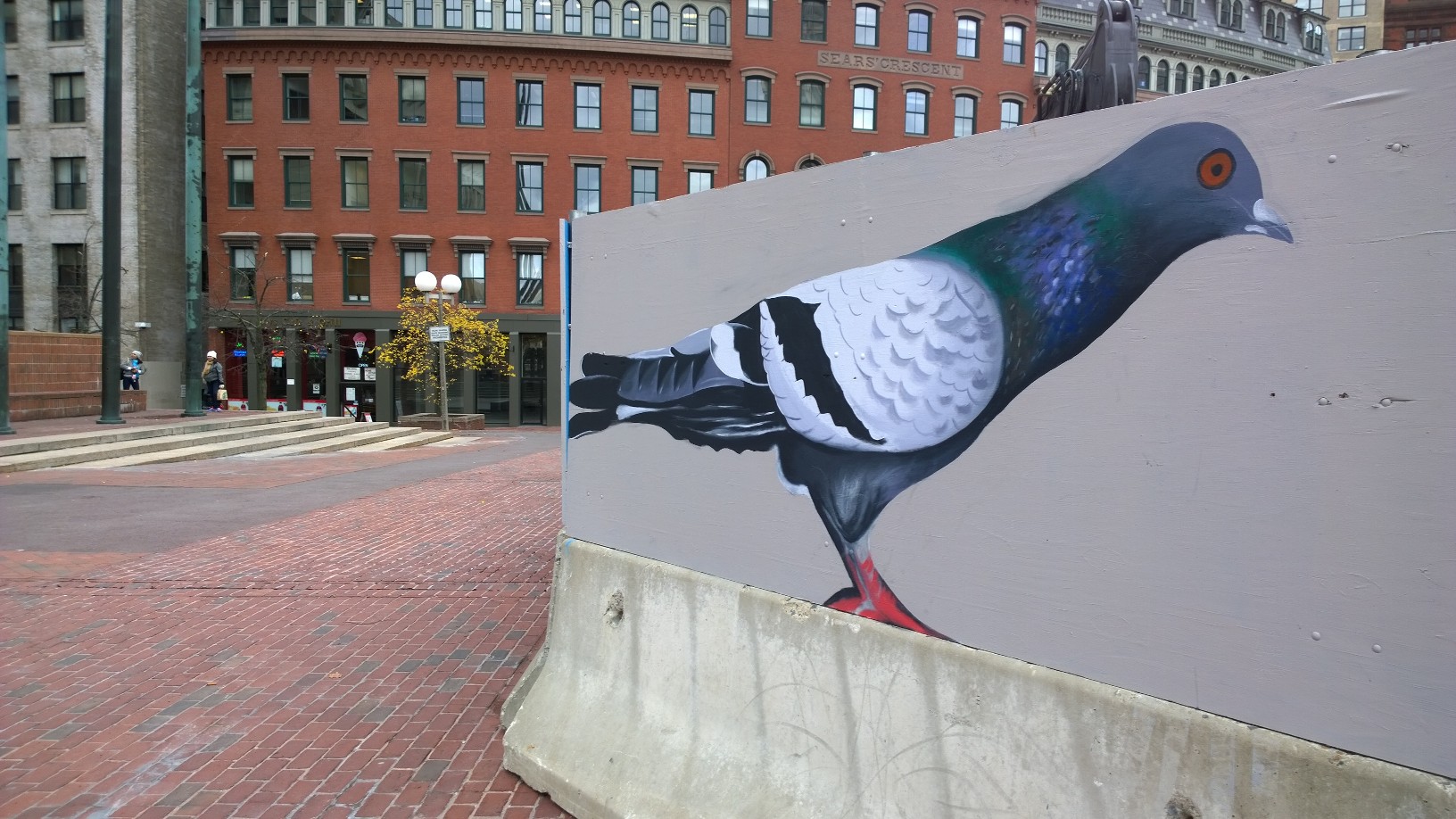
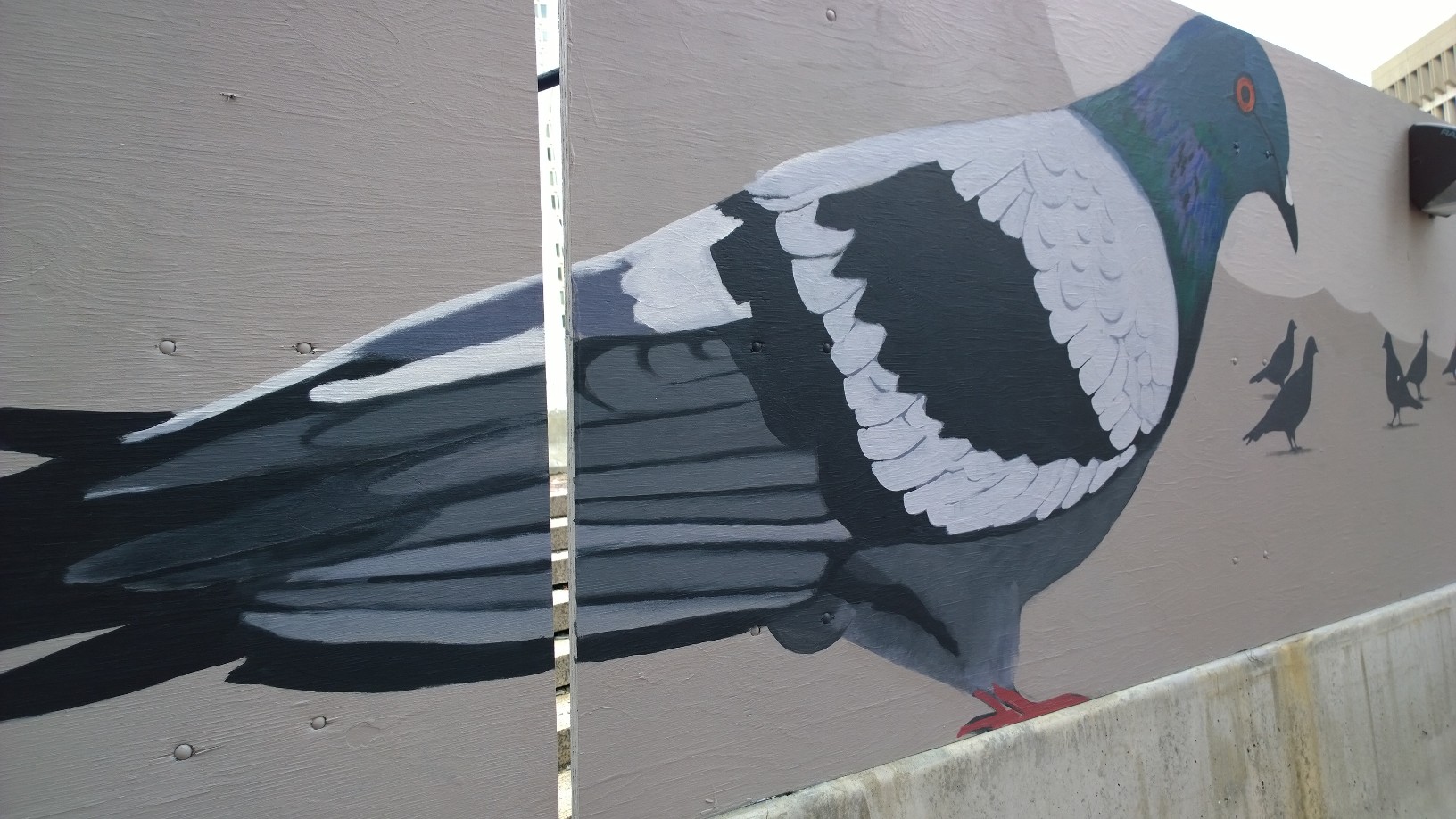
Photo: John and Suzanne’s Mom. Pigeon art at a Boston construction site, 2014.
Pigeons get no respect. They certainly make a mess when they congregate in places where people also congregate. More often than not, human interaction is confined to efforts to get rid of pigeons, or Rock Doves, even though they are actually very pretty. Sometimes I wonder if they would be less hated if we ever saw their babies. They seem to be born fullgrown!
Cathy Free wrote recently about one pigeon at the Washington Post.
“Brooke Ciardi was in the yard of an animal shelter taking photos of dogs to help them get adopted when she suddenly felt something on her head. It was a pigeon that had swooped in and landed in her hair. Ciardi was moderately alarmed to have the bird on her head, but the pigeon seemed perfectly content.
“ ‘I was surprised because this pigeon had no fear of the dogs and no fear of people,’ said Ciardi, who works as an outreach coordinator for the Montgomery County Animal Services & Adoption Center in Derwood, Md. …
“Ciardi soon learned that the pigeon had recently become a regular at the shelter, hitching rides from the parking lot to the building on employees’ heads, shoulders or fanny packs, and refusing to hop down unless forced to. ‘She’d ridden on people to come inside the building at least five times, and they kept having to put her outside,’ Ciardi said. ‘I said, “This isn’t right — she seems to be a pet.” ‘
“Ciardi said her supervisor … decided that Valley — the name staffers chose for the rock pigeon — would make a good pet for the right person. So on April 2, about a week after the bird first landed on an employee’s shoulder, she was put up for adoption. …
“The pigeon’s friendly nature indicated that she had probably been domesticated as a fledgling, Ciardi said. ‘She’s a young pigeon, and pigeons can have a long life span of about 15 years,’ Ciardi said. …
“During World War I and World War II, carrier pigeons were used to transport secret messages from combat zones to their home coops. ‘They have such an interesting history, and they’re really smart,’ Ciardi said. ‘It used to be that they were bred and domesticated to work alongside us in the same way that dogs do. … I think it’s in their DNA to want to be among us.’
“Ciardi and her co-workers agreed it was important to find a good home for Valley. On April 2, Ciardi posted a notice on Facebook that the pigeon was up for adoption. …
“Ciardi then wrote about the bird descending on her in the rain and remaining calm when curious dogs approached.
“ ‘It was finally decided that with her love for human company and lack of survival skills, Valley would really like to be put up for adoption,’ Ciardi posted. ‘Well, she came to the right place!’
“About 850 followers liked the post, and several people mentioned that they wished they could adopt Valley. CBS affiliate WUSA9 covered the quest to find the pigeon a permanent home. …
“Two days after the Facebook post, a woman in New Jersey decided Valley would be a perfect pet for her two young boys. Keryn Rosenberger drove three hours to Montgomery County from South Amboy, N.J., to adopt Valley. …
“Rosenberger is a single mom, and she said her parents kept birds as pets when she was young. She thought Valley would be a good fit for her family. … Rosenberger said she bought some cloth pigeon diapers online for Valley, along with a harness and leash for public outings.”
One day in spring, the school that two of my grandchildren attend had a dress-as-your-favorite-character day. The school principal wore a Mo Willems T-shirt that warned, “Don’t let the Pigeon drive the bus.”
Did you love that book series? Now that all four grandkids are reading advanced books, I feel a certain nostalgia for the Pigeon days. Fortunately, I can still see Pigeon at the opera.
David Allen writes at the New York Times, “Do you know the words to the Queen of the Night’s stratospheric showcase from ‘The Magic Flute’? Maybe the Duke’s famous tune from ‘Rigoletto’? Carmen’s Habanera?
“No, not those words. The other ones: the words, at least, as they are now known to my 6-year-old daughter and the hundreds of children who took grown-ups like me to the Kennedy Center here recently for the premiere of ‘The Ice Cream Truck Is Broken! & Other Emotional Arias,‘ an experiment, including a short new work by the composer Carlos Simon, in what it might mean to draw a very young and impossibly demanding audience into a life in opera.
“See, you might think that Carmen is relating her views on love, but no. Listen closely, and you’ll find that the singer should have shared her cotton candy with her friends, and absolutely will … tomorrow. ‘La donna è mobile’? That’s about how milk squirts out your nose if you happen to laugh at exactly the wrong time. The Queen’s aria? That’s still about anger, but it now invokes something far worse than the vengeance of hell.
“ ‘This bicycle,’ it begins, in a fit of preschool pique, ‘is such a poo-poo vehicle.’
“Opera’s great composers have a new librettist, and he is almost certainly the only person who could induce an institution like the Kennedy Center to do something like this, let alone get Renée Fleming to join him in hosting it; inspire a quintet of young singers to ham their way through it; and persuade Simon, one of the busiest composers around, to crown the show with a 20-minute piece that gives an attention-seeking, picture-book Pigeon the prima donna spotlight it has surely always craved.
“The writer for it all? Mo Willems, who, it turns out, really loves opera! …
“ ‘It’s big emotions. … It’s direct communication. It’s interior dialogue. It’s self-discovery.’ …
“Willems has always beena broader artist than just a writer of picture books, though that task alone is such that he calls it ‘as easy as describing the history of Byzantium in three words.’ Some of his most celebrated characters — who include a venturesome plushie called Knuffle Bunny, the on-and-off best friends Elephant and Piggie, and that insatiable, inimitable Pigeon — had already starred in musicals that he had written before he formalized his long association with the Kennedy Center in 2019, when he became its education artist in residence. That three-year position coincided with the pandemic, to which he responded with invaluable ‘Lunch Doodles‘ videos, but it still let him explore a range of genres, including symphonic music, which he said ‘has always been important to me.’
“ ‘Beethoven’s Fifth is the easiest example,’ he explained, ‘but it’s basically the arc of an episode of television, or a movie: “Ba-ba-ba-baaam,” oh, it’s exciting — and then you take the theme, you take the theme, and then you build with it. So when I was writing a show called “Codename: Kids Next Door,” which is a silly sort of action comedy, I would literally write to the symphony.’
“For the National Symphony Orchestra, Willems painted giant abstractions to accompany a cycle of Beethoven’s nine symphonies, and he worked with the musician Ben Folds to adapt one of his books, ‘Goldilocks and the Three Dinosaurs,‘ for the concert hall. Hearing plans for ‘Goldilocks’ led Tim O’Leary, the general director of the Washington National Opera and a Willems-reading father of three, to inquire about a commission. …
“The author quickly sent him a copy of an Elephant and Piggie book — ‘I Really Like Slop!‘ — with the inscription ‘Tim, this book really sings.’ By their second encounter, Willems had the libretto in his head, a sketch of the characters in concert dress and a title: ‘SLOPERA!‘
“ ‘Obviously, once it was called the “SLOPERA!” we had to do it,’ O’Leary said.
“ ‘SLOPERA!’ could only be performed live outdoors on account of the pandemic, but an indoor recording, with piano accompaniment, was shown virtually to more than 300,000 schoolchildren. Piggie gets Gerald the Elephant to try slop, a stinky green delicacy among porcine foodies. He does, after his initial refusals upset his companion, and he endures the consequences in something like a bel canto mad (or death) scene. He recovers, though, and tells Piggie that while he might not like her food, he still likes her. …
“Willems said, reflecting on what writing his first libretto taught him, aside from the importance of placing consonants carefully. ‘If you look at a picture book manuscript, and you can understand it, it has too many words. If you look at just the illustrations, and you can understand it, the drawings are too detailed. They both have to be incomprehensible. It’s very similar with writing an opera, that the words that you’re using have to be dependent on the music, but the music has to be dependent on the words, and either of them shouldn’t really be able to stand alone.’ …
“[Oznur] Tuluoglu, a young soprano whose most recent prior role was Barbarina at the Annapolis Opera, took on the title character. ‘When you train, you have to be able to sing Mozart, you gotta be able to be a pigeon.’ “
Photo: American Kennel Club
Most species respond to music, just not in the same way humans do.
Now that you have absorbed yesterday’s post on the responsiveness of cheese to music, it should come as no surprise that mammals, birds, and fish also have an affinity for music.
University of Amsterdam professor of music cognition Henkjan Honing writes at Nautilus, “We are all born with a predisposition for music, a predisposition that develops spontaneously and is refined by listening to music. Nearly everyone possesses the musical skills essential to experiencing and appreciating music. … Is musicality something uniquely human? Or do we share musicality with other animals. …
“By the beginning of the 20th century, Ivan Pavlov had discovered that dogs could remember a single tone and associate it with food. Wolves and rats also recognize members of their own species by the perfect pitch of their call and can also differentiate tones. The same applies to starlings and rhesus macaques. …
“Zebra finches turn out to focus mostly on the musical aspects of [sequences, as opposed to the order]. This does not mean they are insensitive to the order … but it is mainly the differences in pitch (intonation), duration, and dynamic accents [that] they use to differentiate the sequences. …
“Humans may share a form of musical listening with zebra finches, a form of listening in which attention is paid to the musical aspects of sound (musical prosody), not to the syntax and semantics that humans heed so closely in speech. … The research on starlings and zebra finches reveals that songbirds use the entire sound spectrum to gather information. They appear to have a capacity for listening ‘relatively,’ that is, on the basis of the contours of the timbre, intonation, and dynamic range of the sound. …
“What we know for sure is that humans, songbirds, pigeons, rats, and some fish (such as goldfish and carp) can easily distinguish between different melodies. It remains highly questionable, though, whether [animals] do so in the same way as humans do, that is, by listening to the structural features of the music.
“A North American study using koi carp — a fish species that, like goldfish, hears better than most other fish — offers an unusual example. Carp are often called ‘hearing specialists’ because of their good hearing. The sensitivity of a carp’s hearing can be compared to the way sounds might be heard over a telephone line: Though quality may be lacking in the higher and lower ranges, the carp will hear most of the sounds very clearly.
“Three koi — Beauty, Oro, and Pepi — were housed in an aquarium at Harvard University’s Rowland Institute, where they had already participated in a variety of other listening experiments. … In the discrimination experiment, the koi were exposed to compositions by Johann Sebastian Bach and the blues singer John Lee Hooker to see whether they could differentiate between the two. In the categorization experiment, the koi were tested to see if they could classify a composition as belonging to either the blues or the classical genre. In the latter experiment, they were alternately exposed to recordings of different blues singers and classical composers ranging from Vivaldi to Schubert.
“The surprising outcome was that all three koi were able to distinguish not only between compositions by John Lee Hooker and Bach, but also between the blues and classical genres in general. The fish appeared to be able to generalize, to correctly classify a new, as yet unheard piece of music based on a previously learned distinction. …
“Rock doves, too, [pigeons] can distinguish between compositions by Bach and Stravinsky. And, like carp, rock doves can also generalize what they have learned from only two pieces of music to other, unfamiliar pieces of music. They can even distinguish between compositions by contemporaries of Bach and Stravinsky. …
“These species can do all of this with no significant listening experience. … This, in itself, is an exceptional trait. Most likely it is a successful tactic to generate food. Yet it still offers no insight into the ‘perception, if not the enjoyment,’ of music. That may be one aspect of musicality that belongs to humans alone.”
More at Nautilus, here. And while we are on the subject of critters’ artistic sensibilities, be sure to read the children’s book This is a Poem that Heals Fish. Hat tip: The inestimable Brainpickings.
Pigeons are often associated with pollution underfoot, but in London, pigeons are being harnessed in the fight against another kind of pollution.
Melissa Breyer reports at TreeHugger that the ubiquitous birds are being “outfitted with light-as-a-feather backpacks that collect air pollution data and tweet back live info in an effort to track air quality.
“Putting pigeons to work was the brainstorm of Pierre Duquesnoy, creative director at the global marketing and technology agency DigitasLBi. He entered the curious concept into the #PoweredByTweets competition which was launched last year in conjunction with the London Design Festival.
“Currently there are 120 stations monitoring air pollution in London but they are in fixed locations. ‘That means there are blind spots,’ Duquesnoy tells the Evening Standard. ‘The stations are really accurate but only for the immediate vicinity, so scientists don’t have a clear idea of what is happening elsewhere.’ …
“Pigeon Patrol was one of six winning entries that was built and exhibited – and now, the patrol is actually patrolling. [They will] measure levels of nitrogen dioxide and ozone, the main gases behind harmful urban air pollution …
“For the project Duquesnoy worked with Plume Labs, a tech firm that helps citizens track their exposure to air pollution.” More here.
One day we took the train to New York City, and in spite of the fact that Suzanne never saw pigeons where we lived, she took one look at the city’s official bird and started singing, “Stop the pigeon!”
So unlike many people, I have some good feelings associated with pigeons, and I am getting a big kick from the pigeons I photographed near city hall yesterday.
Someone with a sense of humor has decorated the barrier around the construction site for the new Government Center T stop with pigeon portraiture.



 Suzanne's Mom's Blog