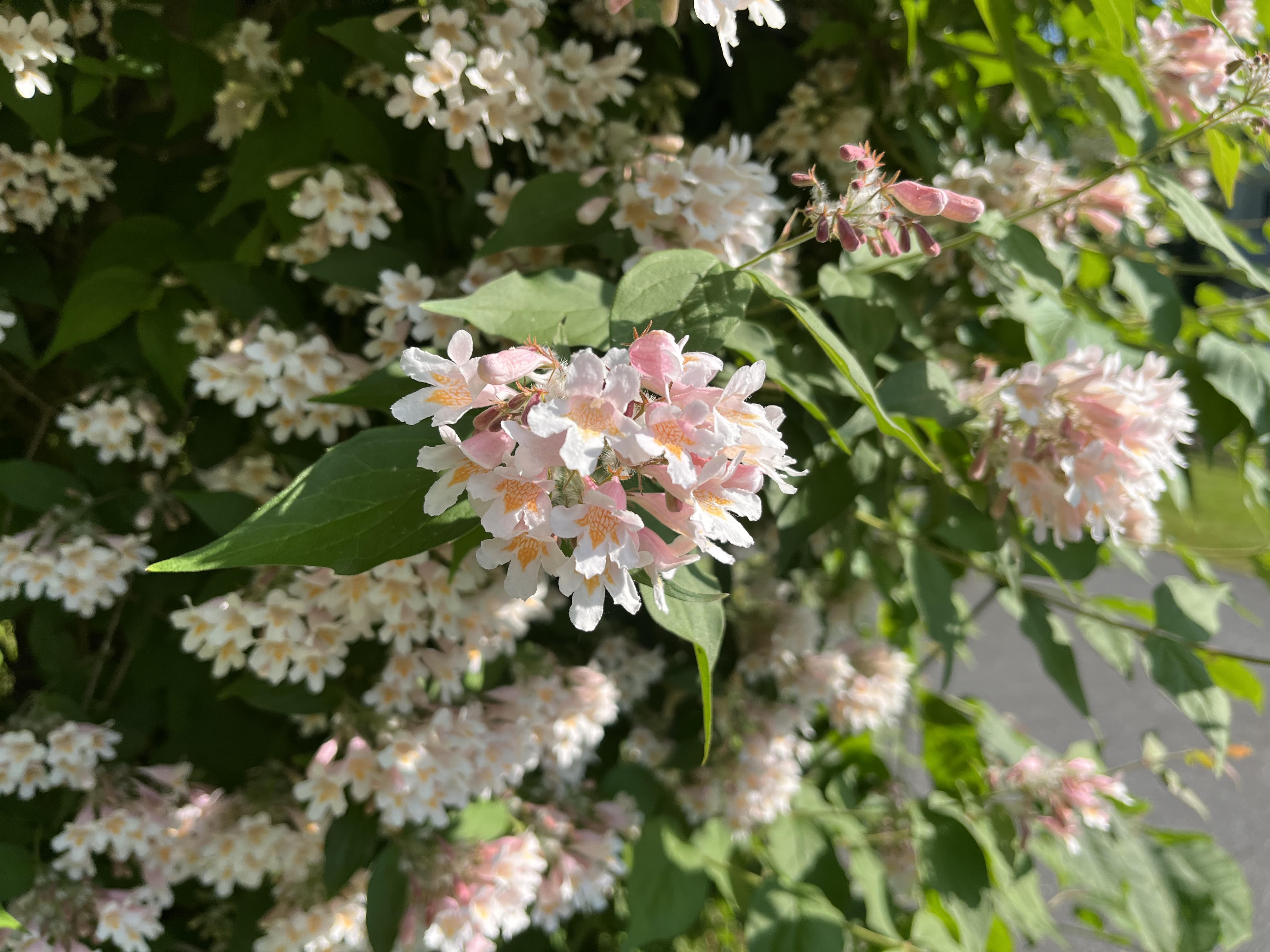
Photo: John and Suzanne’s Mom.
The PictureThis app calls this Beauty Bush. If you want to use the app, note that they try to hide the spot where you click “cancel” to get the free part.
Today’s article, by Michael J. Coren at the Washington Post, will be useful for anyone who walks outside and wonders what kind of flower or tree that is, what bird has that unusual song. It’s a post about apps. I myself use these freebies: Merlin for bird identification and PictureThis for plants (thanking Claudia for that tip).
From Coren: “First I see the wall barley, like tiny fields of wheat on the side of the road. Then a profusion of musk stork’s-bill overflowing with purple flowers. That’s just the crack in the sidewalk. By the time I reach my office, I’ve identified dozens of species, most unknown to me a few hours earlier.
“I’m not a master naturalist, but I have one in my pocket. Thanks to artificial intelligence trained on millions of observations, anyone with a smartphone can snap a picture or record a sound to identify tens of thousands of species. …
“It’s the kind of thing I would normally miss while walking or pedaling to work. Birdsong might be gorgeous but I’d barely hear it. I’d note ‘pine tree’ as a catchall for conifers.
“That has changed. I’m now on a first-name basis with most of my wild neighbors. It has reconnected me to a natural world I love. ….
“For 2.5 million years, humans spent a huge share, if not virtually all, of their time outdoors. Today, many adults are spending more hours on screens than outside.
“Nature is even disappearing from our books, songs and culture, say researchers who looked at nature-related words in popular works during the mid-20th century. Our mental and physical health has declined alongside our estrangement from the outdoors. …
“This new generation of naturalist apps is the Rosetta Stone to the natural world. Reestablishing relationships with your outdoor neighbors might not only transform your commute, it might change your life. There are more than a dozen apps promising to help you identify the natural world, many of them paid. Don’t bother.
Four apps, designed and managed by scientists with world-class data, meet all your ID needs free of charge. And every observation will advance our scientific understanding of the natural world.
“The easiest to use is Seek. The app, an offshoot of iNaturalist, a joint initiative of the California Academy of Sciences and the National Geographic Society, lets you shoot live video. It automatically grabs frames and analyzes them. The augmented reality experience is like downloading a foreign language into your brain. The app identifies the taxonomy of plants and animals instantly as you shoot. If it can’t figure out the species, it will give you its best guess.
“In less than an hour, I had racked up dozens of plants and insects near my house from Bombus vosnesenskii, a native yellow-faced bumblebee, to the purple-flowered bush lupine it was buzzing around. The only drawback? The app doesn’t include deeper context about the species it identifies.
“For that, there’s iNaturalist and Pl@ntNet. Both offer sophisticated, if slightly less user-friendly, apps that upload and analyze photographs of flora. In seconds, they typically return a ranked list of potential candidates with rich descriptions of each. The identification of the most common species is a slam dunk. For rarer ones, it’s easy to compare your observation against those of others in the database.
“The apps’ real superpower is the community around them: Millions of citizen scientists who can vet and confirm your observations. It’s particularly satisfying to watch your skills — and ranking — rise in the apps as you get to know your neighborhood. When you’re ready to up your game, download these apps.
“Finally, there’s Merlin Bird ID, a project of the Cornell Lab of Ornithology. Merlin feels like magic. The app uses a phone’s sensitive microphone to identify bird vocalizations in the sonic landscape around you, painting a visual representation or sonogram analogous to a musical score. …
“Merlin has permanently changed how I hear the world. I can now tune in to birdsong operas that had never entered my consciousness. Within a day, I was able to recognize distinct calls without consulting the app. …
“But the apps are more than tools to get acquainted with nature. They’re pushing AI identification — and conservation — forward. Recognizing natural inhabitants, and our relationship to them, helps us rediscover what remains and protect it.
“ ‘We’re just at the beginning of actual real scientific progress,’ says [Grant Van Horn, a machine learning researcher at the Cornell Lab, who helped build Merlin’s sound ID feature]. ‘And none of this stuff happens without a passionate group of people that helps you curate, train and evaluate the data.’ …
“The first big breakthrough came around 2018 from Snapshot Serengeti, a research project using digital camera traps to photograph thousands of migrating African animals. Organizing this enormous collection featuring a variety of animals, from wildebeests to giraffes, proved overwhelming for the small team of scientists.
“So researchers enlisted thousands of online volunteers to sort and label more than 3 million images. That allowed Jeff Clune, then a computer scientist at the University of Wyoming, and his collaborators to unleash algorithms on what was at the time the world’s largest collection of labeled wildlife images. The new algorithms could identify animals in 99 percent of images with the same accuracy as human volunteers, around 97 percent. …
“Citizen science-powered algorithms are now going beyond individual organisms. They’re mapping their relationships to an entire ecosystem, from the flower a butterfly pollinates to the leaf where the insect lays its eggs.
“ ‘My goal is to turn ecosystems into fire hoses of data,’ says Clune. ‘In the same way a video game company knows everything that happens inside their system, we should know that for the Amazon rainforest. Imagine what that would mean for science.’ …
“Ultimately, the apps’ greatest breakthrough may not be technological at all. It may be raising our awareness. We are nearly blind to entire categories of living creatures. In her book Braiding Sweetgrass, Robin Wall Kimmerer described it as ‘being lost in a foreign city where you can’t read the street signs,’ a form of species loneliness. While these plants and animals are our neighbors, we scarcely acknowledge their existence, let alone their right to exist. …
“This could reverse one of the great losses of the past century: our severed connection to the unique, wild character of where we live.”
More at the Post, here.
And speaking of technology that gets you closer to nature, check this live camera in the early morning East Coast time to watch an osprey feed its baby. Catch it soon, before the baby fledges.
http://198.7.226.69:8023/#view

 Suzanne's Mom's Blog