Feeds:
Posts
Comments

Posts Tagged ‘pollera’

Photo: Juan Karita/AP.
An Aymara grandmother passes the ball during a warm-up before a traditional Bolivian handball match, Dec. 9, 2025.

Juan Karita writes at AP, “Before setting out for the wide, white mountain, Ana Lia González Maguiña took stock of her gear: A chunky sweater to guard against the chill. A harness and climbing rope to scale the 6,000-meter summit of one of Bolivia’s tallest mountains. Aviator glasses to protect from the bright highland sun. And most crucially, a voluminous, hot-pink skirt.

“The bell skirt with layered petticoats — known as the ‘pollera’ (pronounced po-YEH-rah) — is the traditional dress of Indigenous women in Bolivia’s highlands. Imposed centuries ago by Spanish colonizers, the old-fashioned pollera has long since been restyled with local, richly patterned fabrics and reclaimed as a source of pride and badge of identity here in the region’s only Indigenous-majority country.

“Rather than seeing the unwieldy skirt as a hindrance to physically demanding work in male-dominated fields, Andean Indigenous women, called ‘cholitas,’ insist that their unwillingness to conform with contemporary style comes at no cost to their comfort or capabilities.

“ ‘Our sport is demanding, it’s super tough. So doing it in pollera represents that strength, it’s about valuing our roots,’ said González Maguiña, 40, a professional mountain climber. …

“Skirt-clad miners, skaters, climbers, soccer players and wrestlers across Bolivia echoed that sentiment in interviews, portraying their adoption of polleras for all professional and physical purposes as an act of empowerment.

“ ‘We, women in polleras, want to keep moving forward,’ said Macaria Alejandro, a 48-year-old miner in Bolivia’s western state of Oruro, her pollera smeared with the dirt and dust of a day toiling underground. ‘I work like this and wear this for my children.’

“But many also described the current moment as one of uncertainty for pollera-wearing women in Bolivia. … Center-right President Rodrigo Paz entered office [in November 2025] as Bolivia’s economy burned, ending a long era of governance shaped by the charismatic Evo Morales (2006-2019), Bolivia’s first Indigenous president who prioritized Indigenous and rural populations … Through a new constitution, Morales changed the nation’s name from the Republic of Bolivia to the Plurinational State of Bolivia and adopted the Indigenous symbol of the wiphala — a checkerboard of bright colors — as an emblem equivalent to the national flag. For the first time, pollera-wearing ministers and officials walked the halls of power.

“But disillusionment with Morales’ Movement Toward Socialism party grew, especially under his erstwhile ally ex-President Luis Arce, who was arrested [in December] on allegations that he siphoned off cash from a state fund meant to support Indigenous communities.

“Some cholitas now wonder how far that change will go and fear it could extend to their hard-won rights despite Paz’s promises to the contrary. They describe feeling neglected by a government with no Indigenous members. They worry about the implications of the army last month removing Indigenous symbols from its logo and the government deciding to stop flying the wiphala from the presidential palace, as was long the tradition.

“ ‘I feel like the government won’t take us into account,’ said Alejandro, the miner. ‘We needed a change. The economy must get better. But it’s sad to see there are no powerful people wearing polleras. I see it as discrimination.’

“But González Maguiña said she still had hope, given how far Indigenous women had come.

“ ‘We already have the strength and everything that comes with it,’ she said. ‘We’re certainly going to knock on the doors of this new government.’ ”

More at AP, here. I have posted several articles about these Bolivian women in the past. Here is one on handball competitions.
Read Full Post »

Photo: Luisa Dörr.
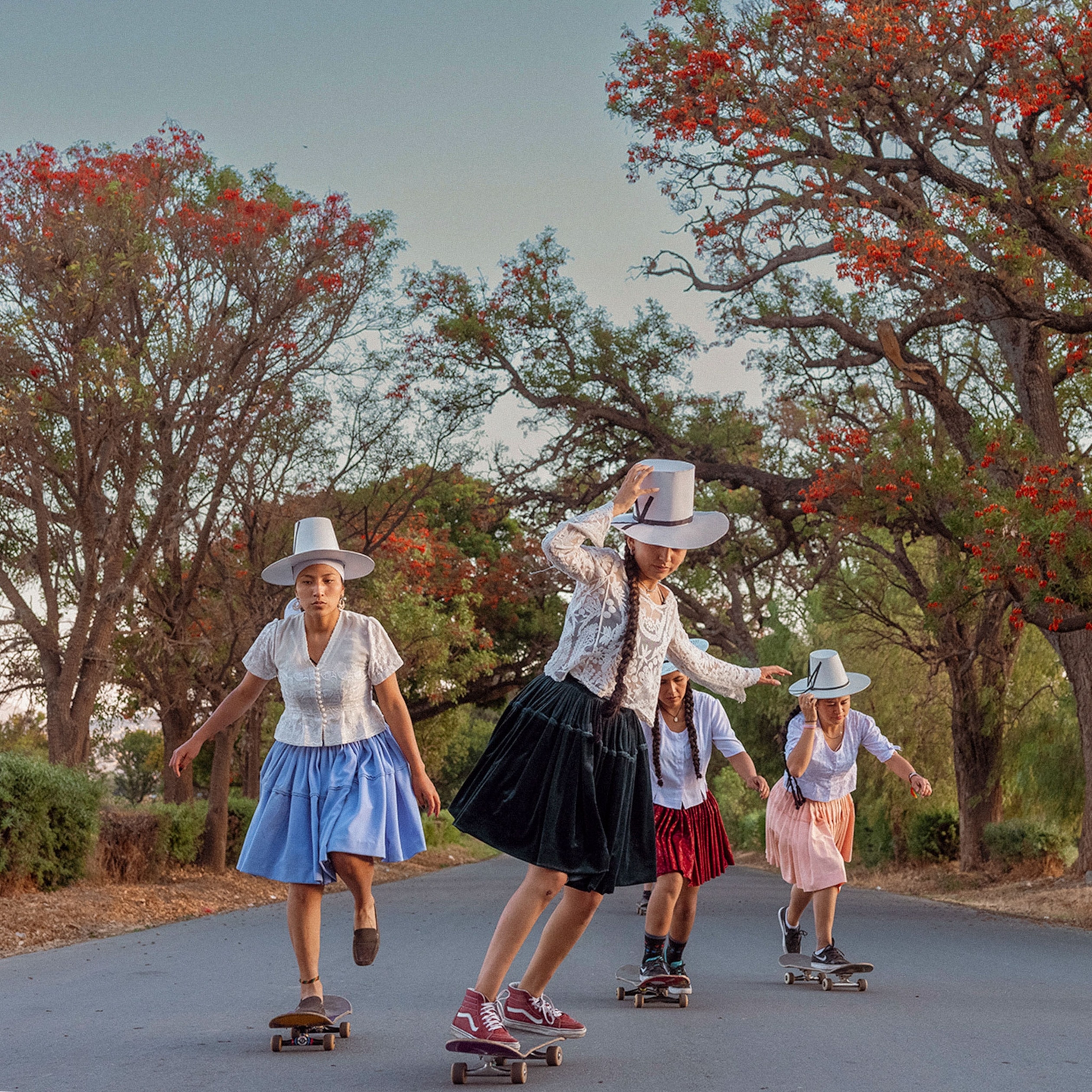
ImillaSkate athletes practice skateboarding on a downhill road near Cochabamba, Bolivia. They use indigenous attire as a statement against discrimination.

We loved the movie Skate Kitchen about female skateboarders in New York. You may have seen my post about it here. Learning how outsiders find their people, their tribe, was a revelation.

My Cousin Claire knows I love stories like that. I think my whole extended family does. Maybe it’s in our DNA. Claire sent me today’s story about female skateboarders in Bolivia and the reasons they are using their sport to stick up for indigenous people.

Paula Ramón writes at National Geographic, “The colorful polleras are a symbol of identity in the Bolivian countryside. But these voluminous, traditional skirts worn by Indigenous Aymara and Quechua women have also been the object of discrimination, some seeing the appearance at odds with modern identity. Now a group of women athletes has brought them back to the city — donning them during skateboarding competitions — to celebrate the cultural heritage of the cholitas.

” ‘The pollerasare very valuable to me,’ says Deysi Tacuri López, 27, a member of ImillaSkate, founded in 2018 in Cochabamba, Bolivia’s third largest city. ‘I wear them with pride.’

“Tacuri sees in the polleras not only a cultural expression but also a form of empowerment. … More than half of Bolivia’s population is of Indigenous descent.

“Tacuri and fellow members at ImillaSkate also among those with Indigenous ancestors. Some of their relatives still wear polleras.      

“ ‘They are my mother’s and my aunts’ clothing, and I see them as strong women. Here in Bolivia, many women in pollerasare the head of their families,’ she said in a telephone interview. ‘For me, mujeres de polleras [pollera wearers] can do anything.’

“Tacuri and her teammates spend long hours practicing moves at Ollantay Park, one of two places in the city with ramps and other structures designed for the sport. …

“ImillaSkate was founded by Daniela Santiváñez, 26, and two friends. She learned to skate as a child thanks to her brother, though it was ‘rare to see girls on skateboards.’ …

“Without women role models to follow in the sport in Cochabamba — and growing tired of listening to her mom’s complaints about her bruises from falls — Santiváñez stopped practicing when she was a teenager. She took up skateboarding again after college, where she got a degree in graphic design. By then, Dani, as her friends call her, discovered she was not the only woman with a passion for the sport.

” ‘One day I was having a conversation with the girls about why all the boys get together to skate — why don’t girls do that?’ recalls Santiváñez. …

“Over the past three years, ImillaSkate has grown to nine skaters. Being an active member means making time to practice every week in order to be able to participate in competitions, and also sharing the same principles of acceptance of diverse groups and traditions. Although the collective is based in Cochabamba, the group has generated a wider audience on social media beyond Bolivia, with more than 5,000 followers on Instagram. They also maintain a Facebook page with more than 7,000 followers, and a YouTube channel where some of their videos get thousands of views.

“Santiváñez clarifies that they wear the skirts only for performances, not necessarily as their street clothing. ‘We do it as a demonstration, as a cry for inclusion,’ she says. … ‘Skateboarding is inclusive, it brings all kinds of people together. …

‘It’s a community, and we’ve taken advantage of this to make the world a kinder place.’

“Tacuri says they first challenged themselves to embrace their own roots. ‘We ourselves have decided to get to know our culture and our identity. We have decided to revalue our clothing and encourage new generations.’ …

“The polleras’ origins date back to the Spanish conquest in the 16th century. Orginally imposed by colonial rulers as a way to easily identify the native population and also have the attire conform to what was being worn in Spain by the poorer people, the skirts eventually were adapted as part of traditional Andean attire, most commonly associated with cholas — Indigenous women from the highlands. Just as their ancestors gave the skirts their own identity by mixing them with patterned blouses, local jewelry, and hats, the skateboarding imillas are making their own modifications to the garment — and trying to remove a stigma.

” ‘The pollera is associated with the countryside, with ignorant people without resources. We want people to understand that there is nothing wrong with wearing a pollera.’ …

“The group didn’t even know where to get the elaborate skirts, so they turned to their grandmothers for help.

“Not all of them jumped on board immediately, concerned they would be stigmatized. Even as the descendant of a mujer de pollera, Luisa Zurita struggled with getting her family to understand the premise behind the wardrobe. Only after she was invited to participate in a local television program for a skateboarding performance did her grandmother give Zurita her blessing — and her favorite pollera.”

More at National Geographic, here. As you would expect of National Geographic, the photos are terrific.

Read Full Post »

In Bolivia, an indigenous woman who would have been disenfranchised before the presidency of Evo Morales has become a popular wrestler. And  she loves what she does.

connects with Angela La Folklorista in La Paz to report her story at WBUR’s Only a Game.

“She calls herself, ‘Una mujer de la pollera.’ Woman of the skirt. That’s another way of saying ‘I’m a cholita.’ Cholitas are indigenous women of Bolivia, usually ethnically Quechuan or Ayamaran. You can recognize cholitas by their ankle-length puffy skirts and their tiny bowler hats, which seem like they’ll fall off any minute. …

“Until recently, cholitas were second-class citizens, boxed out from higher education and often stuck cleaning homes,” generally relegated to the kitchen.

“Where Angela works is nothing like a kitchen.

” ‘In the ring,’ Angela says in Spanish, ‘I have a technical fighter style. I’m not rough. I’m on the nice side. There are bad cholitas, as you would call them, but my style is technical.’

“Angela is a cholita luchadora — a Bolivian pro-wrestler. She fights in a league similar to Lucha Libre in Mexico or the WWE in the United States. It’s the kind of wrestling with heroes and villains, entrance songs. Angela gives me two ringside tickets for the upcoming bout in El Alto – La Paz’s sister city. She’s the headliner. …

“Angela doesn’t fight other women. She fights the men. There’s some weird sexist stuff happening, but by the end of the match Angela is always the winner. …

“ ‘I’m very happy and content to have another night of fighting,’ she says in Spanish, ‘another night of art, adrenaline and strength, another night that I’m in the center of the ring, happy, doing what I like most.’ She’s covered in sweat.

“ ‘Mi madre es luchadora,’ Angela’s middle-school aged daughter Theresa says.

“ ‘It’s a pleasure for me that she’s a wrestler,’ Theresa says in Spanish, ‘I’m very proud of her, I’m her number one fan.’

“Theresa describes the cholitas luchadoras as one of the Seven Wonders of the World. But she doesn’t want her mom’s job. It’s too dangerous for her. And unlike the cholitas who came before her, Theresa can choose her own dream.”

More here.

Photo: Trevin Spencer/Only A Game
The cholitas luchadoras of El Alto. Angela La Folklorista is on the far right.

Read Full Post »