Feeds:
Posts
Comments

Posts Tagged ‘positive’

Photo: Jackie Molloy for KFF Health News.
Hilda Jaffe, 102, in her apartment in New York. Jaffe enjoys doing puzzles, reading, volunteering, and attending cultural events.

I have always thought that a city like New York, with many kinds of public transportation and easy walking to whatever you need, is the best kind of place to grow old. The problem for most of us is that we may still need a car to do the simplest things long after we can’t drive.

Here’s a story about a thriving 102-year-old doing her errands without assistance in New York. I’m convinced that part of her good fortune is not having to drive.

Judith Graham writes at the Washington Post, ” ‘The future is here,’ the email announced. Hilda Jaffe, then 88, was letting her children know that she planned to sell the family home in Verona, New Jersey. She’d decided to begin life anew on her own in a one-bedroom apartment in Hell’s Kitchen in Manhattan.

“Fourteen years later, Jaffe, now 102, still lives alone — just a few blocks from the frenetic lights and crowds that course through Times Square.

“She’s the rarest of seniors: a centenarian who is as sharp as a tack, who carries grocery bags in each hand when she walks back from her local market, and who takes city buses to see her physicians or attend a matinee at the Metropolitan Opera.

“Jaffe is an extraordinary example of an older adult living by herself and thriving. She cleans her own house, does her own laundry, manages her own finances, and stays in touch with a far-flung network of family and friends via email, WhatsApp and Zoom. Her 78-year-old son lives in San Jose. Her 75-year-old daughter lives in Tel Aviv.

“I’ve spoken with dozens of seniors this past year for a series of columns on older Americans living alone. Many struggle with health issues. Many are isolated and vulnerable. But a noteworthy slice of this growing group of seniors maintains a high degree of well-being. …

“Sofiya Milman is the director of human longevity studies at the Institute for Aging Research at Albert Einstein College of Medicine. She studies people known as ‘superagers’ age 95 and older. ‘As a group, they have a very positive outlook on life’ and are notably resilient, like Jaffe, she told me.

“Qualities associated with resilience in older adults include optimism, hopefulness, an ability to adapt to changing circumstances, meaningful relationships, community connections and physical activity, according to a growing body of research on this topic.

“Jaffe has those qualities in spades, along with a ‘can-do’ attitude. ‘I never expected to be 102. I’m as surprised as everybody else that I am here.’ …

“She credits her genetic heritage, luck and her commitment to ‘keep moving,’ in that order. … Asked to describe herself, she quickly responded with ‘pragmatic.’ That means having a clear-eyed view of what she can and can’t do and making adjustments as necessary.

“Living alone suits her, she added, because she likes being independent and doing things her way. ‘If a problem comes up, I work it out,’ Jaffe said. …

“There are only some 101,000 centenarians in the United States, according to the most recent Census Bureau data. Of this small group, 15 percent live independently or conduct their lives independently while living with someone, according to Thomas Perls, the founder and director of the New England Centenarian Study, the largest study of centenarians in the world. …

“About 20 percent of centenarians are, like Jaffe, free of physical or cognitive impairments, Perls said. An additional 15 percent have no age-related illnesses, such as arthritis or heart disease. …

“Every day, Jaffe tries to walk 3,000 steps — outside if the weather is good, or inside, making laps in her hallway, if the weather is bad. Her diet is simple: bread, cheese and decaffeinated coffee for breakfast; a sandwich or eggs for lunch; often chicken and a vegetable or restaurant leftovers for dinner. She never smoked, doesn’t drink alcohol and sleeps an average of eight hours each night.

“Even more important, Jaffe remains engaged with other people. She has subscriptions to the Metropolitan Opera, the New York Philharmonic and a chamber music series. She participates in online events and regularly sees new exhibits at four of New York’s premier museums, where she has memberships. She’s in regular contact with family members and friends.

“Jaffe also belongs to a book club at her synagogue on Manhattan’s Upper West Side and serves on the synagogue’s adult education committee. For more than a decade, she has volunteered several times a week as a docent at the New York Public Library’s main branch on Fifth Avenue. …

“When I asked about the future, Jaffe said she doesn’t worry about what comes next. She just lives day to day.

“That change in perspective is common in later life. ‘Focusing on the present and experiencing the here and now becomes more important to older adults,’ said Laura Carstensen, founding director of the Stanford Center on Longevity, who has studied emotional changes that accompany aging for decades. …

“Jaffe certainly understands the value of facing forward and letting go of the past. Losing her husband, Gerald Jaffe, in 2005 after 63 years of marriage was hard, she admitted, but relinquishing her life and most of her belongings in New Jersey five years later was easy. …

“ ‘It was so exciting for me, being in New York,’ she continued. ‘Every day you could do something — or nothing. … In a house in New Jersey, I would be isolated. Here, I look out the window and I see people.’ ”

More at the Post, here.

Read Full Post »

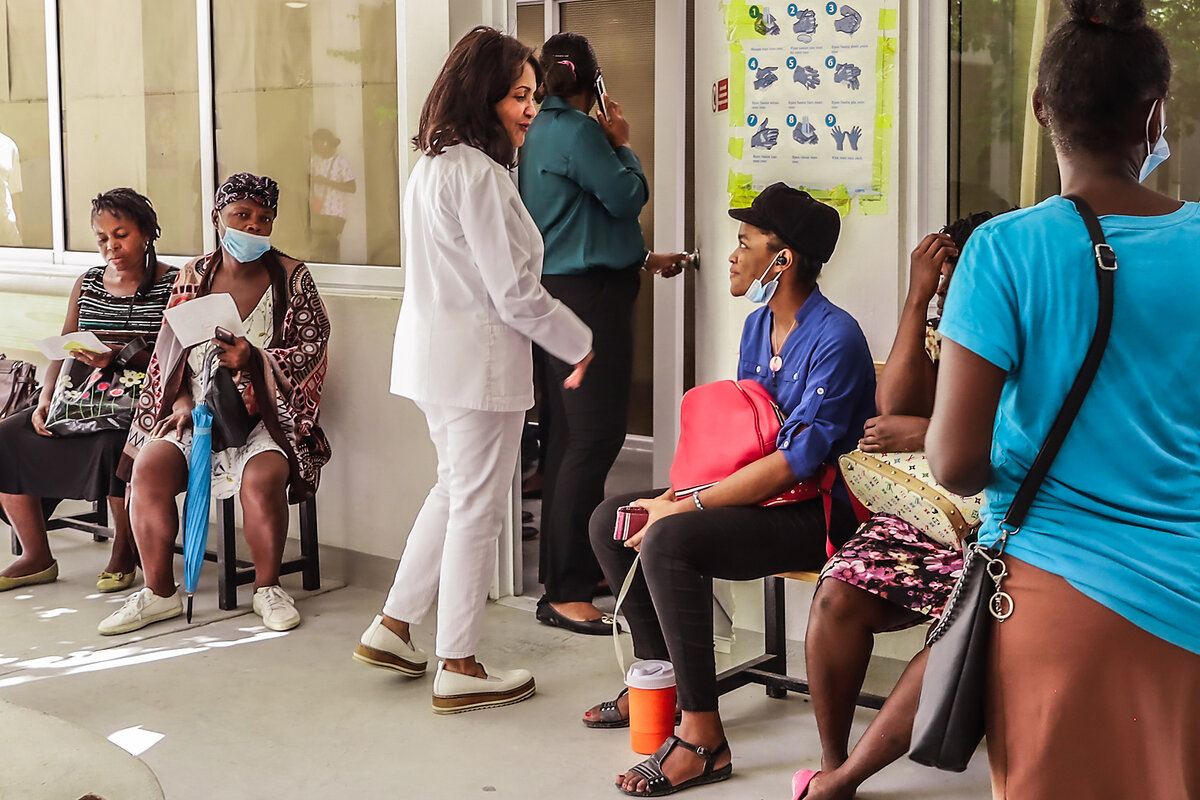
Photo: Victoria Onelien/Special to the Christian Science Monitor.
Dr. Marie-Marcelle Deschamps walks through the medical area of the Gheskio center, welcoming patients, in Port-au-Prince, Haiti, in July.

It’s hard to imagine that in a country ruled by armed gangs like Haiti, a doctor keeps doing her work “without fear.” Would we be without fear if our country were taken over by armed gangs?

Linnea Fehrm writes at the Christian Science Monitor, “Marie-Marcelle Deschamps was speaking at a conference in Washington last spring about her work running one of Haiti’s most innovative hospitals when the startling news started spilling in: Criminal gangs were releasing incarcerated people from a prison in Port-au-Prince, police stations and government buildings were under attack, and the international airport was shuttered. …

“ ‘Every day that I can’t go back is a catastrophe for me,’ she said with a sigh, speaking from her hotel room in Miami several weeks later, where she was anxiously awaiting the possibility of flying back to Haiti. ‘I can’t sleep at night. My staff are struggling, people are dying.’ …

“Dr. Deschamps is co-founder and deputy executive director of Gheskio, a hospital in Port-au-Prince known by its French acronym, where she has worked for the past 42 years. It’s not a typical clinic; it looks beyond physical health to tackle issues such as education, women’s leadership, job training, and community-building. …

“The doctor has guided the organization through earthquakes, epidemics, state coups, and political unrest. But when she finally returned to Port-au-Prince in April, she says she was faced with the most severe crisis she has ever seen. Hundreds of thousands of Haitians had fled their homes due to insecurity, many of whom began flooding her hospital in search of safety and treatment. Some people arrived close to starving, others with gunshot wounds, she says. …

“Gheskio is in downtown Port-au-Prince, adjacent to an enormous, gang-controlled area known as the City of God. The dusty access roads are teeming with heavily armed gangs, whose ranks have been reinforced by people who have escaped from prison. They regularly block the roads and kidnap people from passing cars. …

“Only a handful of hospitals have survived the past year’s violence in Port-au-Prince, according to Jean Bosco Hulute, head of UNICEF’s health program in Haiti. About a five-minute drive from Gheskio is the State University of Haiti Hospital, the largest health facility in the country. For more than four months this year, it was under gang control; doctors and patients were chased off the grounds and wards were looted of everything from medical supplies to ceiling fans. 

“Gheskio receives some funding and equipment from UNICEF, requiring Mr. Hulute to occasionally visit. These trips require ‘careful planning and authorization from the head office’ for safety purposes, he says.

“ ‘Dr. Deschamps, however,’ he says with a chuckle, ‘she just takes her car and drives there.’ 

“She holds weekly meetings with local community representatives, helping to earn respect for her organization’s work – even among gang leaders. When armed men on the street see her hospital ID, they let her pass, she says. …

“Today, the Gheskio grounds are like an oasis amid Haiti’s political and security-related chaos. Dr. Deschamps says she comes here to regain her strength, surrounded by green lawns, verdant gardens, and birds chirping from towering palm trees. …

“Shortly after founding Gheskio, Dr. Deschamps was selected by a group of Haitian and American doctors to study in the U.S. There, she trained under Dr. Anthony Fauci, who would later become a household name during the COVID-19 pandemic.

“ ‘He always had a positive attitude, so we were similar in that way. It has become a strategy in my life to team up with positive people.’ “

Just think of the comfort that her attitude must give to patients!

More at the Monitor, here. No paywall. Subscriptions are reasonable.

Read Full Post »

Photo: Fernando Cortes via Inside Higher Ed.

Unless people are committed to the “ain’t it awful?” worldview, they probably respond in more positive ways to pitches about hopeful progress than pitches describing how dire everything is.

In an opinion piece at Inside Higher Ed, Stephen Porder agrees, noting that climate-change education is more likely to be effective when students learn that there is hope.

Porder writes, “The first year I taught Introduction to Environmental Science was 2007, the year after the release of An Inconvenient Truth. The class was full of eager students, most of whom would have described themselves as environmentalists. … I was there to teach them the science — basically how to use hypothesis testing, data and analysis to convince them the world is going to hell. They didn’t need much convincing.

“The endless description of problems, with little emphasis on solutions, is a hallmark of almost all environmental science and studies textbooks. After 20-plus years teaching in this field, I’ve come to think that our relentless focusing on the negative is, at best, missing an opportunity. … My more recent experiences teaching about solutions, rather than problems, suggests that a healthy dose of positivity even in the face of profound environmental challenges will reach a broader audience, gain more traction and diversify the people working on the admittedly wicked environmental challenges of the 21st century.

“Back in 2007, I walked into the classroom, fresh out of my Ph.D. and postdoc, eager to share the wonders of environmental science. I marveled at the data from the group run by Charles Keeling, who measured rising carbon dioxide in the atmosphere at the observatory on Mauna Loa in Hawai‘i. … I dove into the details of carbon isotopes to demonstrate just how we knew that the rise in carbon dioxide was a result of fossil fuel combustion, as opposed to natural sources. The course was definitely a science course —but looking back I realize each bit of data and analysis was perfused with pessimism. …

“Still, my course evaluations were good. … These good evaluations came from students who were mostly self-selected environmentalists — passionate about ‘saving the planet.’ They were bright, motivated and talented. … Other equally bright, motivated and talented students didn’t take the course. I wondered why.

“Having talked to many such students since, I’ve learned many felt a bit excluded. The environment was a worry for them, as it is for most of us, but it wasn’t their primary worry. They also felt like environmental studies or sciences was not a place where they could explore solutions. They felt that there was a relentless focus on what was wrong, rather than how to put it right. Finally, they felt like the problems we were describing were going to be fixed by people beyond the environmental field.

“I’ve come to agree with them. I, at least, was not doing enough to train problem-solvers. I’d been training people to cleverly document problems. I don’t think I’m the only one in the field who’s fallen into that trap. …

“I handed off Introduction to Environmental Science to a younger professor a few years ago, and from here on out I’m focusing on solutions, not problems. Climate solutions. Agricultural solutions. Deforestation solutions. They exist. They are not perfect and involve hard trade-offs. But their existence should be front and center in our teaching.

“Just putting ‘Climate Solutions’ in a course name dramatically changed my student enrollment. Surprisingly, very few environmental studies and sciences students signed up. Instead, students majoring in economics, political science, engineering, applied math and a variety of humanities fields appeared in my classroom. … Like all my students, they were united by their climate anxiety. But they came for, and responded to, the idea of solutions.

“This eclectic group brought a wealth of different interests, skills and weaknesses to the class and was eager to learn from each other about different approaches to overcoming the 21st century’s biggest environmental (I would argue societal) challenge. They were thrilled at the opportunity to contribute to a better future, even if the environment was not their top priority (for some it became a top priority when they learned there were things they could actually do to make a difference). Many had felt unwelcome in environmental studies/sciences, which often demands a political and philosophical homogeneity of its participants.

“As an example of this, a senior applied math major told me he had been searching for a field where his math could have impact. He had never taken an environmental class before (despite plenty of environmental angst) in part because he didn’t feel welcome or like he fit in with environmentalists. He now works doing data analytics for a solar power company. …

“Solutions are picking up speed. Technological advances in transportation (electric vehicles), space heating (heat pumps) and electricity production (renewables) have made extraordinary leaps since I started teaching. Given that transportation, space heating and electricity generation make up more than 70 percent of all fossil fuel emissions, this is huge news! We should be teaching about it at every level and helping our students gain the skills to push these revolutions forward as engineers, community organizers, investors and so on.

“Already these advances have cooled our future. A decade ago, we were headed for four to five degrees Celsius warming by century’s end. Now three degrees Celsius is more likely. Anyone who studies climate knows that’s still way too much warming to be safe, but it’s also a huge step in the right direction. You may not hear that in most environmental science classes, or in the news, but you should. Even better news is that most of what precludes keeping that number to two degrees Celsius is political, not technological. That wasn’t true when I started teaching, so we need to update our curricula to reflect this remarkable progress.

“I don’t mean to be overly optimistic. The challenges to a stable climate future are enormous. … But by relentlessly beating a drum of negativity in the absence of hope, we’re driving away brilliant young minds that could help make the world a better place.”

More at Inside Higher Ed, here. No paywall.

Read Full Post »